
高齢化を迎えビジネス生活からすこし距離を置き始めてきて、次兄から「業務命令」を受けてわが家の「家系史」を継続探究してきています。先日、従兄弟(父親同士が兄弟)から「別の見方」を受け止めたいと、じっくり懇談4時間半超の対話をしておりました。
同じ一族の従兄弟でも、基本的なものごとの見方が大きく相違していることに、驚いていました。
祖父の生き方についての考え方が、父親世代でも当然ながら相違するし、そこに母系の違いからの受け止め方の距離感も発生することを、痛感させられています。わたしの父親は基本的に祖父が選択した移住地北海道で「独立独歩」的な生き方を好んできた人生で、それはわたしにも強く伝わってきていると実感しています。が、父の兄にあたる一統では、祖父はやはり「故地に帰り錦を飾る人生を夢見ていた」という考え方が強いようでした。
そんなことを含めて「生々しい血脈」を強く感じる、いまに直接繋がってくる家系史段階になってきた。
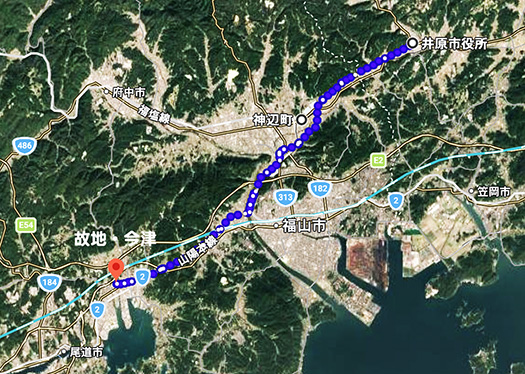
地図は、従兄弟が強く意識している「岡山県・井原」のかれの母系の故地と、わが家系統が江戸後期からの「故地」と考えてきた広島県福山市今津の距離感を表現したもの。江戸期「西国街道(山陽道)」のルートとして1直線。山陽道の宿駅としては、今津宿からすぐ東隣の神辺宿を超えて「高屋宿」「七日市宿」のあった井原地域まで29km程度。
間の「神辺宿」には菅茶山の「廉塾」があってわが家系の曾祖父が入塾していたようで、同時期に井原の縁者になる人物も塾にいたようなのです。そこで縁がつながってか、この井原の人物にわが家系の女子が嫁入りしている。
私から数えれば4−5代前くらいに相当する「つながり」が克明に浮かび上がってくる。
そして、先述した従兄弟は、この井原の家から嫁入りして来た伯母の子。
この伯父は太平洋戦争期、満州国で官僚になっていてそこから艱難の末に日本に帰国したとき、伯母の実家の方に帰国している。実の父母のいる北海道空知郡の方ではなかった、という消息。
このあたり「人生判断基準」に違いがあることに深く気付かされる思い。
まぁ当然ですね。人類はそのように「枝分かれ」しながら、世の動きの中でそれぞれが生存戦略を持って生き続けてきた存在なのでしょう。 しかし、だんだんと「血肉」が迫ってくる・・・。
●お知らせ
拙書「作家と住空間」幻冬舎から電子書籍で発刊
お求めはAmazonで。
https://amzn.asia/d/eUiv9yO
English version⬇
[Exploring Family History / In an Era Where We Can Feel the Vivid Pulse of Our Bloodline]
From the turmoil of the late Edo period through the Meiji era to the end of World War II, the true nature of that era seems to have emerged in a single, continuous thread. I find myself drawn in by its vivid, living quality…
As I’ve entered my later years and begun to step back a bit from my business life, I’ve been continuing to research our family history following an “official order” from my second-eldest brother. The other day, I had a thorough conversation lasting over four and a half hours with a cousin (whose father and my father are brothers) who wanted to hear a “different perspective.”
I was surprised to discover that even among cousins from the same family, our fundamental perspectives on things differed so greatly.
I’ve come to keenly realize that views on my grandfather’s way of life naturally differ even among my father’s generation, and that differences in maternal lineage also create a gap in how we perceive things. My father has essentially led a life of “independence and self-reliance” in Hokkaido—the place my grandfather chose to settle—and I truly feel that this spirit has been strongly passed down to me. However, among my father’s older brother’s branch of the family, there seems to be a strong belief that my grandfather had always “dreamed of returning to his ancestral homeland to live a life of glory.”
Taking all this into account, I’ve reached a stage in my family history where I strongly feel the “vivid bloodline” that connects directly to the present.
The map illustrates the distance between “Ibara, Okayama Prefecture”—the ancestral homeland on my cousin’s maternal side, which he is deeply conscious of—and Imazu in Fukuyama City, Hiroshima Prefecture, which our family line has considered our “ancestral homeland” since the late Edo period. It is a straight line along the route of the Edo-period “Saigoku Kaidō (Sanyō-dō).” As for the post stations along the Sanyō-dō, it is about 29 km from Imazu-juku, passing through the neighboring Kanbe-juku to the east, to the Ibaraki area where Takaya-juku and Nanokaichi-juku were located.
At “Kannabe-juku,” located along this route, there was Suganoyama’s “Renjuku” academy, where my family’s great-grandfather apparently studied; it seems that a person who would later become a relative in Ibara was also attending the academy at the same time. Perhaps because of this connection, a woman from my family’s line married into this Ibara family.
This “connection”—dating back about four or five generations from my own time—comes into sharp focus.
Furthermore, the cousin I mentioned earlier is the child of my aunt, who married into this family in Ihara.
During the Pacific War, this uncle served as a bureaucrat in Manchukuo; after enduring great hardships, he returned to Japan and settled at his wife’s family home. Reports indicate he did not return to Sorachi District in Hokkaido, where his biological parents lived.
This really makes me keenly aware of the differences in “life values.”
Well, that’s only natural. Humanity has likely always existed in this way—branching out and continuing to survive with our own survival strategies amid the changing world. However, the reality of “blood ties” is gradually closing in on me…
● Announcement
My book, *Writers and Living Spaces*, has been published as an e-book by Gentosha.
Available on Amazon.
共有:

Posted on 7月 31st, 2026 by 三木 奎吾
Filed under: 未分類



コメントを投稿
「※誹謗中傷や、悪意のある書き込み、営利目的などのコメントを防ぐために、投稿された全てのコメントは一時的に保留されますのでご了承ください。」
You must be logged in to post a comment.