
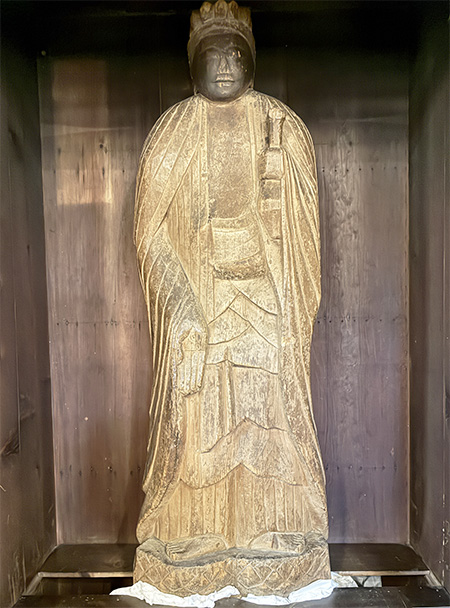
写真は先日のシカ激突事故前に参観していた道南・上ノ国の円空仏。
「円空作十一面観音菩薩立像」で、上ノ国町の「旧笹浪家住宅」収蔵。北海道指定有形文化財(有形第31号)。全長149.9cm 江戸時代(1666年)道内で最も大きく唯一の十一面観音菩薩。明治初期の神仏分離で棄却の運命に遭ったが、長谷川喜平太によって難を逃れ「きへだの観音様」と言い伝えられていた、という。
札幌からは遠い日本海岸・江差の南の上ノ国ですが、円空さん、この地を訪れて作仏していたのですね。1666年作なので、北前船も後の世ほどには行き来がなかった。ニシンが日本社会全体に影響を及ぼし始めたのは1700年代初期からとされるので、円空(1632〜1695年)の生涯と掛け合わせてみると、活況を呈した時期の来訪ではない。
Wikiによると1666年1月青森・弘前藩の城下を追われる。『津軽藩日記』寛文6年正月29日条や北海道に分布する円空仏の背銘によれば、同年春には円空は青森地域経由で蝦夷地の松前にへ渡っている〜との記述。
江戸期の人間の生き方、芸術に惹かれていた人間としてこのような「作仏」をなりわいとして生きるということ。その作風が後世に評価されて「円空仏」という芸術評価を受けるに至ったけれど、芸術で食べて行くということはこの時代では作仏行為が必然だったのでしょう。
美濃国で生まれた円空さんは30代の壮年期に北海道に来て遊行僧として北海道から畿内に渡る範囲を行脚した。現在確認されている円空作品分布は愛知県の3241体が最多で、岐阜県の1684体、埼玉県の175体、北海道の51体とされている。その中の2体がこの旧笹浪家住宅にあって参観できた次第。
上ノ国の城郭跡・勝山館のふもとにある旧笹浪家住宅ですが、1710年代以降にニシン漁景時期に定住した住宅。この円空仏もニシンで成功した地元で「購入」したものなのでしょう。
・・・夫婦とも胃腸炎っぽいので、接触を避けて病後の回復を期しているところ。用事もZoom参加でおとなしく円空さんの仏像をデジカメ写真で見ながら、静養一択。
●お知らせ
拙書「作家と住空間」幻冬舎から電子書籍で発刊
お求めはAmazonで。
https://amzn.asia/d/eUiv9yO
English version⬇
[A Moment of Prayer Before an Enku Buddha. Join the Meeting via Zoom Without Pushing Yourself]
An Enku Buddha I encountered in Kaminokuni, in southern Hokkaido. Traces of his visit to Ezo during his days as a wandering artist. A sculpture that touches the heart deeply. …
This photo shows the Enku Buddha in Kaminokuni, southern Hokkaido, which I had visited just before the recent deer collision accident.
It is the “Standing Statue of the Eleven-Faced Kannon Bodhisattva by Enku,” housed at the “Former Sasanami Family Residence” in Kaminokuni Town. It is designated as a Hokkaido Tangible Cultural Property (No. 31). Total height: 149.9 cm. Dated to the Edo period (1666), it is the largest and only Eleven-Faced Kannon Bodhisattva statue in Hokkaido. Although it was destined to be discarded during the separation of Shinto and Buddhism in the early Meiji period, it was saved by Kiheita Hasegawa and has been known locally as “Kiheda’s Kannon.”
Kaminokuni is located south of Esashi on the Sea of Japan coast, quite a distance from Sapporo, but it seems Enku actually visited this area to create this statue. Since it was created in 1666, the Kitamae ships were not traveling back and forth as frequently as they would in later years. It is said that herring began to have an impact on Japanese society as a whole from the early 1700s, so when we consider this in relation to Enku’s (1632–1695) lifetime, his visit did not occur during the period when trade was at its peak.
According to Wikipedia, in January 1666, he was expelled from the castle town of the Hirosaki Domain in Aomori. Entries in the *Tsugaru Domain Diary* dated the 29th day of the first month of Kanbun 6, as well as inscriptions on the backs of Enku statues found throughout Hokkaido, indicate that by the spring of that same year, Enku had traveled via the Aomori region to Matsumae in Ezo.
As someone fascinated by the way of life and art of the Edo period, he made a living by creating Buddhist statues. Although his artistic style came to be recognized by later generations as “Enkū-style Buddhist statues,” making a living through art in that era likely meant that the act of sculpting Buddhist statues was a necessity.
Born in Mino Province, Enku came to Hokkaido in his thirties and traveled as a wandering monk, making pilgrimages from Hokkaido to the Kinai region. The current confirmed distribution of Enku’s works shows that Aichi Prefecture has the largest number with 3,241 statues, followed by Gifu Prefecture with 1,684, Saitama Prefecture with 175, and Hokkaido with 51. Two of these statues are housed in this former Sasanami Family Residence, where I was able to view them.
The former Sasanami Family Residence, located at the foot of Katsuyama Castle—the ruins of a castle in Kaminokuni—is a house where the family settled during the herring fishing boom beginning in the 1710s. These Enku Buddhist statues were likely “purchased” locally by the family after they had made their fortune from herring.
…Since both my spouse and I seem to have viral gastroenteritis, we’re avoiding contact with others and focusing on our recovery. I’m handling my errands via Zoom and quietly resting, looking at photos of Enku’s Buddhist statues on my digital camera—rest is my only option right now.
● Announcement
My book, “Writers and Living Spaces,” has been published as an e-book by Gentosha.
Available on Amazon.
共有:

Posted on 11月 13th, 2026 by 三木 奎吾
Filed under: 未分類



コメントを投稿
「※誹謗中傷や、悪意のある書き込み、営利目的などのコメントを防ぐために、投稿された全てのコメントは一時的に保留されますのでご了承ください。」
You must be logged in to post a comment.