
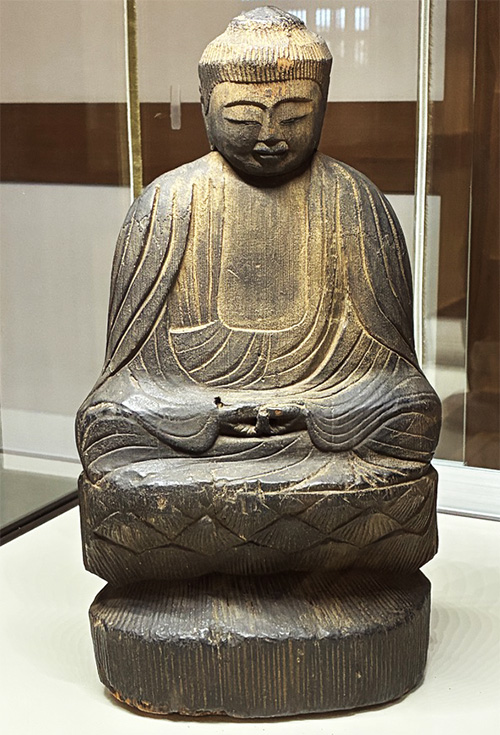
先日紹介の道南・上ノ国の笹浪家住宅所蔵の円空仏の2例目です。
解説文では「この円空仏は道内では唯一の阿弥陀如来像で、明治初めに久遠(現せたな町)と奥尻島の間の海中で拾われたもの、と言われています。」とされていた。1666年作。
わたし的には驚きの「海中で拾われた」伝承であります。川崎大師でもこういう伝承を聞いていたし長谷寺でも似たような伝承が伝わっている。日本の沿岸部には古くから海の彼方(常世の国や観音浄土である補陀落山)から神仏がやってきて幸福をもたらすという「寄り神(よりがみ)・漂着神信仰」があるという。漁師の網にかかったり浜に打ち上げられたりした流木や石、仏像を「海の向こうから訪れた尊い神仏」として祀り、それが地域の核となるお寺の始まりへと結びついたとするワケだ。
わたしが驚くのはむしろ、明治以降に、また北海道でまでこうした伝承が伝わっていること。
ほお〜、と日本人のこの信仰への根強い帰依こころを思ってしまう。いやかえって北海道も日本人マザー精神のなかにしっかりと抱えられているように思えて、こころが安らぐ気がしてしまった(笑)。
みほとけの表情としてもまことに柔和な感じがしてやさしい。
阿弥陀如来とは大乗仏教における主要な仏様の一尊であり、西方にある「極楽浄土」の教主。歴史上の人物であるお釈迦様(釈迦如来)とは異なり、時間や空間を超越した存在とされ、無量光仏:サンスクリット語のアミターバ(量り知れない光を持つ者)の訳なのだという。
いかにも、道南上ノ国から見て西方にあたる海域から「拾われてきた」ことに由縁を感じさせる。
・・・ということで、風邪引きから徐々に体力は回復してきております。阿弥陀如来像デジタル写真の御利益なのでしょう(笑)。
昨日は夫婦でJR琴似駅からお隣の桑園駅まで電車で移動して、AEON店内で買い物三昧。帰りも琴似駅周辺でついでの食品買い入れから徒歩で帰宅。東京首都圏で考えたらそれでも「徒歩圏内」移動でごく一般的な範囲内。「慣れたら」これでまったく問題はないことはわかります。首都圏などとの違いはそれぞれの道路幅が広大で、多少は「風に吹かれる」時間が長いことくらいでしょうか。まぁおとなしく慣れることでしょうね。
●お知らせ
拙書「作家と住空間」幻冬舎から電子書籍で発刊
お求めはAmazonで。
https://amzn.asia/d/eUiv9yO
English version⬇
[Enku Buddha: Kamikuni’s Second Work, “Amida Nyorai”]
Day 10 of car-free living has passed without a hitch. Now that I’m actually living here on foot, I realize this is a super convenient location—at least by Tokyo standards. Perhaps this is divine guidance telling me to avoid luxury at all costs. …
This is the second example of an Enku Buddha from the collection of the Sasanami Family Residence in Kaminokuni, Southern Hokkaido, which I introduced the other day.
The explanatory text states: “This Enku Buddha is said to be the only statue of Amida Nyorai in Hokkaido, and it is said to have been recovered from the sea between Kuon (now Setana Town) and Okushiri Island in the early Meiji period.” It was created in 1666.
Personally, I find the legend that it was “found in the sea” quite surprising. I’ve heard similar legends at Kawasaki Daishi, and a similar tradition is also passed down at Hase-dera Temple. It is said that along Japan’s coastlines, there has long been a belief known as “Yorigami” or “Drifted Deity” worship, in which deities and Buddhas are believed to arrive from across the sea—from the Land of Eternity or Mount Potala, the Pure Land of Kannon—to bring happiness. The idea is that driftwood, stones, and Buddhist statues—whether caught in a fisherman’s net or washed ashore—were enshrined as “venerable deities and Buddhas who had come from across the sea,” and this led to the founding of temples that became the heart of the local community.
What surprises me, however, is that such legends have been passed down even in Hokkaido since the Meiji era.
“Wow,” I find myself thinking, reflecting on the deep-rooted devotion the Japanese have toward this faith. No, on the contrary, it made me feel at ease, as if even Hokkaido is firmly embraced within the Japanese “mother spirit” (laughs).
The expression on the Buddha’s face also feels truly gentle and kind.
Amida Nyorai is one of the principal Buddhas in Mahayana Buddhism and the ruler of the “Pure Land of Bliss” in the West. Unlike Shakyamuni Buddha (Shaka Nyorai), who was a historical figure, Amida Nyorai is considered a being that transcends time and space; his name is said to be a translation of the Sanskrit term “Amitābha” (one of immeasurable light).
Indeed, it feels fitting that this statue was “found” in the waters to the west as seen from Kamikuni in southern Hokkaido.
…And so, my stamina is gradually recovering from my cold. I suppose it’s thanks to the blessings of the digital photo of the Amida Nyorai statue (laughs).
Yesterday, my wife and I took the train from JR Kotoni Station to the neighboring Kuwabara Station and spent the whole time shopping at AEON. On the way back, we picked up some groceries near Kotoni Station and walked home. If you think about it in terms of the Tokyo metropolitan area, this is still a “walkable” distance—well within the norm. I realize that “once I get used to it,” this won’t be a problem at all. The only real difference from places like the Tokyo metropolitan area is that the roads here are much wider, so you end up spending a bit more time “being blown around by the wind.” Well, I suppose I’ll just have to take it in stride and get used to it.
● Announcement
My book, *Writers and Living Spaces*, has been published as an e-book by Gentosha.
Available on Amazon.
共有:

Posted on 11月 16th, 2026 by 三木 奎吾
Filed under: 未分類




コメントを投稿
「※誹謗中傷や、悪意のある書き込み、営利目的などのコメントを防ぐために、投稿された全てのコメントは一時的に保留されますのでご了承ください。」
You must be logged in to post a comment.