
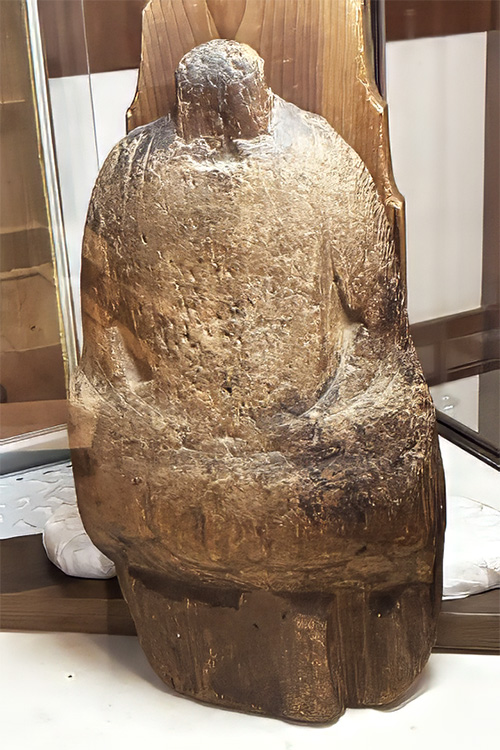
道南・上ノ国の笹浪家住宅にはもう1体円空作とされる像があり、それがこの座像。
わたしにはどうしても正否が判断できなかったのですが、展示説明では「円空作」1666年制作。と明示されている。昨日までに紹介した2体とは違って「有形民俗」第1号認定という上ノ国町の指定文化財。
〜地域の人たちの信仰を集めていただけではなく、子どもたちが遊びの中で「おんぶ」するなど、身近な存在であったという。〜という説明文付き。全長39.5cm。
昨日書いた円空仏は「海から拾われてきた」という故事つきであったけれど、長時間海水にさらされていたという伝承にもかかわらず(笑)特段の劣化痕跡はなく顔かたちなどはしっかりとされていた。一方のこちらは、そもそも顔かたちの像部分が脱落していて顔が確認できない。「顔がいのち」と思える仏像なのにそれがなくなっている。そして説明文も「なるほど」と思えるほどに木肌からは人間の繰り返しの「接触摩耗」の痕跡がうかがえる。
たしかに「民俗」性が伝わってくる。
江戸期からの北海道の子どもたちの日々の遊びの中で大切に扱われ、あるいは場合によっては乱暴に扱われたり、放置されたりしていたことが想像される風貌。ときにはかくれんぼ遊びの「鬼」役の子どもが背負っていたような、具体的なシーンが目に浮かんでくる。
仏像の果たす役割を超えた、まことに人間模様を知り尽くした「尊貴」なお姿と思えてしまった。
「観音菩薩」というのは仏教における代表的な菩薩の一尊であり、人々の苦しみを救う慈悲の象徴として日本をはじめ広く信仰されてきた存在。お姿から腑に落ちてくるのはまさに「慈悲の象徴」そのものか。
みなさん、どう感じられますか?
さて昨日は本格的に調査活動、執筆活動に専念しておりました。
クルマのない期間は、ひたすら打ち込む系の活動の時期かと。おかげさまで400年間の通期での家系DNAの「流れ」のパターンを可視化できてきて、クリアになった部分もあり有意義。一方でまだWifi不調は継続していて、ひたすらiPhoneのテザリング機能を使ってのWEB接続一択。使用量残高とにらめっこしながらのメンドイ状態。
でもおかげさまで、こうしてブログ執筆も無事継続中であります。ひと安心。
●お知らせ
拙書「作家と住空間」幻冬舎から電子書籍で発刊
お求めはAmazonで。
https://amzn.asia/d/eUiv9yO
English version⬇
[Another “Seated Statue of Kannon Bodhisattva” / Enku Buddha, Kaminokuni]
A noble and revered figure from the “folk tradition” of Kaminokuni in southern Hokkaido—the traces of wear left by children who have “played together” with it since the Edo period are etched in my memory. Truly divine. …
At the Sasano family residence in Kamikuni, southern Hokkaido, there is another statue attributed to Enku, and this is that seated figure.
I simply could not determine whether this attribution was correct, but the exhibition description explicitly states, “By Enku, created in 1666.” Unlike the two statues I introduced up until yesterday, this is a designated cultural property of Kamikuni Town, recognized as the first “Tangible Folk Cultural Property.”
~The explanation notes that it was not only an object of devotion for local people but also a familiar presence in their daily lives, with children even using it as a “backpack” during play.~ Total height: 39.5 cm.
The Enku statue I wrote about yesterday came with the story that it had been “found in the sea,” but despite the legend that it had been exposed to seawater for a long time (laughs), there were no particular signs of deterioration, and the facial features were well-preserved. This one, on the other hand, has lost the facial features entirely, making it impossible to make out the face. For a Buddha statue where “the face is its very life,” that part is missing. Furthermore, the explanatory text makes perfect sense when you see the traces of repeated “wear and tear from human contact” clearly visible on the wood’s surface.
It certainly conveys a sense of “folklore.”
Its appearance suggests that it was cherished—and at times, perhaps roughly handled or neglected—during the daily play of Hokkaido children since the Edo period. I can vividly picture specific scenes, such as a child playing “hide-and-seek” carrying it on their back while playing the role of “it.”
It struck me as a truly “noble” figure that transcends the role of a Buddhist statue, one that has come to know the human condition inside and out.
“Kannon Bosatsu” is one of the most representative bodhisattvas in Buddhism and has been widely revered, particularly in Japan, as a symbol of compassion that relieves people’s suffering. Looking at this figure, it truly feels like the very embodiment of “compassion” itself.
What do you all think?
Well, yesterday I devoted myself fully to research and writing.
I suppose this period without a car is a time for activities that require focused, sustained effort. Thanks to this, I’ve been able to visualize the “flow” patterns of my family’s DNA over a 400-year span, and while some aspects have become clearer, it’s been a meaningful process. On the other hand, my Wi-Fi is still acting up, so my only option is to connect to the web using my iPhone’s tethering feature. It’s a hassle, constantly keeping an eye on my data allowance.
But thanks to that, I’m able to continue writing this blog without a hitch. That’s a relief.
● Announcement
My book, “Writers and Living Spaces,” has been published as an e-book by Gentosha.
Available on Amazon.
共有:

Posted on 11月 17th, 2026 by 三木 奎吾
Filed under: 未分類





コメントを投稿
「※誹謗中傷や、悪意のある書き込み、営利目的などのコメントを防ぐために、投稿された全てのコメントは一時的に保留されますのでご了承ください。」
You must be logged in to post a comment.