

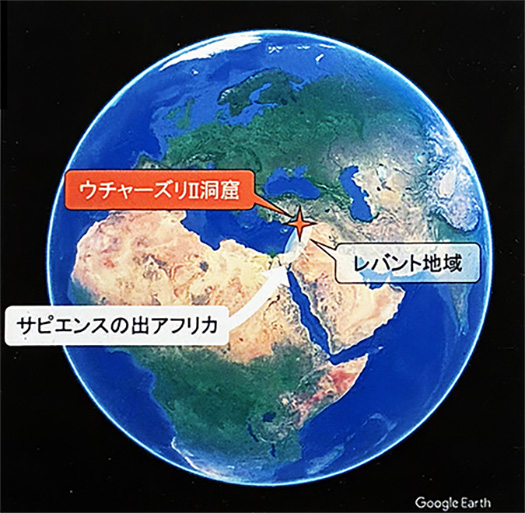
ネアンデルタール人と現生人類の交雑・共生が2万年間続いた遺跡に心が鷲づかみされてしまったまま、時間が停止しているようです(笑)。そもそもウチャーズリⅡ洞窟のサピエンスはどこから来たのか?
約10万年前のサピエンスの化石が地図位置のレバントから発見されるがその後化石記録が途絶え、出アフリカまでの間この地から現生人類・サピエンスは撤退したと考えられている。
いまわたしは歴史好きらしく、家系史探索も掘り起こし作業を並行して継続していますが、それも高々400年ほどの人間記録。2万年間の悠久な時間を共存していた時間感覚からすれば「つい最近のこと」。こういった遺跡研究はさまざまにわたしたちの想像力を無限解放してくれます。
わたしは想像力が常に「前屈み」になり易いタイプ(笑)。そもそも科学博物館の展示案内もほんのちょっと情報断片が引っかかってきただけで、また展示物もポスターパネル6枚ほど。ほかにはウチャーズリⅡ洞窟現地でのドローン撮影とおぼしき映像がモニターに流されていただけ。
最先端的な発見は情報解析の時間がまだ十分に掛けられないのだろうと思います。たぶん科学博の研究陣もどのように分析すべきか、活発に議論している段階なのでしょう。そういう「現段階でわかっていること」という条件づきの公開内容。
しかし一方で情報公開されることで、さまざまな意見が世間的に盛り上がって、分析が全社会的な関心を高めていくものでしょう。それがまた科学者の分析を再加速させる。自由な「情報摂取者」としては、家系史研究と同様にその時代・時間での「人間がいだく心象・動機」を探ることになる。
科学博側の現段階の見解は以下。
〜見えてきた交流の中身
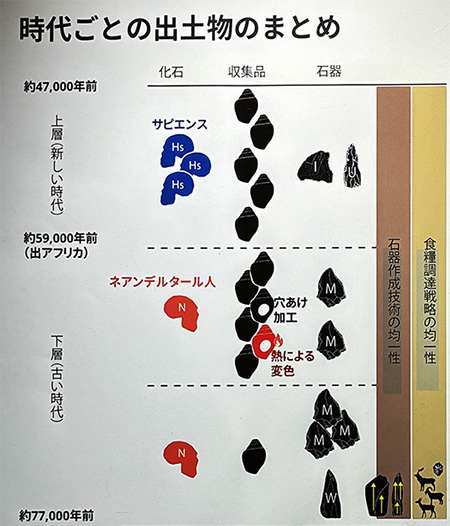
■ウチャーズリⅡ洞窟でネアンデルタール人と現生人類は、2万年以上にわたり交流し均一な文化を維持していた。・同じ方法で石器を作り同じものを食べ、同じ貝殻を集めていた。
■種の垣根を超えて共通した文化を持ち得たのは交流があったからで「役に立たないが美しいもの」にまで至る共通の価値観があったのではないか。・共通の価値観が、両種の間に起きた交雑の基盤になった 〜
アフリカタモトの貝ガラに「穴開け加工」が施されていたから、漁撈採集に向かう男性が、女性に美を飾る装身具としてプレゼント利用したのでは? と、わたしとしては直感した次第。
もちろん証拠はない。しかし、人はどうしてもそういう情景を想像したくなる。さて・・・。
●お知らせ
拙書「作家と住空間」幻冬舎から電子書籍で発刊
お求めはAmazonで。
https://amzn.asia/d/eUiv9yO
English version⬇
[What Is the Origin and Source of Humanity’s Intellectual Curiosity?]
Naturally, it must be “the desire to live a better life.” This cry of life must always have echoed at the very root of human evolution—for Neanderthals, for modern humans, and for me as well. …
My heart has been completely captivated by this archaeological site where Neanderthals and modern humans interbred and coexisted for 20,000 years—it feels as if time has stood still here (lol). But where did the Homo sapiens at Uchazli II Cave come from in the first place?
Fossils of Homo sapiens dating back about 100,000 years have been discovered in the Levant, as shown on the map, but the fossil record then goes cold. It is believed that modern humans—Homo sapiens—withdrew from this region until they migrated out of Africa.
It seems I’ve become quite the history buff lately, and I’m continuing to dig into my family history in parallel—though that, too, covers only about 400 years of human history. Compared to the sense of time spent coexisting over 20,000 years, that’s “just the other day.” Research into sites like this unleashes our imagination in countless ways.
I’m the type whose imagination tends to get carried away (lol). To begin with, the exhibition guide at the Science Museum offered only a few scattered fragments of information, and the exhibits themselves consisted of just about six poster panels. Aside from that, there was only footage—presumably drone footage taken at the Ucharsli II Cave site—playing on a monitor.
I suspect that not enough time has yet been devoted to analyzing the data from these cutting-edge discoveries. The research team at the Science Museum is probably still in the midst of lively discussions about how best to analyze the findings. The information released is therefore conditional—limited to “what is known at this stage.”
However, the very act of making this information public is likely to spark a lively public debate, raising society-wide interest in the analysis. This, in turn, will further accelerate the scientists’ analysis. As a free “consumer of information,” I find myself, much like in genealogical research, exploring the “mental images and motivations” of people from that era and time.
The Science Museum’s current view is as follows.
~The Nature of the Interaction That Has Come to Light~
■ At Uchazuri II Cave, Neanderthals and modern humans interacted for over 20,000 years and maintained a uniform culture. ・They crafted stone tools using the same methods, ate the same foods, and collected the same seashells.
■ The fact that they were able to share a common culture across species boundaries was due to this interaction; perhaps they shared common values that extended even to “things that are beautiful but not useful.” ・These shared values formed the foundation for interbreeding that occurred between the two species. ~
Since the shells of the African river mussel had been “pierced,” my intuition tells me that men heading out to fish and gather might have given them to women as decorative ornaments.
Of course, there is no evidence. However, one can’t help but imagine such a scene. Well then…
● Announcement
My book, *Writers and Living Spaces*, has been published as an e-book by Gentosha.
Available on Amazon.
共有:

Posted on 7月 22nd, 2026 by 三木 奎吾
Filed under: 未分類





コメントを投稿
「※誹謗中傷や、悪意のある書き込み、営利目的などのコメントを防ぐために、投稿された全てのコメントは一時的に保留されますのでご了承ください。」
You must be logged in to post a comment.