
関西〜故地・備後山地から札幌に帰ってきてからあれこれと連絡業務やアポなどのやり取りもあって、なかなか大量に取得してきたデータ類の処理が追いつかない。そう度々は訪れる機会がないだろう地域、そして不確かだった祖母の事前情報などから、徹底的に関連情報類を収集しまくったのです。
いま必要なのは「解析作業」。これはジミジミと「成すべきこと」と考えて取り組んでいくしかない。孫子の世代のため、必要とされるかどうかも不明(笑)だけれど、わたしの世代の責務と考えて取り組んでいます。ただ、時間はなかなか掛かる・・・。
そんなことで、毎日更新のブログはしばし一般的な話題に方針を据えていきたい。
きょうも昨日と同様、利休のふるさと・堺なので、敬意を表して続篇。
茶の湯、茶会という文化にはまったく無縁で生きてきた。それでも、歴史の動乱期に堺の豪商たちが武家政権と交わしてきた関係への興味は持ってきています。とくに利休は、立ち入りすぎた秀吉との関係から「死を賜る」という結末に至るドラマが、日本人の心理に焼き付いている。
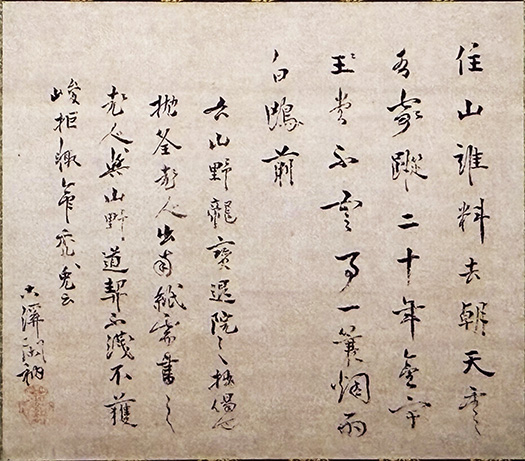
「利晶の杜」で利休の死の直前の茶会で掛けられていた書を見ることができた。
やはりドラマが描くように、利休さんは淡々とこの死を受け入れていったのだろうと思えます。死の直前期に催したこの茶会。
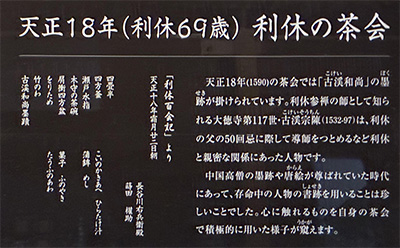
〜天正18年(1590年)の茶会では「古渓和尚」の墨跡が掛けられています。利休参禅の師として知られる大徳寺117世・古渓宗陳(1532〜1597年)は、利休の父の50回忌に際して導師をつとめるなど利休と親密な関係にあった人物。
中国高僧の墨跡や唐絵が尊ばれていた時代にあって、存命中の人物の書跡を用いることは珍しいことでした。心に触れるものを自身の茶会で積極的に用いた様子が窺えます。<古渓宗陳は堺の南宗寺から大徳
寺の住持となるがその際に利休は百質文という多額の奉加金を寄進している。墨跡(原本)の内箱蓋裏には表千家第六代家元・覚々斎の書付。>・・・との解説。
書かれている書の翻刻は以下。
〜住山誰料去朝天雲 水寄蹤二十年金宇 玉堂不吾事一蓑烟雨 白鴎前
右山野龍寶退院之拙偈也 抛筌老人出南紙需言書之 老人與山野道契不浅不獲
峻拒輒命禿兎云 古溪閑衲(印)〜
どうも先般来、こういう古文書に親近感が湧く。が、この道のはるかなること(笑)。
●お知らせ
拙書「作家と住空間」幻冬舎から電子書籍で発刊
お求めはAmazonで。
https://amzn.asia/d/eUiv9yO
English version⬇
[Calligraphy Scroll from a “Tea Ceremony” Held by Rikyu at Age 69]
The viewer is prompted to internally reflect on “what the artist wants to convey” through the atmosphere of the kanji characters. I wonder if that’s what calligraphy is all about as a form of communication. (laughs) …
Since returning to Sapporo from the Kansai region—specifically my ancestral home in the Bingo Mountains—I’ve been so busy with various communications and scheduling appointments that I haven’t been able to keep up with processing the massive amount of data I collected. Since I likely won’t have many opportunities to visit that area again, and given the uncertainty surrounding the information I had about my grandmother beforehand, I went all out to gather every bit of relevant information I could find.
What I need to do now is “analyze the data.” I have no choice but to approach this as a “task that must be done” and tackle it step by step. It’s unclear whether this will even be needed for my grandchildren’s generation (laughs), but I’m approaching it as a duty of my generation. Still, it’s taking quite a while…
For that reason, I’d like to shift the focus of my daily blog updates to more general topics for the time being.
Today, just like yesterday, I’m in Sakai—Rikyu’s hometown—so I’ll continue this series as a mark of respect.
I’ve lived my entire life completely detached from the culture of the tea ceremony and tea gatherings. Even so, I’ve long been interested in the relationships that Sakai’s wealthy merchants forged with the samurai government during that turbulent period of history. In particular, the drama surrounding Rikyu—whose relationship with Hideyoshi became too intimate, leading to the tragic conclusion of being “granted death”—is etched into the Japanese psyche.
At “Rishō no Mori,” I was able to see the calligraphy that was displayed at the tea gathering held just before Rikyu’s death.
Just as depicted in the drama, I can’t help but think that Rikyu calmly accepted his impending death. This tea ceremony was held in the final days before his death.
~At the tea ceremony held in Tenshō 18 (1590), a calligraphy piece by “Master Kokei” was displayed. Kokei Sōchin (1532–1597), the 117th abbot of Daitoku-ji and known as Rikyū’s Zen master, had a close relationship with Rikyū—he even served as the presiding priest at the 50th anniversary memorial service for Rikyū’s father.
In an era when calligraphy by eminent Chinese monks and Tang Dynasty paintings were highly revered, it was unusual to use the calligraphy of a living person. This suggests that Rikyu actively incorporated items that resonated with him into his own tea ceremonies.
The transcription of the calligraphy is as follows:
~Who could have foreseen that the clouds would ascend to heaven this morning? The water has carried my traces for twenty years to the golden hall. The Jade Hall is not for me—just a straw cloak in the mist and rain. Before the white seagull.
The above is a humble verse by Yamano Ryuhō upon his retirement from the monastery. The Elder Hōsen requested that I write it on paper from the South. The Elder and Yamano shared a deep spiritual bond, and I could not
refuse outright, so he instructed the “Bald Hare” to write it. Kokei Kan’na (Seal) ~
Lately, I’ve been feeling a growing affinity for ancient documents like this. But what a long road this is (laughs).
● Announcement
My book, “Writers and Living Spaces,” has been published as an e-book by Gentosha.
Available on Amazon.
共有:

Posted on 9月 1st, 2026 by 三木 奎吾
Filed under: 未分類



コメントを投稿
「※誹謗中傷や、悪意のある書き込み、営利目的などのコメントを防ぐために、投稿された全てのコメントは一時的に保留されますのでご了承ください。」
You must be logged in to post a comment.