

有田焼とは、佐賀県有田町とその周辺地域で製造される磁器を指す。
17世紀初頭、朝鮮人陶工である初代金ヶ江三兵衛(通称:李参平)によって磁器の原料となる陶石が発見され、日本で初めて磁器が焼かれた。以来400年間、この地は食器や美術工芸品など、ものづくりの歴史を連綿と紡ぎ続けている。
かれは豊臣秀吉の朝鮮出兵(1592年、1597年)の際、特殊技能技術者として身柄を確保され、強制的に来日させられた経緯を持つ。そのような過酷な運命にありながら、新天地にその技術を伝え、地道に原材料を発見・開発した功績は大きい。まさに、この地にとっての「厚恩のひと」。
そもそも陶器とは陶土(土)を主な原料としてやや低めの温度で焼いたものであり、ざらっとした質感と吸水性を持つ。信楽焼や備前焼がその代表例。一方、磁器は陶石を砕いたものを原料にし、極限の高温で焼き上げられる。白く硬く、つるりとした表面を持ち、吸水性はない。その代表格こそが有田焼や九谷焼。
有田で「色絵(上絵付け)」が始まったのは1640年代、初代酒井田柿右衛門による成功が端緒。陶磁器用の絵の具で釉薬(ゆうやく)の上に彩色を施す。この技法によりそれまでの染付のみの単色世界から、多彩色の華やかな世界へと飛躍を遂げた。
1650年代からはオランダ東インド会社を介して東南アジアやヨーロッパ諸国への輸出が開始され、ヨーロッパの王侯貴族の間では、有田の磁器を持つことが最高のステータスシンボルとなった。日本の「製造業」が欧米世界を震撼させた嚆矢(こうし)であり、肥前鍋島藩が明治維新期に開明的な雄藩として主導的役割を果たせた背景には、間違いなくこの世界水準の産業的「下地」があった。
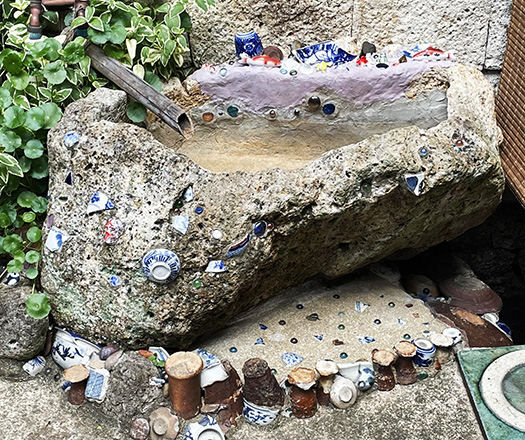
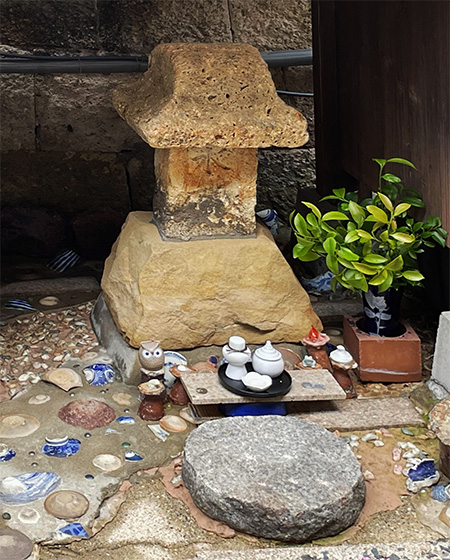
・・・写真は、有田の街並みを歩いていてカミさんは美しい工芸美術に当然ながら目が行く(笑)のに対して、わたしは路傍に鎮座されている「お社」に惹き付けられていた。いかにも庶民の日常の「ものづくり」での祈りを受け止め続けてこられた素朴な存在。そして、焼き物の街らしく、割れた食器類が断片となっても「役に立てられている」様子。
この有田で暮らす職人さんたち、その世帯の親子たちが手を合わせていた様子が目に浮かんだ。
自分たちの暮らしを支えてくれる磁器に対して素朴に神仏に感謝するこころ。いかにも日本的な「心情」がそこに込められているように感じられ、しばしその「美感」に佇ませていただいていた。
●お知らせ
拙書「作家と住空間」幻冬舎から電子書籍で発刊
お求めはAmazonで。
https://amzn.asia/d/eUiv9yO
English version⬇
[The Town of “Arita,” Where Time Has Layered Itself Alongside Porcelain]
From its very beginnings, porcelain production in Arita has been conducted with an international perspective. Among European royalty and nobility, owning Arita porcelain became a status symbol. …
Arita ware refers to porcelain produced in Arita Town, Saga Prefecture, and its surrounding areas.
In the early 17th century, the first-generation Kanegae Sanbei (commonly known as Lee Sanpei), a Korean potter, discovered the porcelain stone used as raw material for porcelain, and porcelain was fired in Japan for the first time. For the past 400 years, this region has continued to weave an unbroken history of craftsmanship, producing tableware, art objects, and other crafts.
He had been taken into custody as a specialist craftsman during Toyotomi Hideyoshi’s invasions of Korea (1592 and 1597) and was forcibly brought to Japan. Despite such a harsh fate, his achievements—in passing on his skills to this new land and diligently discovering and developing raw materials—were immense. He is truly a “man of great benevolence” to this region.
To begin with, earthenware is made primarily from clay and fired at a relatively low temperature, resulting in a rough texture and water absorption. Shigaraki-yaki and Bizen-yaki are prime examples. Porcelain, on the other hand, is made from crushed porcelain stone and fired at extremely high temperatures. It is white, hard, and has a smooth surface, with no water absorption. Arita-yaki and Kutani-yaki are the quintessential examples of porcelain.
The practice of “iro-e” (overglaze decoration) began in Arita in the 1640s, pioneered by the first-generation Sakaieda Kakiemon. This technique involves applying colors over the glaze using pigments specifically designed for ceramics. Thanks to this technique, the world of ceramics made a quantum leap from the monochromatic realm of traditional blue-and-white (sometsuke) to a vibrant, multicolored world.
Starting in the 1650s, exports to Southeast Asia and European countries began via the Dutch East India Company, and among European royalty and nobility, owning Arita porcelain became the ultimate status symbol. This marked the beginning of Japan’s “manufacturing industry” that shook the Western world, and there is no doubt that this world-class industrial “foundation” was the reason the Hizen Nabeshima Domain was able to play a leading role as an enlightened and powerful domain during the Meiji Restoration.
…In the photo, while my wife’s eyes were naturally drawn to the beautiful arts and crafts as we walked through the streets of Arita (laughs), I was captivated by the “shrine” enshrined by the roadside. It was a simple presence that had continued to receive the prayers of ordinary people engaged in their daily “craftsmanship.” And, as befits a town of pottery, even broken tableware, reduced to fragments, seemed to be “serving a purpose.”
I could picture the artisans living here in Arita—and the parents and children in their households—joining their hands in prayer.
A simple heart of gratitude toward the gods and Buddhas for the porcelain that sustains their lives. I felt that a quintessentially Japanese “sentiment” was imbued there, and I lingered for a while, absorbed in that “aesthetic beauty.”
● Announcement
My book, *Artists and Living Spaces*, has been published as an e-book by Gentosha.
Available on Amazon.
共有:

Posted on 7月 10th, 2026 by 三木 奎吾
Filed under: 未分類





コメントを投稿
「※誹謗中傷や、悪意のある書き込み、営利目的などのコメントを防ぐために、投稿された全てのコメントは一時的に保留されますのでご了承ください。」
You must be logged in to post a comment.