
「四百年間のいのちの履歴書」シリーズの基礎的な「脳内」シミュレーション。
やはり画像というのは、現代人には欠かせない情報伝達ツール。多くの「文字ばっかり」書籍というものが構造不況業種になっていくのには、情報伝達の手段をただただテキストだけに絞るということへの、現代人の「それムリ」感が表現されている。
生まれたときからテレビ動画というビジュアルコミュニケーションに慣れてきた人類にとって、ただただテキストの表現だけで理解しろという方がムリであって、たしかに意味内容はテキストによる「明晰化」が不可欠だけれど、状況説明的なものは画像、さらに動画表現の方が親和性がある。現代の新聞メディアの衰退ということには、潜在的にこの問題があるし、書籍文化についても同様のことが言える。
とくに日本文化の特質のひとつが鳥獣戯画を嚆矢とする「マンガ文化」。出版文化衰退のなかでひとりマンガだけは成長性を持続してきている。
いま江戸期社会について肉親としての先祖の生き様をリアルに「立ち上らせたい」と祈念しているけれど、テキストだけではやはり表現がまわりくどいと思う。わたしが取り組んだ住宅雑誌でも、その「良さ」はあくまでもビジュアル中心で訴求していくことがメイン領域。「どう写真に収めたら、その被写体のよい面をわかりやすく伝えられるか」という意識をもっとも強く持っていた。
そんなことから、400年を越す以前の社会の実相もやはりできるだけビジュアル的に理解したいし、表現したくなってくる。建築が残っていれば写真表現が可能だけれど、産業痕跡についてはなかなかその時代の中での実相を把握できるビジュアル表現が難しい。
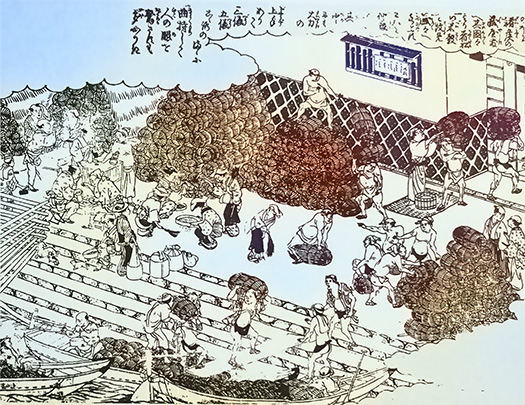
イラストは「摂津名所図会」という図集のなか、大阪・堂島のコメ蔵への搬入の様子。
「天下の台所」という形容表現と一体化させるビジュアルとしては的確かと。
このようなイラスト表現を活用させれば、徐々に江戸社会への強い「想像力」が沸き立ってくるのだと思えるのですね。なんと言っても、わたしたちの祖先たちは同じように暮らしていた日本人であり、その心象についてはほとんど同じ「反応」を持てるのだと思えるのですね。
徐々に浮世絵とかなどの江戸期のビジュアル表現、それもできれば安芸・備後、尾道などの地方社会とビジュアル表現を探索し始めている次第です。
●お知らせ
拙書「作家と住空間」幻冬舎から電子書籍で発刊
お求めはAmazonで。
https://amzn.asia/d/eUiv9yO
English version⬇
Visual Representations That Bring Edo-Period Society to Life
Recreating the vivid sense of reality experienced by our Japanese ancestors in pre-photography times. How can we reconstruct the atmosphere of the Edo period? …
A foundational “mental” simulation for the “Four Hundred Years of Life’s Resume” series.
Images remain an indispensable information transmission tool for modern people. The decline of many “text-heavy” books into structurally depressed industries reflects modern people’s sense of “that’s impossible” when information transmission is confined solely to text.
For humanity, accustomed to visual communication like television and video from birth, expecting understanding through text alone is unreasonable. While textual “clarification” is indeed essential for conveying meaning, situational explanations are more naturally suited to images and video expression. This underlying issue contributes to the decline of modern newspaper media, and the same applies to book culture.
One distinctive trait of Japanese culture is its “manga culture,” originating with the Bird and Beast Play Paintings. Amidst the decline of publishing culture, manga alone has sustained its growth potential.
I now pray to vividly “bring to life” the lived experiences of my direct ancestors within Edo-period society, yet I feel text alone inevitably results in roundabout expression. Even in the residential architecture magazines I worked on, the primary appeal of their “quality” was always centered on visuals. My strongest focus was always on “how to photograph something to clearly convey its best aspects.”
Because of this, I also want to understand the reality of society over 400 years ago as visually as possible, and I feel compelled to express it. If architecture remains, photographic expression is possible, but for industrial traces, it’s difficult to find visual representations that truly capture the reality of that era.
The illustration depicts the scene of rice being delivered to the rice storehouses in Dojima, Osaka, from the illustrated collection “Setsu Meisho Zue.”
As a visual to integrate with the descriptive phrase “Kitchen of the Nation,” it seems quite apt.
By utilizing such illustrative expressions, I believe a strong “imagination” of Edo society gradually begins to well up. After all, our ancestors were Japanese people who lived much like us, and I believe we can share nearly identical “emotional responses” to their inner worlds.
I am gradually beginning to explore visual representations from the Edo period, such as ukiyo-e, and ideally, visual representations of regional societies like Aki, Bingo, and Onomichi.
●Notice
My book “Writers and Living Spaces” published as an e-book by Gentosha
Available on Amazon.
共有:

Posted on 3月 7th, 2026 by 三木 奎吾
Filed under: 未分類




コメントを投稿
「※誹謗中傷や、悪意のある書き込み、営利目的などのコメントを防ぐために、投稿された全てのコメントは一時的に保留されますのでご了承ください。」
You must be logged in to post a comment.