

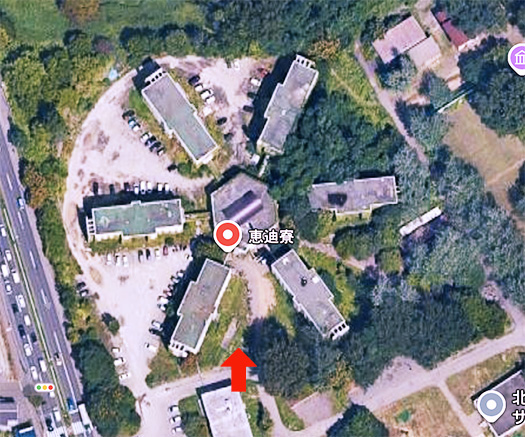
 Screenshot[/恵迪寮上空からのGoogle写真]
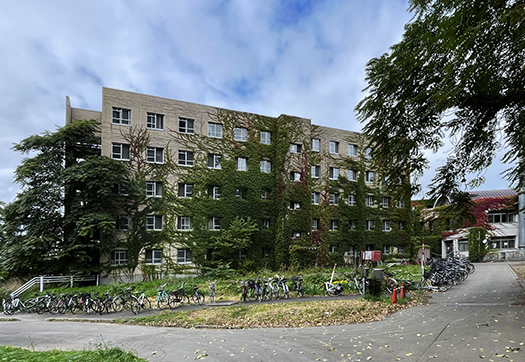
さて北大散歩シリーズ。今回は北大生たちのナマな暮らしを支えている「住」建築としてのこの寮。
わたしは高校生の時に70年日米安保闘争の時期に遭遇して青春期の燃焼を体験した世代。いまでこそどちらかといえば常識的、というか、人間として親から子へのいのちの継承をしっかり保全したい考え方に近いわたしですが、当時はもちろん真っ赤な新左翼活動に傾倒していた。血の刻印。
高校生当時なので、そういう政治活動の「拠点」としてこの北海道大学や札幌医科大学などの学園闘争を担っていた大学生たちと「弟」分として交流していた。頻繁に北大のキャンパスを訪れ、いろいろな「自治会学生運動」系の集会施設などをその「場所・建築」として空間認識していた。
現在はその役割を終えて記念碑だけが残っている「楡影寮〜ゆうえいりょう」の建物に深く沈殿していた。
その後の人生では人間空間・住宅というものに傾倒していったのですが、自分の暮らしてきた家の記憶以外では、こうした学生寮は思春期の空間体験のなかで特異な位置を占めている。北大の「兄姉貴」たちの生活の匂いの染み込んだ空間で弟・妹たちは、なにものかを感受していたのだと思う。それは、わたし自身にとって今となっては、なつかしさとも違う格別な「空気感」記憶。
そういう空気感の「残骸」がいまでも漂っていると思えるのが写真の「恵迪〜けいてき〜寮」。
北大生との交流はキャンパスのなかで利便性の高かった楡影寮が主体だったけれど、学生たちの言葉の端々から同質の空間性を感じさせる建築名としてこの恵迪寮も認識していた。Wikiを確認すると以下要旨。
〜三代目恵迪寮 1983年建築。大学側の管理強化の中、寮生は自分たちの望む生活を得るため創意工夫。昔からの共同生活を続けるため部屋サークル制を採用し、寮生同士が活発に交流を持てるよう考案。大学側は完全個室化を主張し反対したが寮生は共同生活の重要性を主張し続け、後に認められた。〜
・・・というような趣旨がこの設計に反映していると感じる。特異な放射線形状の配置。一方で単体の寮建築としてはシンプルな集合住宅形式。現在で築後40年以上の風雪感が、ツタのからまりに反映している。
青春期から55年以上の時間を経て、やや重さを感じる空間認識・・・。
●お知らせ
拙書「作家と住空間」幻冬舎から電子書籍で発刊
お求めはAmazonで。
https://amzn.asia/d/eUiv9yO
English version⬇
【The layout (diagram) is dramatic, the floor plan utterly natural: “Hokkaido University Keitoku Dormitory”】
A student dormitory architecture where the scent of the older brothers’ lives at Hokkaido University lingers. In such a space, the younger brother breathed. An echo that has transcended 55 years. …
Now, the Hokkaido University Stroll Series. This time, we focus on this dormitory as a “residential” building supporting the raw, everyday lives of Hokkaido University students.
I belong to the generation that experienced the burning passion of youth during the 1970 Japan-U.S. Security Treaty protests while still in high school. While I might be considered more conventional now—or rather, closer to the mindset of wanting to firmly preserve the inheritance of life from parent to child—back then, I was, of course, deeply immersed in fiery new leftist activism. A blood-stained imprint.
Being a high schooler, I interacted as a “younger brother” with the university students leading campus struggles at places like Hokkaido University and Sapporo Medical University, using these sites as ‘bases’ for political activity. I frequently visited the Hokkaido University campus, recognizing various “student union movement” gathering facilities as spatial “places/buildings.”
I was deeply immersed in the building of the “Yuei Dormitory,” which has now completed its role and only its monument remains.
Later in life, I became deeply absorbed in human spaces and housing. Yet, beyond memories of the homes I lived in, these student dormitories occupy a unique position within my adolescent spatial experiences. Within those spaces, saturated with the scent of the lives of the older “brothers and sisters” at Hokkaido University, the younger ones must have sensed something profound. For me now, it’s a distinct memory of an “atmosphere” that differs from mere nostalgia.
The photograph of “Keiteki Dormitory” seems to still carry the lingering “remnants” of that atmosphere.
While my interactions with Hokkaido University students mainly centered around the conveniently located Nirekage Dormitory on campus, I also recognized Keiteki Dormitory by name as a building that conveyed a similar spatial quality through the students’ casual conversations. Checking Wikipedia, the summary is as follows:
~Third-generation Keiteki Dormitory, built in 1983. Amidst the university’s push for tighter management, the residents ingeniously devised ways to achieve the lifestyle they desired. To continue the longstanding communal living, they adopted a room-circle system designed to foster active interaction among residents. While the university insisted on fully private rooms and opposed it, the residents persistently argued for the importance of communal living, and their stance was eventually accepted.~
…I feel this spirit is reflected in the design. A distinctive radial layout. Yet as a single dormitory building, it adopts a simple apartment block form. Over 40 years since construction, the weathered appearance is reflected in the entwined vines.
After more than 55 years since youth, a spatial awareness that feels somewhat weighty…
●Notice
My book “Writers and Living Spaces” published as an e-book by Gentosha
Available on Amazon.
共有:

Posted on 10月 29th, 2025 by 三木 奎吾
Filed under: 未分類




コメントを投稿
「※誹謗中傷や、悪意のある書き込み、営利目的などのコメントを防ぐために、投稿された全てのコメントは一時的に保留されますのでご了承ください。」
You must be logged in to post a comment.