
さて、いろいろな作業進行があるなかで、次兄と進めている当家の伝承資料の「解析」作業も同時進行。
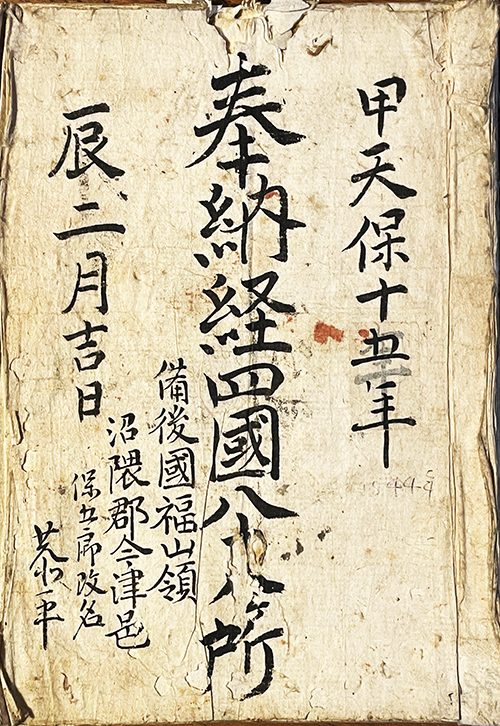
昨日はわたしには経験がなかった「四国八十八箇所」のふたつの巡礼「奉納帳」の分析を次兄と話し合っておりました。写真はその中で古い方の「天保十五年」の日付のついた古文書であります。
わたしは四国巡礼は断片的に数カ寺しか経験がない信心不足な真言宗徒。全箇所を20日かけて巡ったという次兄に、詳細にその「旅路」から推察できる状況分析も教えていただいていた次第。
表紙には「保五郎改名 恭平」という人物名が記載されているけれど、次兄のわが家系調査でもその人名に照合できる一族の人名は見当たらなかった。であるけれど、当家の当主が江戸後期に長く住み、明治の戸籍制度創設にあたっても、そこを本籍地と大切にしてきた地名・沼隈郡今津邑が記されている。
少なくとも、1790年代から1905年頃までの115年間は確実に本拠としていた「故地」。
さらに寺の印ページの順で旅路の「順路」も参照できる。「日付」情報まであるので、旅程の情報全容も知ることができる。古文書解析的にこの内容を分析するには、次兄の豊かな探究経験が不可欠と思われたので、わたしはその分析結果に導かれておりました。・・・
その結果、見えてきた当時の状況景色が徐々にわかってきたワケです。
まず、最大のナゾだった「保五郎改名 恭平」人名は「今津邑」の最有力家で古代王朝時代にまでさかのぼる「国造」伝承まで持つ地域の名家「河本家」にその人名が見いだせるというのです。
この家は代々参勤交代の大名クラスが宿泊する今津宿の「本陣」を務めてきた名家。明治以降には地域首長も務められた家系。わが家系はこの本陣家と「脇本陣」である真言宗寺院・蓮華寺の大名接待・接遇の一切の御用を承る、信用された商家だった。
江戸期の九州の大名・松浦静山公が書き残した「甲子夜話」の一節に、かれが今津宿本陣で過ごした夜、この河本氏一統とわが家系一統が、接待のために本陣家の一室で「御用」を果たすため待機していた様子が活写されたりしている。
この河本氏の一統は「備陽史研究会」という備後の地域史研究会でなんども講演されている。次兄は家系調査にあたって、この家系と接触もあったということ。
その家系の人物の「四国巡礼記録」がどうしてわが家系に伝承されてきているのか?
天保十五年(1844年)は今から182年前という古文書になります。さて? <この稿、つづく>
●お知らせ
拙書「作家と住空間」幻冬舎から電子書籍で発刊
お求めはAmazonで。
https://amzn.asia/d/eUiv9yO
English version⬇
[A Pilgrimage Journal from Shikoku Belonging to “Another Family” from the Late Edo Period Has Come to Light]
A wide range of topics are currently being explored. “New discoveries” continue to emerge from 400 years’ worth of historical records and documents. Based on an analysis of historical documents held by our main family line…
Now, while various projects are underway, I’m also working alongside my second-eldest brother on “analyzing” our family’s historical records.
Yesterday, my second-eldest brother and I discussed the analysis of two “offering registers” from the “88 Temples of Shikoku” pilgrimage—a subject I had no prior experience with. The photo shows the older of the two historical documents, dated “Tenpō 15.”
I am a Shingon Buddhist with insufficient faith, having only visited a few temples here and there on the Shikoku pilgrimage. My second-eldest brother, who reportedly completed the entire pilgrimage in 20 days, has been teaching me how to analyze the circumstances based on detailed inferences drawn from his “journey.”
Although the name “Hogorō, renamed Kyōhei” is written on the cover, my second older brother’s research into our family lineage revealed no relatives whose names matched that entry. However, the document lists the place name “Imazu Village, Numakuma District”—a place where the head of our family lived for a long time during the late Edo period and which he continued to cherish as his registered domicile even after the establishment of the Meiji family registration system.
It is undoubtedly our “ancestral home,” where we were firmly based for 115 years, from at least the 1790s until around 1905.
Furthermore, by following the order of the pages bearing the temple’s seal, one can trace the “route” of the journey. Since it even includes “dates,” it is possible to grasp the full details of the itinerary. To analyze this content from the perspective of historical document analysis, my second older brother’s wealth of research experience seemed indispensable, so I relied on the results of his analysis. …
As a result, the circumstances and landscape of that era gradually came into focus.
First, regarding the name “Hogoro, renamed Kyōhei”—which had been the greatest mystery—it turns out that this name can be found in the “Kawamoto family,” a prominent local family in “Imazu Village” that traces its lineage back to the ancient dynastic era and possesses a tradition of “Kuninari” (provincial governors).
This was a distinguished family that had served as the “honjin” (main inn) at Imazu-juku for generations, accommodating daimyo on their sankin-kōtai journeys. From the Meiji period onward, members of this lineage also served as local magistrates. My own family was a trusted merchant house that handled all matters related to the hospitality and reception of daimyo for both this honjin family and the “waki-honjin”—the Shingon Buddhist temple Renge-ji.
A passage in *Kōshi Yawa* (Night Talks of the Kōshi Year), written by Lord Matsuura Seizan—a feudal lord of Kyushu during the Edo period—vividly depicts the scene of the night he spent at the Imazu-juku Honjin, where members of the Kawamoto clan and my own family were standing by in a room of the Honjin to fulfill their “duties” in hosting the lord.
This Kawamoto family has been the subject of numerous lectures at the “Biyōshi Research Society,” a regional history research group in Bingo. My second-eldest brother reportedly had contact with this family while conducting genealogical research.
How did the “Record of a Pilgrimage to Shikoku” written by a member of that family come to be passed down in our family lineage?
The document dates back to Tenpō 15 (1844), making it 182 years old. Well then?
● Announcement
My book, “Writers and Living Spaces,” has been published as an e-book by Gentosha.
Available on Amazon.
共有:

Posted on 10月 20th, 2026 by 三木 奎吾
Filed under: 未分類




コメントを投稿
「※誹謗中傷や、悪意のある書き込み、営利目的などのコメントを防ぐために、投稿された全てのコメントは一時的に保留されますのでご了承ください。」
You must be logged in to post a comment.