
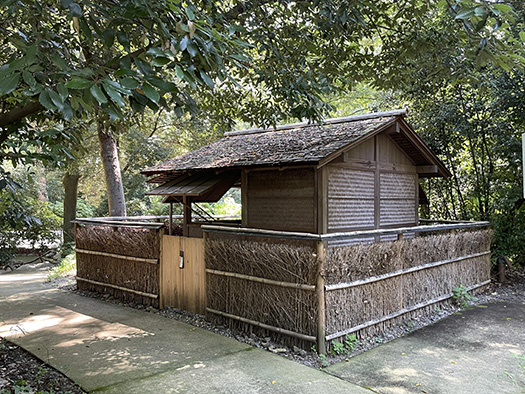
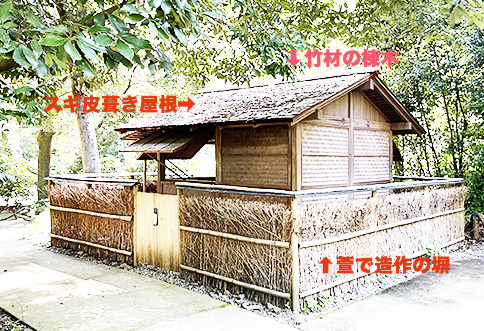
鴨長明という人物。その「方丈記」という著作には完全に心を「わしづかみ」されて生きてきたが、その人物と人生についてはうかつにもまったく思慮が至らなかった。歴史には強い興味があるけれどその時代の文学作品の時代性は関連は考えるけれど、その著作者の人生そのものについてはあまり考えることもなかった。
今回わたし自身の「終の興味分野」として作家と住空間の関係性を考え始めると、当たり前だけれどその著作とその著者は一体のものとすぐに気付く。むしろその作家がどのような「環境要因」にかられて作品を産み落とすに至ったか大前提も大前提の事柄。そうした面はAIの進化で作家たちのマッピングは非常に簡化する。
一方で住環境というものは、どうしても一定の場所に定点的にあり続けるので、人間がその場に訪ねていく必要がある。空間についてはその場の「空気感」が非常に重要なのだ。もちろん写真による「取材者」はその感受性を磨いて「伝わりやすく」表現する必要があるけれど、まだその評価軸は定まっていないし、また空間とはそのような客観情報化には適していないように思う。AI時代への「現場」からの異議申し立て、か。
鴨長明さんは下鴨神社の神官の一族として生まれ、朝廷への出仕などの経歴を積み重ねた。ちょうど源平争乱期に人生が当たっていて平家による福原遷都にも遭遇し朝廷機構の一員としていったんは福原に移動した。けれどその後の源氏の勃興でふたたび京都に帰ってきている。
そういった「宮仕え」を年齢50歳になって辞して、その後は公職から身を引いて「大原」に隠棲した。そこから方々への転居を繰り返すウチに、この方丈庵という住形式に「終の住み方」を見出した。「世の無常とはかなさ」を実体験して、住居もまたその生き方が投影されていったかのようだ。
今日わたしたちの社会では「キャンピングカー」での暮らしもまた、ある種の羨望を掻き立てているけれど、この方丈庵にはそのルーツが見出せるのかも知れない。この庵は転居を繰り返すウチにすべて部材は「組立式」でクルマ2台で積載移動が可能だったとされている。当時のクルマとは牛馬に引かせる荷台車。その程度で済むような「住居」としたということ。
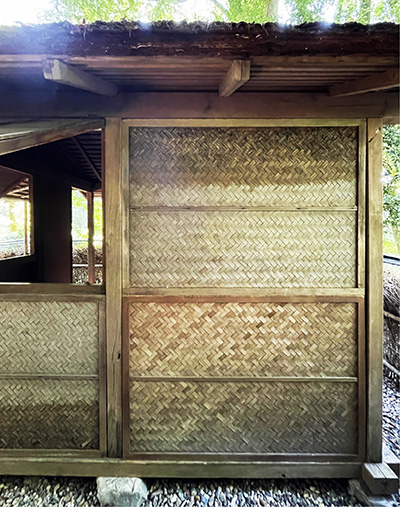
この写真は軸組で組まれた構造の「壁面」部分だけれど、ここでも竹を編んだ「網代」が選択されている。はるかな後世の高断熱高気密住宅革命を生き延びてきた人間からすると、トンデモの「通風」重視・軽量建築だけれど、生き方に於いて「世の無常とはかなさ」対応型であった、ということか。
寒冷対応と、世の無常対応。まさに違う世を生きていた感。
●お知らせ
拙書「作家と住空間」幻冬舎から電子書籍で発刊
お求めはAmazonで。
https://amzn.asia/d/eUiv9yO
English version⬇
【Heian-Period Camper Van Living? Mobile Dwellings / Kamo no Chōmei’s “Hōjō-an” – Part 2】
The modern pursuit of highly insulated dwellings suited to cold climates versus the Heian-period aspiration for a lifestyle embracing the world’s impermanence and transience. …
The figure of Kamo no Chōmei. While his work, The Record of a Ten-Foot Square Hut, has completely captivated my heart throughout my life, I carelessly never gave much thought to the man himself or his life. Though I have a strong interest in history, and while I do consider the historical context of literary works from that era, I rarely pondered the lives of the authors themselves.
Now, as I begin exploring the relationship between writers and their living spaces as my own “final field of interest,” it strikes me as obvious—and immediately apparent—that the work and the author are one and the same. Indeed, the fundamental premise is understanding the environmental factors that compelled the writer to produce their work. AI advancements greatly simplify mapping such aspects of writers.
On the other hand, living environments are fixed in specific locations, requiring people to visit them. The “atmosphere” of a space is crucial. Of course, photographers must hone their sensitivity to convey this effectively, but the criteria for evaluating this remain undefined. Moreover, I feel spaces are inherently unsuited to such objective quantification. An objection to the AI era from the “field,” perhaps?
Kamo no Chōmei was born into a family of priests at Shimogamo Shrine and accumulated experience serving the imperial court. His life coincided with the Genpei Wars, and he encountered the Heike clan’s relocation of the capital to Fukuhara, moving there as part of the court apparatus. However, with the subsequent rise of the Minamoto clan, he returned to Kyoto.
At the age of 50, he resigned from this “court service,” withdrew from public office, and retired to seclusion in Ohara. Through repeated relocations from there, he found his “final dwelling” in the form of this Hōjō-an hermitage. Having experienced the “impermanence and transience of the world” firsthand, his dwelling itself seemed to become a projection of that way of life.
In our society today, living in a “camper van” also stirs a certain envy, but perhaps the roots of this can be found in the Hōjō-an. It is said that, through repeated moves, all its components were “modular,” allowing it to be loaded onto two carts for transport. The carts of that era were carts pulled by oxen or horses. It was a “dwelling” designed to be manageable with just that.
This photo shows the “wall surface” section of a timber-framed structure, yet even here, woven bamboo “ajiro” panels were chosen. To us living in the distant future after the high-insulation, high-airtightness housing revolution, this seems like an absurdly ‘ventilation’-focused, lightweight construction. But perhaps it was a way of life designed to cope with the “impermanence and transience of the world.”
Adapting to cold weather and adapting to the world’s impermanence. It truly feels like they lived in a different era.
●Notice
My book “Writers and Living Spaces” published as an e-book by Gentosha
Available on Amazon.
共有:

Posted on 9月 10th, 2025 by 三木 奎吾
Filed under: 未分類





コメントを投稿
「※誹謗中傷や、悪意のある書き込み、営利目的などのコメントを防ぐために、投稿された全てのコメントは一時的に保留されますのでご了承ください。」
You must be logged in to post a comment.