
竹原塩田は1650年頃の開発創始だけれど、その起源では広島浅野藩の「新田開発」公共事業がきっかけになっている。1640年頃から1670年代頃まで、米作のための新田開発が竹原で活発に造営されたという記録。このなかで一部が「塩田」に切り替えられた経緯。
入り浜塩田には莫大な土木工事費が必要で、また成功したとしてもその後の「販売」の市場問題も不安定要因になるきわめてリスキーな事業だった。それに対して竹原では、賀茂郡代官・鈴木四郎右衛門からの官営工事として行われたのだという。かれは入り浜塩田の先進地域・赤穂から太郎右衛門・七兵衛という2人の技術者を招いて工事させたところ、これがうまくいって良質の塩を得ることができたので、一気に1650年に「慶安の古浜」を開発した。この塩浜も予想外の高収益を挙げたために、当地や、領海各地の港町や首府・広島の広範な「商人層」が争うように塩浜経営を希望するようになったとされる。
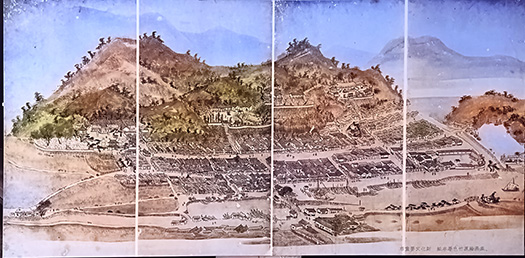
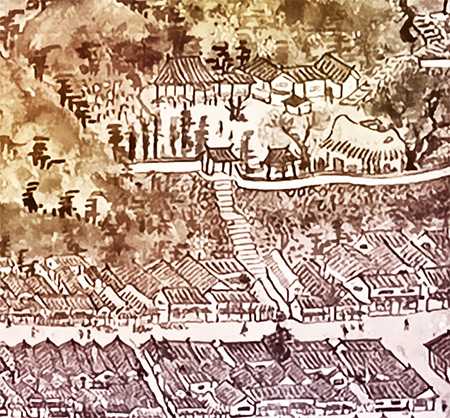
上の「竹原市重要文化財 紙本著色竹原絵屏風」は、こうした活況を呈した様子を表現したもの。当時の商家層が、より大きな利益の拡大を狙っての宣伝目的で絵師を招いて描かせたものだろう。日本の絵画の伝統を踏まえて、斜め上空からの目線で詳細に竹原の「繁盛ぶり」を描いている。
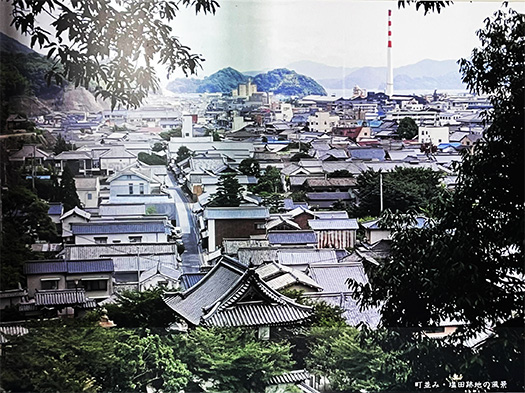
これが現代の街並み写真とされていたけれど、江戸期を通して栄え続けた「竹原の塩業」がこの地域を支えてきた実相がつたわってくる。
わたしは絵が大好きな人間なので、こういった表現にはついつい「魅入られ」てしまう。
人類の、とくに日本民族の「視点」の基底にはこういう客観的で、公明な見方があるのだろう。中空からの目線にはそういう「ものの見方」を伝えてくる強さを感じさせられる。この目線は現実には存在しない対面側の山上からフラットに全体を把握する意思を持った視線。この方角にそのような山とか岬とかは存在しない。
ただ絵師としては竹原の街並みを詳細に歩きまわってメモは取り続けた上で、平面的にも間違いがないようにチェックした上で、こういう目線角度で表現していったのだろう。はるかな後世のわれわれも、ひと目でこの頃の竹原の町の様子が活写されて伝わってくるのだ。
探訪者としても、深く納得できる表現かと。・・・
●お知らせ
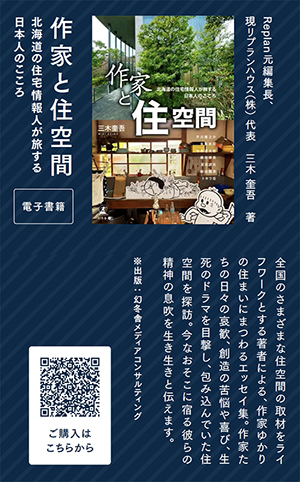
拙書「作家と住空間」幻冬舎から電子書籍で発刊
お求めはAmazonで。
https://amzn.asia/d/eUiv9yO
English version⬇
[Captivated by the Important Cultural Property “Takahara Picture Screens”…]
This flat, bird’s-eye view that captures the entire scene from a slightly diagonal angle above. It must be one of the traditional “conventions” of Japanese painting. I suddenly realized the artistry behind it. …
Although the development of the Takehara Salt Fields began around 1650, their origins can be traced back to a public works project for “new field development” undertaken by the Asano Domain of Hiroshima. Records indicate that from around 1640 to the 1670s, new fields for rice cultivation were actively developed in Takehara. It was during this period that some of these fields were converted into “salt fields.”
Inner-bay salt fields required enormous civil engineering costs, and even if successful, the subsequent market for “sales” remained an unstable factor, making it an extremely risky venture. In contrast, the project in Takehara was reportedly carried out as a government-sponsored construction project under the direction of Suzuki Shiroemon, the magistrate of Kamo District. He invited two engineers, Tarōemon and Shichibē, from Akō—a leading region for inlet salt fields—to oversee the work. When this proved successful and yielded high-quality salt, he proceeded to develop “Keian no Furuhama” in 1650. Because this salt field also generated unexpectedly high profits, it is said that a wide range of “merchants” from the local area, port towns throughout the domain, and the capital of Hiroshima began vying to manage salt fields.
The “Takehara City Important Cultural Property: Colored Ink on Paper Takehara Picture Screen” shown above depicts this bustling scene. It was likely commissioned by merchants of the time to promote their businesses and maximize profits. Drawing on the traditions of Japanese painting, it depicts the “prosperity” of Takehara in detail from a diagonal bird’s-eye view.
Although this was considered a modern street scene photograph, it conveys the reality that the “Takahara Salt Industry,” which flourished throughout the Edo period, has sustained this region.
I am someone who loves art, so I can’t help but be “captivated” by expressions like this.
I suppose this kind of objective and impartial perspective lies at the foundation of the “worldview” of humanity, and particularly of the Japanese people. I sense a power in this aerial perspective that conveys such a “way of seeing things.” This viewpoint represents an intentional effort to grasp the entire scene from a flat, bird’s-eye view—a perspective that does not actually exist on the opposite side of the mountains. There are no mountains or capes in this direction.
As an artist, however, he likely walked the streets of Takehara in detail, taking notes all the while, and after double-checking to ensure the composition was accurate, he chose to depict it from this specific angle. Even for us, living in a distant future, the scene of Takehara at that time is vividly brought to life and conveyed at a single glance.
As a visitor to the town, I find this depiction deeply convincing. …
● Announcement
My book, “Writers and Living Spaces,” has been published as an e-book by Gentosha.
Available on Amazon.
共有:

Posted on 3月 23rd, 2026 by 三木 奎吾
Filed under: 未分類




コメントを投稿
「※誹謗中傷や、悪意のある書き込み、営利目的などのコメントを防ぐために、投稿された全てのコメントは一時的に保留されますのでご了承ください。」
You must be logged in to post a comment.