
先日、機会があって札幌市の中心部にある「大通公園」を通りがかっていた。
わたしは3歳から17歳くらいまで現在の札幌市中央区北3条西11丁目に家があったので、大通公園は独特の血肉感が感じられる公共空間です。その距離スパン感覚や通路と緑地のバランスなど、ほとんど気がつかないような部分で「原初的」な空間認識となっている。
そんな空間だけれど、仔細にしげしげと全部を記憶しているわけではない。
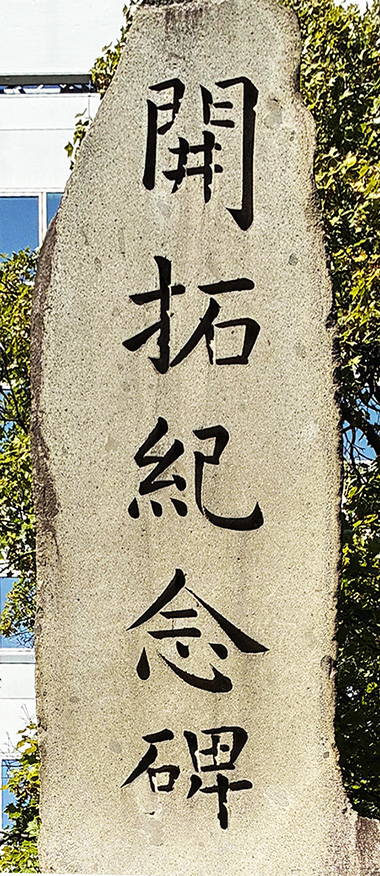
で、ふと見上げた「開拓紀念碑」につい目が引き込まれていた。子どもの頃にはたしかこういう石碑はあったよな、という記憶程度。再見した今回も、あ、そうだ、ちょっと見ておくか、という軽い認識。
そこで気付かされたのが、「記」ではなく「紀」と書かれていることの軽い気付き。こういうのは子ども時代にはあんまり気付くことはないでしょう。しかしよく見ていると、これらの文字の書き下し方というか、個別の文字の「配置バランス」にちょっとした違和感は感じてしまった。
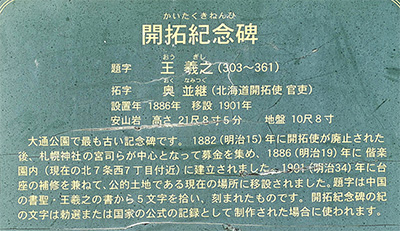
そこで、台座のヨコに置かれていた説明を読んでいた。「え、なに?王羲之?」
子ども時代に「王羲之」という名前は気付くわけもない。
多少は歴史に興味を持つようになって、漢字という文字文化、書聖としてその人名を知った。石碑に彼の生きた時代(303〜361年)の記載があるように、北海道開拓時期とは、1500年以上の時間差がある。
え、どういうこと?と、時間認識の迷宮に突き落とされてしまったが、説明文でようやくその経緯を知った次第。「題字は、王羲之の書から5文字を<拾い>刻まれたもの」。
なんだ、そういうことかよ、であります。
そのような「事情」を知った上で再度碑文の文字バランスを再見すると、謎解きの部分は解消されて、その「拾った」行為と全体の整合性という部分に「不整合」を感じさせられてしまう。
北海道開拓という明治国家としての大プロジェクト、そしてわたしの血脈もそのワンピースではある国家事業へのある種の「祈念碑」的なものを、という気持ちは十分にわかる。しかし・・・。王羲之の書という思いもわかるのだけれど、いかにものバランスの失いぶりに無念感が感じられる。
この石碑が、今日に至るもあまり札幌市民、北海道民に伝承されていないことが深く理解されてくるに至っていた。現実にはハッキリと向き合う必要がある。
●お知らせ
拙書「作家と住空間」幻冬舎から電子書籍で発刊
お求めはAmazonで。
https://amzn.asia/d/eUiv9yO
English version⬇
[Huh? Wang Xizhi wrote the inscription on Hokkaido’s “Pioneer Memorial”?…]
An inscription by the “Sage of Calligraphy,” transcending some 1,500 years of time. No way! As a Hokkaido resident, I felt a bit deflated after learning the truth. What should we do with it for future generations?…
The other day, I happened to pass by “Odori Park” in downtown Sapporo.
Since I lived at what is now Kita 3-jo Nishi 11-chome in Chuo Ward, Sapporo, from the age of three until I was about 17, Odori Park is a public space that feels uniquely familiar to me. Its sense of spatial scale and the balance between walkways and green spaces—details I hardly even notice—have become part of my “primordial” perception of space.
Even though it’s a space like that, I don’t remember every single detail in minute detail.
So, when I happened to look up, my eyes were drawn to the “Pioneer Monument.” My memory of it was merely a vague recollection from childhood—something like, “I’m pretty sure a stone monument like this was here back then.” Even upon seeing it again this time, my reaction was a casual, “Oh, right—I guess I’ll take a quick look.”
That’s when I noticed something: the character was written as “紀” rather than “記.” You probably wouldn’t notice something like this as a child. But looking closely, I felt a slight sense of unease about the way these characters were written—or rather, the “compositional balance” of the individual characters.
So I read the explanation placed next to the pedestal. “Huh? What? Wang Xizhi?”
As a child, I certainly wouldn’t have recognized the name “Wang Xizhi.”
It wasn’t until I developed a passing interest in history that I learned about the culture of Chinese characters and came to know his name as the “Sage of Calligraphy.” As indicated by the inscriptions on the stone monument detailing the period in which he lived (303–361), there is a time gap of more than 1,500 years between his era and the period of Hokkaido’s settlement.
“Huh? What does that mean?” I found myself plunged into a labyrinth of temporal confusion, but the explanatory text finally clarified the circumstances: “The inscription was carved by ‘selecting’ five characters from Wang Xizhi’s calligraphy.”
Oh, so that’s what it was all about.
Once I learned these “circumstances” and took another look at the balance of the characters in the inscription, the mystery was solved—but I couldn’t help but feel a sense of “inconsistency” between the act of “selecting” those characters and the overall harmony of the piece.
I fully understand the sentiment behind creating a sort of “commemorative monument” for the Meiji government’s massive project of Hokkaido’s settlement—a national endeavor of which my own lineage is also a part. However… I also understand the desire to incorporate Wang Xizhi’s calligraphy, but the sheer lack of balance leaves me with a sense of regret.
I’ve come to deeply understand why this monument has not been widely passed down to the citizens of Sapporo or the people of Hokkaido to this day. We must face reality head-on.
● Announcement
My book, *Writers and Living Spaces*, has been published as an e-book by Gentosha.
Available on Amazon.
共有:

Posted on 9月 19th, 2026 by 三木 奎吾
Filed under: 未分類




コメントを投稿
「※誹謗中傷や、悪意のある書き込み、営利目的などのコメントを防ぐために、投稿された全てのコメントは一時的に保留されますのでご了承ください。」
You must be logged in to post a comment.