
昨日北海道を飛び立って、猛暑のつづく関西・関空へ。
で、夕刻までに今回の用件地・岡山県井原市に到着いたしました。
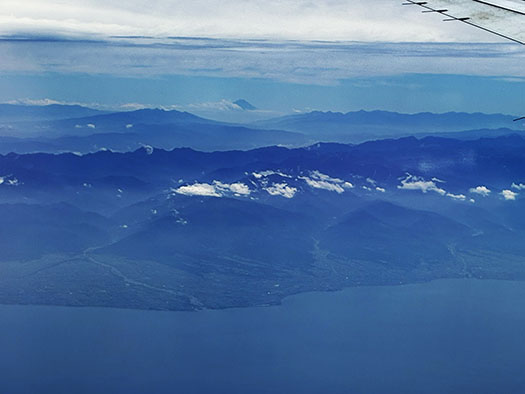
写真は千歳から飛び立った飛行機から、たぶん石川県地域の日本海海上から遠景に富士山が、うっすらと山景を見せてくれていたアングルであります。わたしは北海道で生まれ育ち、東京で学び、就職して以降、独立してからは北海道を起点にして東北・関東・関西と全国をめぐる出張行脚を繰り返してきた。仕事人生当時は、通路側席が空旅でのポジションでしたが、ある時期を境に「窓側」一択になって来た。
心境の変化、であります。
あるフライトで、機上から雲のおりなす景観にふと気付いてから、どうもそうなった。
世界で支配的な宗教は、ほとんどすべて「空中からの視覚」という人類体験からは遠い出自だと思う。そうだけれど、宗教の概念では「天」とか、「地上世界」というような概念がふつうに扱われている。天上天下唯我独尊とはお釈迦様が生まれたときに発したと伝えられる、すべての人の命の尊さを説いた言葉。しかし、語感として少なくとも「成層圏」的な認識世界だったと一般人には思われてきたのではないだろうか?
・・・現代世界はこういった視覚をごく一般化させてくれた。
わたしのように高齢期になってくると、こういう視認はオモシロい。まぁ「この世とあの世のあわい交叉」をどうしても感じさせられるのだ。
そう「あわい」という感覚が、実体験できる視認環境なのだと個人的に思っている。
そういう雲海が地上では豪雨をもたらしたりする。諸行無常という概念とも通底するのではないだろうか。
少なくとも北海道人の多くは、こういう視覚体験を経て東京や大阪、人口密集地域に移動する。個人的は、こういう体験積層はどういった作用をもたらすか、興味を持っている。
さて、本日からは本州の「故地」探索など調査活動に邁進したいと思います。
●お知らせ
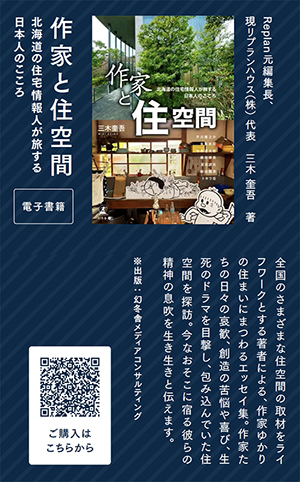
拙書「作家と住空間」幻冬舎から電子書籍で発刊
お求めはAmazonで。
https://amzn.asia/d/eUiv9yO
English version⬇
[For the elderly, the “view of the sea of clouds” lingers in their minds…]
Modern people have accumulated experiences of a “bird’s-eye view” that sets them apart from past generations. It’s interesting to see what kind of changes this brings about in their mental imagery. …
Yesterday, I flew out of Hokkaido and arrived at Kansai International Airport, where the intense heat continues.
I then arrived in Ibara City, Okayama Prefecture—the destination for this trip—by evening.
The photo was taken from the plane as we took off from Chitose; it shows a distant view of Mount Fuji faintly visible over the Sea of Japan, likely somewhere in the Ishikawa Prefecture area. I was born and raised in Hokkaido, studied in Tokyo, and after starting my career—and especially since becoming self-employed—I’ve made Hokkaido my base, traveling all over the country on business trips to Tohoku, Kanto, and Kansai. During my corporate days, I always chose an aisle seat when flying, but at a certain point, I started choosing only window seats.
It’s a change of heart.
It seems to have started after I happened to notice the scenery formed by the clouds from the plane on a certain flight.
I believe that almost all of the world’s dominant religions have origins far removed from the human experience of “viewing the world from the air.” Yet, religious concepts such as “heaven” and “the earthly world” are commonly discussed. “In heaven and on earth, I alone am supreme” is a phrase said to have been uttered by Shakyamuni Buddha at his birth, preaching the sanctity of all human life. However, wouldn’t the general public have tended to perceive this phrase, at least in terms of its connotation, as referring to a “stratospheric” realm of consciousness?
…The modern world has made this kind of visual experience quite commonplace.
As one reaches old age, as I have, this kind of sight is fascinating. Well, it inevitably makes one feel the “intersection between this world and the next.”
Yes, I personally believe that this visual environment allows one to actually experience that sense of “the in-between.”
Such seas of clouds sometimes bring torrential rain to the ground. I wonder if this isn’t fundamentally connected to the concept of impermanence.
At the very least, many people from Hokkaido move to Tokyo, Osaka, or other densely populated areas after having had this kind of visual experience. Personally, I’m interested in what kind of impact this accumulation of experiences has.
Now, starting today, I’d like to devote myself to research activities, such as exploring my “hometown” on Honshu.
● Announcement
My book, *Writers and Living Spaces*, has been published as an e-book by Gentosha.
Available on Amazon.
共有:

Posted on 8月 27th, 2026 by 三木 奎吾
Filed under: 未分類




コメントを投稿
「※誹謗中傷や、悪意のある書き込み、営利目的などのコメントを防ぐために、投稿された全てのコメントは一時的に保留されますのでご了承ください。」
You must be logged in to post a comment.