
わたしたち年代(現在74歳)にとっての「祖母」年代というのは、その生きた時代相というのがよく実感できない。祖父については父を通しての「相伝」的なことがらを意識するけれど、祖母にはほとんど記憶がないのです。祖母は明治11年生まれで、昭和29年没。76歳まで生きたという当時としては長寿。しかもわたしは昭和27年生まれで、満2歳と1ヶ月の間は非常に世話になっていたハズ。
そういう祖母の遺品と思われるものが先般の法事の時に発見できた次第。
祖母は祖父が黄泉に旅立った翌年昭和10年の春に四国遍路の旅に出掛けているとのこと。没年から逆算すると還暦前の57歳時のことになる。そこからも19年元気だったので、健康体質だったのだろう。
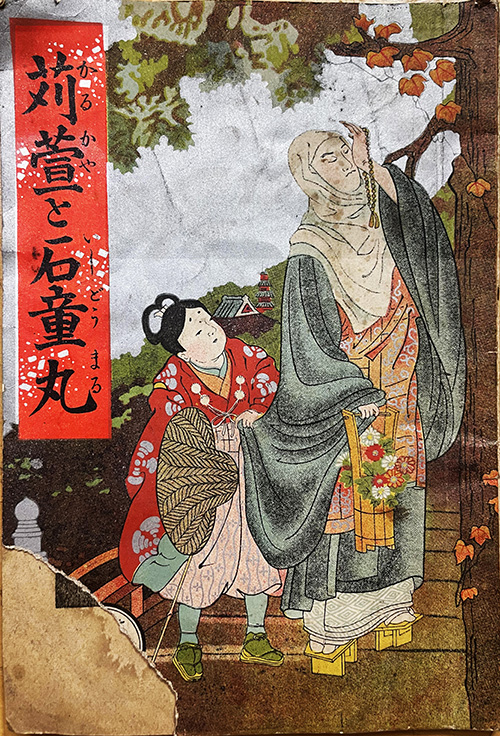
その歩き遍路の旅路で灯明のなかで読んでいたとおぼしき出版物がこれのようだ。
奥付をみると、大正4年初版で昭和8年に第38刷となっていて、高野山にある「刈萱堂」という出版社の発行。年代としては旅路と発行年代が符合している。この「刈萱と石童丸」という説話は、以下の内容。
〜刈萱(かるかや)と石童丸(いしどうまる)は、出家した父・苅萱道心と、父を慕って高野山へ訪れた息子・石童丸の悲劇的な再会を描いた中世の伝説・説話。仏教の「愛別離苦(愛する者と別れる苦しみ)」を主題とし、説教節、浄瑠璃、歌舞伎などで長く愛されてきた物語。<以上Wiki>〜
この年代の出版物なので、表紙だけがカラーで,本文はモノクロ印刷。
出版物として、あるいは絵柄の表現などから、日本的な「物語文学」の祖型を感じさせてくれる。祖母は英語の知識もあったという当時としては高等教育を受けていたひとのようだけれど、心象的な部分では古風な志向性を持った考えだったのだろうか。上述のようなストーリー性に重なる感性を持っていたと思われる。「愛別離苦」というテーマ部分に、愛する夫を失った悲しみが沁みてきたのだろうか?
そういえば、祖父と結ばれた経緯などを勘案するとどうも「恋愛結婚」だったようにも思える。
残された手掛かりの少ない血縁として思いが交差する。英語という外の世界の窓を持ちつつも刈萱という日本的情念を抱いての遍路旅。・・・じっとこの出版物と向き合っている。合掌。
●お知らせ
拙書「作家と住空間」幻冬舎から電子書籍で発刊
お求めはAmazonで。
https://amzn.asia/d/eUiv9yO
English version⬇
[A companion on the Shikoku 88 Temple Pilgrimage—perhaps my grandmother’s favorite book?]
For the first time, I came across a book that still bore the traces of my grandmother’s touch, even though we parted ways when I was just two years old. “Grandma, you really loved this book, didn’t you?”…
For people of my generation (I am currently 74), it is difficult to truly grasp what life was like for our “grandmothers’ generation.” While I am aware of certain things passed down about my grandfather through my father, I have almost no memories of my grandmother. She was born in 1878 and passed away in 1954. She lived to be 76, which was considered a long life at the time. Moreover, I was born in 1952, so she must have taken great care of me during the period when I was exactly two years and one month old.
It was during a recent memorial service that I discovered what appears to be one of my grandmother’s personal effects.
Apparently, my grandmother set out on a pilgrimage along the Shikoku Pilgrimage route in the spring of 1935 (Showa 10), the year after my grandfather passed away. Calculating backward from the year of her death, this would have been when she was 57, just before her 60th birthday. Given that she remained active for another 19 years after that, she must have been in good health.
This seems to be the publication she likely read by lamplight during that walking pilgrimage.
Looking at the colophon, it was first published in 1915 (Taisho 4) and had reached its 38th printing by 1933 (Showa 8). It was published by a company called “Karukaya-do” located on Mount Koya. The dates of her journey and the publication dates align. The story titled “Karukaya and Ishidomaru” is as follows.
~ “Karukaya and Ishidomaru” is a medieval legend and folktale depicting the tragic reunion between Karukaya Dōshin, a monk, and his son Ishidomaru, who visited Mount Kōya out of longing for his father. Centered on the Buddhist concept of “the suffering of separation from loved ones,” it is a story that has long been cherished in sermons, Joruri, and Kabuki.
Since this is a publication from that era, only the cover is in color, while the text is printed in black and white.
As a publication, and judging by the style of the illustrations, it evokes the archetype of Japanese “narrative literature.” My grandmother apparently had some knowledge of English, suggesting she had received a higher education for her time, but perhaps her inner world retained a more traditional sensibility. It seems she shared the sensibilities that resonate with the story described above. Did the theme of “the suffering of parting from loved ones” evoke the sorrow of losing her beloved husband?
Come to think of it, considering the circumstances of how she and my grandfather came together, it seems they may have had a “love marriage.”
As a blood relative with few remaining clues, my thoughts are filled with conflicting emotions. A pilgrimage journey undertaken with a window to the outside world through English, yet embracing the Japanese sentiment of “Kari-kaya.” … I sit here, intently studying this publication. I bow my hands in prayer.
● Announcement
My book, “Writers and Living Spaces,” has been published as an e-book by Gentosha.
Available on Amazon.
共有:

Posted on 5月 9th, 2026 by 三木 奎吾
Filed under: 未分類




コメントを投稿
「※誹謗中傷や、悪意のある書き込み、営利目的などのコメントを防ぐために、投稿された全てのコメントは一時的に保留されますのでご了承ください。」
You must be logged in to post a comment.