


家系のたどってきたたぶん400年くらいの「旅路」という視点から、その流れの中でも江戸後期の「主舞台」であった尾道を見返すような行脚。
これまでも数度は訪れていて「猫石」の作家さんなどと対話してきた土地ですが、ようやく気がついて家系の旅路をたどる目線が明確化してくると、これまで気付かなかったことが次々と視界に広がってくるものですね。
写真は尾道「水道」を千光寺山ロープウェイ山頂から見下ろした様子。その下には、江戸中期、安永3(1774)年に制作された重要文化財「紙本著色尾道絵屏風」美術陶板の一部で、江戸期の尾道港の波止場・荷さばき場所のクローズアップ。手前側の尾道水道に停泊している多数の輸送船から、波止場に面して建てられた倉庫建築に荷が整理整頓されている様子が活写されている。
こうした荷さばきには、多数の「人足」が使役されていて、商人層による「自治」が認められていたこの尾道では、それらの自治組織のリーダーの商家たちが人足たちをいわば公共的労働力として確保するためにの税を負担していたワケだ。そうした自治のありようが、このような図解表現で、わかりやすく理解されてくる。
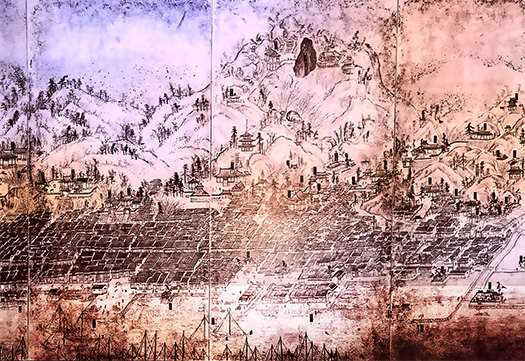
江戸期の物流の基幹であった「瀬戸内海交易」というものが可視化されているようだ。
時期的にも1774年と言えば、わたしの家系の六世の祖やその次の代の当主が活躍していた時期にも相当する。家系がもっとも充実していた時期に当たるので、探索したそういう事実をふまえて見ると、リアリティがまざまざと復元してくる。
こういう場所で松永の塩田で生産された「福山藩領産出の塩」が、全国に、とくに北海道まで「北前船」で運ばれ、サケの塩蔵に利用されたに違いないという想像が自然に湧いてくる。商人たちのビジネス上の情報交換で
「ことしのサケの群来の具合はどうなのかね?」
「おうさ、今年はまたスゴい群来っぷりで塩はなんぼあっても足らないくらいだよ」
「ぬふふ、シメシメ(笑)」みたいな。
さらに、もうちょっと時代が下がってくると、一昨日見学して来たような「松永下駄」の原材料として、北海道の山々から材木が切り出されて船に山積みされてきたりもしたに相違ない。
・・・家系のリアルなビジネスの様子への想像力が自然に沸き立ってくる。
●お知らせ
拙書「作家と住空間」幻冬舎から電子書籍で発刊
お求めはAmazonで。
https://amzn.asia/d/eUiv9yO
English version⬇
From Onomichi, the “Commercial Capital” of the Seto Inland Sea in the Edo Period, to Hokkaido
From logistics in the Seto Inland Sea to a major hub for the Kitamaebune trade. The vitality of a “market economy” society growing within a samurai-ruled society. Imagination runs wild.
A pilgrimage revisiting Onomichi, the “main stage” of my family lineage’s journey spanning roughly 400 years, viewed through that very lens.
Though I’d visited this land several times before, conversing with artists like the creator of “Cat Stone,” it wasn’t until I finally recognized and clarified the perspective of tracing my family’s journey that previously unnoticed things began unfolding before my eyes.
The photograph shows the Onomichi Waterway viewed from the summit of the Senkoji Mountain Ropeway. Below it is a close-up of the wharf and cargo handling area of Onomichi Port during the Edo period, depicted in a section of the Important Cultural Property “Onomichi Picture Screen with Colored Paint on Paper” (created in 1774, the 3rd year of the An’ei era). It vividly depicts the scene of cargo being sorted and organized in warehouse buildings facing the wharf, alongside numerous transport ships moored in the Onomichi Waterway in the foreground.
Numerous “laborers” were employed for this cargo handling. In Onomichi, where merchant-class “self-governance” was recognized, the merchant families leading these autonomous organizations bore the tax burden to secure these laborers as a form of public workforce. Such aspects of self-governance become clearly understandable through this pictorial representation.
It seems to visualize the “Seto Inland Sea Trade,” which formed the backbone of Edo-period logistics.
The year 1774 also corresponds to the period when my family’s sixth-generation ancestor and the head of the next generation were active. As this was the era when our family lineage was at its peak, viewing these facts brings the reality vividly back to life.
In places like this, it’s easy to imagine how salt produced at Matsunaga’s salt fields – “salt from the Fukuyama domain” – was transported nationwide, especially as far as Hokkaido, by Kitamaebune ships, and undoubtedly used for salting salmon. In the merchants’ business exchanges:
“How’s the salmon run looking this year?”
“Oh, man, it’s a massive run this year. We can’t get enough salt, no matter how much we have.”
“Heh heh, just what I was hoping for (laugh).”
Furthermore, as time progressed a bit more, timber cut from the mountains of Hokkaido was undoubtedly hauled by ship, piled high, to serve as raw material for “Matsunaga geta” sandals—just like the ones I saw on my tour the day before yesterday.
…My imagination naturally runs wild with scenes of my family’s actual business activities.
●Notice
My book “Writers and Living Spaces” published as an e-book by Gentosha
Available on Amazon.
Translated with DeepL.com (free version)
共有:

Posted on 12月 22nd, 2025 by 三木 奎吾
Filed under: 未分類




コメントを投稿
「※誹謗中傷や、悪意のある書き込み、営利目的などのコメントを防ぐために、投稿された全てのコメントは一時的に保留されますのでご了承ください。」
You must be logged in to post a comment.