本文へジャンプ

【道東海産珍味「タコまんま」初体験】


 先日の握り寿司パーティの前に、北海道積丹半島・余市の名物鮮魚店・新岡鮮魚店に買い出しに行ったのですが、そこで驚かされたのが、この「タコまんま」。Wikiで調べたら以下のよう。
 〜タコまんまとは北方系のタコ・ヤナギダコの卵巣を呼ぶときの北海道太平洋沿岸地域における呼称。マダコの卵である海藤花に相当するが小卵型のタコで幼生が長期間プランクトン生活を送るマダコと違い、ヤナギダコはイイダコと同様の底生生活の幼体が直達発生する大卵型のタコであるために、ずっと大粒の卵である。ヤナギダコの卵は長径5mm、短径3mm程度と、マダコの卵の2倍以上の大きさの回転楕円体型で、色は白色がかっている。生のままだと透き通っているが、茹でると炊いた米状(まんま、まま)になるためこう呼ばれる。 〜
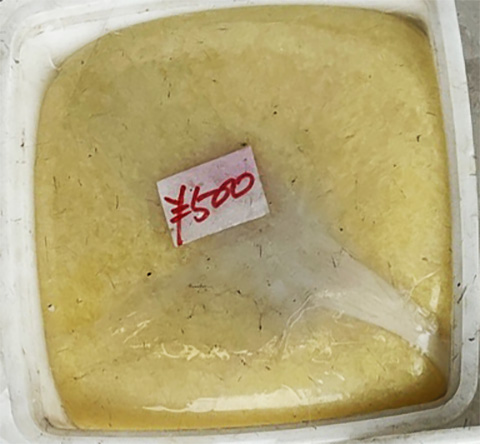
 ということだったのですが、これはあとでわかった知識。店頭では、下の写真のような状態で販売されていまして、皮に包まれて見るからにぽよよーんとした風体。で、これを茹でて表皮を突いてやると内側からムクムクと卵が出現するのだ、という説明をされた。話を聞いていてもまったくわからない。よしわかった、と購入したのですが、写真のヤツはちょっと大型過ぎるので、もう少し小さめの300円で売られていたモノを購入。
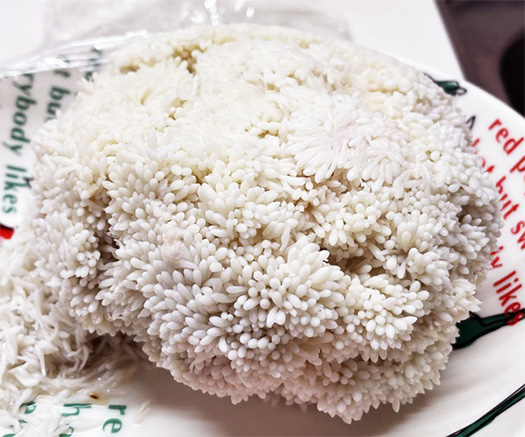
 で、実際に茹でて突いてみたのが上の写真。薄めの塩水で茹でてみた。突いた瞬間に「おお」と驚かされるムクムク開きっぷり。食べる興味よりも、この変身ぶりに視覚的快感を感じてしまった。
 実際に中身が展開したあとの状態はまことに「まんま〜ご飯」そのまま。道東産ということなので、その風体と食味を日本民族が感じ始めてからそう永くはないように思いますが、形状はまことに米粒状。おにぎりの特殊形状とでも言える。
 で、恐る恐る口に運んで食してみると、濃厚な風合いの卵感。ひとりあたり、この写真の1/100程度の少量をぽん酢などで「付け合わせ」として食べるのが常道と思われました。300円でしたがわが家では1日1食の頻度で食すとしても、たぶん1ヶ月以上の量はある。当然、これを少量ごとに切り分けて冷凍保存させることにいたしました。500円のヤツだと、優に2−3ヶ月相当か。メッチャなコスパ食品であります(笑)。
 あんまり一般には流通していないのではないかと思いますが、花開く瞬間の驚きはオススメ。

English version⬇

First experience of the delicacy ‘octopus manma’ from the East Sea of Hokkaido.
Aside from the taste, the moment of transformation during the boiling process is astonishing. It transforms from an ovary into a rice-grain-like aggregate. Moreover, you can enjoy about 100 servings for 300 yen at a super-cosy price. Oh, my… …

 The other day, before a nigirizushi party, I went to buy some fish at Shinoka Fresh Fish Store in Yoichi, Shakotan Peninsula, Hokkaido, and was surprised to see this octopus mamma.
 〜The name ‘octopus manma’ is used to refer to the ovaries of the northern octopus, the willow octopus, in the Pacific coastal region of Hokkaido, Japan. Unlike the Madako, which is a small-egg octopus whose larvae live on plankton for a long period of time, the Willow Octopus is a large-egg octopus whose larvae develop directly from the benthic larvae, similar to the Iidako, and therefore its eggs are much larger in size. The eggs of the willow octopus are 5 mm long and 3 mm short, more than twice the size of those of the Japanese sea cucumber, and are oval in shape and white in colour. They are transparent when raw, but become cooked rice-like when boiled, hence the name. 〜The name is derived from the fact that it is a kind of rice.
 This was knowledge that I found out later. In shops, they are sold in the state shown in the photograph below, wrapped in the skin and looking very poyoyo-like. I was told that if I boiled them and poked the skin, eggs would appear from the inside. I had no idea what he was talking about. I thought I understood and bought one, but the one in the picture was a bit too large, so I bought a smaller one that was sold for 300 yen.
 I actually boiled them and poked them in the photo above. I boiled them in lightly salted water. The moment I poked it, I was surprised to see it open up. I felt more visual pleasure from this transformation than from the interest of eating it.
 After the contents had actually developed, it was just like ‘mamma – rice’. Since it is from the east of Hokkaido, it seems not so long since the Japanese people started to feel its style and taste, but the shape is truly rice-grain-like. It can be called the special shape of an onigiri.
 And when you take it to your mouth and eat it, you will find that it has a rich texture and egginess. It was 300 yen, but even if my family eats one meal a day, there is probably more than a month’s worth. Naturally, we decided to cut it into small portions and store them frozen. 500 yen ones would be equivalent to 2-3 months at most. It’s a very cosy food (laughs).
 I don’t think they are generally available, but I recommend it for the surprise at the moment when they bloom.

【道庁「民間住宅施策推進会議」に参加】


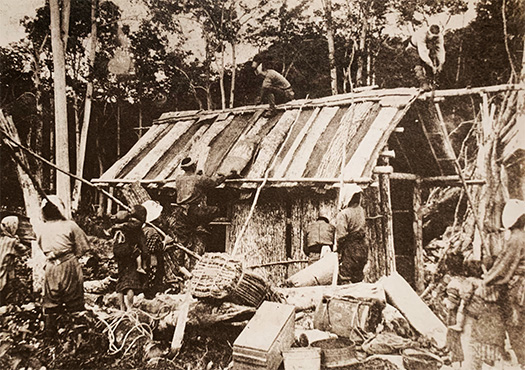
 きのうは表題のような会議に参加しておりました。で、写真は北海道開拓の初源期の移住民による住宅建築の記録写真。
 北海道はほかの日本列島地域とは違ってその積雪寒冷条件から、江戸期までは「米作不適地」として移住は促進されていなかった。明治期に至って、むしろ国防的な主要因から急速に移民促進政策が政府によって開始され、この写真のような入植移住が進行していった。こうした経緯から北海道の開拓政策と移住促進の政策にとって「住宅政策」はもっとも核心的なこととして追究されてきた。最初は「北海道開拓使」という名前の「中央政府官庁」がその政策を主導してきたが、その後は地方政府自治体としての「北海道庁」が主体となって、その政策的DNAを受け継ぎ、地道に住環境の寒冷地対応研究を進めてきた歴史を持っている。
 ほかの地域ではこうした行政側の強い姿勢というのはあまり見られない。基本的には住宅政策というのは国土交通省の政策部局のコントロール下で地方自治体は従属的に担うに過ぎない。であるのに北海道では継続的に地域自治体が住宅業界を「先導」するような施策を打ち出し続けている。
 そしてその住宅施策について開かれた会議を開催し、公開的に論議を重ねてきている。北海道開拓初源期からのこうした「伝統」を守って表題のような会議が開かれてきている次第。こうした道の姿勢が他の自治体にも波及を見せていて鳥取県などが地域住宅施策を打ち出しはじめても来ている。住宅はその建てられる地域の気候風土・民俗に大きく影響を受けるし、また、その地域らしさの根幹にもなる。
 北海道のこうした取り組みは徐々に広がっていく可能性がある。現に住宅性能的な取り組みについては新住協などの活動が全国に波及し、北海道で始められた「革命」が全国に広がっている。
 そういった先導的な北海道の未来的住政策の方向性を形作っていくのがこの会議といえるでしょう。
 わたし自身は国交省の関連した住宅施策会議参加の経験もありますが、リアリティ・迫真性において北海道の会議は隔絶している。会議の方向性はやがて政策として開示されていきますが、会議はまことに実践的な内容で展開している。わたしは自身の経験も踏まえてできるだけ「ユーザー目線」的スタンスでの発言を心がけて参加していますが、全体としてもそういった熱気に満ちていると思います。今後の道の住宅施策にご注目ください。

English version⬇

[Participation in the Hokkaido Government’s ‘Conference on Promoting Private Sector Housing Policies’].
Hokkaido has been at the forefront of overcoming the difficulties of ‘living’ in Japan because it is the most difficult region in the country. This is a policy conference to deeply consider ‘housing’, the cutting-edge of regional character. …

 Yesterday, I was at the meeting as shown in the title. The photograph is a record of house construction by immigrants in the early days of Hokkaido’s pioneering period.
 Unlike other parts of the Japanese archipelago, Hokkaido’s snowy and cold conditions meant that until the Edo period, emigration was not promoted as ‘unsuitable for rice cultivation’. In the Meiji period (1868-1912), the government rapidly initiated a policy to promote emigration, mainly for reasons of national defence, and the settlements shown in this photograph were developed. This is why ‘housing policy’ has been pursued as the most central aspect of Hokkaido’s pioneering and immigration policy. Initially, a central government agency called the Hokkaido Kaitakushi (Hokkaido Development Office) took the lead in this policy, but later the Hokkaido Government took over the policy DNA of the central government and has a history of steadily advancing research into cold-weather living environments.
 In other regions, such a strong stance on the part of the government is not often seen. Basically, housing policy is only a subordinate responsibility of local authorities under the control of the policy department of the Ministry of Land, Infrastructure and Transport (MLIT). In Hokkaido, however, local authorities have been continuously putting forward measures to ‘lead’ the housing industry.
 They have held open meetings and openly discussed these housing policies. The meetings are being held in keeping with this ‘tradition’ from the early days of Hokkaido’s pioneering period. This attitude of the Hokkaido Prefectural Government is spreading to other municipalities, with Tottori Prefecture and other prefectures beginning to introduce local housing policies. Housing is greatly influenced by the climate and folk customs of the region in which it is built, and is also the basis of the character of the region.
 Such initiatives in Hokkaido may gradually spread. In fact, the activities of the Shinjyukyo and others in terms of housing performance initiatives are spreading throughout the country, and the ‘revolution’ started in Hokkaido is spreading throughout the country.
 This conference can be said to be taking the lead in shaping the direction of Hokkaido’s future housing policy.
 I myself have experience of participating in housing policy conferences related to the Ministry of Land, Infrastructure, Transport and Tourism, but the Hokkaido conference is different in terms of reality and realism. The direction of the conference is eventually disclosed as policy, but the conference is developed in a very practical way. Based on my own experience, I try to speak from a ‘user’s perspective’ as much as possible, and I think the conference as a whole is filled with such enthusiasm. Please keep an eye on the future housing policy of the province.

【久しぶりに寿司握り、魚への忘我と三昧】


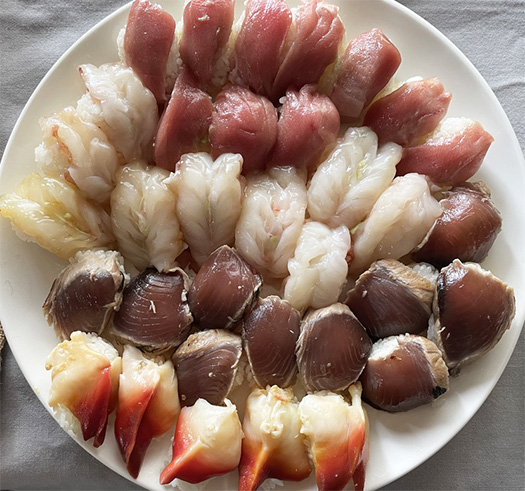
 先週末、やや疲れが溜まっていたので、寿司を握っておりました。家族が集まって食してくれた。
 わたしは料理が趣味でふつうの家庭料理が主なのですが、その延長線上で感じる好みとしてはこの寿司握りに向かいます。人によっては蕎麦打ちに向かう方も多いと思うのですが、これは「好み」なのではないでしょうか。人から勧められて蕎麦打ちのための準備はしてあるのですが、どうも「食わず嫌い」なのか、やる気はまったく出てこないのです。あ、食べるのは大好きなんです、単に食べるだけで、その清涼感にも似た食感、味わいは堪えられません。ただ、自分ではやる気が起きない。とくに「蘊蓄〜うんちく」系のテーマにはついて行けないし。
 一方、寿司の方はとくにネタの捌き、そのプロセスなどのさまざまに対して強く興味を持っている。魚へのこだわりが大きいのでしょうね。海彦・山彦の縄文社会以来の日本列島民族仕分けでは、圧倒的に「海彦」系なのだと自分で思っています。これはたぶん家系の「流れ」みたいな部分かも知れない。江戸期まで基本は商家として瀬戸内海世界で過ごしてきていたらしいのですね。それが北海道移住したときには「土地を耕す」という基本生業になったけれど、やはり一定時間が経過すると、父の代には商家としての生き様が完全に蘇った。
 どうもそういう決断の背景に血筋を感じざるを得ないのですね。だいたい瀬戸内海に面した地域を移動してきたようなので、海への愛着が血に結晶している。いま、さまざまな魚購入の機会で出会う魚たちの豊かな表情に目が釘付けになって堪らないのです。
 最近で言うとことしはニシンの群来が北海道日本海側で見られているということで、鮮魚コーナーが充実している近隣の食品スーパーでは大型のニシン3匹の山盛りが299円とかで売り出されたりしている。まぁ大部分がオスですが、たまに間違えて数の子入りのメスがこういう山盛りに入っていたりするのですね。すごい。
 まぁニシンは刺身にするのではなく焼き魚一択。小骨感もまたいい。その淡白で奥行きのある味わいには人生のいろいろが込められる、忘我する食感に誘ってくれる(笑)。もちろん錯覚ですが、非常にオモシロい。魚それぞれで、楽しい食感を感じさせてもらえる。その「一期一会」感が大好きなのですね。たぶんこの列島社会で人間が生きてきたなかで、こういう食感は連綿と受け継がれてきたことなのでしょう。
 そういう感覚の継承が意識できて、その心理も数寄につながっていると思っています。また今度、どんな魚と出会えるだろうかなぁ・・・。

English version⬇

Sushi nigiri after a long time, forgetfulness and samadhi for fish.
I meet fish without thinking, with my mind empty. The ‘response’ builds up with each encounter. The dialogue transmitted from the knife is the most interesting thing of all. …

 Last weekend, somewhat tired, I was making sushi. My family got together and ate it.
 I enjoy cooking, mostly ordinary home cooking, but my preference, which I feel is an extension of that, is towards this sushi nigiri. I think some people go for buckwheat noodle making, but I think this is a ‘preference’. I’ve been recommended to try buckwheat noodle making by others and I’m prepared for it, but I don’t know if it’s because I don’t like to eat, I don’t have the motivation to do it at all. Oh, I love eating it, I simply love eating it, and its cool, almost refreshing texture and taste is unbearable. But I just can’t bring myself to do it. In particular, I can’t keep up with ‘蘊蓄〜うんちく’ type themes.
 On the other hand, I have a strong interest in sushi, especially in the processing of the ingredients and the various processes involved. I guess they are very particular about fish. I think I am overwhelmingly of the ‘Umi-hiko’ type in the Japanese archipelago since the Jomon society of the Umi-hiko and Yamahiko. This may perhaps be a kind of ‘flow’ in the family lineage. It seems that until the Edo period, they basically spent their time in the Seto Inland Sea world as merchants. When they moved to Hokkaido, their basic occupation became ‘cultivating the land’, but after a certain amount of time, the way of life as a merchant family was completely revived in my father’s generation.
 I can’t help but feel the bloodline behind such decisions. It seems that we have generally moved around the area facing the Seto Inland Sea, so our attachment to the sea is crystallised in our blood. Nowadays, I can’t help but be drawn to the rich expressions of the fish I encounter on various fish-buying occasions.
 Recently, it has been reported that a shoal of herring has been seen on the Sea of Japan side of Hokkaido this year, and at a nearby food supermarket with a well-stocked fresh fish section, three large piles of herring are on sale for 299 yen or something like that. Well, most of them are males, but sometimes, by mistake, there are females with a few herring in these piles. It’s amazing.
 Well, herring are not made as sashimi, but only grilled. Its small-boned feel is also good. Its light and deep taste contains a lot of things in life, and it invites you to a texture that makes you forget (laughs). It is an illusion, of course, but very interesting. Each fish gives you a delightful texture. You love that ‘once in a lifetime’ feeling. Perhaps this sense of texture has been passed down from generation to generation throughout human life in this archipelagic society.
 I am aware of the inheritance of such sensations, and I believe that this psychology is also linked to sukiyori. I wonder what kind of fish I will encounter again next time…


【幼少年のときからの作家の「発想の仕方」痕跡】


 石ノ森章太郎生家探訪シリーズは本日で10回目になった。「作家」という名詞はわたしのような昭和中期生まれの人間には、どうしても芥川賞的な「文学」者がその対象という刷り込みが大きい。少なくとも文学が最上位という固定観念。AIによると作家という名詞は「文章や書画などの作品を創作する専門家」という概念規定。やはり「文章」が最初にある。
 こういう社会全体の考え方が、文化を学び始める子ども時代の心理の基底に折り重なって文筆者がその筆頭概念になっているのでしょう。わたし自身も「作家と住空間」という電子本を書き始めて最初に取り上げたのは芥川龍之介。そういう刷り込みの大きさが自明なのでしょう。コトバの最優位性。
 しかし一方で現代人として、テレビや映画などの映像表現世界のビッグバンを経験してきて、ビジュアル情報の方がはるかに「先験的」だとも思ってきている。戦後以降の「マンガ文化」とそこから発展しているアニメ文化領域の方が、人間の文化受容の基底領域として巨大になって来ている。自分自身に照らしてみたときマンガ文化は、芥川龍之介作品よりもはるかに「感性に身近い」存在だと思えるのですね。そして手塚治虫以降のマンガ家たちの作品発表に手に汗を握り続けてきた生き様のリアルタイム感がハンパない。
 文章表現には分析的な深み・多様性が仕込まれていくけれど、マンガ的表現にはコトバ化を超える「一挙把握」的なコミュニケーションパワーがあるのだと思う。
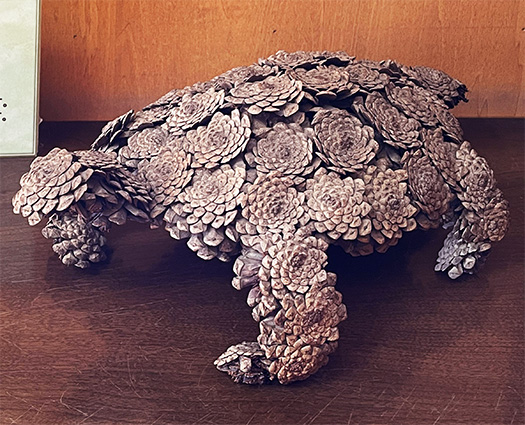
 そんなマンガ文化「作家」としての石ノ森章太郎の少年期の「手すさび」とも、遊び心とも取れるような作品と出会っていた。上の写真の作品は公開されているかれの部屋に無造作に置かれていた。松ぼっくりを素材としてそれを造形的に連結積層させて、たぶん「亀」を表徴、形作ったと思われるもの。この作品が無造作に展示されていたことは、少なくとも生家を保守してきた家族にとって、なによりも石ノ森章太郎の人物性全体がそこに表現されていると感じていたに違いない。
 わたしにはそう受け止められた。素材としての松ぼっくりを家の周りから収集してくる段階からだんだんこの造形をイメージしていたと思われる。石ノ森少年の「創作意欲」の根源部分が色濃く投影されていると感じられたのだ。
 こういう領域になってくると言語表現で明晰化することは困難で、かれ石ノ森少年の「内的なパトス」としか言いようがない。しかしさまざまなかれのマンガ作品に接してきた人間にして見ると、その表現意欲や手法のコアな部分に生々しく触れてしまった感があった。みなさんはどう思われるだろうか?

English version⬇

Traces of the artist’s ‘way of thinking’ from his childhood.
Embodies the state of internal pathos of an artist who worked with a visual communicability that transcended language as his field of expression. Quietly surprising in its rawness. …

 Today marks the tenth in the series of visits to Shotaro Ishinomori’s birthplace. The term ‘writer’ is often associated with people like myself, who were born in the mid-Showa period (mid-1989s), with the idea that ‘literary’ writers, such as Akutagawa Prize-winning writers, are the target of the term, or at least the stereotype that literature is the highest rank. According to the AI, the noun ‘writer’ is defined as ‘a professional who creates works of writing, calligraphy or painting’. After all, ‘writing’ is first.
 This way of thinking about society as a whole is probably folded into the base of the psychology of childhood, when children begin to learn about culture, and the writer is the first concept. When I myself started writing the e-book ‘Writers and Living Space’, I first took up Ryunosuke Akutagawa. The magnitude of such an imprint is probably self-evident. Kotoba’s paramountcy.
 But on the other hand, as a modern person, I have experienced the big bang in the world of visual expression, such as television and film, and have come to believe that visual information is much more ‘a priori’. Since the post-war period, ‘manga culture’ and the animated cultural sphere that has developed from it have become more massive as a base area of human cultural reception. When you look at it in the light of yourself, manga culture seems to be much ‘closer to your sensibility’ than the works of Ryunosuke Akutagawa, doesn’t it? And the real-time sense of the way of life of the manga artists since Tezuka Osamu, who have kept their hands sweaty in the publication of their works, is not a lot.
 While analytical depth and diversity is built into written expression, I think that manga expression has a communicative power that goes beyond verbalisation and is ‘grasped in a single stroke’.
 I met a work that could be seen as a playful expression of Shotaro Ishinomori’s boyhood as such a manga culture ‘artist’ and ‘tesasabi’. The work in the photo above was placed randomly in his room, which was open to the public. It is made of pine cones, which are connected and stacked in a figurative manner to form the shape of a ‘turtle’. The fact that this work was displayed in such a careless manner must have been seen as an expression of Shotaro Ishinomori’s entire personality, at least by the family who maintained the house where he was born.
 That is how it was perceived by me. It is thought that he gradually began to imagine this form from the stage of collecting pine cones from around the house as a material. I felt that the roots of the Ishinomori boy’s ‘creative urge’ were strongly projected in this work.
 When it comes to this kind of area, it is difficult to clarify in verbal expression, and can only be described as Ishinomori’s ‘internal pathos’. However, as someone who has come into contact with a wide range of different manga works, I felt that I was exposed to the core of Ishinomori’s expressive ambitions and methods in a very raw way. What do you think?

【マンガ天才少年への手塚治虫の導き】


 1945年(昭和20年)の太平洋戦争の終結以降、日本社会は大きな転換期を迎えていく。敗戦後間もない1947年1月に手塚治虫は日本マンガ文化の記念碑的作品「新宝島」を出版し、ベストセラーとなった。
 1938(昭和13)年生まれの石ノ森章太郎がこの生家の自分の部屋で空想の羽を膨らませていたのは、1955(昭和30)年前後の時期。やがて仲人も務めてくれることになる手塚治虫の作品に出会った少年は、その豊かな才能を見出した手塚治虫から直接コンタクトを受ける存在になっていた。この生家の展示にはそういう時期の資料類も展示されていた。いちばん上は、手塚治虫が後輩たちを育成する目的で1952-1954年に掛けて「漫画少年」誌で掲載した「漫画教室」のひとこま。
 いかにも手塚的な挿絵と自筆で漫画制作の「手ほどき」が語られていて、まことに戦後のマンガ文化草創期の雰囲気をまざまざと見せている。全国のマンガ大好き少年たちに文化的アジテーションを贈り続けた手塚という存在が、多くの後継人材を育成したことがわかる。そういう意味で戦後マンガ文化の「主流」位置付けが定着したのだろう。
 わたし自身は中学生頃にマンガに強く興味を持って自分でも作品を描いたりしたことがある。これはまったく初めての取り組みだったけれど、なんとか16Pの完成作品とした。マンガ愛好の友人たちから「よく最後まで描けたな」と感心された記憶がある。この作品は完成後すぐに父親からボイラー焼却処分された。そのときは悲しみに落ち込んで家出のまねごとをしたりもしたけれど、父の「愛」も感じられた部分もあって、そのマンガ家志向はほどなく自ら封印した。・・・1965(昭和40)年頃のことだから、こうしたマンガ文化初源期からは12-3年のズレがある。
 そういう体験を持っているので石ノ森や手塚には特殊な感情もあるのだけれど、自ら封印したという思いがあって未練を持つようなことはなかった。なので今回「作家と住空間」電子本の派生取材でこの石ノ森章太郎生家を探訪し、周辺事実を掘り起こすまで上に書いたような消息・事情には深入りしてこなかった。あらためてこういう歴史発掘をして見ると、非常に刺激的で、自分のもうひとつ違った人生風景をなぞっているような気がしてくる。ひょっとして。
 高齢期にまで至ってこういう人生の見返りの機会を得られるのは、内心でいろいろにさざめく波濤があって、まるで偶然久しぶりに初恋のひとと再会する心境に似ている(笑)。人生100年時代、このような人生追体験ということも興味深い文化テーマ領域かも知れない。

English version⬇

[Osamu Tezuka’s guidance to the manga boy genius].
The potential for the development of various new cultural areas in the age of ageing. The theme of ‘re-experiencing and reliving’ post-war manga culture is fascinating. …

 After the end of the Pacific War in 1945, Japanese society underwent a major turning point. In January 1947, soon after the defeat, Tezuka Osamu published his monumental work on Japanese manga culture, New Treasure Island, which became a bestseller.
 It was around 1955 that Shotaro Ishinomori, who was born in 1938 (Showa 13), was puffing out the wings of his imagination in his own room in this birthplace. The boy encountered the works of Osamu Tezuka, who would eventually also serve as his matchmaker, and he became a direct contact from Tezuka Osamu, who had discovered his abundant talent. The exhibition at his birthplace also displayed materials from this period. The top photo is a shot from the Manga Class, which Tezuka Osamu published in Manga Shonen magazine from 1952 to 1954, with the aim of training his younger students.
 The illustrations and handwritten instructions on how to create manga, in Tezuka’s very own handwriting, show the atmosphere of the early days of manga culture in the post-war period. It is clear that Tezuka, who continued to give cultural agitation to manga-loving boys all over the country, nurtured many successors. In this sense, Tezuka’s position as the ‘mainstream’ of post-war manga culture has become firmly established.
 I myself became very interested in manga when I was in junior high school, and even drew some of my own works. This was my very first attempt, but I managed to complete a 16-page work. I remember that my friends who were manga enthusiasts were impressed by how I managed to draw it all the way through. Soon after completing this work, my father had it boiler-burned. At the time, I was so depressed with sadness that I even imitated running away from home, but I felt my father’s ‘love’ in part, and soon after that my manga artist ambition was sealed off by myself. This was around 1965, so there is a 12-3 year gap from the early days of manga culture.
 Because of this experience, I have special feelings towards Ishinomori and Tezuka, but I never had any regrets because I felt that I had sealed them off myself. Therefore, I did not go deep into the above-mentioned facts and circumstances until I visited the birthplace of Shotaro Ishinomori as part of the research for the ‘Writers and Living Space’ e-book and unearthed some of the surrounding facts. When I look at this kind of historical excavation again, it is very stimulating and I feel as if I am tracing a different landscape of my own life. Perhaps.
 To have this kind of opportunity to look back on life in one’s old age is like being reunited with one’s first love after a long time by chance, with waves rippling inwardly (laughs). In the age of 100 years of life, this kind of reliving life may be an interesting cultural theme area.
 

【石ノ森少年の「ベニヤ板壁」改装洋間】


 昨日は石ノ森章太郎の「デスク環境」に絞って検証してみたけれど、本日はかれが高校卒業まで過ごしていた自室空間についてです。間取り図と窓の様子などから、この部屋はおおむね細長い6畳空間であることが推認できる。上の写真が部屋の奥から入口方向を見返した全景で、視界の手前左側に「ベット」と記載されたベッドが置かれていたことがわかる。畳を縦に1枚敷いて、それが横並び6枚並列されるような空間。そのままでは短辺方向に圧迫感が生じることが容易に予測されるので、新設の「出窓空間」が外側に張り出されたと受け取れる。
 この家屋自体は詳細な建築記録を参照できてはいないけれど現在で築100年を超える建築で、この石ノ森少年の自室の内装には昭和中期の「新建材」とおぼしき市町模様の床面フロア材や、当時の先端木製品工場から出荷された合理的建材としての「ベニヤ合板」がつかわれている。新規性の高い出窓空間とあわせて見るとこの内装空間はリフォームされた蓋然性がきわめて高いと思われる。やはりきのう触れたように、父母にとって世を継いでくれる大切な長男に対して無限の愛情を結晶させた空間なのだろうと思える。日本社会を保守し続けてきた家系意識と「家」制度・民俗としての未来への「投企」の感覚か。
 「作家と住空間」電子本で探った柳田國男の武蔵野での新築住宅「喜談書屋」では、施工として竹中工務店が浮かび上がっていたけれど、宮城県には一定の建築情報人脈もあるので建築会社とその人脈性などをたどろうと思えば、当時の建築会社と職方集団なども特定できるのではないかと思っている。今現在はそこまで踏み込まないけれど、そういう面からの探究も必要があれば探ってもみたい。よりリアリティのある住宅像、建築工事像を掘り起こすことも可能だろう。

 こちらはマンガ家への飛翔を夢見続けていた少年期の石ノ森章太郎が、学校から帰ってきて自室で見ていただろう視界。6畳間から奥行きが約1m弱ほど突き出た「出窓空間」が少年の心理にどのように影響を与えたのかと想像力を巡らせていた。きのう触れたように、リフォーム工事に伴ってと思われるオリジナルなデスク環境も少年の「注文」が活かされていただろうことが視認できた。隣室の父母、階下の店舗空間から平屋の和室3室にほかの家族が住んでいて自分の「背中」側にいてくれている。自分は大きな開口部に向き合いながら、マンガ家としての大きな未来を眺望していた。そのような心理洞察が自然に湧いてきていた。

English version⬇

[Ishinomori Boy’s ‘veneer board wall’ refurbished Western-style room
Veneer walls, a floor surface with a Ichimachi pattern design and a projecting bay window space leading to a dazzling future. The artist’s ‘dreaming’ space, which must have been realised through renovation. …

 Yesterday, we focused on Shotaro Ishinomori’s ‘desk environment’, and today we will look at the space in his room where he lived until he graduated from high school. From the floor plan and the windows, it can be inferred that this room is generally a long, narrow 6-mat space. The photo above is a panoramic view looking back towards the entrance from the back of the room, showing that a bed, marked ‘bed’, was placed on the left side in the foreground of the view. The space is such that one tatami mat is laid vertically and six of them are placed side by side. As it is easily predicted that the house would be oppressive in the short side direction as it is, it can be accepted that the newly built ‘bay window space’ was overhung outwards.
 The house itself is now over 100 years old, although detailed construction records are not available, and the interior of the Ishinomori boy’s room uses flooring with a Ichimachi pattern, which appears to be a ‘new construction material’ from the mid-Showa period, and plywood, a rational construction material shipped from an advanced wood products factory at the time. Together with the highly innovative bay window space, it is highly probable that this interior space was remodelled. As I mentioned yesterday, this space seems to be a crystallisation of the parents’ infinite love for their eldest son, who will succeed them in the world. Is this a sense of ‘projection’ towards the future as a result of the family lineage consciousness and the ‘family’ system and folk customs that have continued to maintain Japanese society?
 In Kunio Yanagida’s new house ‘Kidansho-ya’ in Musashino, which I explored in the ‘Writers and Living Space’ e-book, Takenaka Corporation emerged as the construction company. I think it may be possible to identify the building companies and craftsmen’s groups at that time. We are not going that far at the moment, but if necessary, we would like to explore this aspect as well. It may be possible to uncover a more realistic image of housing and construction work.

 This is the view that Shotaro Ishinomori would have seen in his room after returning home from school, when he was a boy dreaming of becoming a manga artist, and we wondered how the ‘bay window space’ protruding from the six-mat room by less than one metre in depth would have affected his mind. As I mentioned yesterday, I could see that the boy’s ‘order’ would have been utilised in the original desk environment, which seems to have accompanied the renovation work. His parents live in the next room, and other family members live in three one-storey Japanese-style rooms from the shop space downstairs and have their ‘backs’ to him. Facing the large opening, I was looking into the great future as a manga artist. Such psychological insights came naturally to me.


【大工造作か? 夢想を育んだ少年時デスク環境】


 さてマンガ作家としての石ノ森章太郎のロケット的なデビューへの助走期、高校卒業までの「こころの痕跡」を探る機縁。と思ったのがロケットランチャー・発射機ともいえる部屋の様子とデスク環境。「作家と住空間」というテーマにとっては、いかにもコアな領域と言える。
 もちろん作品などの創造過程自体はかれ石ノ森の脳味噌の中から発酵し表出してくる部分なので、きわめて「個人的」な部分であり余人からうかがい知れることは限られてくる。しかしその部分にもっとも「肉薄」できるのは、その作家の遭遇していた周辺環境、住のありようであることは紛れもない。それがわたしたちに体感可能な状態で残され、公開されていることは稀有なことだろう。同じ日本人としてほぼ同時代を体験し事跡を知っている人間としては、深く刺激的。
 で、この石ノ森少年が囲まれていたデスク環境を丹念に記憶に刻印し分析的に直視していた。ルポルタージュというコトバの実感そのままに視認チェックしていた。
 まず興味深かったのが、このデスクはどうも「既製品」を購入したものではないという感覚。デスク面の特異な寸法感覚、足回り側面の木による面構成などからどうも造作特注品、大工仕事なのではという感想を持った。デスク表面にも無垢材が張られているようだ。塗装の剥げ具合には、作家の「手ざわり」痕跡のような雰囲気まで感じられてならなかった。また、このデスクには一般的に付属する引き出しなどの収納装置が付設されていなかった。シンプルに「作業平面」だけを骨太に造作構成した様子がうかがい知れたのです。
 さらに興味深かったのが、築100年を越すという和風住宅なのに、この部屋にだけ「出窓」が造作されていること。そしてさらにその出窓には写真のように水道蛇口とボウルまでもが装置されていた。・・・デジタル化以前の創生期のマンガ制作では作画表現に墨を使うけれど、それを洗い流すために、この個室に特別に造作された環境のように受け取れた。そう考えると、デスク表面にうっすらと墨の残滓が木表面に展着した部分もその痕跡と認められる。
 オイオイ、であります(笑)。家長である父親はこの「跡継ぎ」長男に対して、かなりその才能開花のための環境を増築造作して「与えていた」ことが浮かび上がってきてしまう。あらら、謹厳な公務員としてマンガ家を志望した息子に反対した話はどこに行ったのか、とオモシロく感じてしまった。なんも、かわいい息子の純粋な志望に対して建築的な特別環境を構築して大いにその志望を深く支えていたのではないか、というように思われてしまった。
 最終的には息子の志望を認めて送り出した父の、そしてそれを夫婦で意思決定していった母の心情が、なんとも言えずしみじみと「伝わって」くるように思えた。親の盲目の深い愛。

English version⬇

[Carpentry construction? The boyhood desk environment that nurtured his dreaming]
The revelation of the talents of my beloved ‘heir’ son. And endless worry about my child’s future destiny. The architectural environment of a peculiar manga boy. …

 This is an opportunity to explore the ‘traces of the heart’ of Shotaro Ishinomori as a manga artist in the run-up to his rocket-like debut and up to his graduation from high school. The room and desk environment of his room can be seen as a rocket launcher. This is a core area for the theme of ‘artists and living space’.
 Of course, the creative process itself, including the works themselves, is a very ‘personal’ part of Ishinomori’s brain, and what can be learned from him is limited. However, it is undeniably the surrounding environment that the artist encountered and the way he or she lived that can be most closely related to this part of his or her work. It is a rare thing that these are preserved and shown to the public in a way that allows us to experience them. As a Japanese person who experienced the same period and knows the traces of it, it is deeply stimulating.
 In the book, the Ishinomori boy’s desk environment is painstakingly etched in his memory and viewed directly from an analytical point of view. I was checking the visualisation of the term ‘reportage’ as it really is.
 The first thing that was interesting was the sense that this desk had not been purchased ‘off-the-shelf’. The unusual dimensions of the desk surface and the wooden surface structure of the side of the undercarriage gave me the impression that it was a custom-built, carpentry work. The surface of the desk also seems to be covered with solid wood. The peeling paintwork even gave the impression of traces of the artist’s ‘handiwork’. The desk was not fitted with storage devices such as drawers, which are generally attached to desks. It was evident that only a simple ‘work plane’ had been constructed in a robust manner.
 What was even more interesting was the fact that this room was the only one with a bay window, even though it is a Japanese-style house that is over 100 years old. And on the bay window, there was even a water tap and a bowl, as shown in the photo. … In the early days of manga production, before digitalisation, ink was used for drawing expression, and it seemed to me that this private room had been specially built as an environment for washing it away. Considering this, the part of the desk surface where ink residues were spread on the wood surface can also be recognised as a trace of this.
 Oui, it is (laughing). It emerges that the father, who is pretty much the patriarch of the family, had ‘given’ this ‘heir’ eldest son an environment for his talent to flourish by building an extension. Oops, I wondered wryly where was the story of his opposition to his son who, as a respectful civil servant, aspired to be a cartoonist. It seemed to me that he had been deeply supporting his cute son’s aspirations by building a special architectural environment for his son’s genuine aspirations.
 The feelings of the father who finally acknowledged his son’s aspirations and sent him off, and of the mother who made this decision as a couple, seemed to be indescribably and deeply ‘felt’. The blind and deep love of a parent.

【マンガ家志望・思春期の石ノ森章太郎の部屋】


人間は自分ひとりで生きていける存在ではない。親があってはじめてこの世に生を受け、家族というぬくもりに支えられて成長していくもの。そしてその後「世に出た」後も、その出自の環境からさまざまに支えられながら、人生という波濤のなかに漕ぎ出していくものだろう。わたし自身も自ら顧みて、そうした大きな「繭」のようなものに深く抱かれていたことが実感させられる。この石ノ森章太郎生家を探訪していて、おばあちゃんや実姉の残影が色濃く感じられて、作家の内面を「覗き見た」思いが強い。さまざまな断面からのぞき得たけれど、さらに父親や母親の思いなども掘り起こすことが出来たらと思っている。そしてそのことが身を締め付けるように愛おしいと感じられる。
 こういう部分を注目していると柳田國男の掘り起こした民俗、いわば日本人的な「前世」観という思想へのはるかな探究につながるのかも知れない。「作家と住空間」電子本で探究した柳田國男だけれど、わたしはその後も柳田さんの思想痕跡にずっと「抱かれている」と感じている。ただ、柳田さんが生きていた頃から時代は先に進んで、柳田さん以降の日本人の生命の積層があって、独特な「民俗」も多様に展開しているのだと思う。
 そういう典型的存在として、わたしの思春期とも大きく重なる石ノ森章太郎の部屋にたどりついてしまった(笑)。そうなんです、ある種「来てしまった」感が盛り上がり、燃えさかっていた。
 わたし自身はかれ石ノ森章太郎についてそこまで深い「心的交流」をしていたか、と考えれば、たとえば司馬遼太郎の作品群との対話時間のような近接感には至っていない。・・・と思っていた。しかし、この写真のような光景に出会ってしまったら、一気に自分の中学生頃の感受性世界と深く応答させられてしまったのです。
 ちょうど石ノ森章太郎が父親からマンガ家志望に反対されたのと同様に、わたし自身は父親から描いていたマンガ作品を焼却処分されていた。そういう思春期の体験感覚が一気に蘇ってしまった。別に空間としての感じがわたしの過ごしていた部屋と似ているワケではないのに、そういう心理の復元起動力、パワーがこの部屋から感じられた。
 作家の住空間として残されている住宅のなかで同時代感が大きくスウィングしてくるのは、わたし自身の年齢から考えてギリギリ石ノ森の世代でしょう。おおよそ14-5年程度の時間差はあるけれど、戦後しばらく経った昭和中期が鮮烈に襲ってきたと感じていたのです。やはり人間と住空間はオモシロい。

English version⬇

[Aspiring manga artist and adolescent Shotaro Ishinomori’s room
The restorative activation and power of the psyche that the living space has. The feeling of life swinging. The feeling of having ‘arrived’ in such a place. …

Human beings are not beings who can live on their own. He is born into the world only after his parents, and grows up supported by the warmth of his family. After they ‘come into the world’, they are supported in various ways by the environment in which they came from, as they paddle out into the surging waves of life. Looking back on my own life, I realise that I was deeply embraced by such a large ‘cocoon’. When I visited the birthplace of Shotaro Ishinomori, I could feel the strong traces of my grandmother and sister, and I strongly felt that I had ‘peeked’ into the artist’s inner life. I was able to peek into various aspects of the artist’s life, but I hope to be able to further uncover his father’s and mother’s thoughts and feelings. And that makes me feel squeezed and lovely.
 Paying attention to these aspects may lead to a far-reaching exploration of the folk customs that Kunio Yanagida unearthed, the Japanese view of ‘prehistoric life’, so to speak. I have been ‘held’ by the traces of Yanagida’s thought ever since my exploration of Kunio Yanagida in the e-book ‘The Writer and the Living Space’. However, since the time when Mr Yanagida lived, times have moved on and there is a layering of Japanese life after Mr Yanagida, and I think that the unique ‘folklore’ has developed in various ways.
 As a typical example of such an existence, I ended up in the room of Shotaro Ishinomori, whose adolescence also overlapped greatly with my own (laughs). Yes, a certain sense of ‘I’ve arrived’ was rising and burning.
 When I think about whether I myself had such a deep ‘emotional exchange’ with Shotaro Ishinomori, I have not reached the same level of proximity as in the time I spent talking with Ryotaro Shiba’s works, for example. … I thought. However, once I came across a scene like the one in this picture, I was at once made to respond deeply to the world of sensitivity of my junior high school days.
 Just as Shotaro Ishinomori was opposed by his father to his aspiration to become a manga artist, I myself had had the manga works I was drawing burnt by my father. The sensation of that kind of adolescent experience came back to me all at once. The room does not resemble the room in which I used to spend my time, but I could feel the power of psychological restoration and activation in this room.
 Among the residences that have been preserved as artists’ living spaces, it is probably Ishinomori’s generation, just barely considering my own age, that has the greatest swing in the sense of contemporariness. There is a time gap of about 14-5 years, but I felt that the mid-Showa period, some time after the war, had struck me vividly. After all, people and living spaces are interesting.


【石ノ森章太郎生家の間取り】


 さて石ノ森章太郎生家の探訪取材。この家は建築後100年前後と伝えられているとの説明。大正の末期から昭和の初め頃の建築と言うことになる。1926年前後。
 世界情勢としては日露戦争のあとロシア革命が勃発しソ連が成立したての時期。日本は日露戦争に勝利したあと、複雑な国際政治外交の権謀術数の世界にアジアの有力国、対露戦勝国として参入する。そういった時代に生きていた日本人のひとつの間取り、家という社会の基本構成要素のありようが表現されている。
 登米市の中田町が現在名だけれど、当時は「石森町」という地域名。石森と書いて「いしのもり」と呼称するのが地域の習慣だったので、石ノ森章太郎はごく自然に最初は「石森」とペンネームを表記していた(本姓は小野寺)けれど、全国的にはふつうに「いしもり」としか発音されないことに違和感を持っていたのだそう。画業30年を経過した段階でそのことを変えたいと祈念し、正式に「石ノ森〜いしのもり」と「ノ」を入れてネーム更新したのだという。地域伝統社会へのリスペクト。
 作家としてのかれは、地名を誇らしくペンネームとするほどに郷土へのこだわりが強かったということ。少年期の様子などを探索すると手塚作品に衝撃を受けてマンガ家一本道のように思えるのだけれど、別な側面から見ると地域文化や長男として「家長」的な立場認識に、色濃く影響されていたように思われる。
 上の図は説明懸垂幕にあったので一部に「ゆがみ」が反映している「間取り図」。間取りとしては1階に店舗が通りに面して広く取られ、それぞれ床の間付きの大きな和室3室が展開している。いちばん奥に店守りの祖母と叔母の居室兼用の最上位和室があり、真ん中には姉と章太郎の弟・妹、子どもたちが寝起きする和室。そしていちばん手前側が「茶の間」家族のだんらん・食事空間が座卓としてある。席順も記されているように「格」重視の日本人的な家族認識習慣が垣間見える。「世継ぎ」である石ノ森章太郎だけには2階に出窓付きの洋室個室が与えられて、横に家長である両親の隣室があてがわれている。
 石ノ森章太郎が高校卒業時にマンガ家を志望すると言ったとき、謹直な公務員であった父は許さないと言った。そのとき、姉である由恵さんが援護して親を説得し、マンガ家志望の弟の素志を遂げさせた。姉弟の共同戦線に折れざるを得なかった父親の心事に思いをいたすと面白い。父親としてはたぶん章太郎だけの主張であれば、強硬に否認する可能性も高かったのではないだろうか。ところが父親は娘には弱い(笑)。病弱でもある最愛の娘が弟に味方して叛旗を翻す事態に、オロオロさせられただろうことは想像できる。日本の「家」の実像。

English version⬇

[Floor plan of Shotaro Ishinomori’s birthplace
After the victory in the Russo-Japanese War, the period was a whirlwind of change in the complicated international politics. The space layout expresses a sense of ‘home’ that was typical of the period. A sense of patriarchal responsibility for the continuation of the family. …

 Now, an exploratory interview at Shotaro Ishinomori’s birthplace. The house is reported to be around 100 years old. It was built between the end of the Taisho era (1912-1926) and the beginning of the Showa era (1926-1989).
 The world situation was that the Russian Revolution broke out after the Russo-Japanese War and the Soviet Union had just been established. After winning the Russo-Japanese War, Japan entered the complex world of international political and diplomatic intrigue as a powerful Asian country and victor against Russia. The work expresses one of the layouts of the Japanese people who lived in those times, and the way in which the basic components of society, the house, were constructed.
 Nakada-cho in Tome City is the current name of the area, but at the time the name of the area was Ishimomori-cho. It was local custom to write Ishimori and call it Ishinomori, so Shotaro Ishinomori naturally used the pen name Ishimori at first (his real name was Onodera), but he was uncomfortable with the fact that it was usually pronounced only as Ishimori throughout the country. After 30 years of painting, he prayed to change that and officially updated his name to ‘Ishinomori – Ishinomori’ with a ‘no’. Respect for local traditional society.
 As a writer, Kare was so strongly attached to his hometown that he proudly used the name of the place as his pen name. When we explore his boyhood, it seems as if he was impacted by Tezuka’s works and became a manga artist in one way or another, but from a different perspective, it seems that he was strongly influenced by the local culture and his perception of his position as the ‘patriarch’ as the eldest son.
 The diagram above is a ‘floor plan’ reflecting some ‘distortion’ as it was on the explanatory banner. The layout consists of a shop on the ground floor facing the street, with three large Japanese-style rooms, each with an alcove. At the far end is a top-level Japanese-style room that doubles as a living room for the shop keeper’s grandmother and aunt, and in the middle is a Japanese-style room where the elder sister, Shotaro’s younger brother and sister and their children sleep and wake up. At the very front is the ‘chanoma’ (tea room), where the family gathers and eats together at a table. The order of seating is also marked, which gives a glimpse of the Japanese custom of recognising family members with an emphasis on ‘rank’. Shotaro Ishinomori, the ‘heir’ of the family, is given a private Western-style room with a bay window on the second floor, with the room next to his parents, who are the patriarchs, allocated to him.
 When Shotaro Ishinomori said he wanted to become a manga artist upon graduating from high school, his father, an honest civil servant, said he would not allow it. At that time, his older sister, Yue, backed him up and persuaded his parents to let him fulfil his ambition to become a manga artist. It is interesting to reflect on the father’s feelings about having to break down in the face of the sister and brother’s joint front. The father probably would have been more likely to strongly deny the claim if only Shotaro had insisted on it. However, fathers are weak against their daughters (laughs). It is imaginable that he would have been horrified by the situation in which his beloved daughter, who was also sickly and weak, sided with her brother and rebelled against him. The reality of the Japanese ‘family’.

【トキワ荘のマドンナ・石ノ森章太郎実姉の残影】


 作家と住空間というわたしのNEXTライフテーマですが、どちらかといえば「住空間」の方に7:3くらいで力点があると認識しています。作家自身についてはたくさんの情報データもあるので、そちらには配慮しつつもあくまでもサブ的にと考えているところ。たまたま石ノ森章太郎のことを考えて見て、その作品については同時代的に耽溺していた自分自身の「体感」があって、作家とその作品世界理解という意味ではそう深くは触れる必要性を感じていなかったのです。正直。
 ・・・なんですが、この住宅で触れた実姉・由恵さんの「人形作品」を目にしてこころが完全に奪われてしまった次第。昨日の人形と並んで、上の人形作品もまた展示されていた。昨日アップした人形が「正」であるとすればこちらは「奇」の表現だと思う。同一人物にして、このように違いが生み出されるというのは、その「才能」の深みに驚かされる。参考までに昨日紹介の人形も以下に再掲。

 どうもこの「実姉・由恵さん」に強く興味が沸き起こってしまった。
 Wikiの「石ノ森章太郎」の項の記述などをみると彼女のことが、人間・石ノ森章太郎にとってはまさに「血肉」のような存在であったことが、断片的ながら、強く浮かび上がってくる。石ノ森は厳格な公務員であった父からマンガへの進路を反対されていたが、この実姉が父親を説得して石ノ森を上京させたとある。そしてさらに彼女は、生来病弱で外出もままならない病の療養のこともあって弟を追うように上京して当時のマンガ文化勃興期の「梁山泊」トキワ荘で、石ノ森と同居しながら暮らしていたと記されている。その生前の写真はこの「生家」で公開され、管理の方からは「大いに広報拡散してください(笑)」と許諾も受けているけれど、公開は避けたい。しかし、実に「トキワ荘のマドンナ」という表現は正鵠を穿っていると強く思えるほどの美人。
 石ノ森章太郎とは3歳上。高校卒業後すぐに上京した弟とトキワ荘で同居していた時期は、それこそ花も恥じらうほどだっただろうか。石ノ森章太郎は上京後、トキワ荘では最年少ながらすぐに「売れっ子」マンガ家になっていたことも合わせ考えると実姉・由恵さんも実弟・章太郎の作品制作に協力していた蓋然性はきわめて高い。さらにこうしたマドンナの存在が、トキワ荘に集ったマンガ作家たちの青春模様に色濃く影響したことも想像される。まさに新文化創造の「るつぼ」感がハンパない。
 そういった彼女の才能の片鱗が、デフォルメされた印象的な人形造形に表出しているように思える。

English version⬇

Remnants of Tokiwasou’s Madonna Shotaro Ishinomori’s own sister.
The power of expression expressed in her impressive doll modelling. Although she was too sickly to go out, she may have kindled the flame of her talent as the greatest collaborator of her own brother. …

 My NEXT life theme is ‘Writers and Living Spaces’, and I am aware that the emphasis is more or less 7:3 on ‘living spaces’. There is a lot of information and data on the artist himself, so while I take that into consideration, I consider it to be only a sub-themes. When I happened to think about Shotaro Ishinomori and look at his works, I had my own ‘experience’ of his works, which I was indulging in at the same time, and I didn’t feel the need to touch them so deeply in terms of understanding the artist and his world of works. Honestly.
 But when I saw my own sister Yue’s ‘doll works’ in this house, my heart was completely taken by them. Along with the dolls from yesterday, the dolls above were also on display. If the doll I uploaded yesterday is a ‘positive’ expression, this one is an expression of ‘strangeness’. The fact that such a difference can be produced by the same person is astonishing in the depth of his ‘talent’. For reference, the doll introduced yesterday is also reproduced below.

I became strongly interested in this ‘real sister, Yue’.
 The Wiki article on Shotaro Ishinomori shows that she was like ‘flesh and blood’ to the human Shotaro Ishinomori, although only in fragments. Ishinomori’s father, a strict civil servant, was opposed to Ishinomori’s career in manga, but his own sister persuaded him to move to Tokyo. It further states that she followed her brother to Tokyo and lived with Ishinomori at Tokiwa-so, the ‘Ryozanbaku’ of the then emerging manga culture, as he was recovering from an illness that made him sickly and unable to leave the house. Photographs of his early life are available in this ‘birth house’, and the management has given permission for me to ‘spread the word’ (laughs), but I don’t want to make them public. However, I strongly believe that the expression ‘Madonna of Tokiwaso’ hits the nail on the head.
 She is three years older than Shotaro Ishinomori. When she lived together with her younger brother at Tokiwa-so, who moved to Tokyo immediately after graduating from high school, even the flowers must have been ashamed of themselves. Considering that Shotaro Ishinomori was the youngest manga artist at Tokiwaso after moving to Tokyo, but soon became a ‘successful’ manga artist, it is highly probable that his own sister, Yue, also cooperated with his brother Shotaro in the production of his works. It can also be imagined that the presence of such a madonna had a strong influence on the youth of the manga artists who gathered at Tokiwa-so. The sense of a melting pot for the creation of new culture is truly overwhelming.
 It seems that a glimpse of her talent is expressed in the deformed and impressive doll modelling.