
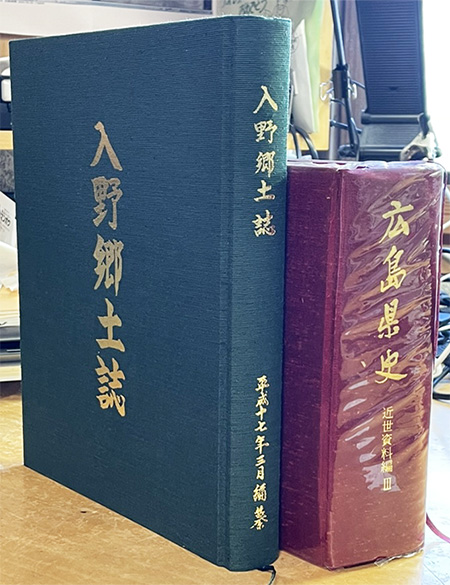
入野郷土誌の精読を続けています。通常こうした地方史については、各県や大きな都市、たとえば福山や竹原などの歴史も重ねられている中心的な都市で作られていて、この広島県東広島市河内町のさらに1地域に過ぎない「入野地区」で作られるのは珍しいのではないかと。
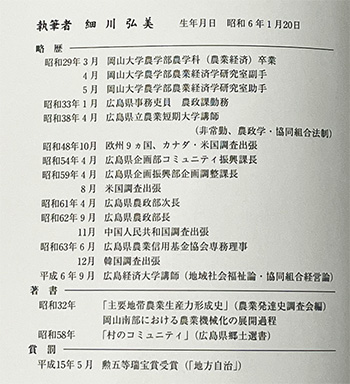
わたしの場合、広島県史や竹原市史・福山市史などが家系探究の基礎資料なのですが、もっとも古い故地である入野にそういう地域史資料があるとは思わなかった。たまたまその存在を知った次第ですが、読み進めてみて、前述の地方史と比較して徹底的に農業基盤についての各条記載が目立っている。地域史では超絶の部類に属するように思う。そういうことなので、江戸期ではわたしの家系の「庄屋 平七」という名が各所で頻出もする。そんなことを考えていたら「執筆者」細川弘美氏の経歴が巻末に記載されていた。
略歴(要旨)
昭和29年3月 岡山大学農学部農学科(農業経済)卒業
岡山大学農学部農業経済学研究室助手
昭和33年1月 広島県事務吏員 農政課勤務
昭和61年4月 広島県農政部次長昭和62年9月 広島県農政部長
著書
昭和32年
「主要地帯農業生産力形成史」(農業発達史調査会編)
岡山南部における農業機械化の展開過程
昭和58年
「村のコミュニティ」(広島県郷土選書)
平成15年5月勲五等瑞宝賞受賞(「地方自治」)
という方。一貫して農業研究をライフワークとされてきたようでした。
で、そういう方が「入野」という小さな地域の郷土誌について積極的に取り組まれた。こういう事実を知り、同時に広島県という瀬戸内海地域でありながら、入野などの中部丘陵地域では年間降雨量が日本でも有数の少なさである、ということもはじめて知った。
こういう2つの事実から、この地域の運営にとって「農業用水の管理」こそが最高レベルの事項だということがあきらかになってきたのですね。執筆者の細川氏も、農業研究者としてこの地域は非常に興味深かったのだろうと思い至ったのです。そうするとわが家系が、この地に紀州からやってきてすぐに「庄屋」を代々務めてきたということの「因縁・由縁」の推測が浮かび上がってくる。
そう、農業用水およびその土木についての専門的知見を持つ家系・・・。う〜む。
●お知らせ
拙書「作家と住空間」幻冬舎から電子書籍で発刊
お求めはAmazonで。
https://amzn.asia/d/eUiv9yO
English version⬇
[The author of the Irino Local History is an “agricultural researcher” with a background as director of the prefectural agricultural policy department…]
Agriculture is the fundamental foundation of Japanese society. Its roots lie in the management of “water sources” and the “civil engineering” involved. My family lineage became “village headmen” almost immediately after settling here…
I’m continuing to read the *Iri no Local History* in detail. Typically, local histories like this are compiled in major cities—such as Fukuyama or Takehara—that serve as regional hubs where the histories of various prefectures and larger cities are intertwined. It’s quite rare, I think, for one to be produced specifically for the “Iri no District,” which is just one small area within Kawachi Town, Higashi-Hiroshima City, Hiroshima Prefecture.
In my case, the History of Hiroshima Prefecture, the History of Takehara City, and the History of Fukuyama City serve as my primary sources for genealogical research, but I never expected such a local history resource to exist for Irino, my oldest ancestral home. I happened to learn of its existence by chance, and as I read through it, I noticed that, compared to the aforementioned local histories, the entries detailing the agricultural foundation stand out remarkably. I believe this ranks among the very best in the field of local history. Consequently, the name “Shōya Heishichi” from my family lineage appears frequently throughout the Edo period. As I was pondering this, I noticed the author’s biography, Hiromi Hosokawa, listed at the end of the volume.
Biography (Summary)
March 1954: Graduated from the Department of Agriculture (Agricultural Economics), Faculty of Agriculture, Okayama University
Research Assistant, Agricultural Economics Laboratory, Faculty of Agriculture, Okayama University
January 1958: Administrative Officer, Hiroshima Prefecture; assigned to the Agricultural Policy Division
April 1986: Deputy Director, Agricultural Policy Department, Hiroshima Prefecture; September 1987: Director, Agricultural Policy Department, Hiroshima Prefecture
Publications
1957
“History of the Formation of Agricultural Productivity in Major Regions” (edited by the Agricultural Development History Research Committee)
The Development Process of Agricultural Mechanization in Southern Okayama
1983
“Village Communities” (Hiroshima Prefecture Local History Series)
May 2003: Awarded the Order of the Sacred Treasure, 5th Class (“Local Autonomy”)
This is the person in question. It seems he consistently regarded agricultural research as his life’s work.
And yet, such a person actively engaged in compiling a local history of “Iri,” a small region. Upon learning this fact, I also realized for the first time that while Hiroshima Prefecture is located in the Seto Inland Sea region, the annual rainfall in the central hilly areas, such as Iri, is among the lowest in Japan.
These two facts made it clear that “agricultural water management” is the top priority for the region’s administration. I came to realize that the author, Mr. Hosokawa, must have found this area particularly fascinating as an agricultural researcher. This led me to speculate on the “fate and connection” behind why my family, having come to this land from Kishu, immediately began serving as “village headmen” for generations.
Yes, a family lineage with specialized knowledge of agricultural water and related civil engineering… Hmm.
● Announcement
My book, “Writers and Living Spaces,” has been published as an e-book by Gentosha.
Available on Amazon.
共有:

Posted on 4月 11th, 2026 by 三木 奎吾
Filed under: 未分類




コメントを投稿
「※誹謗中傷や、悪意のある書き込み、営利目的などのコメントを防ぐために、投稿された全てのコメントは一時的に保留されますのでご了承ください。」
You must be logged in to post a comment.