
昨日に引き続き「入野郷土誌」の1712年(正徳・亨保年間)当時にピントを絞って、その山村的農業経営の実態について、わたしの九世の祖・原平七の目線で探究しています。九世の祖というのは、わたしの父を2代目と数えての「世」の代わりを表現したもの。
いきなり余談ながら日本で通用してきた世代とかの概念って、その基礎はやはり仏教的な「この世・あの世」概念であり、血脈が「生まれ変わり」最大の概念基盤だったのだと伝わってくる。「前世」はDNA連鎖と強く近似する概念。・・・
で、九世の祖・原平七は、かれから4代前の祖先がこの入野に紀州から転入してきてすぐの3代前から「入野村・庄屋」として経済活動してきていた。そういう実態から1712年、この入野だけではなく属していた「豊田郡」中7人の公的役割「所務役」に安芸・浅野藩から拝命されるに至っている。経済圏規模としてはほぼ「大名家」1家分に相当する1万石弱の規模の地域の経済を「管掌」させられたワケだ。
浅野藩には「原氏」という七大軍団長クラスの重臣もいる。紀州からの移入という経緯もあり、そういう血脈的な縁も想像されるけれど、入植した現地・入野では指導的農家層として、実質的な「経済支配構造」の管理運営者ではあったのだろう。そして村単位の庄屋を大きく超える広域地域経済管掌を任されるほどの、信認蓋然性を藩から認識されていたのだ。幸か不幸か。
その結果として、1718年には藩全体で勃発した百姓一揆で「打ち毀し」される対象になったわけだ。
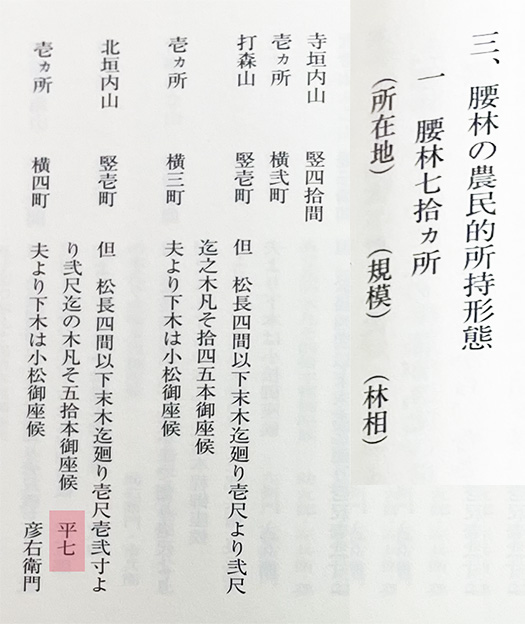
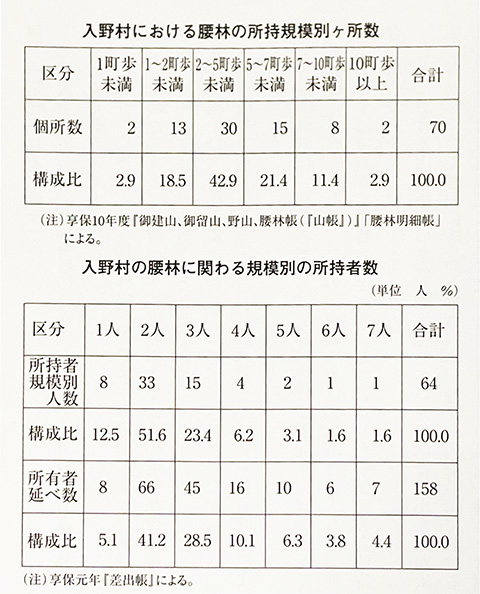
で、その後の1725年段階の広島藩の林野政策に沿った「差出帳」〜現在の総合経済実態調査〜においても、その調査責任者として記録されていた。上のデータはその時点での山林利用の所有者名にわが九世の祖(平七)があった調査部分。その下には山林所有の入野村統計まとめ資料(入野郷土誌執筆の細川氏)。
山林の所有区分方法は公有私有でいくつかに別れるが、この17世紀中期の時代、広島藩領内では瀬戸内沿岸都市の発達と「人浜塩田」の盛行によって薪炭材や塩田燃料としての「塩木」需要を増大させていた。
この入野では10数キロ南下した瀬戸内海都市・竹原で塩田が開かれて活況を呈していた。この地域での経済基盤の大変容がもたらされつつあった、ということだろう。興味深くデータを見続けている。・・・
●お知らせ
拙書「作家と住空間」幻冬舎から電子書籍で発刊
お求めはAmazonで。
https://amzn.asia/d/eUiv9yO
English version⬇
[Exploring the Reality of the “Lifestyle Economy” in Iri no, Hiroshima Domain]
In the 1700s, the rise of salt production—a new industry in the Edo-period economy—led to an increase in the added value of surrounding areas and forests. …
Continuing from yesterday, I am focusing on the year 1712 (during the Shōtoku and Kyōhō eras) in *The Iri no Local History* and exploring the realities of agricultural management in that mountain village through the eyes of my ninth-generation ancestor, Hara Heishichi. The term “ninth-generation ancestor” refers to the number of generations counting from my father as the second generation.
As a sudden digression, it seems clear that the concept of generations, as it has been understood in Japan, is fundamentally rooted in the Buddhist concept of “this world and the next,” with bloodline serving as the primary foundation for the idea of “reincarnation.” The concept of a “past life” closely parallels the chain of DNA. …
So, the ninth-generation ancestor, Hara Heishichi, had been engaged in economic activities as the “village headman of Irino Village” since three generations prior—immediately after his ancestor four generations back moved to Irino from Kishu. Based on this reality, in 1712, he was appointed by the Asano Domain of Aki to serve as one of seven “administrative officials” for the “Toyoda District,” which included not only Irino but the entire region. In terms of the economic sphere, he was effectively entrusted with overseeing the economy of a region spanning just under 10,000 koku—a scale roughly equivalent to that of a single daimyo household.
The Asano Domain also had a high-ranking retainer of the Hara clan who held the rank of a major military commander. Given their background as immigrants from Kishu, one might imagine such blood ties played a role, but in their adopted home of Irino, they likely served as the leading farming class and the de facto managers of the “economic control structure.” Furthermore, the domain recognized them as trustworthy enough to entrust them with overseeing a regional economy far larger than that of a single village. Whether this was fortunate or unfortunate is another matter.
As a result, during the peasant uprising that erupted throughout the entire domain in 1718, they became a target for “destruction.”
Furthermore, in the “Sashide-cho” (a document similar to today’s comprehensive economic survey) compiled in 1725 in accordance with the Hiroshima Domain’s forestry policy, he was recorded as the person in charge of the survey. The data above shows the section of the survey listing the names of forest land owners at that time, which includes my ninth-generation ancestor (Heishichi). Below that is a summary of statistics on forest ownership in Irino Village (compiled by Mr. Hosokawa, author of the Irino Local History).
While forest ownership was categorized into public and private sectors, during this mid-17th century period, the development of coastal cities along the Seto Inland Sea and the prevalence of “Hibama salt fields” within the Hiroshima domain had increased the demand for “shio-ki” (saltwood) used as firewood, charcoal, and fuel for the salt fields.
Here in Irino, salt fields had been established in Takehara—a city on the Seto Inland Sea about 10 kilometers to the south—and were thriving. This likely signaled a major transformation in the region’s economic foundation. I continue to study the data with great interest. …
● Announcement
My book, “Writers and Living Spaces,” has been published as an e-book by Gentosha.
Available on Amazon.
共有:

Posted on 4月 12th, 2026 by 三木 奎吾
Filed under: 未分類


コメントを投稿
「※誹謗中傷や、悪意のある書き込み、営利目的などのコメントを防ぐために、投稿された全てのコメントは一時的に保留されますのでご了承ください。」
You must be logged in to post a comment.