
さていよいよ松浦武四郎の北海道との関わりの段。時代相としてはいよいよ欧米世界からの接触が頻繁になってきて、ついに1853年にアメリカ合衆国東インド艦隊司令長官ペリー率いる艦隊が、日本の江戸湾の入り口である浦賀沖に来航する「黒船騒動」が勃発する時代。
そこにいたるまでにもさまざまな「接触」が起こって開国に向かっての胎動の時期。
●1842年8月29日 幕府、文政の撃攘令を廃止(異国船に薪水を給与)。アヘン戦争終結。
●1842年9月7日 幕府、川越藩に相模海岸を、今治藩に安房上総海岸警備を命ず。
といった事件、動向が沸き立ってきている。そういうなかで「北門の鎖鑰」という国防上の大テーマが日本国内で巨大なテーマとして浮かび上がってくる。日本全国を旅することに没頭していた松浦武四郎にとってもこうしたテーマは強い問題意識として突き動かされていたことは間違いない。かれ28歳の時に、ついに北海道の地に上陸することになる。
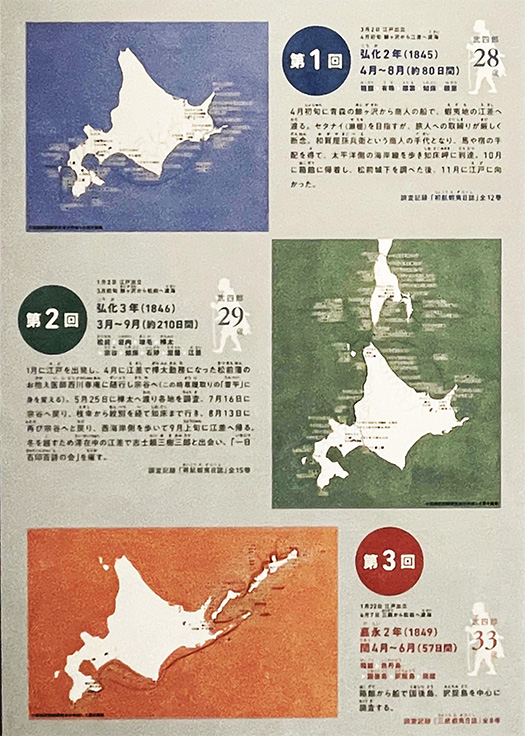
1845年4月初旬に青森県の鰺ヶ沢から商人の船に乗って蝦夷地の江差に渡る。そこから陸路北上して瀬棚を目指すが、松前藩による旅人への取り締まりが厳しく断念。和賀屋孫兵衛という商人の「手代」となることで交通手段としての馬や移動の宿を確保できて遠く太平洋側の海岸線を歩いて「知床岬」に到達。そこから10月には函館に帰着し松前城下を調査後、11月に江戸に向かったという記録。実質的にはトータル約80日間の北海道内地形探査の旅とされている。
翌年1846年には今度はトータル210日間にも及ぶ大探査行を行っている。1月に江戸を発出し4月には当時樺太勤務になった松前藩のお抱え医師・西川春庵に随行して宗谷に渡っている。このときは「草履取り」の役職だったとされる。5月25日に樺太に渡って各地を調査。7月16日に宗谷に戻りオホーツク海側の枝幸〜紋別を経て知床まで探査行。8月13日に再び宗谷に戻り、今度は北海道西海岸・日本海側を歩いて江差に戻っている。このとき昨日記載した頼三樹三郎とともに一種の「歌会」を開催している。
1−2回をみると北海道を知床を境にして「南部」、そして宗谷を起点にして「北部」の地形を詳細に把握する旅だったのだと確認できる。そして第3回は3年後の1849年、33歳の時に函館から船で国後・択捉を中心に探査している。
御三家和歌山藩領の「地士」としての立場、そしてその地域の経済管理者としての家の立場を使って、人脈的にも大いに活用しているだろう様子がわかる。
●お知らせ
拙書「作家と住空間」幻冬舎から電子書籍で発刊
お求めはAmazonで。
https://amzn.asia/d/eUiv9yO
English version⬇
[Three personal research trips to Hokkaido / Hokkaido native Takashiro Matsuura – 5]
Amidst the turmoil of the end of the Edo period, Hokkaido became urgently important to the Japanese state, but information about the region was scarce. Demand for regional information skyrocketed. …
Now we come to the section on Matsura Takashiro’s involvement with Hokkaido. At this time, contact with the Western world was becoming increasingly frequent, and in 1853, Commodore Perry of the United States East India Squadron arrived at Uraga, the entrance to Edo Bay, sparking the “Black Ship Incident.”
Even before that, there had been various “contacts” leading up to the beginning of the opening of the country.
●August 29, 1842: The shogunate abolished the Bunsei Expulsion Edict (which prohibited the provision of firewood and water to foreign ships). The Opium War ended.
●September 7, 1842: The shogunate ordered the Kawagoe Domain to guard the Sagami Coast and the Imabari Domain to guard the Awa-Kazusa Coast.
Such events and developments were beginning to boil over. Amidst this, the major national defense theme of “the key to the northern gate” emerged as a huge issue within Japan. For Matsura Takashiro, who was absorbed in traveling throughout Japan, there is no doubt that this theme was a strong driving force behind his consciousness. At the age of 28, he finally landed on the soil of Hokkaido.
In early April 1845, he boarded a merchant ship from Ajigasawa in Aomori Prefecture and crossed to Esashi in Ezo. From there, he attempted to travel north by land toward Setana, but strict restrictions imposed by the Matsumae Domain forced him to abandon the plan. By becoming an assistant to a merchant named Wagaya Magobei, he secured horses and lodging for his journey, enabling him to walk along the Pacific coastline and reach Cape Shiretoko. He returned to Hakodate in October, surveyed Matsumae Castle Town, and then headed to Edo in November, according to records. This journey is considered to have been an approximately 80-day exploration of Hokkaido’s interior.
The following year, 1846, he undertook a major exploration lasting a total of 210 days. In January, he departed from Edo and in April, he accompanied Nishikawa Haruan, a physician employed by the Matsumae clan who was stationed in Sakhalin at the time, to Soya. At this time, he is said to have held the position of “sandal bearer.” On May 25, he crossed to Sakhalin and surveyed various locations. On July 16, he returned to Soya and conducted an exploration from Esashi to Monbetsu along the Sea of Okhotsk coast, reaching Shiretoko. On August 13, he returned to Soya again and walked along the west coast of Hokkaido and the Sea of Japan side back to Esashi. At this time, he held a kind of “poetry gathering” with Ryo Mikisaburo, who was mentioned yesterday.
From the first and second expeditions, it can be confirmed that this was a journey to gain a detailed understanding of the terrain of Hokkaido, with Shiretoko as the boundary between the “southern” and “northern” regions, starting from Soya. The third expedition took place three years later in 1849, when he was 33 years old, exploring Kunashiri and Etorofu by ship from Hakodate.
It is evident that he made full use of his connections, leveraging his position as a “local official” of the Miyoshi family’s Wakayama domain and his family’s role as economic managers of the region.
●Notice
My book “Writers and Living Spaces” has been published as an e-book by Gentosha.
Available for purchase on Amazon.
共有:

Posted on 8月 1st, 2025 by 三木 奎吾
Filed under: 歴史探訪



コメントを投稿
「※誹謗中傷や、悪意のある書き込み、営利目的などのコメントを防ぐために、投稿された全てのコメントは一時的に保留されますのでご了承ください。」
You must be logged in to post a comment.