
きのう個人の探訪としての松浦武四郎の3回にわたる主に北海道島への北方調査記録を見た。1845年から1849年の時期に相当する。1853年の黒船来航の直前期で、世界中の列強諸国がアジア進出の機会をもとめている世界的な動乱期に当たっている。松浦武四郎などの調査活動記録は時の政権、幕府には貴重な対外交渉上の有用な調査記録になっていたことは当然だろう。なんといっても列強と渡り合うには、かれらの欲望、領土と交易の利権獲得をめぐっての外交交渉なのだ。欲望丸出しのかれらと対応するのに、自国領土と主張するについての詳細な知見は幕府当局にとって喉から手が出るほどに絶対必要不可欠なものだった。
黒船来航を経て幕府もこうした対応がいよいよ待ったなしとなって、松浦武四郎は幕府お抱えの身となって再度の調査活動を行うことになる。
幕府はロシアとの交渉で1855年に日露和親条約締結を締結。「日露両国混在」と条約確認した樺太、そして北海道について日本国家として確定させた自国領土問題と認識し公式に調査活動を開始したのだ。その役割を松浦武四郎に命じたことになる。「蝦夷地御用御雇人」。幕府開設以来前例のない人材登用か。歴史好きの現代北海道人としては明治期「御雇外国人」ケプロンやクラークさんたちを思い出すような官職。
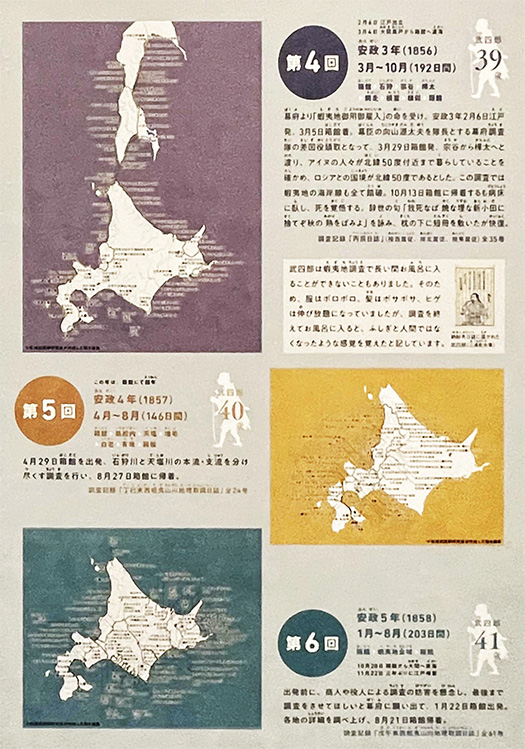
1856年2月6日幕臣・向山源大夫を隊長とする幕府調査隊の「指図役頭取」として3月5日箱館着。3月29日箱館発、宗谷から樺太に渡りアイヌの人びとが北緯50度ラインにまで暮らしていることを確認して、対ロシア交渉において北緯50度を国境ラインとすることの根拠事実とした。
この時の調査ではトータルで192日間、蝦夷地の海岸線をすべて踏破する。10月13日に箱館に帰着するも、病床に伏して死をも覚悟した。蝦夷地調査で長い間風呂に入ることもできず、服はボロボロ、髪はボサボサ、ひげは伸び放題で調査活動後風呂に入ると「人間ではなくなった」感覚を体験したという。緊迫化する国際情勢のなか、国益に殉ずる覚悟を持った国士としての活動だったことだろう。その意気の高さを深く実感させられる。辞世の句まで書いて枕の下に置いていたが、幸いにして健康を回復する。
翌1857年には、北海道島の石狩川と天塩川の「本流・支流」を分け尽くす調査活動を行っている。死線を彷徨ってなお、元気に翌年のこの調査も146日間に及んだという。さらに翌年1858年、幕府による調査活動にも関わらず松前藩や場所請負人(蝦夷地漁業権独占の商人たち)の妨害活動が妨げになっていたことを上申し、1月22日から8月21日まで北海道島の詳細調査。合計6回の大調査活動。まさに初代「北海道人」。
●お知らせ
拙書「作家と住空間」幻冬舎から電子書籍で発刊
お求めはAmazonで。
https://amzn.asia/d/eUiv9yO
English version⬇
[1855 “Japan-Russia Coexistence” Sakhalin Treaty Followed by Shogunate Investigation / Takashiro Matsuura-6]
At the height of territorial negotiations with the great powers at the end of the Edo period, he fought hard for the national interest. The first Hokkaido resident who established the foundation of the Hokkaido territory. …
Yesterday, I reviewed Matsura Takashiro’s three-part record of his northern expedition to Hokkaido Island as part of his personal exploration. This corresponds to the period from 1845 to 1849. It was the immediate period preceding the arrival of the Black Ships in 1853, a time of global turmoil when the world’s major powers were seeking opportunities to expand into Asia. It is only natural that Matsura Takashiro’s survey records were invaluable to the Tokugawa shogunate as useful diplomatic documents. After all, to negotiate with the Western powers, one must engage in diplomatic negotiations centered on their desires for territorial and trade rights. For the shogunate authorities, detailed knowledge of their own territory was absolutely essential to counter the Western powers, whose desires were laid bare.
Following the arrival of the Black Ships, the shogunate found itself in a situation where such measures could no longer be postponed, and Matsura Takashiro was once again tasked with conducting surveys as an official of the shogunate.
In 1855, the shogunate concluded the Japan-Russia Friendship Treaty with Russia. The treaty confirmed that Sakhalin and Hokkaido were “mixed territories of Japan and Russia,” and the shogunate officially began investigative activities, recognizing them as Japanese territory. Matsura Takashiro was assigned this role. “Ezochi Gyoyou Gyoyoujin” (Ezochi Government Employee). This was an unprecedented appointment of personnel since the establishment of the shogunate. As a modern Hokkaido resident with an interest in history, this official position reminds me of the “foreign employees” of the Meiji period, such as Keplon and Clark.
On February 6, 1856, he arrived in Hakodate on March 5 as the “chief instructor” of the shogunate survey team led by Mukoyama Gendayu, a shogunate official. On March 29, he departed Hakodate, crossed from Soya to Sakhalin, and confirmed that the Ainu people lived as far north as the 50th parallel, using this as factual evidence to establish the 50th parallel as the border line in negotiations with Russia.
During this survey, he spent a total of 192 days traversing the entire coastline of Ezo. He returned to Hakodate on October 13 but fell ill and prepared himself for death. During the Ezo expedition, he had not been able to bathe for a long time, his clothes were in tatters, his hair was disheveled, and his beard had grown unkempt. After the expedition, when he finally bathed, he reportedly felt as though he had “ceased to be human.” Amidst the escalating international tensions, his activities as a patriot dedicated to the national interest were truly commendable. His high spirits are deeply felt. He even wrote a death poem and placed it under his pillow, but fortunately, he recovered his health.
The following year, 1857, he conducted a survey to distinguish between the main streams and tributaries of the Ishikari and Teshio rivers on Hokkaido Island. Even after wandering the brink of death, he energetically continued this survey for 146 days the following year. In 1858, despite the shogunate’s survey activities, he reported that the Matsumae Domain and local contractors (merchants who monopolized fishing rights in Ezo) were obstructing the work. From January 22 to August 21, he conducted a detailed survey of Hokkaido Island. In total, he carried out six major survey activities. He was truly the first “Hokkaido person.”
●Notice
My book “Writers and Living Spaces” has been published as an e-book by Gentosha.
Available for purchase on Amazon.
共有:

Posted on 8月 2nd, 2025 by 三木 奎吾
Filed under: 歴史探訪



コメントを投稿
「※誹謗中傷や、悪意のある書き込み、営利目的などのコメントを防ぐために、投稿された全てのコメントは一時的に保留されますのでご了承ください。」
You must be logged in to post a comment.