
歴史随想的な「元寇史料館」シリーズに沈殿しているうちに世上ではいろいろな現実が動き続けている。とりわけ不明な動きがコメの価格上昇。コロナ開けの世界的な需要急増局面での各種「値上がり」圧力はある程度は理解できるけれど、さすがに日本人の主食であるコメについてのインフレは座視できない。
わたしの場合は知人の宮城県の農家の方から10年くらい前から直購入させていただいてきていましたが、今回の価格急騰局面でついにコメ生産現地で買い占めの動きが活発化して、わが家のような小さな需要には対応できなくなってしまっておりました。でも、当面2−3ヶ月の分については先日最終出荷していただいて確保しています。高齢化と健康を考えて小食化に努めているわが家では、夫婦毎日1合で用足りるのですが、ときどき「寿司」を握ったりするので、そのときには1升程度。そういうことでそれなりに困る。
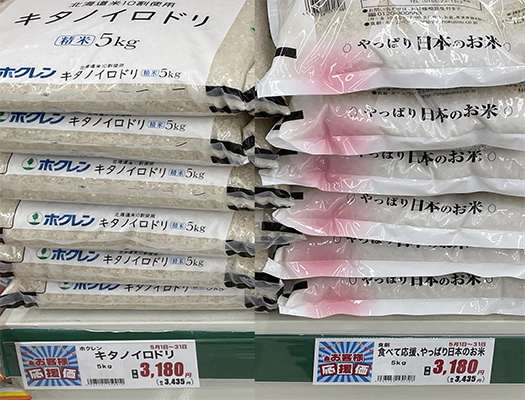
わが家が買い物するお店などではイマドキだと5kg袋が3,500円前後といったところ。写真は、先日の2日間の道東への長距離ドライブの旅路でふと見かけていたコメの値段。これからコメの値段はどのように推移するのかわかりませんが、まだ備蓄があるわが家としては、まぁ焦る必要はないのではというカミさんの意見。素直に主婦の意見に従っておりましたが、さて。
コメの値段とか、米作農家対応というのは、日本の農水省の最重要課題であり、最高レベルの政治課題でもあると思うのですが、その米価の構造についてはあまりユーザーレベルでは関心が持たれなかった。それが揺らいできているのだけれど、メディア報道ではあまり突っ込んだ解説が出てこない。コメ農家に政治的基盤があるという江藤さんという農水大臣が、コメの価格はもうすぐ下がりますとアナウンスしたのに、逆に高騰が進んでいるのが現実。これはヤバいということで自由民主党の小野寺政調会長が動いている様子が報道されていた。農相は政治力に疑問が付くので与党側にハンドルを任せたというような展開かと。
https://news.yahoo.co.jp/articles/a1403de36fb4e4527ec05648e8b46ed3bbc390e9
よく理解しにくい記事だったのだけれど、備蓄米については政府として「販売」しても制度的に「買い戻す」ことが前提となっているので、その価格分が「儲け」として確保されているとのこと。従ってそこそこの「高値」での取引になっている。市場小売り価格を下げるのが現段階での政治方針のハズが、どうも不透明。障害になっている買い戻し制度について「一時的」にそれを撤廃するというような報道。全体的に「隔靴掻痒〜かっかそうよう」<かゆいところに手が届かない様子>の感が否めない。
しかも一方で、コメ輸出の場合には国の支援策として10アール当たり4万円の助成金が得られることも報道されている。1アール当たり4,000円。1アールあたり平均収穫量は約530〜550キログラムなので、コメ集約側としてはモチベーションになり得る。国内で売るより輸出した方が儲かるのか?
もう少し状況を見て、わが家としての購入方針を決めていきたい。
English version⬇
‘Is the rice price spike a failure of agricultural policy?’
Measures to deal with the sharp rise in rice prices have not taken effect fast enough. In fact, they seem to be going backwards. Isn’t this kind of “resentment” the worst thing for politics? …
Various realities continue to move in the world while precipitated by the historical essay series ‘Genko Shiryokan’. One particularly unclear trend is the rise in the price of rice. I can understand to some extent the pressure for various “price hikes” due to the rapid increase in global demand for corona, but I cannot ignore the inflation of rice, which is the staple food of the Japanese people.
In my case, I have been buying directly from a farmer in Miyagi Prefecture, who is an acquaintance of mine, for about 10 years, but the recent surge in prices has finally triggered a buying up of rice in the rice producing areas, and I am no longer able to meet the small demand that my family is experiencing. However, we have secured the last shipment of rice for the next two to three months. In our family, where we are trying to eat smaller meals for the sake of our ageing population and health, one cup of rice is enough for us every day, but sometimes we make sushi, so we need about 1 sho of rice. We have a certain amount of trouble with that.
At the shops where we shop, a 5 kg bag costs around 3,500 yen. The photo shows the price of rice we saw on our two-day long-distance drive to the east of Hokkaido the other day. I don’t know how the price of rice will change from now on, but my wife’s opinion is that there is no need to be in a hurry, as we still have a stockpile. I followed the housewife’s opinion honestly, but now let’s see.
The price of rice and the response of rice farmers is the most important issue for the Japanese Ministry of Agriculture, Forestry and Fisheries, and I think it is also a political issue at the highest level, but the structure of the rice price has not been of much interest at the user level. That has been shaken up, but there has not been much in-depth commentary in media reports. The Minister of Agriculture, Forestry and Fisheries, Mr Eto, who has a political base among rice farmers, announced that rice prices would soon fall, but the reality is that the price of rice is rising in the opposite direction. It was reported that Onodera, chairman of the Liberal Democratic Party’s policy research committee, was making moves because he thought this was a bad idea. The Minister of Agriculture’s political power is questionable, so he has left the steering wheel to the ruling party side.
https://news.yahoo.co.jp/articles/a1403de36fb4e4527ec05648e8b46ed3bbc390e9
The article was difficult to understand, but it was assumed that the government would systematically “buy back” stockpiled rice even if it was “sold”. The article was difficult to understand, but it said that the government is supposed to ‘buy back’ the stockpiled rice even if it is “sold”, so the price is secured as ‘profit’. Therefore, the price is at a “high” level. The political policy at this stage should be to reduce the retail market price, but it is unclear. It is reported that the buy-back system, which has been an obstacle, is to be abolished ‘temporarily’. Overall, there is an undeniable sense of “itching to scratch an itch”.
On the other hand, it is also reported that rice exporters can get a subsidy of 40,000 yen per hectare under a state support scheme, which can be a motivating factor for rice aggregators, as the average yield per hectare is approximately 530-550 kg. Is it more profitable to export than to sell domestically?
We would like to look at the situation a little more and decide on our purchasing policy.
共有:

Posted on 5月 15th, 2025 by 三木 奎吾
Filed under: 状況・政治への発言





コメントを投稿
「※誹謗中傷や、悪意のある書き込み、営利目的などのコメントを防ぐために、投稿された全てのコメントは一時的に保留されますのでご了承ください。」
You must be logged in to post a comment.