
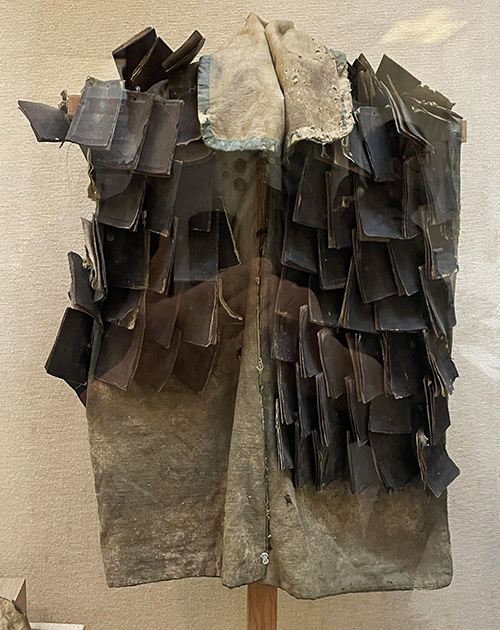
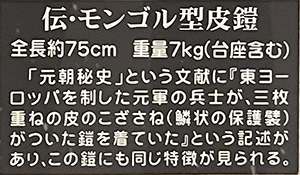
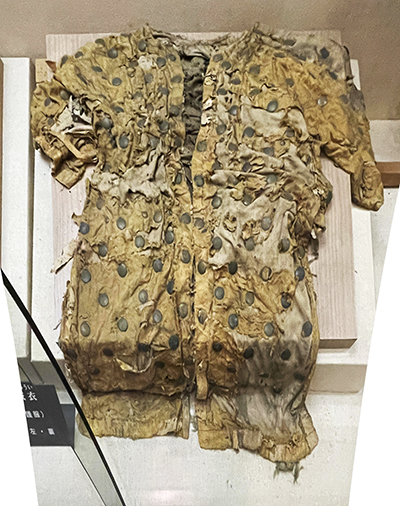
このシリーズで元軍の兵士の戦闘衣が展示されていた様子を書いたけれど、その増補資料も整理できたので追記したい。また前回「真綿」という表記をしたけれど、そのコトバは以下のような意味合いを持つことも確認のために前提として記したい。
<真綿:真綿(まわた)とは、絹の一種で蚕の繭を煮た物を引き伸ばして綿にした物。日本においては、室町時代に木綿の生産が始まる以前は、綿(わた)という単語は即ち真綿の事を指した。白くて光沢があり、柔らかく保温性にも富んでいるため、昔から布団や綿帽子、防寒着の中に詰め込む素材として、又はそのまま服の間に挟んで使用〈背負い真綿〉利用されてきた。〜Wiki要旨>
中国では古くから養蚕が行われていたけれど、北方のモンゴル族支配地域ではそういう生産活動が行われず、漢民族国家からの贈与によってはじめてこうした「衣類による断熱効果」を知ったのだという。それを契機にして体温維持についての「高断熱化」がモングル民族において発達して、民族間・士族間での弱肉強食が展開した大陸国家・中国で「元」という大帝国を誕生させたことになる。
まことに技術発展と権力抗争の相関性がわかる逸話だと思われる。
そして、その高断熱高武装「戦闘衣」革命によってユーラシア大陸を制圧した元軍が、海洋国家ニッポンを襲撃したことになる。この戦闘衣は同時に重厚な鉄板の利用で、刀での攻撃にも矢による殺傷攻撃にも抜群の性能を誇っていた。
第1波の侵略攻撃において、乗馬しての機動性を備えた個別武士による「名を上げる」型の戦闘を仕掛けた日本軍に対して、こうした革命的戦闘衣によって敵勢からの刀と矢での攻撃にはシステムとして完璧に上回っていた元軍が、はるかに優勢だったことは非常にわかりやすい。その上、数において大きく上回っていたのだから、戦闘局面の展開はその性能差が如実に表れた結果と言える。
また弓矢についても日本軍の射程距離が100mだったのに対して敵勢は220mだったことから、いったん戦闘が始まった途端に趨勢は明らかだったことだろう。
このような戦争の現実の中で、日本側の作戦としては、敵軍の弱点に絞って攻撃するしかないだろう。元軍の弱点は、それまでの征服戦争とまったく違う「海軍による侵略戦争」だったこと。その上、日本の周辺海域についての詳細な「海底地形」調査などまではムリだっただろうから、そういう反撃が効果的だったとふつうに想像できる。
そして日本武士たちは、船で「夜襲」を掛けたのだという。<以下、あした以降>
English version⬇
[High performance “leather armour” of Yuan soldiers Yuan Pirates Historical Museum-4]
Silkworm cocoons – “cotton” brings armed revolution to Northern Mongolia. Highly insulated high “armoured” revolution of high defence and combat clothing against swords and bows and arrows. It created a dictatorial and powerful state. …
In this series, I wrote about the display of ex-army soldiers’ combat uniforms, and now that I have organised the additional material, I would like to add to it. In addition, I mentioned the word ‘mawata’ in the previous article, but I would like to note that the word has the following connotations.
<Mawata: Mawata is a type of silk made from silkworm cocoons, which are boiled and then stretched into cotton. In Japan, before cotton production began in the Muromachi period (1336-1573), the word ‘wadding’ referred to cotton. Because it is white, shiny, soft and insulating, it has long been used as a material for stuffing into bedding, cotton hats and winter clothing, or as ‘backpack cotton’, which is placed directly between clothes. 〜The silkworm was first discovered as a gift from the Han Chinese state, which led to the development of the ‘thermal insulation effect of clothing’. This led to the development of ‘high insulation’ for maintaining body temperature among the Mongols, and the birth of the great empire of Yuan in China, a continental state where the weak and strong were the rule among ethnic groups and warlords.
It is an anecdote that truly illustrates the correlation between technological development and power struggles.
The Yuan army, which had conquered the Eurasian continent through its highly insulated, highly armed “battle dress” revolution, then attacked the maritime nation of Nippon. This battle garment simultaneously boasted outstanding performance in both sword attacks and killing attacks with arrows, thanks to the use of heavy steel plates.
It is very easy to see that in the first wave of invasion attacks, the Yuan forces were far superior to the Japanese forces, which had set up a “make a name for themselves” type of battle by individual warriors with mobility on horseback, and were perfectly superior as a system to sword and arrow attacks from the enemy forces due to these revolutionary fighting garments. In addition, since they were greatly superior in numbers, the development of the battle phase was the result of the difference in performance.
In terms of bow and arrow, the Japanese forces had a range of 100 metres, while the enemy forces had a range of 220 metres, so once the battle began, the trend was clear.
In this reality of war, the only strategy for the Japanese side would have been to focus on the weak points of the enemy forces and attack them. The weakness of the Yuan forces was that it was a “naval war of aggression”, completely different from the previous wars of conquest. Moreover, it would have been impossible to conduct a detailed survey of the ‘underwater topography’ of the seas surrounding Japan, so such a counter-attack could normally be imagined to have been effective.
The Japanese warriors then made a “night attack” with their ships. <The following is from tomorrow onwards.
共有:

Posted on 5月 4th, 2025 by 三木 奎吾
Filed under: 歴史探訪




コメントを投稿
「※誹謗中傷や、悪意のある書き込み、営利目的などのコメントを防ぐために、投稿された全てのコメントは一時的に保留されますのでご了承ください。」
You must be logged in to post a comment.