
今回「作家と住空間」という電子書籍を出版して以降、昔人の考えたこと、やってきたことへの思いが強くなってきます。芥川龍之介とか、司馬遼太郎などの作品と住空間に触れることで、その「場所で」かれらはどんな心象に至っていたのか、という想像力に加速度が付いてくる。人生時間に能動的に関われる期間内に、そういう過去の人びととの対話を心がけたい。「高齢期」の生き甲斐としてそのことに集中したい。一般的には「歴史数寄」ということになる。
元寇っていう大きな歴史事実について、もうちょっと深い事実を探査してみたくなった心理的起点。よく「神風なんて国粋主義的な刷り込みに過ぎない」という考えから元寇という歴史事実そのものの発掘をスルーさせるような「圧」がありますが、なんかおかしい。この元寇史料館もその存在自体がまったく知られていない。そもそも管理運営すら公共ではなく、公共から日蓮の開いた宗派寺院に「委託」されているようなのだ。受付窓口は僧侶の方。そろそろ平明に事実の解明・一般化に向かうべきではないか?
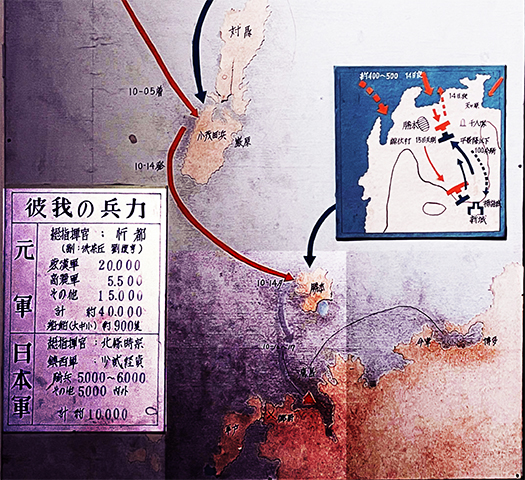
上の図は、展示資料の断片的図柄からPhotoshopで復元再生させたデータ。この資料に寄れば元寇第1波での彼我の兵力は敵勢40,000に対し、九州の御家人たちの動員兵力が10,000程度になっている。
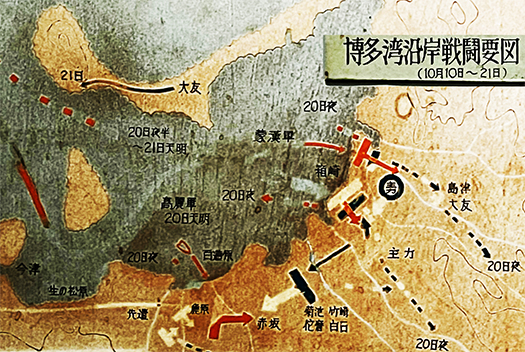
博多の町衆・市民たちは当然さまざまに日本軍に協力しただろうから、そういう総体としての防衛勢力は元軍に対して必ずしも劣勢だったとは思えないが、純軍事勢力では格差があった。結果として1274年10月20日の戦闘においては、数において圧倒的優勢な元軍の跳梁跋扈を許してしまう。薩摩の島津や豊後の大友などの日本側は敗退を繰り返した。きのう見たようにそもそも軍装において大きな技術格差まで存在した。その上、弓矢の弾道距離も2倍程度の格差であり、さらに矢には毒が塗ってあったので損害は甚大だった。「てつはう」といわれる火薬兵器もその威圧力で圧倒されたという。
しかし元軍の「士気」はどの程度だったかは不明。そもそも海軍的な戦争は元としてもはじめての経験。というか海軍をいくら大人数で派遣しても、その地域に根ざす勢力の裏切り協力などが得られなければ、食糧物資の確保など非常に困難だったことだろう。日本国内の内戦でも木曽義仲の失敗などを見れば、あきらかだと思う。強盗のように物資を現地で巻き上げるというのでは民心を把握することは到底ムリ。そういう教訓に踏まえ信長は、初上洛時、軍の非道行為を厳禁し、違反者は発見時に即座に死刑に処している。
その程度のことを元軍が理解していないハズはない。かれらは軍事作戦的には圧倒して博多の街を炎上潰滅させたが焼いてしまっては略奪も不可能。その後全軍が海上の軍船に帰還していたという。<以下、あした以降に>
English version⬇
The first wave of the battle of Bun’ei no Yakuwari, at the Museum of Genko History – 3]
On 20 October 1274, the Yuan forces landed in Hakata, overwhelmed the armies of the Imperialists in Kyushu, and set the city of Hakata ablaze. But was naval “conquest” essentially possible? …
Since the publication of the e-book “Writers and Living Space”, my thoughts about what people thought and did in the past have grown stronger. By coming into contact with the works and living spaces of Ryunosuke Akutagawa, Ryotaro Shiba and others, my imagination about what kind of mental images they had in those “places” has been accelerated. I would like to try to have a dialogue with these people of the past during the period when I can actively engage in the time of my life. I want to concentrate on this as the purpose of living in my “old age”. Generally speaking, this is called “historical pondering”.
This is the psychological starting point of my desire to explore more in-depth facts about the great historical fact of the Genko. There is often a “pressure” to let people go through the excavation of the historical fact of the Genko, based on the idea that “kamikaze is just a nationalistic imprinting”, which is something strange. The existence of this museum itself is not known at all. In the first place, even the management and operation of the museum is not public, but seems to have been “entrusted” by the public to a sectarian temple founded by Nichiren Shoshu. The reception desk is staffed by priests. Isn’t it time to start clarifying and generalising the facts in plain sight?
The figure above is data reconstructed and reproduced by Photoshop from fragmentary patterns in the exhibition material. According to this data, the number of troops mobilised by the Imperialists in Kyushu in the first wave of the Genko was around 10,000 compared to 40,000 by the enemy.
The townspeople and citizens of Hakata would naturally have cooperated with the Japanese in various ways, so it does not seem that the defence force as a whole was necessarily inferior to the Yuan forces, but there was a disparity in terms of pure military strength. As a result, in the battle of 20 October 1274, they allowed the Yuan forces, which had an overwhelming superiority in numbers, to ransack the city. The Japanese side, including Shimazu of Satsuma and Otomo of Bungo, were repeatedly defeated. As we saw yesterday, there was even a large technology gap in military equipment. In addition, the ballistic range of their bows and arrows was about twice as great, and the arrows were coated with poison, so the damage was enormous. The explosive weapons known as “tetsu-hau” were also said to have been overwhelmed by their overpowering power.
However, the extent of the “morale” of the Yuan forces is unknown. In the first place, this was the first experience of naval warfare for the Yuan. In fact, no matter how large a navy was dispatched, it would have been extremely difficult to secure food supplies without the treacherous cooperation of forces rooted in the area. The failure of Kiso Yoshinaka in the Japanese Civil War is a clear example of this. It would have been impossible to grasp the people’s mindset if they were to collect supplies on the spot, like robbers. Based on this lesson, Nobunaga strictly forbade any atrocities committed by his troops when they first arrived in Kyoto, and immediately executed those who violated the law on discovery.
There is no reason to believe that the Yuan forces did not understand this. They overwhelmed the city of Hakata in terms of military operations and destroyed it in flames, but looting was impossible once the city was burnt to the ground. Afterwards, the entire army returned to their warships at sea. <
共有:

Posted on 5月 3rd, 2025 by 三木 奎吾
Filed under: 歴史探訪



コメントを投稿
「※誹謗中傷や、悪意のある書き込み、営利目的などのコメントを防ぐために、投稿された全てのコメントは一時的に保留されますのでご了承ください。」
You must be logged in to post a comment.