
さて「元寇史料館」探訪記に復帰です。
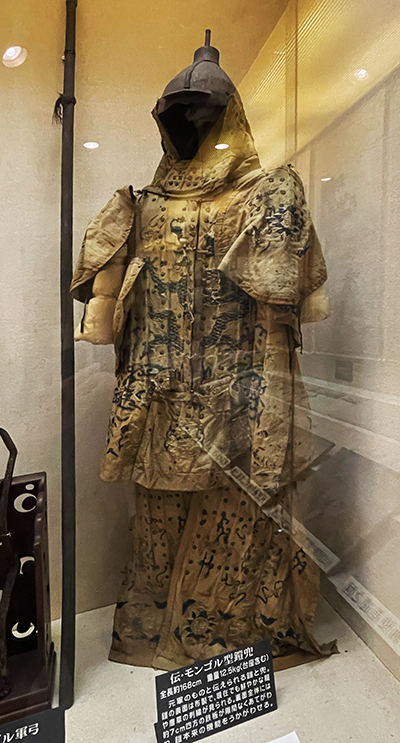
この稀有な「戦争史料館」という珍しい存在で、もっとも目を懲らされたのは、上の写真の元軍兵士の鎧兜。但し書きとして「伝」と付けられているのは、実物として当時から保存され続けてきたものだろうけれど、その事実を証明できる周辺的な解明が出来ずに、その後、元という国家そのものが滅亡してしまったことに起因するだろうと思われた。現代ではそうした解明も可能だろうけれど機微な外交関係下では、そうした軍事にも通じる情報探索は難しいことは容易に想像できる。
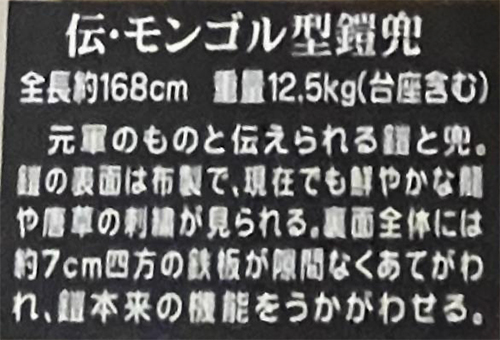
2枚目の写真の通り、168cmの長さ・12.5kgの重量。鎧〜よろい〜の表面は布製で今に至っても色鮮やかな龍や唐草の刺繍デザインが施されている。裏面全体に7cm四方の鉄板が隙間なく装備され、鎧としての優れた機能性をうかがわせる。〜という解説。
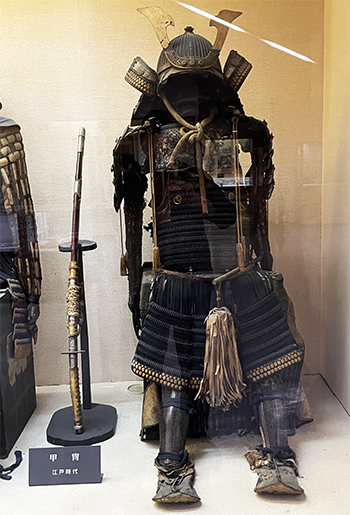
他方日本兵の方は、この時期のものではなく江戸期の日本の武士の装備写真が参考に展示されていた。
この鎧兜について、展示に付けられた説明文の該当部分を以下に引用する。
〜「漢」代の中国はたいへん経済的・文化的に充実した国力を誇っていたが、一方で絶えず北方民族などからの征服脅威にさらされていた。そのため匈奴と呼ばれた勢力に対してはもっぱら物品贈与の外交を持って懐柔手段に当たっていた。そういう物品の中に「真綿」が存在した。北方民族の匈奴にしてみると真綿はほかの豪華な「錦」などの製品よりもその「防寒性」から必需品であったという。さらに真綿は「軽くてあたたかく」しかも矢弾を防ぎ身を守る効果のあることに気づき、やがて「戦闘衣」として用いるようになったのである。このことはヨーロッパのローマ帝国でも知られて中国製のこうした戦闘衣を着て戦わせたところ、敵矢をよく防いだと言われている。┈┈濡れると真綿のその性能はさらに強化された。真綿は最強の「防弾チョッキ」だった。〜
一方日本における真綿の生産歴史は検索では以下の通り。
〜真綿の生産史の概要: 古代:弥生時代後半頃に真綿が日本に伝来し、神話にも養蚕に関する記述があります。 古代から中世:真綿は交易品や衣服、また寝具としても使われました。特に中世には生糸技術が失われたため、養蚕は真綿生産に専念しました。 江戸時代:木綿の栽培が普及し、生糸技術が復活したため、真綿の生産は衰退し始めましたが、近江地方では真綿の生産が盛んに行われていました。〜
こうした歴史を通じた戦争と戦闘衣の進化過程の彼我の相違が、大きく影響した側面があった。元寇についての教科書の図でも、元軍兵士の戦闘衣にはやや奇異を感じたけれど、大きな「性能差」を生み出していたことが理解できた次第。<以下、明日以降につづく>
English version⬇
Biographies of Yuan soldiers in “armour” at the Yuan Enemy Museum – 2]
Various continental states have fought each other since the beginning of history. As a result of this history, there has been a rational development in terms of military equipment. Historical clarification from physical evidence. …
Now back to the exploration of the ‘Genko Historical Museum’.
The most eye-catching thing in this rare ‘war archive’ is the armour helmet of a Yuan soldier in the photo above. The reason why it is labelled as a “legend” is probably due to the fact that it has been preserved as an actual item since that time, but the nation of Yuan itself was destroyed afterwards without any peripheral clarification that could prove the fact. Such clarification may be possible in modern times, but it is easy to imagine that under sensitive diplomatic relations, it would be difficult to search for information that could be used for military purposes.
As shown in the second photo, it is 168 cm long and weighs 12/5 kg. The surface of the armour – yoroi – is made of cloth and is still decorated with colourful dragon and arabesque embroidery designs to this day. The entire reverse side is equipped with a 7 cm square iron plate with no gaps, suggesting the armour’s superior functionality. 〜Commentary.
The following is a quote from the relevant part of the description of this armour attached to the exhibition.
〜During the Han dynasty, China was a powerful and economically and culturally rich country, but at the same time it was constantly threatened by conquests from northern tribes. For this reason, the Xiongnu were exclusively treated with the diplomacy of gifts of goods as a means of nostalgia. Among these goods was cotton. For the northern Xiongnu, cotton was more essential than other luxurious products such as brocade because of its ‘cold-proofing’ properties. They also realised that cotton was “light and warm” and also effective in protecting them from arrows and bullets, and eventually began to use it as “fighting clothes”. This was also known in the Roman Empire in Europe, and it is said that when the Romans made their warriors wear such garments made in China, they were able to defend themselves against enemy arrows. When wet, the performance of cotton was further enhanced. Cotton was the strongest “bulletproof vest”. ~
Meanwhile, the history of cotton production in Japan is as follows in the search.
〜˜ Overview of the history of cotton production: Ancient times: cotton was introduced to Japan around the late Yayoi period, and there are also descriptions of sericulture in mythology. Ancient times to the Middle Ages: Cotton was used for trading goods, clothing and bedding. Especially in the Middle Ages, sericulturalists concentrated on cotton production due to the loss of raw silk technology. Edo period: Cotton production began to decline as cotton cultivation became widespread and raw silk technology was restored, but cotton production continued to flourish in the Omi region. ~
These differences between him and herself in the evolutionary process of warfare and combat clothing throughout history were a major aspect of the impact of the war. In the textbook’s illustration of the Genko, I felt that the battle dress of the Yuan soldiers was a little strange, but I could understand that it created a big “performance difference”. <Continued from tomorrow.
共有:

Posted on 5月 2nd, 2025 by 三木 奎吾
Filed under: 日本社会・文化研究





コメントを投稿
「※誹謗中傷や、悪意のある書き込み、営利目的などのコメントを防ぐために、投稿された全てのコメントは一時的に保留されますのでご了承ください。」
You must be logged in to post a comment.