
先日「ミュージアム体験」の北海道大学博物館の一般向け講演を聴講。ご教授いただいた湯浅万紀子先生とは親しくお話しもさせていただけたのですが、今回のわたしの広島県福山市「松永はきもの資料館」の展示との遭遇は、超絶なミュージアム体験でした。
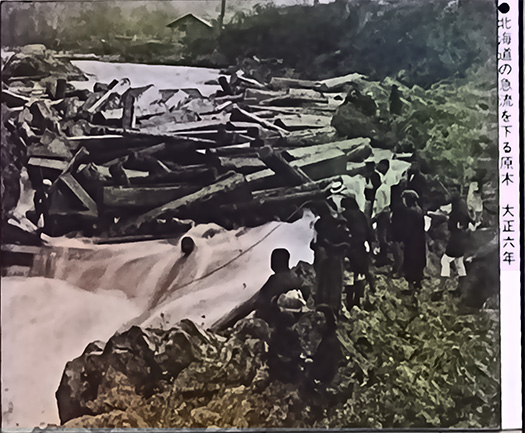
示されていた展示パネル写真。現品はモノクロでしたがPhotoshopのAI「カラー化」技術で、よりリアリティを高めた1枚。カラー化自体はおおむね的確と思われます。
で、この写真は大正6年(1917年)の北海道での「原木伐採」の様子。
福山市松永地域は江戸後期、革新的「入浜式塩田」導入で福山藩専売事業の中核を占め続けていたのですが、やがて塩生産が瀬戸内海全域で活性化。市場原理から塩価格下落などの問題も生起した。
その流れから松永地域では塩精製工程の必要性から大量の薪木集中があったので、地域の起業家・丸山茂吉氏がその木材を活用した「下駄」の大量生産を企画し事業化に成功。それまでの桐素材などに限定した製造工程から、豊富な木材資源のどんな樹種でも対応するシステムを作り上げて大成功した。全国需要の6割を超える生産を誇っていた。
塩業から「はきもの」産業への地域基幹産業の大転換が起こっていたのです。
明治期のわたしの家系はこのような地域経済の変容の中で、自らの中核事業・塩業の危機から、一方での下駄産業の盛業をみて、当然ながら自らをその材木需要にシフトさせようと考えた。
北海道地域では旧財閥系企業群も大きな興味を持ってやがて「製紙工業」などに結実させる木材産業が大きく勃興する。そこに、祖父はベンチャー的参入を企図した。製塩が国家の専業事業になって地域産業家としては頓挫した1905年(明治38年)の段階でのこと。
上の写真は、その当時から10数年後の北海道留萌地域での様子。祖父は少し北方の「天塩川」流域での事業展開ですが、ほぼ同定。
このプロジェクトは予想を超える雪融け時期の「融雪水」濁流によって材木が日本海に大流出し、あえなく大破綻。
その痛恨の事実をこの1枚の記録写真は物語っている。多数の「使役者」が河川を下る材木を見張っている様子がわかる。プロジェクトがどれだけの資本投下だったかが察せられる。そして濁流化した河川の様子、躍り上がるかのような材木のリアリティ。
亡き祖父が体験した事業の真実が、心底に響いてくる。
●お知らせ
拙書「作家と住空間」幻冬舎から電子書籍で発刊
お求めはAmazonで。
https://amzn.asia/d/eUiv9yO
English version⬇
【Matsunaga Discovers Traces of “Grandfather’s Enterprise” at Kimono Museum (Shock)】
Was the aim of my grandfather’s timber harvesting project in Hokkaido’s Teshio River basin to link with the thriving “geta” sandal industry in his hometown of Fukuyama Matsunaga? An awakening museum experience. …
The other day, I attended a public lecture on “Museum Experiences” at Hokkaido University Museum. I had the pleasure of speaking with Professor Makiko Yuasa, who kindly shared her insights. However, my encounter with the exhibition at the Matsunaga Kimono Museum in Fukuyama City, Hiroshima Prefecture, was an absolutely extraordinary museum experience.
The displayed panel photo. The original item was monochrome, but this image, enhanced with Photoshop’s AI “colorization” technology, achieved greater realism. The colorization itself seems generally accurate.
This photograph depicts “logging operations” in Hokkaido in 1917 (Taisho 6).
The Matsunaga area of Fukuyama City had been central to the Fukuyama Domain’s salt monopoly business since the late Edo period, thanks to the introduction of the innovative “irigami-style salt fields.” However, salt production soon flourished throughout the entire Seto Inland Sea. Market forces then led to issues like falling salt prices.
Amid this shift, the Matsunaga area saw a concentrated demand for large quantities of firewood due to the salt refining process. Local entrepreneur Shokichi Maruyama conceived and successfully commercialized the mass production of “geta” (wooden clogs) using this timber. He built a highly successful system capable of utilizing any tree species from the abundant local wood resources, moving beyond the previous manufacturing process limited to materials like paulownia wood. Production exceeded 60% of national demand.
A major shift occurred in the region’s core industry, transitioning from salt production to the “footwear” industry.
During the Meiji period, my family, amidst this regional economic transformation, faced a crisis in its core salt business. Witnessing the thriving geta industry, it naturally considered shifting its focus to meet the demand for timber.
In Hokkaido, former zaibatsu-affiliated companies also took a keen interest, leading to the significant rise of the timber industry, which eventually crystallized into sectors like the paper industry. My grandfather planned a venture-style entry into this field. This occurred in 1905 (Meiji 38), when salt production became a state monopoly, halting his regional industrial ambitions.
The photo above shows the situation in the Rumoi region of Hokkaido, about a decade later. My grandfather’s venture was slightly further north, in the Teshio River basin, but it’s essentially the same area.
This project suffered a catastrophic failure when unexpectedly heavy snowmelt floods carried the timber out to the Sea of Japan in a massive, muddy torrent.
This single photograph vividly captures that bitter reality. You can see numerous laborers watching the timber float down the river. One can sense the immense capital investment behind the project. And the reality of the muddy river, the timber seemingly leaping out of the water.
The truth of the venture my late grandfather experienced resonates deep within.
●Notice
My book “Writers and Living Spaces” published as an e-book by Gentosha.
Available on Amazon.
共有:

Posted on 12月 26th, 2025 by 三木 奎吾
Filed under: 未分類




コメントを投稿
「※誹謗中傷や、悪意のある書き込み、営利目的などのコメントを防ぐために、投稿された全てのコメントは一時的に保留されますのでご了承ください。」
You must be logged in to post a comment.