
本日目覚めたら、Facebookから「新しい才能」バッジを獲得しました、という知らせ。
「え? わたしそれほど<新しく>ない前期高齢者ですが・・・」と脳ミソは反応していたのですが、ブログ表現者として先方のメガネに適ったと言うことだそうです。ありがたく。一応、ご報告いたします。
で、本日もふたたび「カラー化」による過去時間のリアルタイム化探索であります。
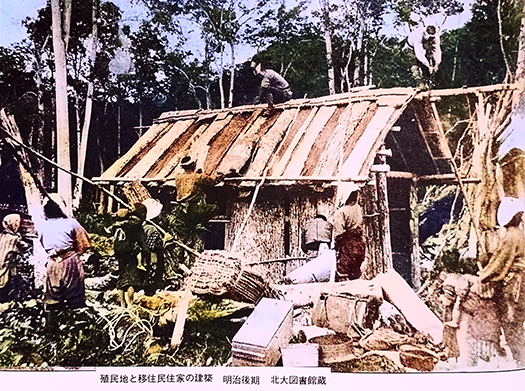
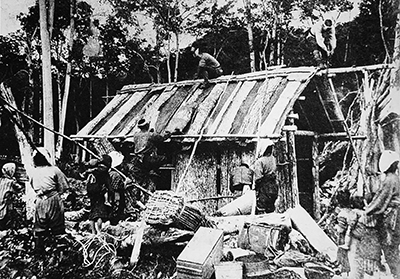
写真は北海道大学図書館所蔵の「殖民地と移住民住家の建築」と題された記録写真と、その当時の空気感に迫りたいということからモノクロ画像のカラー化を試みた画像&元画像。
この明治後期という時代には、わたしの家系、祖父が北海道岩見沢市郊外の栗沢に入植した。もちろんその時代の「写真」は、ごく一部の写真専門家が特殊な機材を持参して撮影したもの。なので、わが家系にはそうした伝承写真などはまったくありません。しかし時代背景と「殖民地(入植地)」の雰囲気はほぼ同様だと思える。
わたしの家系は30代早々の祖父と祖母、幼子2人という家族で入植したので、その居所(住宅というにはあまりにDIY的簡素さ)の建築に当たって、この写真のように近隣の方々にお手伝いいただいたことが推定できる。
移住に当たっては郷里・広島県備後地域の地縁のある北海道先住の方を手づるにしたということなので、概ねこのような光景が展開していただろうと思われるのですね。蓋然性がきわめて高い。
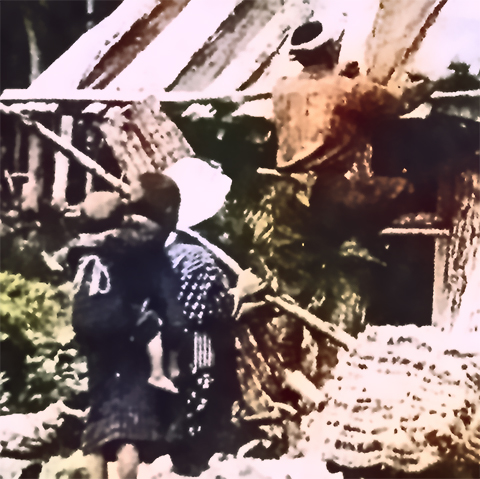
モノクロ写真を凝視していたら、幼子が背中におぶさっている。その足がほんのりとカラー化されて、心象が強く刺激されてくる。わが家系でもわたしの伯母にあたる幼子がこのように背負われていたに違いない。やはり写真からの情報伝達が一気に「血肉化」してくるような気分。
明治後期の北海道移住、そのリアルタイム感が迫ってくる。
しかしそれにしても、本州温暖地での「小屋組」での簡素な家。
極寒の北海道で、こういう小屋に住み暮らし始めた血脈の人びとの辛苦が深く胸に迫ってくる。
●お知らせ
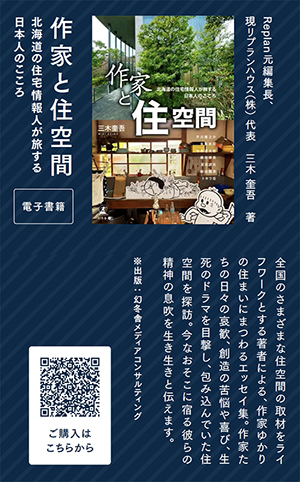
拙書「作家と住空間」幻冬舎から電子書籍で発刊
お求めはAmazonで。
https://amzn.asia/d/eUiv9yO
English version⬇
The Reality of Late Meiji-Period Migration to Hokkaido with Young Children and Building Homes
Our ancestors boldly migrated to snowy, frigid Hokkaido with these DIY log cabins. Chronologically, this perfectly aligns with my own family lineage. …
Woke up today to find a notification from Facebook saying I’d earned a “New Talent” badge.
My brain reacted with, “Huh? I’m not exactly
And so, today once again, it’s an exploration of bringing past times into real-time through “colorization.”
The photos are from the Hokkaido University Library collection titled “Architecture of Colonies and Immigrant Settlements.” I attempted to colorize these monochrome images to capture the atmosphere of that era, along with the original images.
During this late Meiji period, my family lineage—my grandfather—settled in Kurisawa, on the outskirts of Iwamizawa City, Hokkaido. Naturally, “photographs” from that era were taken only by a handful of specialized photographers who brought their own equipment. So, my family has absolutely no such inherited photographs. However, the historical context and the atmosphere of the “colony (settlement)” seem almost identical.
My family settled there as a small household: my grandfather and grandmother in their early 30s, and two young children. When building their dwelling (too DIY and simple to call it a house), it’s reasonable to assume they received help from neighbors, much like in this photo.
For the migration, they reportedly used connections to existing Hokkaido settlers with ties to their hometown region of Bingo, Hiroshima Prefecture. So, scenes like this were likely common. The probability is extremely high.
Staring intently at the black-and-white photo, I notice a young child being carried on someone’s back. The child’s legs are faintly colored, powerfully stirring my emotions. In my own family, my aunt as a child must have been carried like this. It feels as if the information conveyed by the photo suddenly becomes deeply personal.
The real-time sense of late Meiji-era migration to Hokkaido presses in.
Yet even so, a simple house built with a “small frame” in the warm regions of Honshu.
The hardships endured by the bloodline who began living in such huts in the bitter cold of Hokkaido deeply move me.
●Notice
My book “Writers and Living Spaces” published as an e-book by Gentosha
Available on Amazon.
共有:

Posted on 10月 7th, 2025 by 三木 奎吾
Filed under: 未分類



コメントを投稿
「※誹謗中傷や、悪意のある書き込み、営利目的などのコメントを防ぐために、投稿された全てのコメントは一時的に保留されますのでご了承ください。」
You must be logged in to post a comment.