
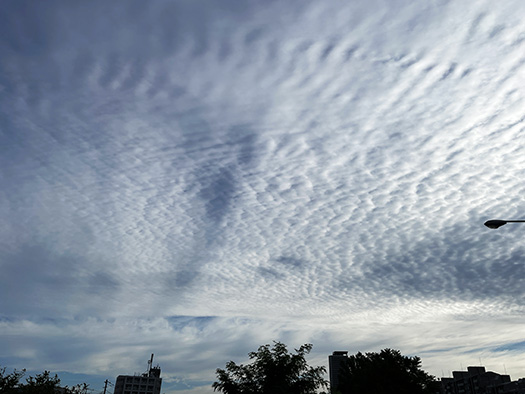
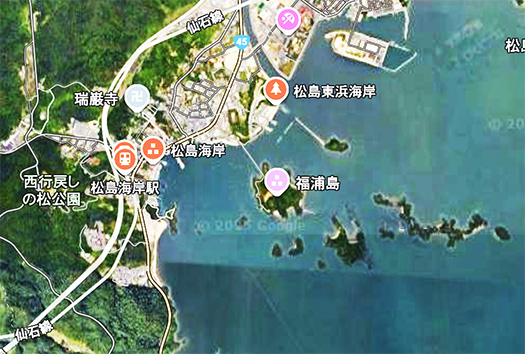
芭蕉さんは「歌枕を訪ねる旅」として奥の細道を行脚されたけれど、なぜか松島については句が残されていない。(写真は無関係。昨日の札幌の「うろこ雲」とGoogleマップ「松島」)
奥の細道の「曽良」さんの清書された文章(『おくのほそ道』素龍清書本)では、松島の条では以下のような記述。
〜松島は扶桑第一の好風にして
およそ洞庭、西湖を恥ぢず。
東南より海を入れて、
江のうち三里、浙江の潮をたたふ。
島々の数をつくして、
そばだつものは天を指さし、
伏すものは波にはらばふ。
あるは二重に重なり、三重にたたみて、
左にわかれ右に連なる。
負へるあり、抱けるあり、児孫愛すがごとし。
松の緑こまやかに、枝葉潮風に吹きたわめて、
屈曲おのづから矯めたるがごとし。
その気色、窅然として美人の顔を粧ふ。
ちはやぶる神の昔、
大山つみのなせるわざにや。
造化の天工、
いづれの人か筆をふるひ、ことばを尽くさむ。
雄島が磯は、地続きて海に出でたる島なり。
雲居禅師の別室の跡、座禅石などあり。
はた、松の木陰に世をいとふ人も
まれまれ見え侍りて、
落ち穂・松かさなどうちけぶりたる草の庵、
静かに住みなし、
いかなる人とは知られずながら、
まづなつかしく立ち寄るほどに、
月、海に映りて、昼のながめ、またあらたむ。
江上に帰りて宿を求むれば、
窓を開き二階を作りて、
風雲の中に旅寝するこそ、
あやしきまで、妙なる心地はせらるれ。
松島や 鶴に身を借れ ほととぎす 曾良
予は口を閉ぢて眠らんとして寝ねられず。
旧庵を別るるとき、素堂、松島の詩あり。
原安適、松が浦島の和歌を贈らる。
袋を解きて、こよひの友とす。
かつ、杉風、濁子が発句あり。
<以上、奥の細道 原文全文より転載。>
というような記述で、「予」は「口を閉ぢて眠らんとして寝ねられず」と記されている。正直な「感想」というような記述だろうか。お弟子さんの曾良さんの「松島や 鶴に身を借れ ほととぎす」と詠じている句が記されるのみ。
たっぷりと情景描写はされていて「あやしきまで、妙なる心地はせらるれ」とあるので、現地での体感でもさまざまなイメージは盛り上がっていたことは間違いがない。
この時代までの日本人の感性としてはやはり「多島海」の風景に強い心象があったのだろう。このあと、いまは干上がっている多島海として知られていた東北秋田の「象潟〜きさかた」をも探訪している。ここでも松島との対比が語られていた。日本三景である「松島・天橋立・厳島」ともすべてが海と陸地との景観美。
やはり音節重視の57調による詠嘆表現という日本文学の主要なテーマ性に於いて、これらの情景がもっとも「歌枕」とされやすいということなのだろう。
松島にとって芭蕉さんが句を残さなかったことは、案外良かったのかも知れない。
「特別」感がよりきわだつ効果があったのではとも思える。う〜む。とても敵わないみたいな(笑)。
●お知らせ
拙書「作家と住空間」幻冬舎から電子書籍で発刊
お求めはAmazonで。
https://amzn.asia/d/eUiv9yO
English version⬇
Why didn’t Basho write about Matsushima? / A Journey Through Japanese Poetry in 5-7 Syllable Verse – 5
The original text, “Oku no Hosomichi,” contains quite detailed and intricate expressions of emotion. It conveys a sense of mystery and wonder, as well as a sigh of admiration. …
Basho traveled along the Oku no Hosomichi as a “journey to visit places mentioned in poems,” but for some reason, he left no poems about Matsushima. (The photo is unrelated. It shows yesterday’s “fish scale clouds” in Sapporo and Google Maps’ “Matsushima.”)
In the neatly written text of “Sora” from Oku no Hosomichi (Soryu Seisho-bon), the following description appears in the section on Matsushima.
Matsushima is the finest scenery in Japan,
comparable to Dongting Lake and West Lake.
From the southeast, the sea flows in,
and within three miles of the river, the tides of the Zhejiang River surge.
The number of islands is countless,
some pointing toward the sky,
others lying flat on the waves.
Some overlap in two layers, others in three,
branching left and right.
Some bear others, some embrace others, like parents loving their children.
The green of the pines is delicate, their branches and leaves swaying in the sea breeze,
bending naturally as if straightened.
Their appearance is serene, like the face of a beautiful woman adorned with makeup.
In the ancient days of the gods,
was this the work of the great mountain gods?
The work of nature’s artistry,
who could possibly wield a brush and find the words to describe it?
Oshima is an island connected to the mainland by a strip of land.
There are traces of the hermitage of the monk Unkyu, including a meditation stone.
Indeed, people who shun the world can be seen
rarely in the shade of the pine trees,
living quietly in grass huts scattered with fallen ears of rice and pine cones,
without anyone knowing who they are.
Yet, one cannot help but feel a sense of familiarity upon visiting them,
as the moon reflects on the sea,
and the daytime view is renewed.
Returning to the river, I seek lodging,
opening the window and building a second floor,
sleeping in the midst of wind and clouds,
a strange yet wonderful feeling.
Matsushima, borrow the body of a crane, hototogisu.
I close my mouth and try to sleep, but cannot.
When parting from the old hermitage, Sodo composed a poem about Matsushima.
Hara Yasutoki presented a waka poem about Matsushima.
Opening the bag, I made it my companion for the night.
Additionally, Sugi Kazé and Nakago composed haiku.
Such descriptions include the phrase “Yū” being recorded as “closing his mouth and trying to sleep but unable to do so.” Is this an honest ‘impression’? The only other description is of his disciple Sōryō’s poem, “Matsushima, borrow the body of a crane, hototogisu.”
The scene is described in great detail, with the phrase “a mysterious, wonderful feeling” suggesting that the author’s impressions of the place were indeed vivid.
It seems that the Japanese of that era had a strong emotional connection to the scenery of the “archipelago sea.” Later, he also visited “Kisakata” in Akita, Tohoku, which was once known as an archipelago sea but is now dry. Here too, the contrast with Matsushima was mentioned. All three of Japan’s Three Scenic Views—Matsushima, Amanohashidate, and Itsukushima—feature the beauty of the landscape where sea and land meet.
Perhaps it is because these scenes are most easily associated with “utamakura” (poetic motifs) in Japanese literature, which emphasizes the rhythmic structure of 5-7 syllable verses.
Perhaps it was for the best that Basho did not leave any haiku about Matsushima.
It may have had the effect of making it feel even more “special.” Hmm. It’s really no match (laughs).
●Notice
My book “Writers and Living Spaces” has been published as an e-book by Gentosha.
Available on Amazon.
共有:

Posted on 8月 23rd, 2025 by 三木 奎吾
Filed under: 日本社会・文化研究




コメントを投稿
「※誹謗中傷や、悪意のある書き込み、営利目的などのコメントを防ぐために、投稿された全てのコメントは一時的に保留されますのでご了承ください。」
You must be logged in to post a comment.