
さてふたたび「奥の細道」松尾芭蕉さん探訪篇です。名前をいろいろ考えたけれど「五七調日本語の旅」というように固定させたい。
言うまでもなく、現代生活では明治以降の洋風スタイル、世界標準文化の受容、追いつき追い越せの日本国家社会の「近代化現代化」が急務となって、国語というものが大きく変革されることになった。それはそうだろう、五七調日本語は、ともすれば言葉遊びに堕しかねない「音韻」を楽しむ言語文化。芭蕉はそういうなかで「変革者」ではあっても、基本的にはその日本的詩文音韻情感の世界にいる人物。
司馬遼太郎はそういう科学文明受容の「国家使命」の国語文化改革の中心に据えられた夏目漱石が、孤独なイギリスでの「文化摂取」活動に於いて深く苦悩したという論旨を展開していた。わたしたち戦後人もまた、深く世界共通文化世界のなかで生きてきた。科学的明晰性を追求できる言語として、さまざまなカタカナでの直接単語導入とか、「的」という、英語「tic」の音韻的借用語尾を開発したりした。このような日本における改革は、とくに「的」など中国にも及んで漢字も日本の変革を経由して改革されてきている。そういう背景があって、今日の東アジア世界のありようは規定されてきている。
現代ではさらに日本文化はその先を行くマンガというビジュアルツールの爆発的世界展開によって、世界標準化に至ろうとしている。またブログというオープンな表現手段によって文章表現の領域自体も大きく変革を余儀なくされてきている。旧来の著名作家の独占による文章文化世界も崩壊し大きな変革期がやってきている。
そういう情勢の中で、温故知新。五七調日本語も再度見直すべきではないかと思える。
おっと、本日のテーマからは大きく逸脱。目も、より一層赤くなってくる(笑)。
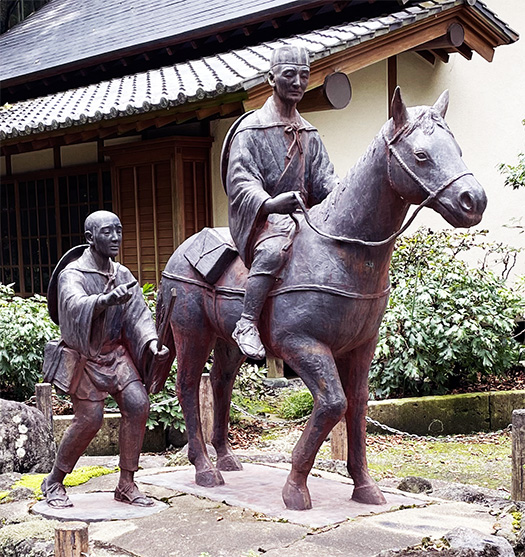
写真は芭蕉さんの移動手段で銅像化されたもの。黒羽芭蕉館の玄関前設置。これは江戸期までの移動交通手段・伝馬制度によって宿駅から宿駅の間の移動手段として使われていた馬の利用。公共の用途では無料利用だったが、一般人は今日社会と同様に「相対賃銭」と言われる費用を負担していた。これは「公定賃銭」よりも高額で「御定」賃銭の2倍程度であったと言われている。現代でも国会議員は飛行機でも広い前方席を無賃乗車できるけれど、一般人は後部席の狭い席で高額を支払わされることにその残滓があるように思う。
芭蕉さんも、訪問した地域有力者から馬代を費用負担してもらったりして、その感謝の旨を申告し記録したりしている。世は金に連れている・・・。
●お知らせ
拙書「作家と住空間」幻冬舎から電子書籍で発刊
お求めはAmazonで。
https://amzn.asia/d/eUiv9yO
English version⬇
[How did Basho travel? / A Journey Through Japanese Poetry – 4]
Today’s era is a period of cultural change in communication, similar to the Japanese language reform period during the Meiji era. There has been a big bang of change, including the evolution of direct communication through manga and the destruction of the monopoly of experts through blog culture. …
Now, let’s return to Matsuo Basho’s “Oku no Hosomichi” (The Narrow Road to the Deep North). I considered various names, but I decided to settle on “A Journey Through Japanese 5-7-5 Poetry.”
Needless to say, in modern life, the acceptance of Western-style culture and global standards since the Meiji era, as well as the Japanese national society’s urgent need to “catch up and surpass” in its “modernization and industrialization,” led to major changes in the Japanese language. That makes sense, as the 5-7-5 Japanese verse form is a linguistic culture that enjoys “sound patterns,” which can easily devolve into wordplay. Basho was a “reformer” in that sense, but fundamentally, he remained within the world of Japanese poetic sound patterns and emotional expression.
Shimabara Ryotaro argued that Natsume Soseki, who was placed at the center of the national language cultural reform as part of the “national mission” to embrace scientific civilization, deeply struggled during his solitary “cultural absorption” activities in England. We, the postwar generation, have also lived deeply within the shared cultural world. As a language capable of pursuing scientific clarity, we have introduced various direct loanwords using katakana and developed phonetic loanword suffixes such as “-teki,” derived from the English “-tic.” Such reforms in Japan have even extended to China, where characters have been reformed through Japan’s reforms. Against this backdrop, the current state of East Asia has been shaped.
In modern times, Japanese culture is further advancing toward global standardization through the explosive worldwide expansion of manga, a visual tool. Additionally, the realm of written expression itself is being forced to undergo significant transformation through the open expression medium of blogs. The traditional literary world dominated by renowned authors is collapsing, and a major transformative era is upon us.
In such circumstances, it may be time to revisit the traditional 5-7-5 Japanese verse form.
Oops, I’ve strayed far from today’s theme. My eyes are getting even redder (laughs).
The photo shows a statue of Basho’s mode of transportation. It is installed at the entrance of the Kuroba Basho Museum. This refers to the use of horses as a means of transportation between post stations under the post station system, which was the primary mode of transportation until the Edo period. While public use was free, ordinary people, like in today’s society, had to bear the cost known as “relative fare.” This was reportedly about twice as high as the “official fare.” Even today, while members of parliament can ride in the spacious front seats of airplanes for free, ordinary people have to pay high prices for the cramped seats in the back—a remnant of that system, I think.
Basho also had the local influential figures he visited cover the costs of horse transportation, and he recorded his gratitude for this. The world is driven by money…
●Notice
My book “Writers and Living Spaces” has been published as an e-book by Gentosha.
Available for purchase on Amazon.
共有:

Posted on 8月 22nd, 2025 by 三木 奎吾
Filed under: 日本社会・文化研究





コメントを投稿
「※誹謗中傷や、悪意のある書き込み、営利目的などのコメントを防ぐために、投稿された全てのコメントは一時的に保留されますのでご了承ください。」
You must be logged in to post a comment.