
平安ー鎌倉期の西行さんや、江戸期の芭蕉さんなど日本史上では多くの「漂泊」の旅人文化があります。踊り念仏の一遍さんなどもそうした系譜の中で捉えた方がふさわしいとも感じます。で、高齢化社会という日本人のあらたな社会環境のなかで再発見されるべき「生き様」文化のひとつの領域ではないかと思っています。
かれらの時代にはひたすら歩きまわるという道行きで、しかも和歌や俳句などの詩文文化によってこころの陰影感を表現する活動だった。そういったはるかな先人たちの道行きとは違って現代のわれわれらしい行程というのもあるでしょう。わたしはビジネス生活としては住宅情報の世界で生きてきましたが、その基本は「現地での取材・撮影」行動。そういったライフスタイルは血肉になっているので、日本文化の「建築」に関連した公開的施設を巡り歩き、その周辺で可能な限り「住宅」の撮影機会を探る、という生き方を選択してきています。そういった流れから「公開された住宅」としてそこで生きていたことが明示されている「作家」住宅に着目したところ。
基本はブログという文章表現で「書き留めて」そのあとで写真を交えた空間性表現の「深化」をこころみる、というような指向性。一方建築としても各地の宗教寺院や神社などの公共的空間を歩くことになる。
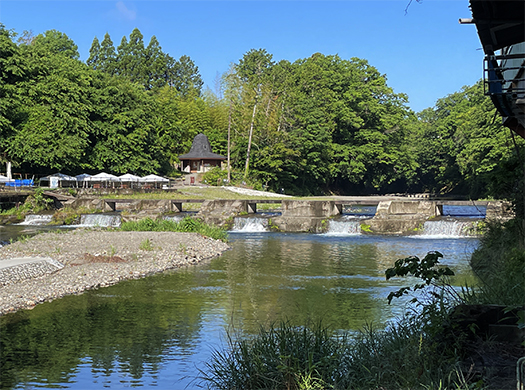
今回はそうしたなかから埼玉県飯能市という地方を歩いてみた。こういう目立たない(失礼)地方都市は、庶民的な生き方探訪には格好の対象。で、早朝ホテルでヒアリングした周辺を散歩。飯能河原という素朴な自然美のそばに真言宗寺院をみつけ朝の礼拝をと願った次第。あ、わたしけっこう神社とか宗教は好きなんです。奥の細道(笑)。
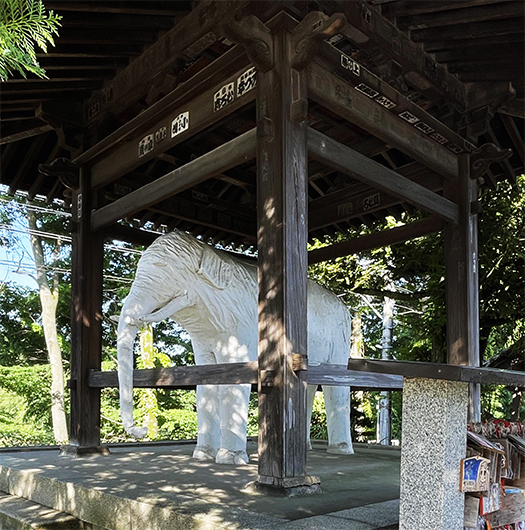
そうしたら上の写真のような光景に遭遇。この「観音寺」では通常鐘楼とされる場所に、なんと白象が端座していたのであります。
寺のHPには以下の記述要旨。「白象はお釈迦様の生母マーヤ夫人の夢に現れ釈迦の誕生を予言した。こうした説話の白象を、昭和40年代に祭事にからんである檀家の方が作られた。それを縁あって鐘楼堂に収めさせていただいた。以来、観音寺檀家信徒の方々や飯能幼稚園生徒たちを優しく見守っている」。
戦争最中で鐘楼の鐘は供出されて空虚になっていた場所に白象が収まったことになる。なかなか良い姿であり、またその縁起も楽しい。手づくり感のあふれる姿とその周辺の空気感に深く癒されていました。
●お知らせ
拙書「作家と住空間」幻冬舎から電子書籍で発刊
お求めはAmazonで。
https://amzn.asia/d/eUiv9yO
English version⬇
[In a strange town, a “white elephant” is found in the bell tower of a temple on the riverside of a walking path]
Drifting journey like Saigyo’s is a lifestyle that should be reviewed in an aging society. On the road, white elephants are showing us nirvana (laughter)….
There have been many “drifter” traveler cultures in Japanese history, such as Saigyo in the Heian and Kamakura periods and Basho in the Edo period. I feel that Ippen, the dancer and nembutsu practitioner, should be considered as part of such a lineage. I believe that this is one area of “way of life” culture that should be rediscovered in the new social environment of an aging Japanese society.
In their time, they used to walk around and express the shadows of their hearts through poetic and literary culture such as waka and haiku. Unlike the paths taken by their predecessors, there may be a path that is unique to us today. I have lived in the world of housing information in my business life, but the basis of my business life has been to “go to the site and take pictures. This lifestyle is in my blood, and so I have chosen to live my life by visiting public facilities related to the “architecture” of Japanese culture and seeking out opportunities to photograph “houses” in the vicinity of such facilities whenever possible. In that vein, I have just focused on “artist” residences that clearly indicate that they were lived there as “public” residences.
The basic orientation is to “write down” in the form of a blog, and then try to “deepen” the expression of spatiality with photographs. On the other hand, as for architecture, I will walk through public spaces such as religious temples and shrines in various regions.
This time, I walked around Hanno City in Saitama Prefecture. Such an inconspicuous (pardon the pun) regional city is an ideal target for exploring the way of life of the common people. So, I took a walk around the area I had heard about at the hotel early in the morning. I found a Shingon temple near the simple natural beauty of Hanno Kawara and wished to pray there in the morning. I like shrines and religions a lot. I love shrines and religion.
Then, I came across the scene shown in the photo above. In this “Kannon-ji” temple, a white elephant was sitting in the place that is usually used as a bell tower.
The temple’s website has the following description. The white elephant appeared in the dream of the Buddha’s mother, Mrs. Maya, and predicted the birth of the Buddha. In the 1965’s, a parishioner made the white elephant from this story in connection with a festival. The elephant was placed in the bell tower of the temple. Since then, it has been gently watching over the parishioners of Kannonji Temple and the students of Hanno Kindergarten.
The white elephant was placed where the bell of the belfry had been left empty after the bell was offered during the war. It is quite a nice figure and its auspiciousness is also enjoyable. I was deeply healed by the full of handmade appearance and the atmosphere of the surrounding area.
●Notice
My book “Writers and Residential Space” is published by Gentosha in e-book format
Available at Amazon.
共有:

Posted on 5月 30th, 2025 by 三木 奎吾
Filed under: 「都市の快適」研究




コメントを投稿
「※誹謗中傷や、悪意のある書き込み、営利目的などのコメントを防ぐために、投稿された全てのコメントは一時的に保留されますのでご了承ください。」
You must be logged in to post a comment.