
元寇史料館での体感シリーズも合計10回目の連載記事で、トータルの文字数はたぶん10,000字を超えてきました。日を重ねながらいろいろな側面にスポットを当てて特定テーマを書き続けるというブログスタイルのメリットを感じています。
それに対して、いま現在ではyoutube動画に対して「広告収入」が得られるということから、そちらの方が個人の情報発信のメインに変化してきていますが、どうもそういうメディア利用というのは、本来的な情報の深さ探究と考えてどうなのかなと思っています。まぁいろいろな見解のあり得るNHKですが、その番組作り、とくに衛星放送分野での番組は、非常に興味深い「深み」がある。それに対して、広告収入狙いの民放系の番組作りは完全に「オワコン」化している。どうも、そういう情報の本質論でカネ儲け最優先という姿勢に未来はないのではと思っています。
おっと、本日の連載ブログのテーマから完全に逸脱(笑)。失礼。
1274年の第1波文永の役から7年後の1281年、ついに第2波「弘安の役」が勃発する。文永の役で撤退した軍事行動について彼我の政治的解釈の違いが、その間の「外交交渉」への態度に表れた。1275年、交渉に訪れた外交使節をときの鎌倉幕府執権・北条時宗は「切り捨てる」という処断を下す。怖ろしい外交態度だが、このことは世論の支持を受けたとされている。各界各層は島国的心理から大いに溜飲を下げた。
元の側は外交使節の音沙汰がないので再度使節を、それも「かれらはどうなったか?」と聞くために派遣したがその使節もまた、鎌倉に送られることすらなく太宰府で切り捨てたという。外交常識を越える狂気。
どうも日本の国内世論の趨勢には国際常識とは異質な「偏向性・偏執性」が根ざしていると思える。目先の軍事最優先の軍人政治家・北条時宗24歳の無謀な「やらかし」。それを囃す国内世論。このあたり、江戸末期の幕府政権は少なくとも国際常識において常識的だったと対比できる。
このような外交の結果として、元軍は怒りを露わに第1派をはるかに凌駕する大軍14万を北部九州〜山口県に侵攻させてきた。弘安の役勃発。
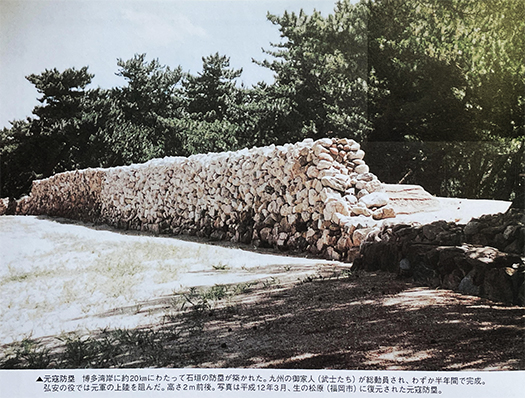
しかし今回は太宰府・博多の街を防衛するために長大な「石塁」が築かれていた。鎌倉幕府として御家人たちにその領地の面積毎に費用負担させて築かせたといわれる。元軍側としては博多湾から遠望するこの石塁を見て驚いただろう。石塁の内側には土が盛られ、石塁に取り憑いてよじ登ろうとすれば防衛軍によって頭上から弓矢で射殺された。専守防衛的な軍備に対して途方に暮れたことだろう。
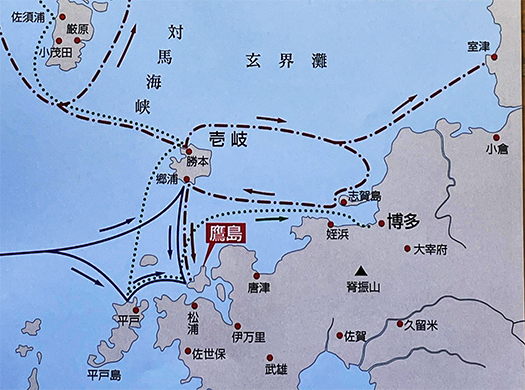
元の派遣軍の高麗を中心とする先発隊は攻めあぐねて躊躇し、後軍の10万を超す大部隊もまた、博多湾に近づけず鷹島周辺海域に海上で長期間停軍せざるを得なくなった。地図で見ると鷹島の南海域に入れば風と波からの「安全域」が確保されていたとされる。先発隊もここに合流して日本軍を威圧していた。
ときに1281年の新暦7/12から8/17までの1カ月間の長滞陣。
この大軍勢の集結が、巨大な脅威として日本側に軟化をせまったと考えられる。さて。
English version⬇
[Second Wave Kouan-no-Yaku ‘defensive fortifications’ for exclusive defence Genkou Historiography – 10]
The insanity of cutting off diplomatic emissaries and the domestic public opinion that is said to have entertained it. The hard-line attitude of the Japanese people, which was very much in the style of a domestic dialectic. …
This is the tenth article in the series on the experience at the Genko Historical Museum in total, and the total number of words has probably exceeded 10,000. I feel the merit of the blog style, which allows me to continue writing on a specific theme, highlighting various aspects as the days go by.
On the other hand, nowadays, the main source of information transmission for individuals is Youtube videos because of the ‘advertising income’ that can be obtained from them, but I wonder how this kind of media use is considered to be an essential exploration of the depth of information. Well, there are many different views on NHK, but its programming, especially in the field of satellite broadcasting, has a very interesting “depth”. In contrast, the programming of commercial broadcasters, which is aimed at advertising revenue, has become completely “wacky”. I think there is no future for such an attitude of putting the highest priority on making money from the essentialism of information.
Oops, a complete departure from the theme of today’s series of blogs (laughter). Pardon me.
In 1281, seven years after the first wave of the 1274 Battle of Bun’ei, the second wave, the Battle of Koan, finally broke out. The difference in political interpretation between the two sides regarding the military action that led to the withdrawal from the battle of Bun’ei was reflected in the attitude towards “diplomatic negotiations” during that period: in 1275, the regent of the Kamakura Shogunate, Hojo Tokimune, decided to “cut off” the diplomatic mission that had come to negotiate with the Emperor. This was a frightening diplomatic attitude, but it is said to have been supported by public opinion. All sectors of society were very much disheartened by the island nation mentality.
When the Yuan side did not hear from the diplomatic mission, it sent another one, this time to ask ‘What happened to them?’ But the envoys were not even sent to Kamakura, and were abandoned in Dazaifu. This is madness beyond the bounds of diplomatic common sense.
It seems that the trend of Japanese domestic public opinion is rooted in a polarisation and paranoia that is alien to international common sense. The reckless “daredevilry” of 24-year-old Hojo Tokimune, a military politician who gives top priority to immediate military matters. The domestic public opinion that encouraged this. In this area, the shogunate administration at the end of the Edo period can be contrasted with the common sense of international common sense at least.
As a result of such diplomacy, the Yuan forces were outraged and invaded Northern Kyushu – Yamaguchi Prefecture with a 140,000-strong army far outnumbering the first faction. The Kouan War broke out.
This time, however, long “stone mounds” were built to defend the cities of Dazaifu and Hakata. It is said that the Kamakura Shogunate made the nobles bear the costs for each area of their territory to build them. The former military would have been surprised to see these stone mounds in the distance from Hakata Bay. The inside of the stone mound was covered with earth, and anyone attempting to climb up the mound was shot overhead with a bow and arrow by the defenders. They must have been at a loss against the self-defensive military preparations.
The advance force of the Yuan army, led by the Koryo, hesitated to attack, and the rear force of over 100,000 troops also could not approach Hakata Bay and had to halt for a long time at sea in the waters around Hawk Island. Maps show that a “safe zone” from wind and waves was secured once they entered the waters south of Hawk Island. The advance party also joined here to intimidate the Japanese forces.
At the time, the campaign lasted for a month, from 12 July to 17 August of the new calendar year 1281.
It is thought that this large military build-up forced the Japanese to soften up as a huge threat. Now.
共有:

Posted on 5月 12th, 2025 by 三木 奎吾
Filed under: 歴史探訪



コメントを投稿
「※誹謗中傷や、悪意のある書き込み、営利目的などのコメントを防ぐために、投稿された全てのコメントは一時的に保留されますのでご了承ください。」
You must be logged in to post a comment.