
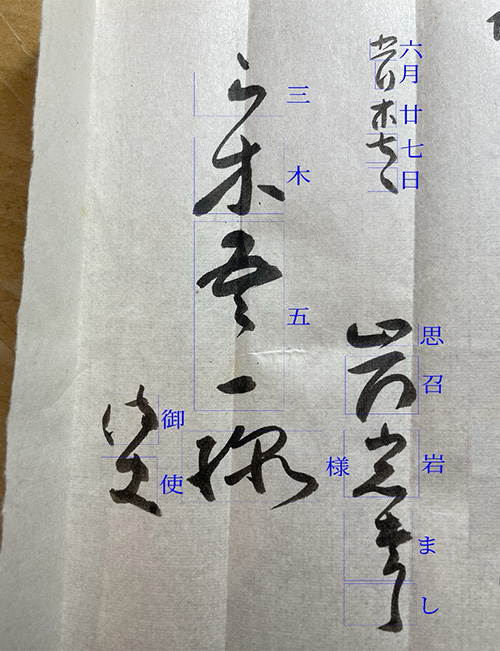
最近は古文書・書簡などの「くずし字」と正対させられてきています。先祖の事跡などをたどるとき、その肉筆の文章には、過去のひとびとが作っていた社会の実相が色濃く反映されていると気付くのです。言葉遣いでそこに「空気感」のようなものが託されていて、古い社会の共通認識で「つたわる」のですね。
わたしたち現代人は日本語として活字的に精緻な漢字・かな文字をごく当然の基盤として受け止めているけれど、過去の日本人は、明治以前、いや明治以降でも多くは筆文字での日本語表現に慣れていて、その読解能力を基盤としてコミュニケーションを成立させてきた。
が、わたしたち現代人はそういう教育体系には浴していない。筆文字でも正確性を期して1字1字丹念に書かれた文字は読解できるけれど、くずし字はその時代性と書き手ー読み手の相互理解基盤で伝達が成立していたので、その前提条件共有がないわたしたちには、先人とコミュニケーションしにくい。
考えて見るとデジタル時代になって、こういう状況はさらに加速化している。
アナログの印刷物(新聞雑誌)情報時代からデジタル情報時代になって、個人差はあっても1日に摂取する情報量は飛躍して増加しているだろう。わたしは基本、新聞を読まずYahooトップページのニュース欄でその日の出来事を確認し、興味に即してそこから深層まで掘ったり、あるいは横歩き的に情報探索したりする。摂取する情報量はアナログ時代の比ではない。
いきおい、筆文字・くずし字への顧慮はどんどんうち捨てられてしまう。
そういう現実に深く気付かされてきている。ヤバい。父母や祖父母とすらコミュニケーションしにくくなってしまうのだ。いわんや、江戸期以前の先祖様たちおや、であります。
写真はこういうくずし字解読に対して、トッパンが提供する無料スマホ用アプリ「古文書カメラ」でAIを活用した古文書解読手段。正式な専門家による解析依頼という方法はあるけれど、自分でスキルを磨きながら訓練していくには、これがいいかと考えてきています。
しかしこれでもやはり「おおまか」な把握で、詳細にはなかなかなのであります。ふ〜む。
●お知らせ
拙書「作家と住空間」幻冬舎から電子書籍で発刊
お求めはAmazonで。
https://amzn.asia/d/eUiv9yO
English version⬇
[What Has Been Lost Due to the Discontinuity Between Modern Writing and Cursive Script]
Our grandparents—and in some cases, even our parents—used to communicate using cursive script. Yet modern people lack the ability to decipher it. …
Recently, I’ve been coming face-to-face with “cursive script” found in ancient documents and letters. When tracing the deeds of my ancestors, I realize that their handwritten texts vividly reflect the true nature of the society in which people of the past lived. A certain “atmosphere” is conveyed through their choice of words, and it “comes across” through the shared understanding of that bygone society.
We modern people take the precise, printed characters of Kanji and Kana for granted as the foundation of the Japanese language, but people in the past—before the Meiji era, and indeed even after it—were largely accustomed to expressing Japanese through handwritten characters, and they established communication based on their ability to read and interpret them.
However, we modern people have not been immersed in such an educational system. While we can read characters written with a brush that were carefully crafted one by one for accuracy, cursive script relied on the context of its era and a shared foundation of mutual understanding between writer and reader for effective communication. Without that shared context, it is difficult for us to communicate with our predecessors.
When you think about it, this situation has accelerated even further in the digital age.
With the shift from the era of analog print media (newspapers and magazines) to the digital information age, the amount of information we consume daily has likely increased exponentially, even if there are individual differences. Personally, I rarely read newspapers; instead, I check the day’s events in the news section on Yahoo’s homepage, then either dig deeper into topics that interest me or explore information in a more lateral manner. The volume of information I consume is incomparable to that of the analog era.
Consequently, consideration for brush script and cursive writing is being increasingly cast aside.
I’ve become deeply aware of this reality. It’s serious. It’s becoming difficult to communicate even with my parents and grandparents. Let alone our ancestors from the Edo period and earlier.
The photo shows a method for deciphering old documents using AI, provided by Toppan’s free smartphone app “Old Document Camera.” While there is the option of requesting analysis from a professional expert, I’ve come to think this is a good way to hone my own skills through practice.
However, even with this, the results are still only a “rough” understanding; it’s quite difficult to get into the details. Hmm.
● Announcement
My book, “Writers and Living Spaces,” has been published as an e-book by Gentosha.
Available on Amazon.
共有:

Posted on 5月 12th, 2026 by 三木 奎吾
Filed under: 未分類



コメントを投稿
「※誹謗中傷や、悪意のある書き込み、営利目的などのコメントを防ぐために、投稿された全てのコメントは一時的に保留されますのでご了承ください。」
You must be logged in to post a comment.