
祖母という存在はわたしのDNAの1/4程度「関わっている」のだと思う。わたしは父母という存在から生まれ出たけれど、その父母もそれぞれの祖父母から生まれ出た。いのちの輪廻。
それぞれの出自によって個人の「思い」というのは温度差があるものだろうが、わたしの場合、この年齢になるまで祖母についてあまり深く考えたことはなかった。たしかに父母については強く「いのちへの関与感」を持ち続けているけれど、祖父母については直接接触感が少ないので、その差なのだろう。わたしは2歳で祖母とは死別したので、強い印象記憶がない。
次兄からわが家系の「過去生〜かこしょう」についての探究活動「引継」を下命されて以来、長幼の序には従順なことから、次々とわが家の遺品や伝承品に向き合わされてきている。
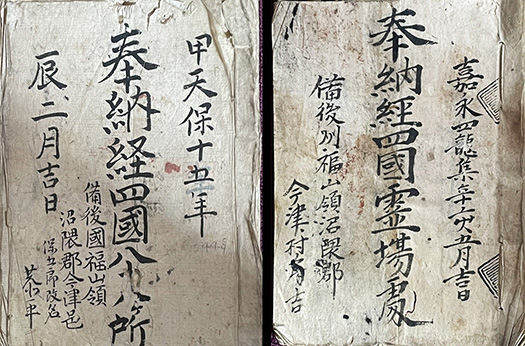
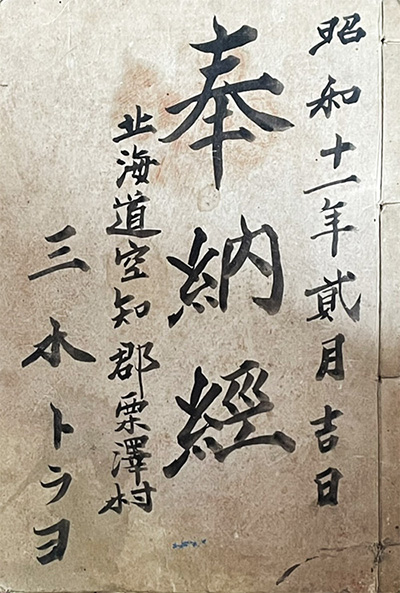
写真は、長兄の家に保管されてきた伝承品のなかから発見されてきた3つの四国八十八箇所「奉納経」。
日本人の心象歴史の中でこの四国巡礼は非常に重要な領域を占めているだろう。わたし自身は「なんちゃって」系。四国は大好きで家族旅行では4−5回「巡って」いるけれど、一度、第十番札所・安楽寺宿坊にお世話になって宿泊し、本堂裏の「曼荼羅界」的な秘所を巡らせていただいた経験がある程度。
この写真のように各巡礼寺院からの「お札」をきちんと記録して保存しているものを見せられると、その個人の一種の「尊厳」を見させられる思いも沸いてくる。
・・・で、下の段の祖母の「奉納経」のほかに,上の写真の2つのものを正視させられている。
どちらも家系がながく暮らしていた「備後州・福山領沼隈郡今津」とまではわかるのだけれど、その下の名前「恭平・房吉」という名前の先祖には、どうも思い当たらないのだ。天保15年は1844年で、嘉永4年は1851年。わが家が保管してきた伝承品のひとつなのに、その主の名前が紐付けられない。
煌々たる光量の中に突然出現した「ナゾ」。
ひとつの解釈としては、家督を継ぐメインラインではない商家「阿賀屋」を実務で支えた分家、あるいは「奉公人」であった可能性。
う〜むと唸らされております。・・・しかし、前向きに考えれば「まだまだ修行が足りないなぁ」と祖母が嘆いている、もっと努力しなさいという諭しと受け止めるしかない。・・・さて。
●お知らせ
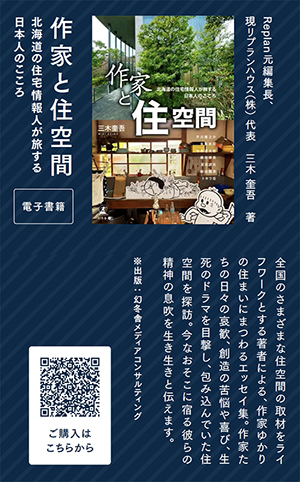
拙書「作家と住空間」幻冬舎から電子書籍で発刊
お求めはAmazonで。
https://amzn.asia/d/eUiv9yO
English version⬇
[A Family Heirloom: The “Dedicatory Sutra” from the Shikoku 88 Temple Pilgrimage—Who Was Its Owner?]
An exploration of our family history stretching back more than four hundred years. Fragments of time and space keep posing riddles in my mind. Practice, and more practice…
I believe my grandmother is “connected” to about a quarter of my DNA. I was born to my parents, but they, in turn, were born to their respective grandparents. It’s the cycle of life.
While the intensity of one’s “feelings” likely varies depending on one’s background, in my case, I hadn’t really thought deeply about my grandmother until I reached this age. It’s true that I continue to feel a strong “sense of connection to life” regarding my parents, but since I had little direct contact with my grandparents, that’s likely the reason for the difference. I lost my grandmother when I was two years old, so I have no vivid memories of her.
Since my second older brother tasked me with “carrying on” the family’s research into our lineage’s “past lives,” and because I am obedient to the order of seniority, I have been gradually confronted with our family’s heirlooms and traditional artifacts one after another.
The photo shows three “dedicated sutras” from the Shikoku 88 Temple Pilgrimage, discovered among the heirlooms preserved at my eldest brother’s home.
This Shikoku pilgrimage likely occupies a very important place in the collective imagination of the Japanese people. As for myself, I’m more of a “pretend” type. I love Shikoku and have “toured” it four or five times on family trips, but my experience is limited to staying at the guest quarters of Anrakuji Temple (the 10th temple) and being allowed to explore the “mandala-like” secret area behind the main hall.
When I’m shown items like these in the photo—where “charms” from each pilgrimage temple have been carefully recorded and preserved—I feel as though I’m being shown a kind of personal “dignity.”
…And so, in addition to my grandmother’s “dedicated sutra” in the lower row, I find myself staring intently at the two items in the photo above.
While I can tell that both are from “Imazu, Numakuma District, Fukuyama Domain, Bingo Province”—where my family lived for generations—I simply cannot place the ancestors with the given names “Kyōhei” and “Fusakichi” listed below them. Tenpō 15 is 1844, and Kaei 4 is 1851. Even though this is one of the heirlooms our family has preserved, I cannot connect it to the names of its owners.
A “mystery” that suddenly appeared amidst the brilliant light.
One possible interpretation is that they were a branch family that supported the “Agaya” merchant house—which was not the main line inheriting the family headship—in its day-to-day operations, or perhaps they were “servants.”
I find myself pondering this deeply. …However, looking on the bright side, I can only take this as a gentle admonishment from my grandmother, sighing, “You still have a long way to go,” urging me to try harder. …Well then.
● Announcement
My book, “Writers and Living Spaces,” has been published as an e-book by Gentosha.
Available on Amazon.
共有:

Posted on 5月 10th, 2026 by 三木 奎吾
Filed under: 未分類



コメントを投稿
「※誹謗中傷や、悪意のある書き込み、営利目的などのコメントを防ぐために、投稿された全てのコメントは一時的に保留されますのでご了承ください。」
You must be logged in to post a comment.