

昨日お伝えした東日本大震災から15年の復興メモリアル行脚ツアー企画、段取りが付いて参加申込みをさせていただきました。いろいろなスケジュールがあったので、調整する必要が生じていた次第。
人間のいのちの時間の中では、やはり自然や社会の摂理やその運命とかかわりを持って生きて行くことになる。それらの抗しようのない絶対要因のなかでどう生き延びていくか、自分の本然をどのように実現させていくのか、それが普遍のいとなみなのでしょうね。東日本大震災とは、やはり対話を継続していく必要性を感じさせられています。さて。
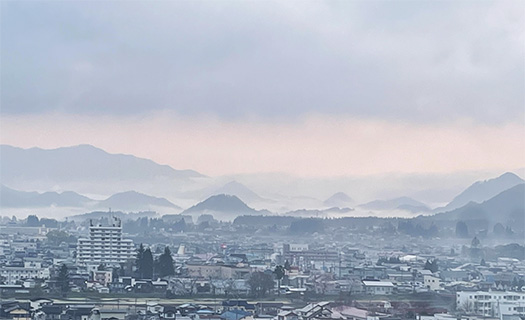
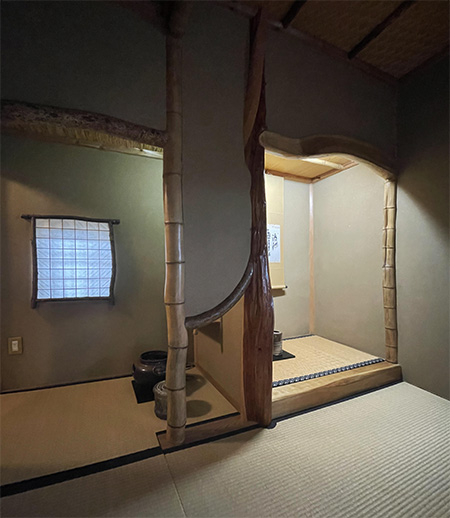
写真は今回のツアーの中で印象的だった自然の光景とある茶室のしつらい。
上の写真は秋田角館〜津軽〜十和田周辺を巡り歩く拠点のホテルとして選択してくれていた大館のホテルからの朝方の遠望。大館というのは山間の平野部に都市環境が成立しているのですが、周囲には山々が連なって取り囲んでいる地形。雨気をふくんだ大気が山の合間に雲海を成立させて、墨絵のような美感を見せてくれていた。
日本の地形はこういう景観美を多く発生させるような自然環境。
北海道札幌ではしかし、あまり見かけることはない。中国の山水画というのは、こういう地形景観を表現したものなのだという解説を聞きますが、それが納得できるような景観美。
一方下の写真は、弘前近郊の黒石で参観していたある「茶室」の床の間。自然木や太い竹などで構成されたインテリア意匠。
わたしの美感印象のなかで、この2つの空間美が共鳴しているように思える。
上の写真が自然が造形する「あわさ」であるとすれば、下の写真は建築構造に、そうした「あわさ」感覚を導入した結果のように感じられるのです。これは個人としての印象。
きのうは山の手の家で不要になった木質テーブルを、里塚の家の方に移転してもらって、その環境の整理整頓をしておりましたが、機能性と空間の印象要素を両にらみしながら整理整頓して行くとき、この写真がもたらしてくるような感性の要素と対話することになる。機能性と同時に、ある志向性として「あわさ」というものに気付かされてきているのであります。
高齢期の認知の「あわさ」にならないよう、取扱には充分注意すべき志向性(笑)。
●お知らせ
拙書「作家と住空間」幻冬舎から電子書籍で発刊
お求めはAmazonで。
https://amzn.asia/d/eUiv9yO
English version⬇
[The Aesthetics of the Local Environment and Human Space]
There is undeniably a captivating beauty inherent in the ever-changing nature. The subtle beauty evoked by a sea of clouds. Perhaps this same underlying aesthetic runs through the architecture of the tea room, which is designed to express the human spirit. …
I’ve finalized the arrangements for the 15th-anniversary reconstruction memorial tour I mentioned yesterday and have submitted my application to participate. I had to make some adjustments due to various scheduling conflicts.
In the span of a human life, we inevitably live in connection with the laws of nature and society, as well as our own destinies. How we survive amidst these unavoidable, absolute forces, and how we realize our true selves—that is the universal struggle, isn’t it? The Great East Japan Earthquake continues to remind me of the necessity to maintain a dialogue with it. Well then.
The photos show a striking natural scene from this tour and the interior of a tea room.
The photo above is an early morning view from the hotel in Odate, which served as our base for exploring the Akita Kakunodate, Tsugaru, and Towada areas. Odate is a city situated in a mountainous plain, surrounded by a ring of mountains. The moisture-laden air formed a sea of clouds between the mountains, creating a scene of ink-painting-like beauty.
Japan’s topography provides a natural environment that gives rise to many such scenic beauties.
However, you don’t see this very often in Sapporo, Hokkaido. I’ve heard explanations that Chinese landscape paintings are meant to express this kind of terrain and scenery, and this view truly makes that explanation make sense.
On the other hand, the photo below shows the tokonoma (alcove) of a “tea room” I visited in Kuroishi, near Hirosaki. The interior design features natural wood and thick bamboo.
In my aesthetic perception, these two spatial beauties seem to resonate with one another.
If the photo above represents a “fusion” shaped by nature, the photo below feels like the result of introducing that sense of “fusion” into an architectural structure. This is my personal impression.
Yesterday, I had a wooden table that was no longer needed at the Yamanote house moved to the Satotsuka house, and I was tidying up that space. When organizing while balancing both functionality and the aesthetic elements of the space, I find myself engaging in a dialogue with the sensibilities evoked by this photograph. Alongside functionality, I am becoming increasingly aware of “harmony” as a guiding principle.
It’s an orientation that requires careful handling so as not to become the “blurring” of cognition that comes with old age (laughs).
● Announcement
My book, “Writers and Living Spaces,” has been published as an e-book by Gentosha.
Available on Amazon.
共有:

Posted on 4月 25th, 2026 by 三木 奎吾
Filed under: 未分類





コメントを投稿
「※誹謗中傷や、悪意のある書き込み、営利目的などのコメントを防ぐために、投稿された全てのコメントは一時的に保留されますのでご了承ください。」
You must be logged in to post a comment.