
「四百年間のいのちの履歴書」シリーズ。資料収集に朗報。
先日3/16、まるで涅槃を旅した気分だったわたしの家系の「故地」広島県河内町入野。その社会福祉協議会から昨日、2005年に発刊の「入野郷土誌」を郵送で寄贈いただいた。
この故地は行政区画として変遷を重ねてきていて現在は東広島市河内町の「字〜あざ」として残っている。現地には行政区画の変遷をあらわす石碑がある。以前は独立した村だったが、現在までの経緯記述。そういうなかでこの「社会福祉協議会」さんが、地域機能窓口になっていただけた次第。
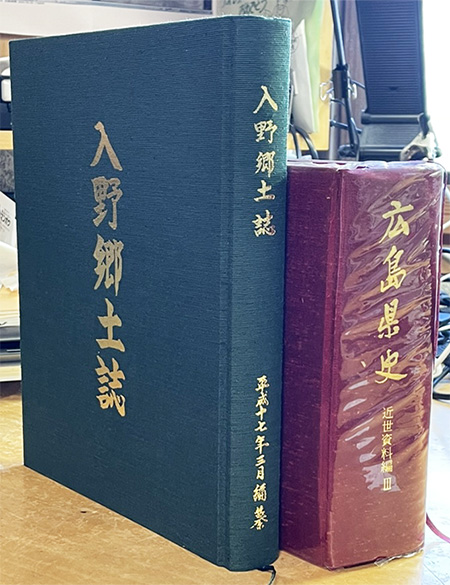
送られてきた資料書籍は広島県史と比べても冊子サイズが大きく,装丁は重厚で広島県史とまったく見劣りしない。いち「字」として異例の重厚な記録資料。想像すれば自治体消滅に際して、県史並みの重厚さと予算で資料を収集保存させた事実が伝わってくる。
この資料の存在を知って入手し研究したいと思って調べたが、国立国会図書館や東広島市中央図書館には保存されていたが、外部に貸出は不可の保存資料扱い。参照するには東京や現地に行って借りてその場で参照するしかない。非常に貴重な極秘資料扱いなのです。
そこで著者法人の「入野地区社会福祉協議会」に連絡し、販売をお願いした。
ところが上述の経緯なので「非売品」扱いで現物は保持されていなかった。入野が自治体から「地区」になったとき、住民だけに配布された旧自治体としての痕跡記録だったのです。であるのに当方の事情を勘案してくださり篤志として事務局長さん個人の分を寄贈いただいた(!)。「この事務所に保存があるので、大丈夫です」というありがたい厚意。たぶんはるばる北海道に流離した地縁者への厚情であると理解。深く感謝。先祖の「導き」かも知れない。故地の一族の墓域痕跡のことをお話ししたところ「ああ、あそこですね」との即座のお答え。まことに「染み入り」ます。
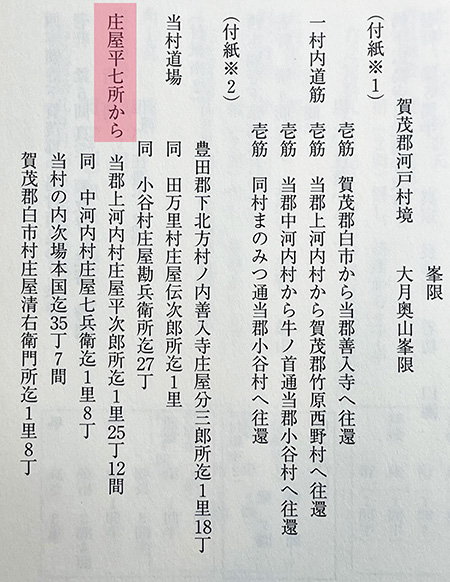
さっそく調べたら上のような記録箇所を発見。1718年段階の広島藩による入野村の「土地境界」調査記録部分ですが「庄屋平七所から・・・」という記述。これは現代文訳すると「庄屋の(原)平七の屋敷地(所)から〜」という意味。この記録年代当時、原平七が「庄屋」だった確かな記録と理解出来る記載。
わたしの家系地縁の証拠・・・。
●お知らせ
拙書「作家と住空間」幻冬舎から電子書籍で発刊
お求めはAmazonで。
https://amzn.asia/d/eUiv9yO
English version⬇
[Documents from “Iri no,” my ancestral home in Hiroshima Prefecture 400 years ago, have arrived in Hokkaido…]
Judging by the circumstances of its publication, this appears to be a record of the municipality’s dissolution that was distributed exclusively to residents. I have respectfully read the “Iri no Local History” from my ancestral home. Immediately, …
The “400-Year History of Life” series. Good news for my research.
On March 16, I visited Iri no in Kawachi Town, Hiroshima Prefecture—the “ancestral home” of my family—and felt as though I had journeyed to Nirvana. Yesterday, the local Social Welfare Council sent me a copy of the *Iri no Local History*, published in 2005.
This ancestral home has undergone numerous changes in administrative boundaries and currently remains as the “Aza” (subdistrict) of Kawachi-cho, Higashi-Hiroshima City. There is a stone monument on site marking these administrative changes. It describes the history from when it was an independent village up to the present day. It is within this context that the “Social Welfare Council” has served as a local information hub.
The book sent to me is larger in size than the *History of Hiroshima Prefecture*, and its binding is substantial, standing up well to the prefectural history. It is an exceptionally comprehensive record for a single “aza.” One can imagine that, upon the dissolution of the local government, the materials were collected and preserved with a budget and level of detail comparable to that of the prefectural history.
Upon learning of this material’s existence and wishing to obtain and study it, I investigated. While it was preserved at the National Diet Library and the Higashi-Hiroshima City Central Library, it was classified as a reference-only archive and could not be loaned out. To consult it, one must travel to Tokyo or the local site to borrow it and view it on-site. It is treated as an extremely valuable, top-secret document.
Therefore, I contacted the authoring organization, the “Iri no District Social Welfare Council,” and requested that they sell it to me.
However, due to the circumstances described above, it was treated as “not for sale,” and no physical copies were retained. It was a record of the former municipality’s history, distributed exclusively to residents when Irino was designated a “district” by the local government. Despite this, the secretary-general took our circumstances into consideration and generously donated a personal copy to us as a gesture of goodwill (!). “We have a copy preserved here at the office, so it’s fine,” he said with gracious kindness. I understand this as a deep act of compassion toward a fellow local who had drifted all the way to Hokkaido. I am deeply grateful. It might even be the “guidance” of my ancestors. When I mentioned the traces of our clan’s burial grounds in our hometown, the immediate reply was, “Ah, that place, right?” It truly “touches my heart.”
I looked into it right away and found the record mentioned above. It’s a section from a 1718 survey of “land boundaries” in Irino Village conducted by the Hiroshima Domain, containing the phrase “from the village headman Heishichi’s residence…” Translated into modern Japanese, this means “from the residence of the village headman (Hara) Heishichi…” This entry can be understood as definitive proof that Hara Heishichi was the “village headman” at the time the record was made.
Evidence of my family’s local roots…
● Announcement
My book, “Writers and Living Spaces,” has been published as an e-book by Gentosha.
Available on Amazon.
共有:

Posted on 4月 4th, 2026 by 三木 奎吾
Filed under: 未分類



コメントを投稿
「※誹謗中傷や、悪意のある書き込み、営利目的などのコメントを防ぐために、投稿された全てのコメントは一時的に保留されますのでご了承ください。」
You must be logged in to post a comment.