
いま、わたしは過去に収集した住宅・建築系の写真を整理中。ある企画に昇華させたいと考えている。
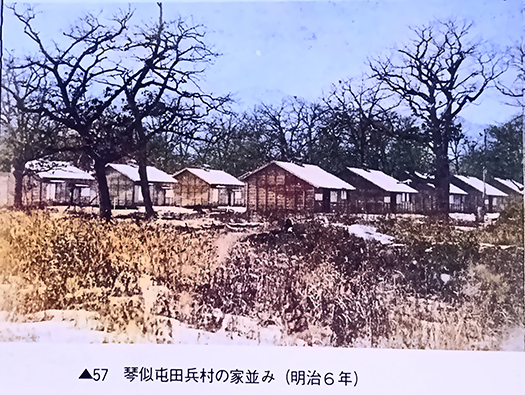
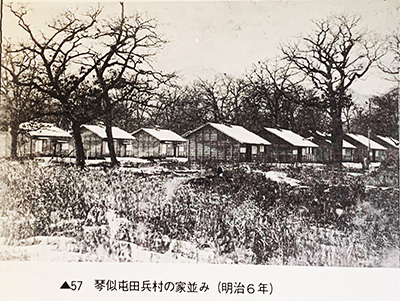
そういう写真のなかに北大に所蔵される建築歴史写真データがあって、この明治6年の北海道「屯田兵屋」のモノクロ画像記録もあった。この写真はかなり重要な記録でいろいろな北海道史に登場する。
幕末から明治の時代、日本国家は南下侵略戦略を取るロシアとどう対峙するかが、もっとも大きな国家テーマの時代。また明治の革命によって階級としての武士が消滅した時代でもあった。そういった諸状況のなか昇華した「国策」として、北方の新領土・北海道開拓と対ロシアの国防という国家目的に沿うカタチで「屯田兵」が組織された。高校の友人たちにはその家系子孫という人間も多数いる。
その第1陣が、北海道の首府とされた札幌の防衛の意味からいまの札幌市西区琴似、当時の「琴似村」に配置され、屯田兵村が「官営住宅」として整備され建設された。ここに集住してすぐ屯田兵は明治10年にははるか西南戦争にも出撃している。上の写真はモノクロ画像を、現代のAI技術で「カラー化」させた。対比的にモノクロ画像も添付した。
屋根にうっすらと雪が積もっていて周辺の樹木からもすべての葉が落ちている。明治6年晩秋〜初冬。現在のわが家から至近500-600mの距離の場所と推認。いま現在はこの屯田兵屋の場所には札幌市西区役所がある位置か。樹木のなかの1本にはいま車道の真ん中に残された1本の木と似た樹相が感じられる・・・。方向的には先日来このブログで触れている琴似本通りの歩道から西側方向を撮影していたように思われる。ちなみにいまのわが家は、この写真の左側奥地と想像することが出来る。
・・・というように時間を隔てた時空間の印象が復元されてくる。
歴史時間の刻印の少ない北海道民にとってはアマテラス神話とも比肩する創始の存在。そういう時代感が、非常に身近でリアリティをもって蘇ってくる。ごく身近な「天上世界」。
●お知らせ
拙書「作家と住空間」幻冬舎から電子書籍で発刊
お求めはAmazonで。
https://amzn.asia/d/eUiv9yO
English version⬇
【The Tondenhei Houses in Sapporo’s Primeval Forest: Restoring Past Spaces and Times】
The sky is blue, the snow is white… For Hokkaido residents with a short history, it’s a world of founding myths. Here, one can deeply contemplate the ancestors who lived here.
I am currently organizing my collection of housing and architecture photographs. I hope to elevate them into a new project.
Among these photos are architectural historical images held by Hokkaido University, including this monochrome record of the “Tondenhei House” in Hokkaido from 1873. This photograph is a significant historical document appearing in various accounts of Hokkaido’s history.
From the late Edo period through the Meiji era, Japan faced its greatest national challenge: how to confront Russia’s southward expansionist strategy. It was also an era where the samurai class vanished due to the Meiji Revolution. Amidst these circumstances, the “settler soldiers” were organized as a national policy, serving the dual state objectives of developing the new northern territory of Hokkaido and defending against Russia. Many of my high school friends are descendants of these settlers.
The first contingent was stationed in what is now Kotoni, Nishi Ward, Sapporo City—then “Kotoni Village”—for the defense of Sapporo, designated as Hokkaido’s capital. A屯田兵 village was developed and constructed as “government housing.” Soon after settling here, these屯田兵 were deployed as early as 1877 to fight in the distant Satsuma Rebellion. The photo above is a monochrome image colorized using modern AI technology. For comparison, the original monochrome image is also attached.
A light dusting of snow covers the roofs, and all leaves have fallen from the surrounding trees. Late autumn to early winter of Meiji 6 (1873). The location is estimated to be within 500-600 meters of my current home. Presumably, the Sapporo City Nishi Ward Office now stands on the site of these屯田兵 houses. One tree among them resembles the solitary tree now left in the middle of the roadway… Directionally, it seems this was shot looking westward from the sidewalk along Kotoni Main Street, which I’ve mentioned in recent blog posts. Incidentally, my current home can be imagined as the area deep in the left background of this photo.
…In this way, impressions of a spatiotemporal realm separated by time begin to be reconstructed.
For Hokkaido residents, whose historical time bears few imprints, this founding presence rivals the myth of Amaterasu. That sense of era revives with profound immediacy and reality. A “heavenly world” right at hand.
●Notice
My book “Writers and Living Spaces” published as an e-book by Gentosha
Available on Amazon.
共有:

Posted on 10月 9th, 2025 by 三木 奎吾
Filed under: 未分類




コメントを投稿
「※誹謗中傷や、悪意のある書き込み、営利目的などのコメントを防ぐために、投稿された全てのコメントは一時的に保留されますのでご了承ください。」
You must be logged in to post a comment.