
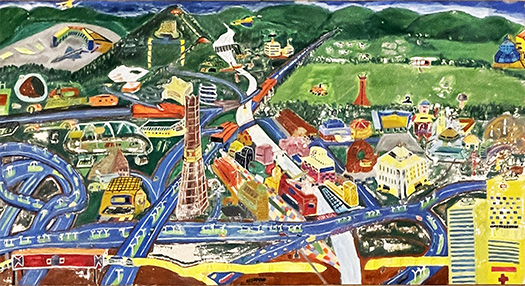
先日訪れていた「新十津川」の開拓記念館で出会った印象的な絵。
「母村」奈良県十津川の記録的大水害から北海道への集団移住を決意して、新天地を切り開いてきたひとびとのことは、北海道人として強い同胞感を持っている。それまでの日本社会が定住開発できにくかった寒冷な北海道で、必死に開拓努力されてきたことは、強く共感を刺激される。
一方で最大人口1.6万人にまでなった新十津川は現在6,000人台で人口が推移。<昭和30年の16,199人をピークに長期的に減少傾向にあり、令和2年には6,484人。>
この絵は、その新十津川の小学校6年生の生徒たちがイマジネーションたくましく、新十津川の輝かしい未来を描いたものです、という説明文が添えられていた。
一見して、交通手段というものへの強い憧憬がうかがわれた。移動交通という発展方向へのシンプルなキャッチアップ姿勢。画面中央には石狩川が描かれ町の中心を流れている。その流路を横断して道央圏・滝川市への大動脈幹線道路。そしてタテ方向には画面下部の先に札幌都市圏への幹線道路。町中にも立体の道路ICが描き出されている。さらには航空施設と見なせる図も示されている。幹線道路の交差点にあたる位置には、一見テレビ塔とも思える高層建築。
いかにもな、近現代の社会目線に則した利便性重視「都会化」が未来目標と感じられる。わたしたち現代人の持っている「地域発展」という概念がビジュアル化されたものだと受け止められた。こどもたちの「イマジネーションたくましく」というよりも当然ながら現代のオトナ社会からの教化が反映されたものと思えた。
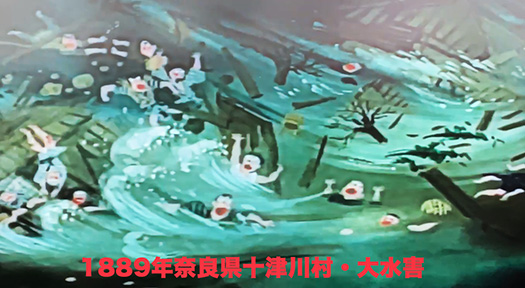
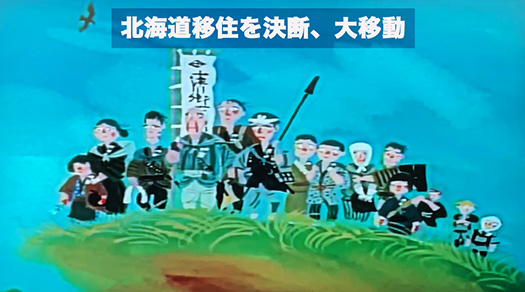
ひとの「思い」というものはビジュアル表現で明示される。こちらのイラストは同じ新十津川の開拓記念館で見た「母村」を襲った大水害と、移住決意のイラスト表現。いかにも切実な未来投企姿勢。
このような表現を超えて、リアリティを持って「未来のカタチ」を想像する必要がある。オトナたち、あるいはもうすぐ辞世する高齢年代こそは、もうちょっと「面白み・人間味のある」未来形を示すべきか、と。
●お知らせ
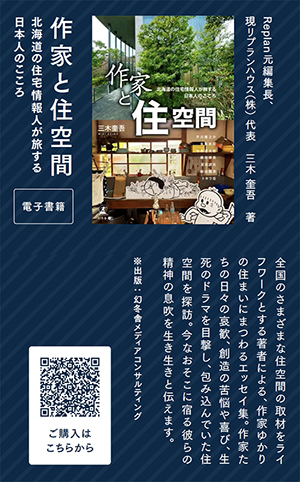
拙書「作家と住空間」幻冬舎から電子書籍で発刊
お求めはAmazonで。
https://amzn.asia/d/eUiv9yO
English version⬇
【The Future Envisioned by Children in Shintotsukawa, Hokkaido’s Group Relocation Project】
A sudden doubt arises about the future shape modern society so casually presents to children. Is this really an exciting future? …
An impressive painting I encountered at the Shin-Totsukawa Pioneering Memorial Museum I visited recently.
As a native of Hokkaido, I feel a strong sense of kinship with the people who decided to collectively migrate to Hokkaido after the record-breaking flood disaster in their home village of Totsukawa, Nara Prefecture, and who carved out a new frontier. Their desperate pioneering efforts in the cold climate of Hokkaido, where Japan’s society at the time struggled to achieve settled development, deeply resonate with me.
Meanwhile, Shin-Totsukawa, which once reached a peak population of 16,000, now hovers around 6,000. It has been in long-term decline since its peak of 16,199 in 1955 (Showa 30), reaching 6,484 in 2020 (Reiwa 2). >
The accompanying description stated: “This painting depicts the bright future of Shintotsukawa, imagined with great creativity by sixth-grade elementary school students from the town.”
At first glance, a strong yearning for transportation was evident. A simple desire to catch up with development focused on mobility. The central Ishikari River flows through the town’s heart. Crossing its course is a major arterial highway connecting to the central Hokkaido region and Takikawa City. Running vertically toward the Sapporo metropolitan area is another main artery visible at the bottom of the image. Multi-level road interchanges are depicted within the town itself. Additionally, what appears to be an aviation facility is shown. At the intersection of these highways stands a tall structure that could be mistaken for a television tower.
This clearly reflects a future goal of modern, convenience-focused “urbanization” aligned with contemporary societal perspectives. It felt like a visual representation of the concept of “regional development” held by us modern people. Rather than children’s “robust imagination,” it seemed, unsurprisingly, to reflect the indoctrination from contemporary adult society.
Human “thoughts” are explicitly conveyed through visual expression. This illustration depicts the devastating flood that struck the “home village” and the decision to relocate, both seen at the same Shintotsukawa Pioneers’ Memorial Museum. It embodies a profoundly earnest attitude toward envisioning the future.
We must go beyond such expressions and imagine the “shape of the future” with realism. Shouldn’t adults, or rather the elderly generation nearing the end of their lives, show a future form that’s a bit more “interesting and human”?
●Notice
My book “Writers and Living Spaces” published as an e-book by Gentosha
Available on Amazon.
共有:

Posted on 10月 4th, 2025 by 三木 奎吾
Filed under: 未分類




コメントを投稿
「※誹謗中傷や、悪意のある書き込み、営利目的などのコメントを防ぐために、投稿された全てのコメントは一時的に保留されますのでご了承ください。」
You must be logged in to post a comment.