

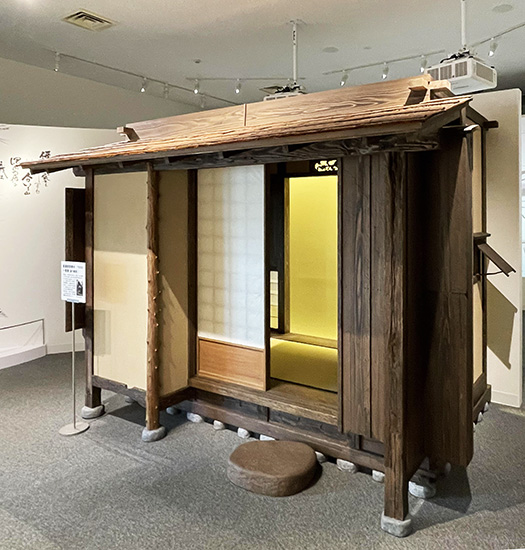
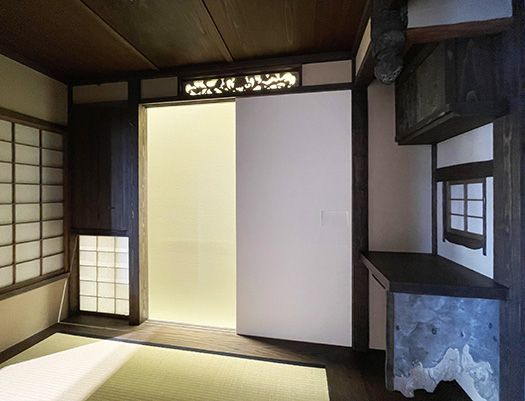
70歳の古希を前に足腰の衰えから旅を続けることが難しいと感じた松浦武四郎は、畳1枚と多少の付属空間による書斎「一畳敷」を東京神田五軒町の自宅に建てた。
写真は松浦武四郎記念館(松阪市)のエントランス正面に展示されている原寸模型。
生涯を旅とともに過ごしてきた先人として、その最期に当たって住宅建築にその「思い」を仮託したのだと直感できて、参観させていただいた。上は「外観」で下は「内観」。あまり詳細な解説ではなかったので、推測になるけれど、奥の引き建具から本屋への出入り口になっていると思われた。また、1畳のタタミ空間の他に向かって手前側左手に「床の間」があり小スペースながら「縁」空間もあるので正しくは1坪程度の面積ではないか。たった一枚の畳に板縁を廻らせ、床の間と神棚、書棚をしつらえた空間。
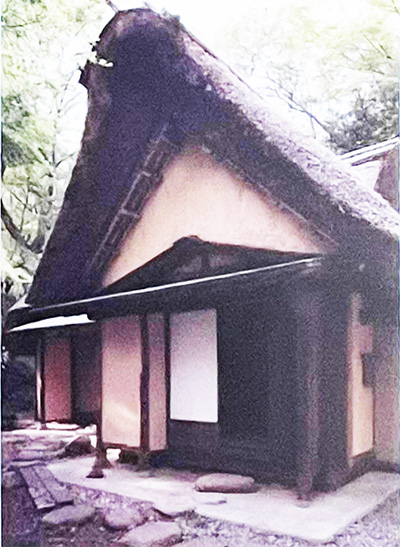
建築の実物は、東京都三鷹市大沢の国際基督教大学キャンパスに移築保存されている。<下に写真>
旅を重ねてきた人生をふりかえって、結局は「立って半畳、寝て一畳」という実感に至った、かれ松浦武四郎の「肉声」が伝わってくるように思えた。言うまでもないだろうが、このことわざは「人間が生活する上で必要なスペースは、立っている状態では畳半畳、寝ている状態では畳一畳あれば十分であるという意味」とされている。
ただし、松浦武四郎はこの空間を装丁建築するにあたって全国の友人知己に手紙を書いて、数年かけて各地の霊社名刹などの建造物の「古材」を集め、1886年自邸に一畳敷を増築した。90もの歴史ある木片で組み上げられており、その空間構成の来歴は古くは白鳳時代から江戸時代にまで遡ることになる。神社建築の世界では伊勢神宮の外宮の殿舎建築は「式年遷宮」で20年ごとに建て替えられ、その構成部材は全国の有力な神社建築に分け与えられる。わたしの地元の北海道神宮も明治以降のその分与された古材が社殿のどこかで使われている。その「伝統」に即したいとかれは思ったのだろう。
松浦さんの「内意」としてはどうも、空間は人生で思う存分に「巡り」回ったけれど、最期は「時間」も縦横に1畳敷のなかでその「旅」を味わい尽くしたいと願ったのではないかと妄想させられた。なんとも「数寄」の極致なのではないだろうか。
そしてかれのその希望は実際に叶えられたということにまた、目を瞠らされる。すごい。ひとり外宮か。
●お知らせ
拙書「作家と住空間」幻冬舎から電子書籍で発刊
お求めはAmazonで。
https://amzn.asia/d/eUiv9yO
English version⬇
[Final space = half a tatami mat standing, one tatami mat lying down / Takashiro Matsuura-10]
Composed of old materials from famous temples that have been visited, just as old materials from the Ise Grand Shrine’s periodic relocation ceremony are distributed to shrines throughout the country. It’s like traveling through time from the Asuka period to the Edo period. …
As he approached his 70th birthday, Matsura Takashiro felt that his declining physical strength made it difficult to continue traveling. He therefore built a study called “Ichijōshiki” in his home in Kanda Gokenchō, Tokyo, consisting of a single tatami mat and a small adjoining space.
The photo shows a full-scale model displayed at the entrance of the Matsura Takashiro Memorial Museum (Matsusaka City).
As a pioneer who spent his entire life traveling, I sensed that he had entrusted his “vision” for residential architecture to this space as he neared the end of his life, and I had the opportunity to visit it. The top image shows the “exterior,” and the bottom shows the “interior.” Since there wasn’t much detailed explanation, this is just speculation, but I think the sliding doors at the back lead to the entrance of the bookstore. Additionally, besides the one-tatami-mat space, there is a “tokonoma” (alcove) on the left side of the front area. Despite the small space, there is also an “engawa” (veranda), so the actual area is likely around one tatami mat. The space features a single tatami mat with wooden borders, a tokonoma, a shrine shelf, and a bookshelf.
The actual building has been relocated and preserved at the International Christian University campus in Ozawa, Mitaka City, Tokyo. [Photo below]
Reflecting on a life spent traveling, I came to realize that, in the end, “half a tatami mat when standing, one tatami mat when lying down” is all that is needed. It seemed as if the ‘voice’ of Matsura Takashiro was being conveyed to me. Needless to say, this proverb means that “the space necessary for human life is half a tatami mat when standing and one tatami mat when lying down.”
However, Matsura Takashiro, when designing this space, wrote letters to friends and acquaintances across the country, spending several years collecting “reclaimed wood” from historic shrines and temples, and in 1886, he added a one-tatami-mat extension to his residence. The space is constructed using 90 pieces of historically significant wood, with its origins tracing back as far as the Asuka period and the Edo period. In the world of shrine architecture, the outer shrine buildings of Ise Grand Shrine are rebuilt every 20 years as part of the “Shikinen Sengu” ritual, and the structural components are distributed to other prominent shrines across the country. My local Hokkaido Shrine also uses some of these reclaimed materials in its shrine buildings. I suppose he wanted to adhere to that “tradition.”
As for Matsura’s “inner intention,” it seems that he had fully experienced the “cycle” of life through space, but in the end, he desired to savor the ‘journey’ within the confines of a single tatami mat, both vertically and horizontally. It is truly the pinnacle of “suki” (a Japanese aesthetic sensibility).
And the fact that his wish was actually fulfilled is truly astonishing. Amazing. A solitary outer shrine.
共有:

Posted on 8月 7th, 2025 by 三木 奎吾
Filed under: 住宅取材&ウラ話




コメントを投稿
「※誹謗中傷や、悪意のある書き込み、営利目的などのコメントを防ぐために、投稿された全てのコメントは一時的に保留されますのでご了承ください。」
You must be logged in to post a comment.