
中国大陸に並立した2国・元と宋という複雑微妙な国際情勢のなかで、新興の元から国書を送られて「こっちの陣営に付いて味方してくれるよな、な?」というような関係を迫られた日本。その政権は実権を「征夷」をタテマエとする武家が支配する国。そういう意味では幕末期に征夷大将軍として黒船を迎えた江戸幕府にも似た立ち位置に立たされていたと見ることもできるのかも知れない。
鉄という農耕と軍事の最先端物資を半島からの輸入に頼っていた時代、日本国家社会は白村江という「世界戦争」の渦中に立ったことはあるけれど、その後は百済からの移住者を抱擁し鉄も自国生産できるようになってほぼ対外的な関係としては「交易」だけという通常運転で行ってきた。金属探査もそうした移住者によって進み、結果として奥州からの産金まで結果する奇跡にも恵まれる。
その間、文化としての漢字や仏教思想の導入など、主に経済・文化的な関係性が基本だった。その流れは律令国家制度の導入にまで進んだけれど、それは日本の社会風土には必ずしも馴染まず、やがて各地域毎の「一所懸命」思想による武家支配体制が基本になっていった。
政治体制としては、国内的な争乱の調整型権力として鎌倉幕府というのはあったのだろう。頼朝の領地大盤振る舞い政策に呼応した各地域支配目的の御家人たちは、幕府に対し自分に有利な支配地の差配をさせることが大目的で成立してきた。それは土地の支配権の再配分が基本であってそこに「国防」という認識はなかった。この基本線は江戸幕府においても同様だっただろう。であるのに託された権力名は「征夷」大将軍。
一方、大陸国家では皇帝権力による「独裁」がながく続き、日本のような分権的社会とはその権力構造が違いすぎた。
このような基本において今日の共産党独裁体制のかの国は基本的に変わっていないとも思える。鎌倉や江戸の幕府政権も分権的志向の強い政権であり、今日の議会制民主主義社会とも通底している。
さてそういう状況下で国内調整型権力として、戦争大好きの独裁型権力・元と、衰退期にあるが交易を通じて関係も深めていた宋とを比べて見れば、宋に肩入れするようなスタンスを取ることは自然だったのだろう。幕府にして見るとこの元寇戦は二律背反ではあった。というのは対外戦では獲得できる領土は存在せず、その支配権を差配することが出来ない中で、征夷という「タテマエ」の有言実行を迫られた、という状況。これは政権担当者としてきわどい局面。
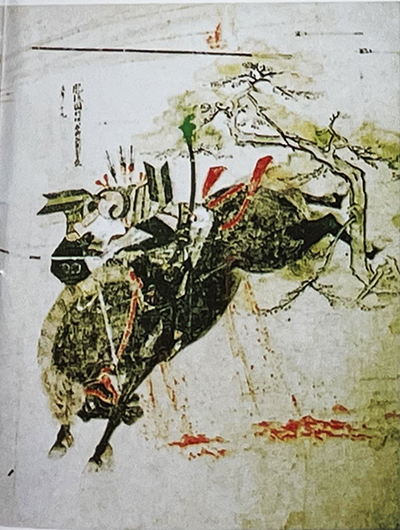
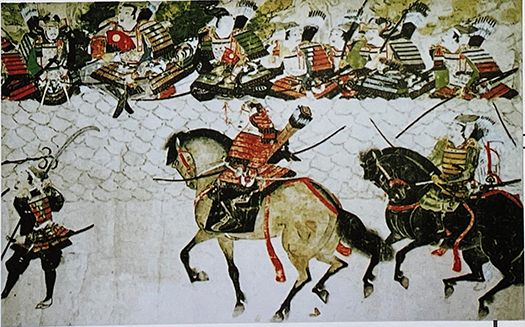
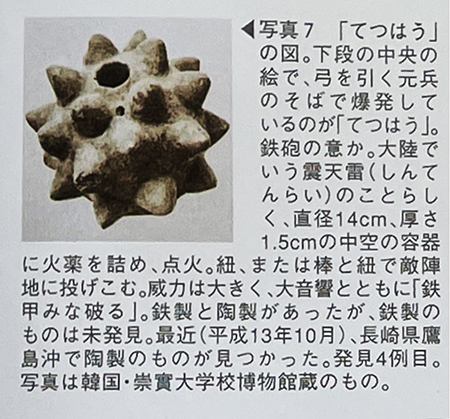
そういう状況で最前線では鎌倉期御家人たちが、未曾有の新兵器で武装し「集団戦」を仕掛けてくる外敵に対して幕府に聞こえるように「大きく名乗りを上げて」立ち向かって行った。おい幕府、おれはこんなに勇敢に戦っているぜ!
報われない可能性の高い「一所懸命」戦争。
English version⬇
The ‘otherworldly’ value warfare of international warfare, Yuan Enmity Museum-8
The Kamakura warriors were hard-working individuals who rushed forward with their personal conspicuous ‘bravery’ against the cutting-edge armaments of the war-loving armed dictatorship, the Yuan army. …
In the complex and delicate international situation of the two parallel states on the Chinese mainland, Yuan and Song, Japan was sent a letter of state from the newly emerging Yuan, which said, ‘You will join our camp and take our side, won’t you?’ Japan was forced into a relationship with the Yuan. The regime was ruled by a warrior clan whose real power was based on the principle of ‘conquest of the barbarians’. In this sense, Japan could be seen as being in a similar position to the Edo Shogunate, which welcomed the Black Ships as a barbarian conqueror in the final days of the Tokugawa shogunate.
In the period when Japan was dependent on imports from the peninsula for iron, the most advanced agricultural and military commodity, Japanese society was once in the middle of a ‘world war’ called the Baekchon River, but afterwards it embraced immigrants from Baekje and was able to produce its own iron, and has continued with normal operations, almost exclusively through ‘trade’, in its relations with the outside world. Metal exploration was also advanced by these immigrants, resulting in the miraculous discovery of gold from Oshu.
During this period, the relationship was mainly based on economic and cultural relations, including the introduction of Chinese characters and Buddhist thought as a culture. This trend led to the introduction of the Ritsuryo state system, which was not always compatible with the Japanese social climate, and eventually became based on a system of samurai rule based on the idea of ‘issho’ in each region.
As a political system, the Kamakura shogunate probably existed as a coordinating power for domestic disputes. In response to Yoritomo’s policy of territorial largesse, the local rulers established the Kamakura Shogunate with the main aim of having the Shogunate distribute the lands they controlled in their favour. This was based on the redistribution of control over land, and there was no recognition of ‘national defence’. This basic line was probably the same for the Edo Shogunate. The name of the power entrusted to the shogunate, however, was the ‘barbarian’ shogun.
On the other hand, in continental states, the ‘dictatorship’ of the emperor continued for a long time, and the power structure was too different from that of a decentralised society like Japan.
On this basis, today’s communist dictatorships seem fundamentally unchanged. The Kamakura and Edo shogunate regimes also had a strong decentralised orientation, which is also common to today’s parliamentary democratic societies.
Under these circumstances, when comparing the war-loving dictatorial Yuan as a domestic coordinating power with the Song dynasty, which was in decline but was deepening its relations through trade, it was natural for the Shogunate to take a stance in favour of the Song dynasty. From the perspective of the Shogunate, this war against the Yuan Pirates was a contradiction in terms. The Shogunate had no territory to gain from foreign wars, and was unable to control it, but was forced to carry out its ‘policy’ of conquering the barbarians. This was a critical moment for those in charge of the administration.
In such a situation, the Kamakura court nobles, on the frontline, armed with unprecedented new weapons, ‘announced themselves loudly’ so that the Shogunate would hear them and confront the foreign enemies who were launching a ‘mass war’. Hey Shogunate, I am fighting so bravely!
A ‘hard’ war with a high chance of not being rewarded.
共有:

Posted on 5月 9th, 2025 by 三木 奎吾
Filed under: 歴史探訪



コメントを投稿
「※誹謗中傷や、悪意のある書き込み、営利目的などのコメントを防ぐために、投稿された全てのコメントは一時的に保留されますのでご了承ください。」
You must be logged in to post a comment.