
ついに閲読できた「広島県史」を読み進めています。
旧国名「安芸と備後」地域ですが、わたしの家系伝承でもっともコア地域。他に紀州、兵庫県、四国の瀬戸内海側地域が「遠雷」していますが、直接的・確実な伝承が確認できる地域です。
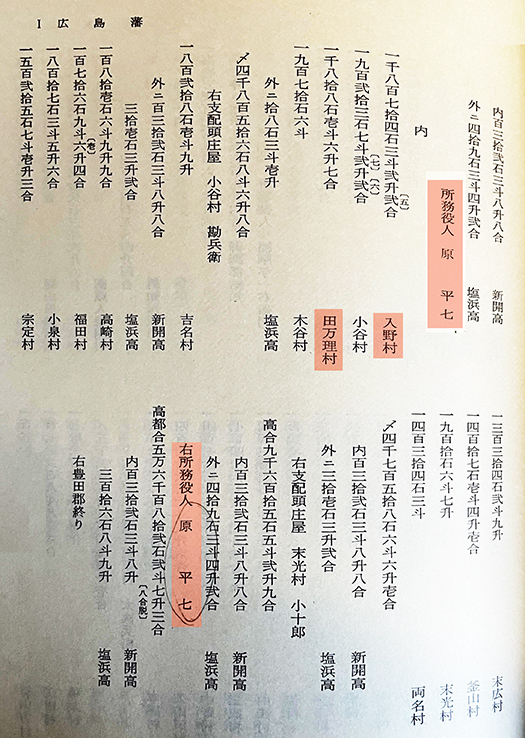
昨日の「浅野家侍帳」での同姓(原氏)の武家一統の確認に引き続き、今回は1676年-1728年を生きた9代前の先祖「原平七」が、浅野藩「所務役人・頭庄屋郡邑受方記」という文書で明示されていた。
家系が伝承してきた故事が藩の公的な記録資料で証明されたワケです。この故事を記録に残した6代前の祖先の調査の正確性が証明された。はるかな末裔として率直にうれしい。まぁご先祖にして見れば「なんだ、今まで確認できなかったのか」と譴責されるでしょうが。ありがたく受け止めたいと思います。
この記録では広島浅野藩の合計生産高は417,685石あまりで、その中で「所務役人40人、頭庄屋81人」と経済面責任者の合計数が記載されている。
この記録では先祖が管掌していた生産高合計は9,615石余、そのうち「新開」132石余「塩浜」49石余と記されている。新開とはあらたに開発された「新田(畑)」を表している。新開に対しては一定の税制優遇があったので別扱いで表記された。また、塩浜は製塩業の規模を表すもの。コメの1石と塩の1石には市場流通性という商品特性に違いがある。この「単位設定」については今後、調査していきたい。
ほかの所務役の管轄地域と比べて「塩浜」の比重が高いのが特徴。
江戸期の経済は戦国期までのコメ最優先が貫徹している社会。基本はコメの収量で測られた時代だが、徐々に「市場経済」化していく社会過程でもあった。この「塩浜」のような米以外の商品が藩経済にとってもウェートが増大した時代だったのだろう。先祖はこういう状況をどう受け止めていたか?・・・
●お知らせ
拙書「作家と住空間」幻冬舎から電子書籍で発刊
お求めはAmazonで。
https://amzn.asia/d/eUiv9yO
English version⬇
【Ancestral “Role Evidence” from Around 310 Years Ago / Official Document of the Hiroshima Domain】
It feels like I can hear a casual voice saying, “Hey, I was doing this back then (lol).” A DNA-like reaction sinks deep within me. …
I’m finally reading through the “History of Hiroshima Prefecture.”
It covers the old provinces of Aki and Bingo—the core region in my family’s oral history. While distant connections exist to Kishu, Hyogo Prefecture, and the Seto Inland Sea side of Shikoku, this is the area with direct, verifiable ancestral ties.
Following yesterday’s confirmation of the same surname (Hara) samurai lineage in the “Asano Clan Samurai Register,” this time, my 9th-generation ancestor, Hara Heishichi, who lived from 1676 to 1728, was explicitly listed in a document titled “Asano Domain Official Duties, Village Headmen, and District Receiving Officers Register.”
This means the family’s long-held tradition has been proven by official domain records. It validates the accuracy of the research conducted by my sixth-generation ancestor who recorded this tradition. As a distant descendant, I’m frankly delighted. Well, if my ancestors were here, they’d probably scold me, “What? You couldn’t confirm this until now?” But I’ll gratefully accept it.
This record states the total production of the Hiroshima Asano Domain was over 417,685 koku. Within this, it lists the total number of economic officials: “40 administrative officials and 81 head village headmen.”
This record also details the total production managed by my ancestor: over 9,615 koku. Within this, it specifically notes “Newly Developed Fields” (Shinka) at over 132 koku and “Salt Fields” (Shiomachi) at over 49 koku. “Shinkai” refers to newly developed “new fields (farmland)”. As shinkai enjoyed certain tax incentives, it was recorded separately. Furthermore, ‘shiohama’ indicates the scale of the salt production industry. There is a difference in the market circulation characteristics between one koku of rice and one koku of salt. I intend to investigate this “unit setting” in the future.
A notable feature is the high proportion of “salt fields” compared to other administrative districts.
The Edo period economy maintained the rice-first priority established since the Warring States period. While fundamentally measured by rice yield, it was also a period of gradual transition toward a “market economy.” This era likely saw non-rice commodities like these “salt fields” gaining increasing weight within the domain’s economy. How did our ancestors perceive this situation? …
●Notice
My book “Writers and Living Spaces” published as an e-book by Gentosha
Available on Amazon.
共有:

Posted on 1月 29th, 2026 by 三木 奎吾
Filed under: 未分類



コメントを投稿
「※誹謗中傷や、悪意のある書き込み、営利目的などのコメントを防ぐために、投稿された全てのコメントは一時的に保留されますのでご了承ください。」
You must be logged in to post a comment.