
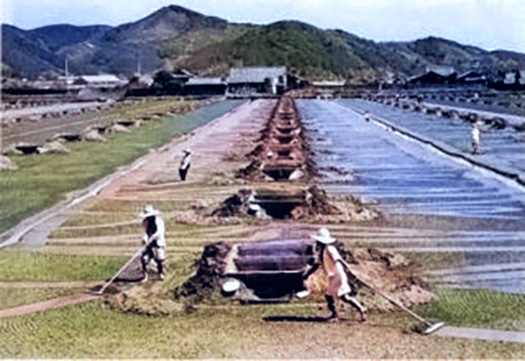
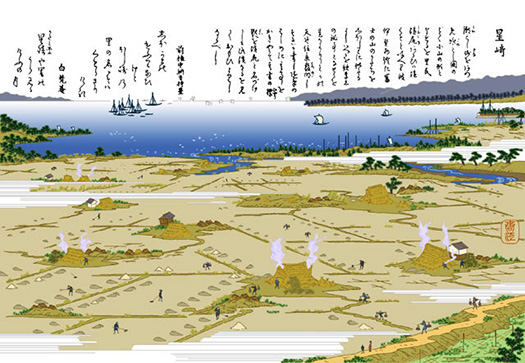
「四百年間のいのちの履歴書」シリーズ、昨日からの「竹原塩田」篇。
わたしにこの家系史探究の承継を命じた次兄の取り組んでいたのは、やはり「系図」探査という日本人一般にある心的情動部分が大きい。しかし引き継いだわたしは社会的生き様に強く惹かれるタイプ。どんどん探究できる各時代相のなかで、大部分共通したDNAを持つ先祖が、どう生きたかという視点が強まってくる。
江戸期は当初1800万石程度だった「GDP」が元禄期くらいまでに3000万石程度まで拡大して耕地面積も広がっていた。それと同時に、ひたすら「コメ経済」志向で増税を考えている武家と、拡張された田畑ではむしろ米以外の商品作物への期待感が高まる農家とで対立が生まれる。瀬戸内海海浜地域では農業土木技術のもっとも直接的な商品作物化として「塩業」というニュービジネスが勃興した。
この瀬戸内海塩業の最先端地域が播州・赤穂で、その経済的富裕の評判を聞きつけた「高家」吉良上野介が露骨に賄賂をせびったのが忠臣蔵事件。縁戚の広島浅野家としてこの塩浜新技術は即、導入された。
試験操業は大成功し、すぐに塩田の大型化が始められその「浜主」権を求め地元の豪農商は言うに及ばず、遠く広島城下の商家まで利権を競合したという。それに対して浅野藩はさらに積極的な「勧業政策」で応えた。経済最重視の秀吉政権以来の体質が、この浅野家には十分にあったと言えるのだろうか。
米作農地に対しては増税対応なのに塩田に対しては「勧業的」ならば、民心は当然そうした事業領域に注目していく。
そもそも新規に開発された「新開」田畑では、米以外の商品作物での現金収入志向が農民層に大きく広がっていった時代相。市場経済が進展していくのは趨勢。
この竹原塩田からの現金収入は藩経済の主要産品だった。
わが家系の「所務役」であった原平七は地域総体の管掌はしていたが、塩田の主要部は竹原市域で浅野藩の直轄だった。しかし近隣の吉名村・木谷村は所務役として管掌する塩田地帯。租税の状況について豪農層としてその経済構造については熟知していたことだろう。そして経済構造としては、尾道からの北前交易での「移出」が核心的利益だということはアタマに叩き込まれていた。 <さらに竹原塩田シリーズ、続きへ>
●お知らせ
拙書「作家と住空間」幻冬舎から電子書籍で発刊
お求めはAmazonで。
https://amzn.asia/d/eUiv9yO
English version⬇
【Takahara Salt Fields: A Regionally Managed “Edo Period New Business”】
The peasantry became strongly drawn to cash income from “cash crops” other than rice. Salt production was the most privileged commodity even within the samurai-dominated system. Its enormous profit rights…
The “Four Hundred Years of Life’s Resume” series, continuing yesterday’s “Takahara Salt Fields” installment.
My second eldest brother, who entrusted me with continuing this family history research, was driven largely by the typical Japanese emotional attachment to genealogy exploration. But I, who took over, am strongly drawn to examining social ways of life. As I delve deeper into each era, my focus intensifies on how ancestors sharing largely common DNA lived their lives.
During the Edo period, the “GDP”—initially around 18 million koku—expanded to roughly 30 million koku by the Genroku era, accompanied by increased cultivated land. Simultaneously, conflict arose between the samurai class, fixated on a “rice economy” and seeking tax increases, and the farmers, who saw the expanded fields as opportunities for cash crops beyond rice. Along the Seto Inland Sea coast, a new business emerged: the salt industry. This represented the most direct application of agricultural engineering techniques to cash crop production.
The forefront of this Setouchi salt industry was Banshu (present-day Hyogo Prefecture) and Akō. Hearing of its economic prosperity, the high-ranking court noble Kira Kozukenosuke blatantly demanded bribes, sparking the Chūshingura incident. As a related clan, the Hiroshima Asano family immediately adopted this new salt field technology.
Trial operations proved highly successful, prompting immediate expansion of the salt fields. Local wealthy farmers and merchants, naturally, sought the rights to manage these “salt fields,” and even merchants from distant Hiroshima Castle town competed for these privileges. The Asano domain responded with an even more aggressive “promotion of industry policy.” One might say the Asano family fully embodied the economic-first mindset inherited from the Hideyoshi administration.
While imposing tax increases on rice-farming land, the domain adopted a “promotional” stance toward salt fields. Naturally, public attention shifted toward such ventures.
Moreover, newly developed “reclaimed” farmland fostered a widespread trend among peasants toward cash crops for income beyond rice. The advancement of a market economy was an inevitable trend.
Cash income from the Takehara salt fields was a primary product of the domain’s economy.
Hara Heishichi, who served as the “Sokumyaku” (administrative officer) for our family branch, managed the overall region, but the main salt fields were located within Takehara City and were directly controlled by the Asano domain. However, the salt field areas in the neighboring villages of Yoshiina and Kitan were under his jurisdiction as Sokumyaku. As a wealthy farmer, he would have been thoroughly familiar with the economic structure and tax situation. And as for the economic structure, it was drummed into our heads that the core profit came from the “shipment” via the Kitamae trade from Onomichi.
●Notice
My book “Writers and Living Spaces” published as an e-book by Gentosha
Available on Amazon.
共有:

Posted on 2月 12th, 2026 by 三木 奎吾
Filed under: 未分類



コメントを投稿
「※誹謗中傷や、悪意のある書き込み、営利目的などのコメントを防ぐために、投稿された全てのコメントは一時的に保留されますのでご了承ください。」
You must be logged in to post a comment.