
昨日はようやく大雪一段落。友人から「やり過ぎ、歳も考えろ」と厳重注意。ごもっとも。
さて「四百年間のいのちの履歴書」シリーズ。本日は今から400年以上前頃の家系と地域の状況。
伝承ではわたしの家系は東広島市河内町「入野」地域に1600年代初期に入地したのですが、夫婦と男女4人の子どものうち「女子」はすぐに隣村の「田万里」に嫁さんに行って、その婚家は当時のわが家の氏である「原」を名乗っている。実際にこの田万里では江戸期を通してこの原家が庄屋をずっと続けていた記録が残っている。
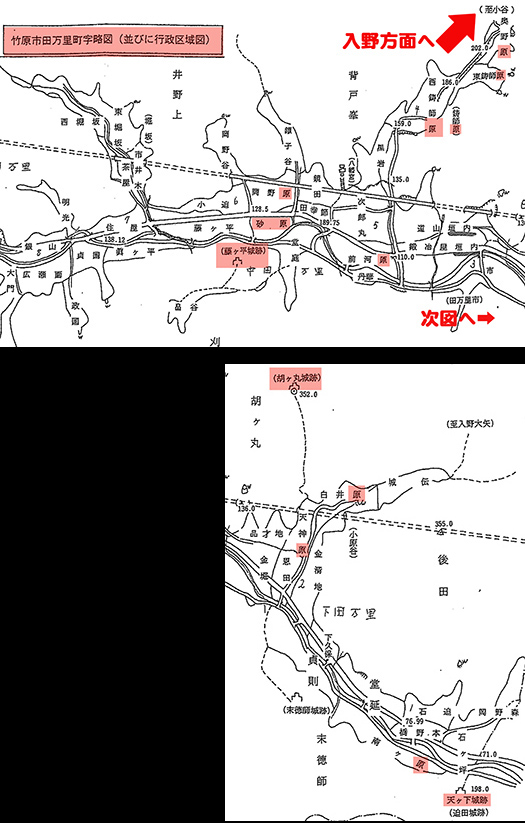
で、明治以降の1958年に竹原市に行政区画で編入されて以降の地図(上図)を見ると、字(あざ)名でたくさんの「原」地名が発見できる。砂原・岡野原・前河原・東西の鋳師原・奥野原・天神原・白井原・南ヶ原などとなっている。この田万里地域自体が〜名前の由来:「たまり」という地名は、賀茂川周辺の土砂堆積や入浜式塩田開発などと関連がある(竹原の歴史的風致より)〜ということなのですが、どうも地形の土木的改良の歴史的痕跡が、地名に残されていることが明らかと思える。
そしてやがて「竹原の塩田開発(1650年頃から開始)」への技術的な伝播が推測されてくる。時期も符合する。実際に古文書の記述で田万里から竹原の塩田造作へ、労働力供給があった記録も残っている。
こういった情報を総合すると、入野に入村した家系は紀州由来の土木技術・知見から隣村の田万里の農地改良・河川土木に経営的に関与し、そこからさらにその進化形と思える竹原の塩田づくりにも深く関与したという推論が浮かび上がってくるのです。
紀州から転封の浅野家の領国経営動態と、わが家系の活動領域の一端が垣間見えてくる。・・・
●お知らせ
拙書「作家と住空間」幻冬舎から電子書籍で発刊
お求めはAmazonで。
https://amzn.asia/d/eUiv9yO
English version⬇
【Hiroshima: Numerous “Hara” Place Names in Tamari, Takehara City / Exploring Ancestral Lands】
Place names containing “Hara” in Tamari, a neighboring village of Irino where settlers from Kishu entered the land, preserve traces of terrain modification and farmland development. From there, involvement in the Takehara salt field development that began in 1650 also emerged. …
Yesterday the heavy snow finally let up. A friend sternly warned me, “You’re overdoing it—think about your age.” They’re absolutely right.
Now, for the “Four Hundred Years of Life’s Resume” series. Today covers my family lineage and the local situation over 400 years ago.
According to tradition, my family settled in the “Iri-no” area of Kawachi-cho, Higashi-Hiroshima City in the early 1600s. Of the couple and their four children (two sons and two daughters), the daughters quickly married into the neighboring village of “Tamari.” Their marital families adopted the surname “Hara,” which was our family name at the time. Records show that this Hara family continuously held the position of village headman (shoya) in Tamari throughout the Edo period.
Looking at maps from after 1958, when the area was administratively incorporated into Takehara City, numerous place names containing “Hara” can be found in the azaname (subdivision names). These include Sunahara, Okanohara, Maekawara, Higashi-Nishi Iushihara, Okuhara, Tenjinbara, Shiraihara, and Minamigahara. The Tamari region itself—Origin of the Name: The place name “Tamari” is associated with sediment accumulation around the Kamo River and the development of inlet-type salt fields (from The Historical Scenery of Takehara)—clearly reveals that historical traces of civil engineering improvements to the terrain are preserved in the place names.
This suggests a likely technological transmission to the “Takahara Salt Field Development” (starting around 1650). The timing aligns. Historical documents actually record labor supply from Tamari to the construction of Takahara’s salt fields.
Synthesizing this information, a hypothesis emerges: the lineage that settled in Irino utilized civil engineering techniques and knowledge originating from Kishu to become involved in the agricultural land improvement and river engineering projects of neighboring Tamari. From there, they likely became deeply involved in the development of Takahara’s salt fields, seen as an evolved form of these earlier projects.
This offers a glimpse into the domain management dynamics of the Asano clan, transferred from Kishu, and a facet of my family lineage’s sphere of activity. …
●Notice
My book “Writers and Living Spaces” published as an e-book by Gentosha
Available on Amazon.
共有:

Posted on 1月 27th, 2026 by 三木 奎吾
Filed under: 未分類




コメントを投稿
「※誹謗中傷や、悪意のある書き込み、営利目的などのコメントを防ぐために、投稿された全てのコメントは一時的に保留されますのでご了承ください。」
You must be logged in to post a comment.