
四百年間のいのちの履歴書シリーズ。
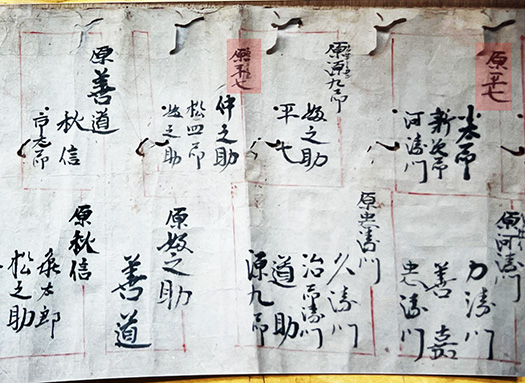
昨日この故地・入野の属する自治体である河内町教育委員会が現地で、わが家系と縁が深そうな原家を訪問し、当時88歳で隠居されていた時彦氏にヒアリング調査(1997年実施)した様子を調査中と書きましたが、そのひとつの伝承書類が上の写真。
こちらのお宅の「家系図」の一部でそこにわが家系伝承との人名「重複」(!)。
こちらの家系図の中にわが家の家系伝承でもその名が記される「原平七」という名が記されている。時代的には亨保3年(1718年)の芸備地域全域での巨大百姓一揆の時代に相当する。
このご先祖は1676-1728年の52年間を生きた人物で、わが家系の記録探査では「入野村庄屋役・苗字帯刀御免」であり広島浅野藩から「所務役」に任命され、所務管轄領は豊田郡中13ヶ村・9,615石の生産高地域を担当した、いわば浅野藩の地域生産管理役。これらの記録は広島県の公的な歴史記録からも史的事実として確認できている。わたしの家系・九世の祖。その人物が同姓「原氏」の別家において、同時代と比定出来る年代に記録されていた次第。
この平七の代での百姓一揆による打ち毀しで、この時点で88歳だった時彦氏がまだ幼い時に、たぶん推定すれば江戸末期〜明治期に生きていられた祖母から「昔、わが家は庄屋をしていたが、百姓一揆で焼き討ちに遭い文無しになり、ドロボーも来ない家になった」と聞かされたとのこと。
伝承としてはピッタリ符合する。
わたしの家系ではこの平七さん時期の記録は乏しくその子の「源七」という八世の祖が、広島県福山市松永で、塩田経営をしたという流れになっている。
これらを総合すると1718年の焼き討ちで「一家離散」に追い込まれ、家系の各人が必死の生き残りを賭けてそれぞれ自分の運を天に任せて各地に散らばったと思われる。わたしの家系・源七は平七の何番目の子どもかも記録がない。藩の所務役を務めたような家の当主(平七)で、どう見ても「多産系」の血筋なのにたったひとりしか子を成さなかったとは考えにくい。
家系の深掘りをしてくると多くのミッシングリンクに突き当たりますが、考えて見れば徳川氏ですらも本流から傍流へ、血の流れは輻輳する。大きな「血脈の発見」に遭遇した次第。
●お知らせ
拙書「作家と住空間」幻冬舎から電子書籍で発刊
お求めはAmazonで。
https://amzn.asia/d/eUiv9yO
English version⬇
【An Ancestor of the Same Surname Appears in Another Family’s Genealogy in My Ancestral Home】
The name of my ninth-generation ancestor appears in the “family tree” of another family with the same surname in my ancestral home. It feels like encountering the depth of human history. What a turbulent life. …
The Four-Century Life History Series.
Yesterday I mentioned that the Kawachi Town Board of Education—the local government body for this ancestral land of Irino—conducted a field visit to the Hara family, who appear to have deep ties to my lineage. They interviewed Mr. Tokihiko, then 88 years old and retired, as part of their research (conducted in 1997). One of the documents from that oral history is pictured above.
This is part of the “family tree” from that household, showing a name “duplication” (!) with our family tradition.
Within this family tree is the name “Hara Heishichi,” a name also recorded in our family tradition. Chronologically, this corresponds to the era of the massive peasant uprising across the entire Geibi region in Kyōhō 3 (1718).
This ancestor lived for 52 years, from 1676 to 1728. Our family records indicate he served as the “Shōya (village headman) of Irino Village” and held the privilege of bearing a surname and sword. He was appointed by the Hiroshima Asano Domain as a “Domain Official” (Tokumiyaku), overseeing the administration of 13 villages in Toyoda District with a total production of 9,615 koku. He was, in essence, a regional production manager for the Asano Domain. These records are confirmed as historical facts through official historical records of Hiroshima Prefecture. He is my ninth-generation ancestor. This individual was recorded in a branch family of the same surname, “Hara,” during a period identifiable as the same era.
During this period of Heishichi’s time, when the village headman’s house was destroyed in a peasant uprising, Tokihiko, who was 88 years old at the time, was told by his grandmother—who likely lived from the late Edo to Meiji periods and was still alive when he was young—that “Long ago, our family served as village headmen, but we were burned out in a peasant uprising, lost everything, and became a house that even thieves wouldn’t bother.”
This oral tradition fits perfectly.
Records from Heishichi’s generation in my family line are scarce. The narrative continues with his son, the eighth-generation ancestor named “Genshichi,” who managed salt fields in Matsunaga, Fukuyama City, Hiroshima Prefecture.
Synthesizing these accounts, it seems the 1718 arson forced the family into dispersion. Each member, fighting desperately for survival, entrusted their fate to heaven and scattered to different regions. My branch, Genjiro’s, lacks records indicating which child Heishichi was. He was the head of a family that served as a domain official (Heishichi), and given that he clearly belonged to a “fertile lineage,” it’s hard to believe he fathered only one child.
Delving deeper into family lineage inevitably reveals many missing links. Yet, upon reflection, even the Tokugawa clan itself sees bloodlines diverging from the main stream into collateral branches. I have thus encountered a significant “discovery of blood ties.”
●Notice
My book “Writers and Living Spaces” published as an e-book by Gentosha
Available for purchase on Amazon.
共有:

Posted on 1月 12th, 2026 by 三木 奎吾
Filed under: 未分類



コメントを投稿
「※誹謗中傷や、悪意のある書き込み、営利目的などのコメントを防ぐために、投稿された全てのコメントは一時的に保留されますのでご了承ください。」
You must be logged in to post a comment.