
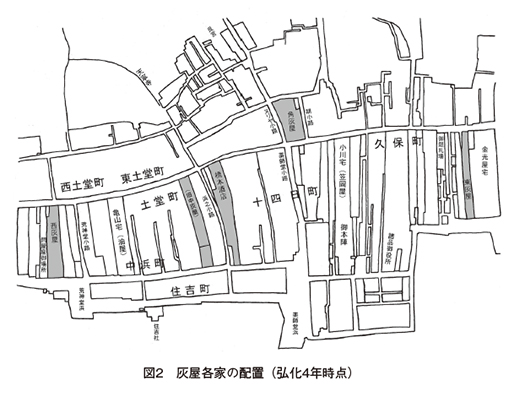
わが家の家系研究の一断面。
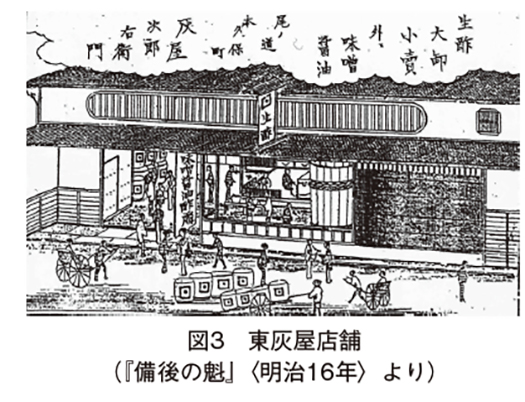
この絵図は、広島県立文書館紀要のなかの「近世尾道商人の系譜と展開」中のもの。いかにも「町屋」としての商家のたたずまいが表現されている。江戸期の一般的な商家の店舗風景を思わせる。江戸の街のにぎわい絵図などでもこういった表現をよく見受ける。尾道は瀬戸内海交易の中核的な存在であり、日本の「資本主義」が揺籃されたというふうに考えられる。いま考察してみれば・・・。
しかしわたしたちが60年以上前当時に学習していた「日本歴史」教育では、仇敵のように江戸期の「身分制度」を教えられ厳格な「士農工商」身分制が江戸期の人びとの価値観の根幹を規定したと教わってきた。わたしなど「よい子」そのものだったので(笑)固く信じて疑わなかった。日本の近代資本主義化は、明治維新以降、初めて成し遂げられたような錯覚を刷り込まされてきた。
しかし尾道など家系の故地、その事跡を探究すればするほど、背景としての江戸期商品経済活動のダイナミックさに気付かされる。そういった経済面に着目しなければ動態的な理解が得られないことに直面してしまう。
最近も、磯田道史先生MCのNHK歴史番組で江戸期の東北荘内の酒田藩と「本間家」のことがビビッドに解明されていた。庄内では江戸期の「回米」経済が主要な「原動力」だったことがわかる。武家による統治は政治表面上はそうだけれど、庄内の場合は基本商品としてのコメは大阪に回米されて現金化され、それが藩全体の経済基盤を形成した。加えて自助努力で紅花・商品作物への旺盛な取り組みなど、藩経済全体の「代理者」としての本間家という存在がわかりやすく見えていた。いわば藩全体の経済運営が本間家という起動力だったのだと知れる。回米は巨大な輸送船・運搬手段が大前提であり、その回船を維持管理する資力がこの本間家に集中する地域特性があったとわかるのだ。
そういう実態は日本中でそのようだったことが容易に理解できる。
江戸期のそういう商品流通の巨大なセンター機能を瀬戸内海交易・尾道は担っていた。その周辺地域に根拠を持ったわたしの家系は、おのずとその中で生き延びていたのだ。経済構造の歴史解明がいちばん正鵠だと気付かされてきている。・・・ちょっと遅いかなぁ(泣)。
お知らせ
拙書「作家と住空間」幻冬舎から電子書籍で発刊
お求めはAmazonで。
https://amzn.asia/d/eUiv9yO
English version⬇
【Illustrated Map of Onomichi Merchant Houses from Late Edo to Early Meiji Periods】
Everything hinges on the economy. That’s only natural. Understanding its true nature defines human destiny. We must firmly incorporate this perspective into our reconstruction of family histories. …
A glimpse into my family’s genealogical research.
This illustration is from “The Genealogy and Development of Early Modern Onomichi Merchants” in the Bulletin of the Hiroshima Prefectural Archives. It vividly captures the appearance of a merchant house as a typical “machiya” townhouse. It evokes the common sight of merchant shops during the Edo period. Such depictions are frequently seen in illustrations of bustling Edo streets. Onomichi was a pivotal hub in Seto Inland Sea trade and is often considered the cradle of Japan’s “capitalism.” Reflecting on it now…
However, in the “Japanese History” education we received over 60 years ago, the Edo period’s “class system” was taught as if it were an enemy. We were taught that the strict “samurai, farmers, artisans, merchants” hierarchy fundamentally defined the values of Edo period people. Being the very picture of a “good student” (laugh), I firmly believed this without question. We were indoctrinated with the illusion that Japan’s modern capitalist transformation was only achieved after the Meiji Restoration.
However, the more I researched the ancestral lands of places like Onomichi and their historical deeds, the more I became aware of the dynamic nature of Edo-period commercial economic activity as a backdrop. I found myself confronted with the fact that without focusing on these economic aspects, a dynamic understanding simply cannot be gained.
Recently, an NHK historical program hosted by Professor Michifumi Isoda vividly illuminated the Edo-period Sakata Domain in Tohoku’s Shonai region and the “Honma family.” It became clear that the Edo-period “rice circulation” economy was the primary “driving force” in Shonai. While samurai rule was the political facade, in Shonai’s case, rice as a basic commodity was circulated to Osaka, converted into cash, and formed the economic foundation of the entire domain. Furthermore, the program clearly showed the Honma family acting as a kind of “agent” for the entire domain economy, driven by their own efforts and vigorous engagement in safflower and other cash crops. Essentially, the Honma family served as the driving force behind the domain’s overall economic management. Rice circulation required massive transport ships and means of transportation as a fundamental prerequisite. Regional characteristics meant the financial resources to maintain and manage these transport ships were concentrated within the Honma family.
It’s easy to understand that this reality was common throughout Japan.
The Seto Inland Sea trade and Onomichi served as a massive center for such commodity distribution during the Edo period. My family lineage, rooted in the surrounding areas, naturally survived within this system. I’m increasingly realizing that unraveling the history of economic structures is the most accurate approach… though perhaps a bit late (tears).
Notice
My book “Writers and Living Spaces” published as an e-book by Gentosha
Available on Amazon.
共有:

Posted on 11月 17th, 2025 by 三木 奎吾
Filed under: 未分類



コメントを投稿
「※誹謗中傷や、悪意のある書き込み、営利目的などのコメントを防ぐために、投稿された全てのコメントは一時的に保留されますのでご了承ください。」
You must be logged in to post a comment.