本文へジャンプ

【戦国経済成長と建築道具進化/日本のいい家㊳-12】


室町の世は戦国期を含めて人口増加の時代。
1115年の平安末期で724万人ほどだったものが、1600年段階で1390万人ほど。
500年間でほぼ人口倍増している。(上智大・鬼頭先生「歴史人口」資料より)
この歴史時間では各地方で自立的な経済圏が成立してその蜜を簒奪する武権も
同時に確立していった過程だといえるのでしょう。
関東平野などの未耕作地域が開墾されていって、各地域の発展が進んだ。
朝廷・皇統周辺での権力たらい回しと各地方への支配高等官派遣政治から
各地域権力者である武家がそれに支配されるバカらしさに気付いて
武力で権力を生み出していって、さらに地方の経済基盤を大きくした時代。
まことに「地方創生」が生き生きと展開していった時代でしょう。
封建というと否定的に捉えられるけれど、人類進歩では民主主義に向かう
必然的な社会プロセスが現出していった時代。戦国は
過酷な権力争奪の時代だけれど、地域発展の面では合理性が高いと思う。
極東アジア世界ではどうも日本だけが真正の「封建」を実現したのか。

きのう見たように、大鋸が木材の製材プロセスを一変させたことで、
従来からは隔絶したような木材生産が可能になったことで、
それを利用しての各地域での土木建築が活況を呈した。
戦争の攻防の要である城砦建築需要が盛り上がり、
しかもそれらがどんどん落城して常に需要の新陳代謝があった。
もしこの時代に建材商社があれば、ウハウハだったことでしょう(笑)。
まぁ戦争での景気なので笑い事ではないけれど、事実はそうでしょう。
ただ、首都京都では繰り返された戦火で都市家屋は繰り返し焼却され
安土桃山期になって建材不足、ヤマの森林不足が深刻化し、
北山に人工的に「杉山」が植林されたと言われ、それが北山杉という
ブランド林になっていったと言われる。
この逸話には日本の「市場価値」の真実があるように感じる・・・。
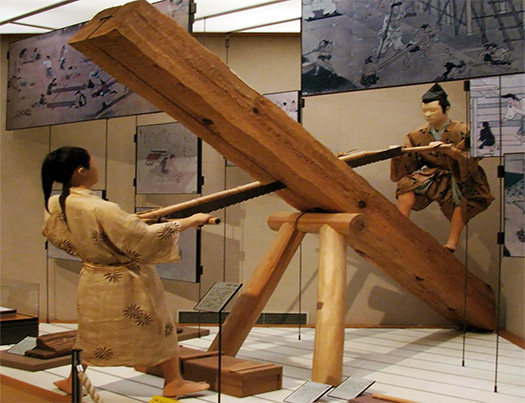
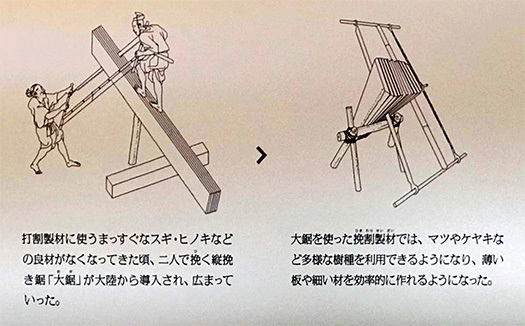
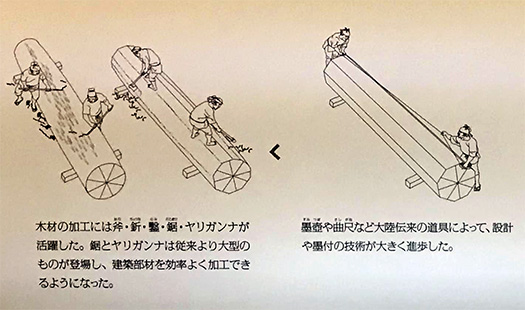
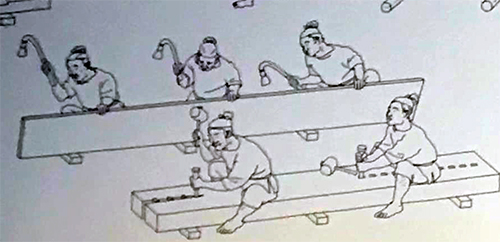
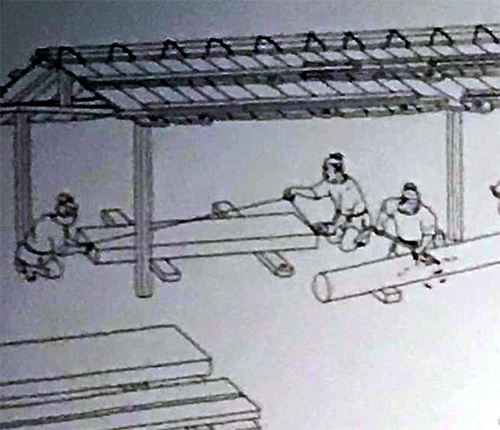
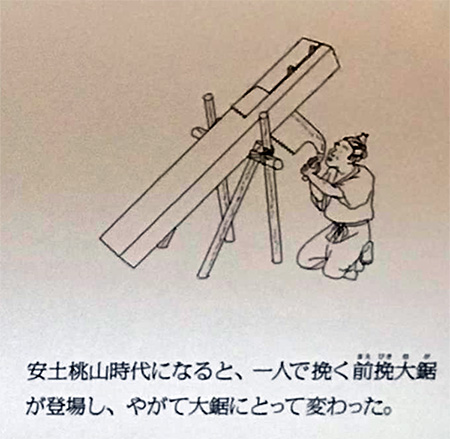
室町期に導入された大鋸はすぐに技術革新が起こってイラストのように
ひとりで操作する「前挽き大鋸」に進化して旺盛な需要に応えていった。
たしかに伐採地でか、建設地近くでかを問わず、2人1組の作業は
工程管理上、面倒だったことでしょう。必然的変化。
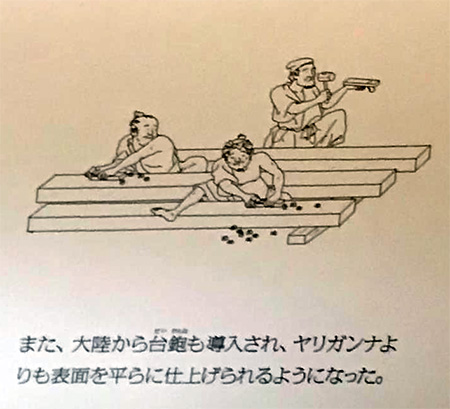
そして今日の「台カンナ」も導入されて木材加工技術はどんどん進化した。

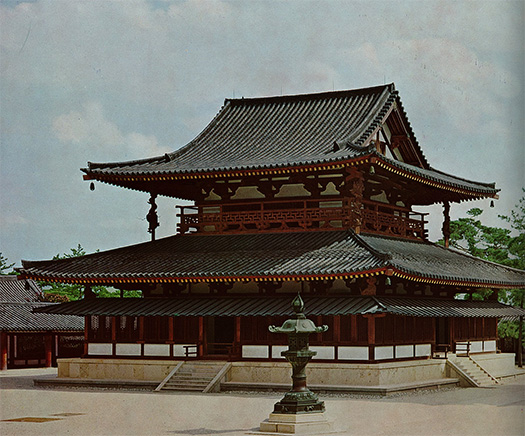
こういう活況を呈した建築技術の発展の末に
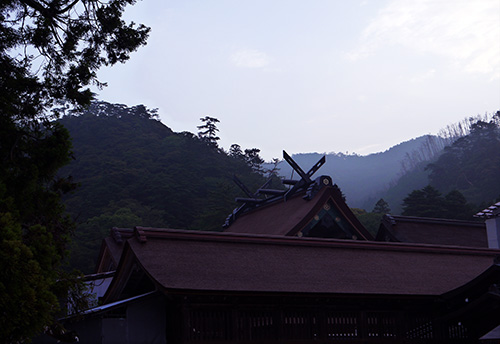
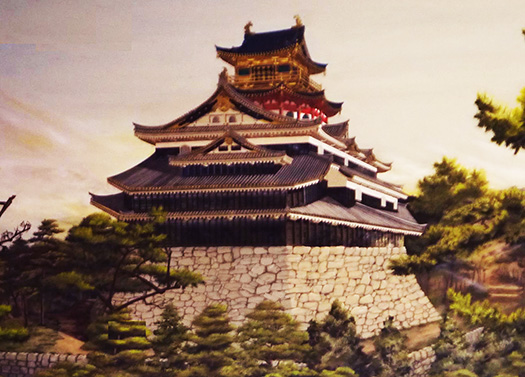
写真のような「安土城」などの高層建築文化が盛り上がっていく。
そして一方では利休などの「数寄屋茶室」文化も併存した。
日本の木造建築が止揚されて独特の文化として成立していったのでしょう。

English version⬇

[Sengoku Economic Growth and Evolution of Building Tools / Good House in Japan ㊳-12]
The world of Muromachi is an era of population growth, including the Warring States period.
At the end of the Heian period in 1115, there were about 7.24 million people, but in 1600 there were about 13.9 million people.
The population has almost doubled in 500 years. (From Sophia University, Professor Kito’s “Historical Population” material)
In this historical time, an independent economic zone is established in each region, and there is also the military power to steal the honey.
It can be said that it is a process that was established at the same time.
Uncultivated areas such as the Kanto Plain have been cleared, and the development of each area has progressed.
From the power circumvention around the imperial court and the imperial court and the politics of dispatching high-ranking officials to each region
Being aware of the stupidity of the samurai, who are the powers of each region, being dominated by it
An era in which power was created by force and the local economic base was further expanded.
It must be an era when “regional revitalization” was truly developed.
Feudalism is considered negative, but human progress is toward democracy.
An era when inevitable social processes emerged. Sengoku
Although it is an era of severe power struggle, I think it is highly rational in terms of regional development.
In the Far East Asian world, did Japan realize the genuine “feudalism”?

As we saw yesterday, Daigiri changed the lumbering process of wood.
By making it possible to produce wood that has been isolated from the past,
Civil engineering and construction in each area using it was booming.
Demand for fort construction, which is the cornerstone of the offense and defense of the war, has risen.
Moreover, they were steadily falling and there was always a metabolism of demand.
If there was a building materials trading company in this era, it would have been ugly (laughs).
Well, it’s not a laugh because it’s a war economy, but it’s true.
However, in the capital city of Kyoto, urban houses were repeatedly incinerated due to repeated wars.
In the Azuchi-Momoyama period, the shortage of building materials and forests in Yama became more serious.
It is said that “Sugiyama” was artificially planted in Kitayama, which is called Kitayama cedar.
It is said that it has become a brand forest.
I feel that this anecdote has the truth of Japan’s “market value” …
Daigiri, which was introduced in the Muromachi period, soon undergoes technological innovation, as shown in the illustration.
It has evolved into a “front-ground Daigiri” that can be operated by itself, and has responded to strong demand.
Certainly, the work of a pair of people is done regardless of whether it is in a logging area or near a construction site.
It would have been troublesome in terms of process control. Inevitable change.
And today’s “Tai Kanna” was also introduced, and the wood processing technology has evolved steadily.

At the end of the development of such a booming building technology
High-rise building culture such as “Azuchi Castle” as shown in the photo will rise.
On the other hand, “Sukiya tea room” culture such as Rikyu also coexisted.
It seems that Japanese wooden architecture was suspended and established as a unique culture.

【室町期「大鋸」製材革命ビッグバン/日本のいい家㊳-11】


木材製材の歴史で「大鋸〜おが」は14〜15世紀室町時代に中国から導入された。
大鋸は長さが約2メートルあり2人がかりで左右あるいは上下から
縦挽きに挽いて木材を切る。木材建材の生産能率が飛躍的に上昇した。
竹中大工道具館展示では、法隆寺以降の時代について
この製材革命を持って打ち割製材から「挽き割製材」への画時代としている。
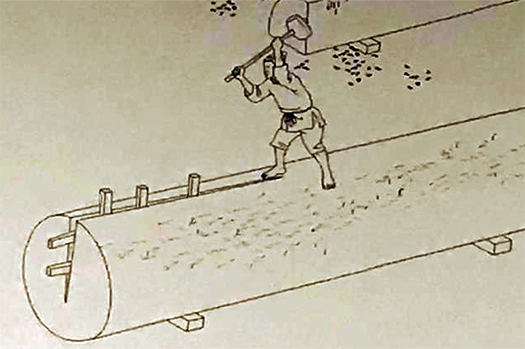
それまでの製材方法は「打ち割り」製材と呼ばれるもので、
以前紹介した竹中大工道具館イラスト展示では以下のようだった。

上の写真は千葉県の「国立歴史民俗博物館」展示のものです。
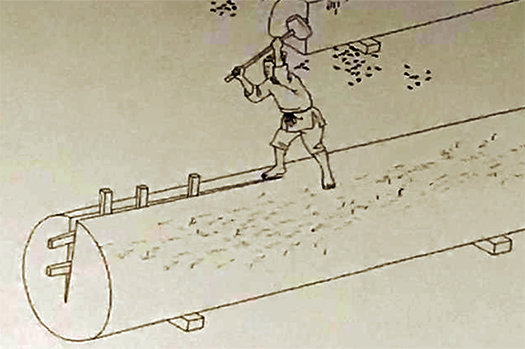
打ち割製材では切り倒した木材の「筋目」に沿って楔を入れて
木槌を振り下ろして、割って製材としていた。その結果、
構造材として利用しやすいのは、杉などの割りやすい材が中心であって、
利用地と伐採地の距離が遠隔化し材の供給に問題が生じていたに違いない。
この製材現場の実態が、日本の木造技術の進化にとって障害になっていた。
割りやすい木を採取し尽くすと供給が乏しくなっていった。
司馬遼太郎エッセイでも日本の大型木造建築の時代的増減に触れた件があり
大型木造建築が旺盛な奈良期から室町期まで減少するとされている。
司馬さんは原材料が伐採され尽くした結果、森林回復にそれくらい掛かった、
という説を上げていたけれど、どうもこの大鋸導入以前の状況だったと思われる。
四天王寺・法隆寺から東大寺・各地の国分寺建設などで
木造技術者は全国に拡散したけれど、やがてこの製材のボトルネックが生じた。
その結果、大規模建築が時代的に減少したのではないだろうか。
竹中大工道具館展示説明でも、木材の樹種がこの大鋸によって
飛躍的に多様化していって各地の身近な山から製材出荷が可能になった。
やはり打ち割り製材では手間が掛かりすぎ、かつ樹種の制約もあったのだ。
そして各地域の人口拡大、経済規模の拡大に沿って支配権力の拡散も、
戦国時代=地域活性化として現実化していった。
各地域の武力権力者は軍事拠点としての城砦建築を活発化させたけれど、
この「大鋸」革命によって構造材生産が幾何級数的に拡大したのだろう。

戦国期の戦争は同時に土木建築の競争でもあったのだと思われる。
武田信玄の甲州の産金とその土木技術の軍事転用や
墨俣の一夜城や高松城の水攻めなどの奇想天外な土木建築活用の秀吉など、
こうした製材革命による木材の大量利用が歴史の影で進行したのだと思う。
ジオラマ展示にはそういう民族的革命事態が暗示されている。
室町期の大鋸の輸入と兵器としての鉄砲輸入は日本史の重要な変化。
鉄砲はより大きく取り上げられるけれど、大鋸もそれ以上だったと思う。
戦争が活発化するのと各地で攻防のための築城は同時進行した。
当然、活発な用材の供給実態が想像されるけれど、
このことについての調査研究活動はあまり注目されていない。
秀吉の巨大な土木建築活用の実態などを見ると、
この「革命」のインパクトをまざまざと実感させられるのだけれど。・・・

English version⬇

[Muromachi period “Daigiri-Oga” sawmill revolution big bang / Japanese good house ㊳-11]
In the history of lumber lumber, “Daigiri-Oga” was introduced from China during the Muromachi period in the 14th and 15th centuries.
Daigiri is about 2 meters long and requires two people from the left and right or from above and below.
Cut the wood by grinding it vertically. The production efficiency of timber building materials has increased dramatically.
At the Takenaka Carpentry Tools Museum exhibition, about the era after Horyuji Temple
With this lumbering revolution, we are in the era of painting from split sawing to “grinding sawing”.
The lumbering method up to that point was called “splitting” lumbering.
The illustration exhibition at Takenaka Carpentry Tools Museum introduced earlier was as follows.

The photo shows the exhibition at the “National Museum of Japanese History” in Chiba Prefecture.
In split lumber, insert a wedge along the “streaks” of the cut down wood.
I shook the mallet down and broke it to make lumber. as a result,
Most of the materials that are easy to use as structural materials are easy-to-break materials such as cedar.
There must have been a problem with the supply of lumber due to the remote distance between the land used and the logging area.
The reality of this sawmill was an obstacle to the evolution of Japanese wooden technology.
When all the fragile trees were collected, the supply became scarce.
Ryotaro Shiba’s essay also touched on the changes over time in large-scale wooden architecture in Japan.
It is said that the number of large wooden buildings will decrease from the Nara period, when it was flourishing, to the Muromachi period.
Mr. Shiba took so much time to reforest as a result of logging being exhausted.
However, it seems that the situation was before the introduction of this Daigiri.
From Shitennoji / Horyuji to Todaiji / Kokubunji in each area
Wooden engineers spread all over the country, but eventually a sawn bottleneck arose.
As a result, the number of large-scale buildings may have decreased over time.
Even in the explanation of the Takenaka Carpentry Tools Museum exhibition, the wood species are selected by this Daigiri.
It has become dramatically diversified, and it has become possible to ship lumber from familiar mountains in each region.
After all, it took too much time and effort to use split lumber, and there were restrictions on the tree species.
And as the population of each region expands and the scale of the economy expands, the power of control also spreads.
It became a reality as the Warring States period = regional revitalization.
Powerful people in each region activated the castle construction as a military base,
This “Daigiri” revolution may have expanded the production of structural materials geometrically.

It seems that the war during the Warring States period was also a competition for civil engineering and construction.
Takeda Shingen’s Koshu gold production and military diversion of its civil engineering technology
Hideyoshi, who utilizes the strange civil engineering architecture such as Sunomata’s Ichiya Castle and Takamatsu Castle’s water attack, etc.
I think that the mass utilization of timber due to this lumber revolution has progressed in the shadow of history.
The diorama exhibition implies such an ethnic revolution.
Imports of large saws and guns as weapons during the Muromachi period are important changes in Japanese history.
The guns are taken up more widely, but I think the Daigiri was even more.
As the war intensified, the construction of castles for offense and defense proceeded at the same time.
Of course, you can imagine the actual supply of active lumber,
Research activities on this matter have received little attention.
Looking at the actual situation of Hideyoshi’s use of huge civil engineering buildings,
You can really feel the impact of this “revolution” …

【大陸から建築技術導入:法隆寺/日本のいい家㊳-10】


さて古代の日本列島での木造技術を見てきたけれど、
やがてアジア世界との交流が本格的に始まっていく。
天皇制というシステムと統一国家としての統治思想として鎮護国家政策で
各地で国分寺・国分尼寺が造営されて建築として
たぶん「見たこともない」キラキラとしたものとして
この列島の人々の心を占領していったに違いない。
中央集権国家体制の構築と、アジア的律令体制とが一体化して導入された。
建築の流儀として、そのデザイン細部まで入り込んできた。
見たような「出雲大社神殿」のような巨木建築の志向性とはかなり違いがある。
個人的には日本史では奥州での「産金」が大きな影響を及ぼしたと思います。
奈良期に大仏を造営したけれど鍍金にあたって国内でついに産金したことは、
「経済大国」ニッポンの初源体験だったのではと思っています。
四天王寺、法隆寺建設段階ではひたすらアジア世界価値感の導入だったものが、
人口増、経済発展が進みさらに自国内での産金によって
ジャパンasNO1みたいな自信が社会に充満していったのではないか。
その後のヤマト朝廷支配、その基本体制の定着にとって、
産金による自国への自信というものは大きかったのではないか。
天智期での白村江敗戦以降の中国からの脅威が律令体制の積極導入につながり、
仏教文化の積極受容が進められアジア世界への普遍化の流れがあったものが
自国産金で一気に自信回復した、と思えるのです。
そしてその産金地帯が日本権力体制の「汽水域」のような地域だったことが
その後の東北地方の政治動乱の伏線になっていった。

法隆寺建築はそのような国家の状況の中で象徴的な建築営為だった。
竹中大工道具館展示ではアジア世界からの技術導入的に捉えられている。
たしかにそういう側面は大きかっただろうけれど、一方で三内丸山、
出雲神殿建築の木造技術伝統がそれを容易に受容させたとも思える。
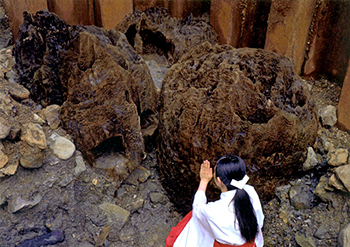
礎石の考え方も、出雲神殿でも掘っ立ての基礎部分には多くの砕石が多密度。
技術の受容に当たってたぶん、簡単に「応用」として土着できたのだと思う。
明治の西洋文化導入でも「世界の驚異」的なペースで進めたように。
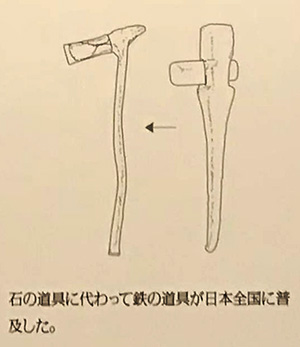
ノコギリやヤリカンナなど道具は先進のものが導入されただろうけれど、
その使い方は相当スピードで技術文化が定着していった。
法隆寺の建設が想定創建年607年、そこから国分寺建設開始が741年。
それまでの建築スタイルから移行し、それが全国で一斉に建築できるまで
底堅い技術基盤が確立したのだと考えると興味深い。
多数の新技術・新ツールを使いこなす職人が全国的にネットワーク形成された。
日本の歴史人口は上智大学経済学部教授・鬼頭宏さん資料で
奈良期の725年で450万人ほど。その人口規模で全国のクニで造営された。
その時代の最先端技術職人がそれを可能にさせたということ。
典型的な「技術史」と考えるとテーマとして面白いと思われます。

English version⬇

[Introduction of building technology from the continent: Horyuji Temple / Good Japanese House ㊳-10]
Well, I’ve seen the wooden technology in the ancient Japanese archipelago,
Eventually, exchanges with the Asian world will begin in earnest.
With the system of the emperor system and the guardian state policy as the idea of ​​governance as a unified nation
Kokubunji Temple and Kokubunnanji Temple were built in various places as architecture
Maybe as a “never seen” glitter
It must have occupied the hearts of the people of this archipelago.
The construction of a centralized national system and the Asian decree system were introduced in an integrated manner.
As an architectural style, the details of the design have been taken into consideration.
There is a considerable difference from the orientation of giant tree architecture such as the “Izumo Taisha Shrine” that you saw.
Personally, I think that “gold production” in Oshu had a great influence on Japanese history.
The Great Buddha was built in the Nara period, but the fact that it was finally plated in Japan was
I think it was the first experience of “economic power” Japan.
At the construction stage of Shitennoji and Horyu-ji, the introduction of Asian world value was earnestly introduced.
Due to population growth, economic development, and domestic gold production
I think society was filled with self-confidence like Japan as NO1.
For the subsequent Yamato court rule and the establishment of its basic system
I think the confidence in their own country from the money they produced was great.
The threat from China after the defeat of Baekgang in the Tenji period led to the active introduction of the decree system.
The positive acceptance of Buddhist culture has been promoted and there has been a trend toward universalization in the Asian world.
It seems that the self-confidence was restored at once with the domestic money.
And that the gold-producing area was a region like the “brackish water area” of the Japanese power system.
It became a hint of political turmoil in the Tohoku region after that.

Horyuji architecture was a symbolic architectural activity in such a national situation.
At the Takenaka Carpentry Tools Museum exhibition, it is seen as a technology introduction from the Asian world.
I’m sure that aspect was big, but
On the other hand, it seems that the wooden technology tradition of Sannai Maruyama and Izumo Temple architecture easily accepted it.
Even in the Izumo Temple, there are many crushed stones in the foundation of the digging.
In accepting the technology, I think it could have been easily indigenous as an “application”.
It seems that the introduction of Western culture in the Meiji era proceeded at a “world wonder” pace.
Advanced tools such as saws and spear canna would have been introduced,
The technical culture became established at a considerable speed in its usage.
The construction of Horyuji Temple is assumed to be in 607, and the construction of Kokubunji will start in 741.
From the previous architectural style to a new style, until it can be built all over the country
It is interesting to think that a solid technological foundation has been established.
A nationwide network of craftsmen who master a large number of new technologies and tools has been formed.
The historical population of Japan is based on materials by Hiroshi Kito, a professor at the Faculty of Economics, Sophia University.
About 4.5 million people in 725 during the Nara period. It was built in Kuni all over the country with its population size.
The state-of-the-art craftsmen of that era made it possible.
Thinking of it as a typical “history of technology”, it seems to be an interesting theme.

【掘立から石場建てへ/日本のいい家㊳-9】


竹中大工道具館の木造進化プロセス展示シリーズ、古代編の最後に
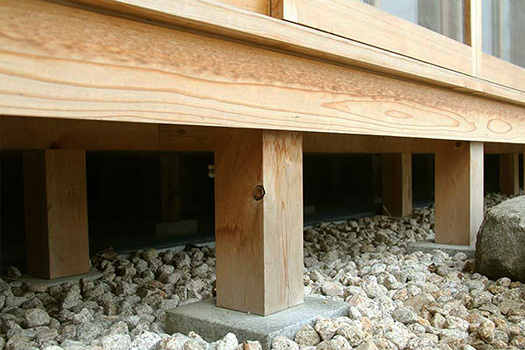
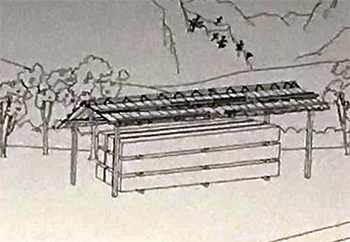
このような「石場建て」の様子が提示されている。
木造の建築は最初は掘っ立てで主要な柱を地中に埋め込んで土圧で安定させた。
三内丸山、出雲大社、そして20年ごとに式年遷宮を繰り返す伊勢神宮も
掘っ立てで建てられてきた。
三内丸山ではその掘っ立て柱が地中で腐りにくいようにクリの木が採用された。
しかし地中の含水量や水はけ状況に応じて柱の腐朽は避けられない。
そういうことから耐久性を考えた建築ではより高級なものから
徐々に礎石の上に柱を立てていく石場建て工法が採用されていくことになる。
鎌倉時代、都市鎌倉の武家住宅などでは石場建てが採用され
一般庶民住宅などでは掘っ立てだったという。
大陸の建築では礎石建築が主流、というか、輸入されるような建築技術としては
こうした「先進技術」が主体だっただろうことは自明。
石場建ては伝統工法のコアな部分であり、
日本の木造技術進化のなかで耐久性向上に於いて枢要だったこともあきらか。
地震大国日本では礎石と木造構法を緊結させずに地震力を「いなす」知恵は
画期的な技術だったと言えるのでしょうね。

日本の木造技術の進化では、基礎がこのような方向に定まって以降、
次に大きな改変が起こってくるのは高断熱高気密化なのでしょうか。
戦後以降、コンクリート成型した連続的な基礎が一般化してから
高断熱技術は、それを前提として断熱の工夫が重ねられることになった。
写真のような床下通風を重視した、いわば蒸暑気候対応の耐久性から
室内気候コントロール機能を重視した高断熱化では
断熱で建物を包み上げることが志向されていったので、
基礎外断熱のような密閉化の方向に向かっていった。
現代の建築基準法的な捉え方からすれば、建物を滑らせて地震耐力を高めるのは
計算不能の領域の技術となっていった。
このような床下開放型の建築でも床断熱工法で断熱できる。しかし、
北海道ではより簡便な断熱対応として基礎外断熱が主流だと言えるでしょう。
もうひとつ大きなポイントはこのような非緊結の石場建てでは
建物の自立安定のために加重を一定程度、自重として掛けていくために
屋根材として瓦などが採用されていったという流れがあるのでしょう。
いやむしろ、デザイン的な要素として屋根の仕上げ方の結果として
より安定性の高い石場建てが多くの建物で採用された側面が大きいのかも。

さて本日いよいよ2020東京オリンピックの最終日。
当地札幌は連日の猛暑で早朝スタートということで男子マラソン。
競歩や女子マラソンなども男子マラソン会場と重複して利用したのですが、
最後のシメのオリンピックの華であります。
ということで、ここしばらく市内の交通規制も強化されています。
市民として、できるだけ気温上昇が抑えられるように祈っていました。・・・
どうも本日早朝も雨の気配は薄いのですが、選手のみなさんの健闘を祈念します。

English version⬇

[From digging to stone building / Japanese good house ㊳-9] At the end of the ancient edition of the Takenaka Carpentry Tools Museum’s wooden evolution process exhibition series
The state of such “stone building” is presented.
The wooden construction was initially dug up and the main pillars were buried underground and stabilized by earth pressure.
Sannai Maruyama, Izumo Taisha Shrine, and Ise Jingu Shrine, which repeats the ceremony every 20 years
It has been built by digging.
At Sannai Maruyama, chestnut trees were adopted so that the dug pillars would not rot in the ground.
However, decay of pillars is unavoidable depending on the water content in the ground and drainage conditions.
For that reason, in architecture that considers durability, from higher-class ones
The stone yard construction method, in which pillars are gradually erected on the cornerstone, will be adopted.
During the Kamakura period, stone-built houses were adopted in samurai houses in the city of Kamakura.
It is said that it was a shack in ordinary people’s houses.
Cornerstone architecture is the mainstream in continental architecture, or as an imported building technology
It is self-evident that such “advanced technology” would have been the main focus.
Ishiba-ken is a core part of traditional construction methods,
It is clear that it was the key to improving durability in the evolution of Japanese wooden technology.
In Japan, an earthquake-prone country, the wisdom of “inasushi” the seismic force without binding the cornerstone and the wooden construction method
It can be said that it was an epoch-making technology.

In the evolution of Japanese wooden technology, since the foundation was decided in this direction,
Is it the high heat insulation and high airtightness that will cause the next major change?
After the war, after the generalization of continuous concrete-molded foundations
High heat insulation technology has been devised for heat insulation on the premise of that.
From the durability of the hot and humid climate, which emphasizes underfloor ventilation as shown in the photo.
With high heat insulation that emphasizes indoor climate control function
Since it was intended to wrap the building with heat insulation,
We went in the direction of sealing like external insulation.
From the modern building code perspective, sliding a building to increase seismic resistance is
It became a technology in the uncalculable area.
Even in such an underfloor open type building, it is possible to insulate by the floor insulation method. but,
In Hokkaido, it can be said that external insulation is the mainstream for easier insulation.
Another big point is in such a non-tied stone building
To apply a certain amount of weight as its own weight for the independence and stability of the building
There may be a trend that roof tiles were used as roofing materials.
Rather, as a result of how the roof is finished as a design element
It may be that the more stable stone-built building was adopted in many buildings.

By the way, today is the final day of the 2020 Tokyo Olympics.
The local Sapporo is a men’s marathon because it starts early in the morning due to the intense heat every day.
I also used racewalking and women’s marathons at the same time as the men’s marathon venue.
It is the flower of the last Olympic Games.
As a result, traffic regulations in the city have been tightened for some time.
As a citizen, I prayed that the temperature rise would be suppressed as much as possible.・ ・ ・
It seems that it is not raining early in the morning today, but I wish all the players a good fight.

【柱梁を仕上げ、板材を削る手業/日本のいい家㊳-8】


今日の木建材は現場で切って貼って組み立てるのが容易なように仕上げられている。
原木への加工処理が資本主義的な合理化システムで貫徹されている。
すべてが経済原則=合理主義に貫かれて生産が統御されている。
それは必然だと思う一方で、自然との関係が希薄になると感じるのも顕著な心理。
人類社会というのは合理主義と一方でルネサンス的な人間性復興も特徴的。
人類発展の主要なツールとしての木材へのリスペクトも大きな心性。
今日、戸建て住宅は木造が圧倒的に多数派だけれど、
「家であればいい」と考える志向と、一方で木造らしさを求める志向もある。
ただただ生活ボックスとしての機能性で十分と考えるのもアリだけれど、
木造の「らしさ」に強く惹かれるのも自然なことだと思う。

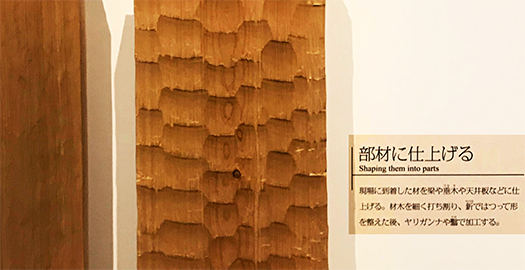
上の写真は木材の表面仕上げとして最初期に近い「手斧仕上げ」。
古建築でときどきこの仕上げの材と出会うことがある。
「え、なんか不揃いで不細工」「信じらんない〜」
と感じるのもある意味自然だと思う。けれどわたしなどは、
思わず目が点になるように、深く心理フェチに陥ってしまう(笑)。
なんというか、一振り一振り、木材原木に対して
「きれいになりますように、平滑になりますように」と念を掛けた様子が伝わる。
もちろんより平滑にする方法は人類は獲得しているし、それが合理的とはわかる、
けれど、こういう職人の手業というのも深く魅了してくれるのだ。
原木というのは生物個体であるので木目もあれば、節もある。
空間を構成する材料である普遍的機能の一方、抜けがたく「個性」もある。
こうした仕上げ方を見ていると、木材の個性と職人の息づかいも個性。
そういう人間の手作業をデザインの主要エレメントとも捉えられる。
まるで「木造ルネサンス」的な魅力としても感じられる。

考えてみると、戦後高度成長時代由来の合理主義社会は
「たくさん同じものを作るのが合理化、進歩だ」と信じたのかも知れない。
おかげで全国どこでも同じ家、同じ暮らし方という均質な社会を志向してきた。
しかしその先にどんな「ステキな未来」があるのかどうか、
疑わしいと感じる現代人は増えてきていると思う。
そして個性的な生き方、暮らし方を考える人々にとって
未来的な家づくりというものは、フェーズが変わってくるのではないか。

English version⬇

[Handicrafts for finishing pillars and beams and scraping boards / Good Japanese house ㊳-8]
Today’s wooden building materials are finished to be easy to cut, paste and assemble on site.
The processing of raw wood is carried out by a capitalist rationalization system.
Everything is governed by economic principles = rationalism.
While I think it is inevitable, it is also a remarkable psychology to feel that the relationship with nature is weakened.
Human society is characterized by rationalism and the renaissance of humanity.
Respect for wood as a major tool for human development is also a big spirit.
Today, the majority of single-family homes are made of wood,
Some people think that it’s okay if it’s a house, while others want it to be wooden.
It’s ant to think that the functionality as a living box is enough,
I think it’s natural to be strongly attracted to the “likeness” of wooden structures.

The photo above is a “hatchet finish” that is close to the earliest as a surface finish for wood.
Occasionally I come across this finishing material in old architecture.
“Well, it’s uneven and ugly.” “I can’t believe it.”
I think it’s natural in a sense. But I and others
I fall into a deep psychological fetish so that my eyes become a point (laughs).
Somehow, one by one, against wood logs
You can see how he thought, “May it be clean and smooth.”
Of course, humanity has acquired a way to make it smoother, and it turns out that it is rational,
However, this kind of craftsmanship is also deeply fascinating.
Since a log is an individual organism, it has grain and knots.
While it has a universal function that is a material that composes space, it also has an indispensable “individuality.”
Looking at this finishing method, the individuality of the wood and the breath of the craftsmen are also individual.
Such human manual work can be regarded as the main element of design.
It feels like a “wooden renaissance” charm.

Come to think of it, the rationalist society that originated in the postwar period of high economic miracle
He may have believed that “making a lot of the same things is rationalization and progress.”
Thanks to this, we have aimed for a homogeneous society with the same house and the same way of living everywhere in Japan.
But what kind of “wonderful future” is ahead?
I think that the number of modern people who feel suspicious is increasing.
And for people who think about their unique way of life and way of life
The phase of futuristic home building may change.

【列島社会の製材・運搬史/日本のいい家㊳-7】


木を扱う、利用するという営為は人類史の中でもかなり枢要だと思える。
人類が進出した世界同時多発的にこうした技術進化は進んだだろうけれど、
四季変化があり、多量の降雨で豊かな森林を維持する極東アジアの列島は
木造技術進化において稀有な諸条件を満たしていたと思われる。
ヨーロッパに向かった人類集団は石による建築文化が優先したとも思えるし、
土にこだわった建築文化を生み出したりもした。
一方で文明段階が進んでいく毎にそれら相互間での技術交流も活発化しただろう。
しかし、日本オリジナルの木の文化はマザーのように深く刻印もされている。

竹中大工道具館展示での地味なイラスト展示シリーズですが、
なかなかモノとしてのエビデンスが残りにくい営為だけれど
しかしそれが決定的だったことについて表現して行くには
こういった「公知」を明示する必要はあると思います。
きっと展示担当者も相当にエビデンス探しを行っただろうけれど、
そもそもその工具、道具も初源のカタチが失われてもいる。あとで触れるが、
法隆寺宮大工だった西岡常一氏は初源の大工手仕事の復元にこだわり
ヤリカンナなどの失われた道具を復刻させたりしたという。
人類進化のプロセスをカタチにして遺すのは技術発展の基盤を守る意味でも
非常に重要だと思う。失われてから大事さがわかってくる事柄。
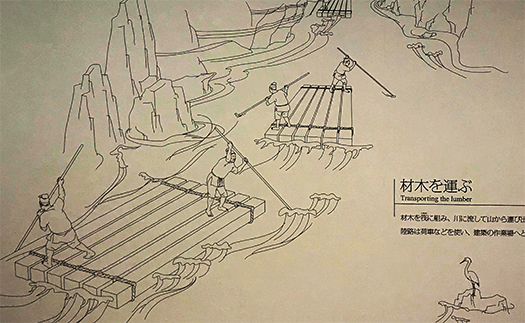
原木を伐採し、打ち割り製材して現地である程度加工を加えた材木を
豊富な河川交通を利用して建築利用地に運んで来る作業。
現代ではこういった機能は世界中から商社が果たして、
建築現場ではその出産地のことを想像することも少なくなったけれど、
初源期の建築営為では、まさに「どこから用材を切り出すか、いつ切るか」
ということもきわめて重要なファクターだったに違いない。
とくに三内丸山にしろ、出雲神殿にしろ「巨木」への帰依が感じられる日本では
太く高い原木への探究心が強かったに違いない。
出雲では神話のように、巨木用材が流木として流れ着いたという伝承がある。
その数、数百本と語られている。そういうことが「たまたま」起こることはない。
それは相当遠隔地から利用する用材を調達し、出雲の浜に運び入れたのでしょう。
その様子を宗教施設として語り伝える意味で神話化したに違いない。
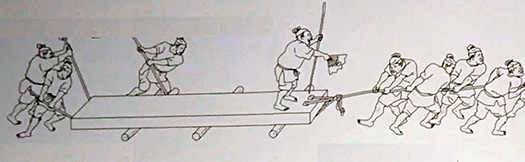
陸上輸送ではコロの原理で巨木材を運んだだろうことが推定される。
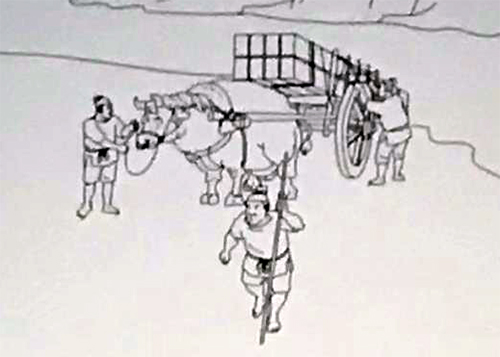
戦国期の安土城建築では「修羅」巨大運搬具もジオラマ展示されていたけれど、
牛車というような重量物運搬具も、その初源を知りたくなってくる。
重量物を運ぶには「道路」も整備される必要があるけれど、
列島居住初源期、三内丸山縄文段階では、あの巨木をどう「移動」させたか、
地盤というものを見抜く知見も存在したのでしょう。・・・

この列島社会でどんな木造技術進化が生起したのか、
探査していく工程には尽きせぬ先人たちの知恵と工夫が存在しているのでしょう。

English version⬇

[History of lumbering and transportation in archipelago society / Good Japanese house ㊳-7]
The act of handling and using trees seems to be quite important in human history.
Although such technological evolution would have progressed at the same time in the world where human beings have advanced,
The archipelago of Far East Asia, which has four seasons and maintains abundant forests with heavy rainfall
It seems that it met rare conditions in the evolution of wooden technology.
It seems that the stone architectural culture was prioritized for the human group heading to Europe.
I also created an architectural culture that was particular about the soil.
On the other hand, as the civilization stage progressed, technological exchanges between them would have become more active.
However, the original Japanese wood culture is deeply engraved like a mother.

This is a series of sober illustrations exhibited at the Takenaka Carpentry Tools Museum.
It’s an activity where evidence as a thing is hard to remain
But to express that it was decisive
I think it is necessary to clearly indicate such “public information”.
I’m sure the person in charge of the exhibition would have searched for evidence, but
In the first place, the original shape of the tools and tools has been lost. I will touch on it later
Tsunekazu Nishioka, who was a carpenter at Horyuji Temple, is particular about restoring the original carpenter’s handiwork.
He is said to have reprinted lost tools such as Yarikanna.
Leaving the process of human evolution in shape also means protecting the foundation of technological development.
I think it’s very important. Things that become important after being lost.
Logs are cut down, sawn by splitting, and processed locally to some extent.
Work to bring to the construction site using abundant river traffic.
Today, trading companies from all over the world perform these functions.
At the construction site, I rarely imagine the place of birth,
In the construction business in the early days, it is exactly “where to cut the lumber and when to cut it”.
That must have been a very important factor.
Especially in Japan where you can feel the devotion to “giant trees” whether it is Sannai Maruyama or Izumo Temple.
He must have had a strong quest for thick and tall logs.
In Izumo, as in mythology, there is a tradition that giant wood lumber has drifted as driftwood.
It is said that there are hundreds of them. That doesn’t happen “by chance”.
It must have procured materials for use from a considerable remote area and brought them to the beach of Izumo.
It must have become a myth in the sense that it tells the situation as a religious facility.
It is presumed that in land transportation, huge timber would have been carried by the principle of rollers.
In the Azuchi castle architecture during the Warring States period, a diorama of “Shura” giant carrier was also exhibited.
You will want to know the origin of heavy goods carriers such as ox carts.
“Roads” need to be maintained to carry heavy objects,
How did you “move” that giant tree during the Jomon period of Sannai Maruyama, the first source of residence in the archipelago?
Perhaps there was also knowledge to see through the ground.・ ・ ・

What kind of wooden technology evolution has occurred in this archipelago society?
There must be inexhaustible wisdom and ingenuity of our predecessors in the exploration process.

【森での樹木伐採・製材/日本のいい家㊳-6】


きのうはこの列島で木造が盛り上がっていった背景を想像してみた。
そもそも石器を利用して丸木舟を操って、大陸や半島からこの列島に到着した人々は
木の利用について相当高度な知見と技術を持っていただろう。
そして来着は波状的に繰り返されたに違いない。
根拠地・発出点社会との往復を繰り返して列島の状況を現認確認しながら
どのように生存拠点を確保していくか、命を賭けて探究したに違いない。
そうでなければ安全に海を越えて列島には到達できなかっただろう。
そして列島の中での生存最適地も、発出地でも船上からも探っていたに違いない。
列島到着後も、そのように船を操って活発に移動していただろう。
当然、多くの仲間がいて、活発に情報交換しながら最適地を探究しただろう。
その「社会」では木の利用技術がもっとも根源的な生存に直結するものだっただろう。
命と情報を運ぶ船こそは、人類史の枢要な道具だったことだろう。

この渡海してくる人々の精神性を考えてみたくなる。
以前視聴し記事化した3万年前の日本列島に到達した人々のNHK想像ドラマでは
その出発地域での地域社会から、選りすぐられた5組の男女ペアが旅立っていた。
現代のDNA研究からこうしたチーム編成であれば到着後の社会が
遺伝子的に健康状態で存続しうるのだとされていた。
古代の現生人類もこのような知見は自然獲得されていたとわたしは思います。
公知に至る道筋は違っても、人類の普遍的な知見には到達すると確信する。
そもそも常にフロンティアとして新天地に挑んできた人類社会なのだから。
ところで社会にとって未知な領域にフロンティアを発出させる起因はなんだろう。
これは出アフリカ以来の現生人類のグレートジャーニーの動機と重なる。
たぶん一番妥当な考え方は、一見自家撞着のように思えるけれど、
それが「伝統的」な集団意思だった、ということなのではないか。
出アフリカ以来、人類集団はこうしたフロンティアを常に発出させてきた。
日本列島への渡海をチャレンジしたのが3万年前であれば、そこまでにすでに
4−5万年近いグレートジャーニー経験を積層させてきている。
選りすぐりの人材を未知なる世界に発出させることが、社会の大義であり
それは一種の人類集団の「掟」であったのではと想像できる。
未知と遭遇しその発見のなかから未来を開拓する「伝統」が社会を導いた。
とくにアフリカから東に向かった人類集団は上る太陽への自然信仰があったか。
他の先行した人類とは比較にならないほど「好奇心」DNAを持った現生人類には
フロンティア行動への集団的・社会的欲求が強かった。

おっと、テーマが大きく拡散気味(笑)。
竹中大工道具館展示イラスト表現は、木の伐採からその利用しやすい加工に推移。
伐採した木材を利用しやすいように伐採現場周辺で一定寸法に製材加工貯蔵した。
打ち割り製材と石斧、木槌などの石器時代道具でも普遍的に可能だった。
やはり社会的な「分業」は機能していると言えるだろう。
木樵作業にしろ、打ち割り製材作業にしろ、手斧による仕上げ作業にしろ
専門的技量の集積は、道具の原始性もあって自然な流れだろう。
太い木々は一定の高山地で自生することを考えれば、伝統として冬場の降雪を
運搬のために利用していたのではないかとも想像できる。
春から秋までは食料採集に取り組み、次代のための建築への労働投資は
そのようにサイクル化されていたようにも想像する。
列島の明瞭な四季変化はそうした社会発展にも寄与したに違いない。

English version⬇

[Tree logging / sawing in the forest / Good Japanese house ㊳-6]
Yesterday I imagined the background of the rising wooden structures on this archipelago.
People who arrived at this archipelago from continents and peninsulas by manipulating a dugout canoe using stone tools in the first place
He would have had a fairly high level of knowledge and skills regarding the use of wood.
And the arrival must have been repeated in a wavy manner.
While repeatedly confirming the situation of the archipelago by repeating round trips to the base / origin society
He must have bet his life on how to secure a survival base.
Otherwise it would not have been possible to safely cross the sea and reach the archipelago.
And he must have been searching for the best place to survive in the archipelago, both from the place of origin and from the ship.
Even after arriving at the archipelago, he would have been actively manipulating the ship in that way.
Naturally, there would have been many friends, and they would have searched for the optimal location while actively exchanging information.
In that “society”, the technology of using wood would have been directly linked to the most fundamental survival.
The ship that carries life and information would have been a key tool in human history.

I want to think about the spirituality of these people who come to the sea.
In the NHK imaginary drama of people who reached the Japanese archipelago 30,000 years ago, which was previously watched and published as an article
Five selected pairs of men and women departed from the community in the area of ​​departure.
From modern DNA research, if such a team is formed, the society after arrival will be
It was said that it could survive genetically in good health.
I think that such knowledge was naturally acquired by modern human beings in ancient times.
I am convinced that we will reach the universal knowledge of humankind, even if the path to publicity is different.
In the first place, it is a human society that has always challenged the new world as a frontier.
By the way, what is the cause of the frontier in an area unknown to society?
This overlaps with the motives of the Great Journey of modern humans since their departure from Africa.
Perhaps the most plausible way of thinking seems to be self-sufficiency,
Isn’t that the “traditional” collective will?
Since leaving Africa, human groups have always launched these frontiers.
If you challenged to travel to the Japanese archipelago 30,000 years ago, you have already done so.
He has accumulated nearly 40,000 years of great journey experience.
It is the cause of society to send selected human resources to the unknown world.
It can be imagined that it was a kind of “rule” of the human group.
The “tradition” that pioneered the future through the encounter with the unknown led the society.
In particular, did the human population heading east from Africa have a natural belief in the rising sun?
For modern humans with “curiosity” DNA that is incomparable to other preceding humans
There was a strong collective and social desire for frontier behavior.

Oops, the theme is big and diffused (laughs).
The illustrations on display at the Takenaka Carpentry Tools Museum have changed from logging to easy-to-use processing.
The felled timber was processed and stored to a certain size around the logging site so that it could be used easily.
It was universally possible with split lumber and stone age tools such as stone axes and mallets.
After all, it can be said that the social “division of labor” is functioning.
Whether it’s lumberjack work, split lumber work, or hatchet finishing work
Accumulation of specialized skills will be a natural flow due to the primitive nature of the tools.
Considering that thick trees grow naturally in certain alpine areas, it is traditional to have snowfall in winter.
I can imagine that it was used for transportation.
Work on food gathering from spring to autumn, labor investment in construction for the next generation
Imagine that it was cycled like that.
The clear four-season changes in the archipelago must have contributed to such social development.

【日本列島の森林資源と製材/日本のいい家㊳-5】


木造の日本における初源期を探索するテーマで縄文、弥生、出雲とみてきた。
どうも日本人というのは巨木信仰に近いような民族性を感じる。
太く、高くという志向性が顕著に見られる気がするのですね。
そういう意味で出雲大社に眠っている人々のDNA的な叫び声が
「原日本人」的な民族性のマザーとして沈殿していったのではないかと思う。
神社の境内環境として深い森がイメージされ、杉が欠かせぬ主役であるのには
合理的な整合性がそこにあるのだと想像させてくれる。
現生人類が約3万年前ころに石器時代の技術段階でこの列島に到着した頃、
ヒマラヤから吹き下ろす偏西風がアジア大陸から日本海を間に挟むことで
適度な温熱環境と多湿な気候条件もたらしてくれていた。
結果、列島の火山地形では豊かな森林資源が旺盛に繁茂していただろう。
ある程度の高地山岳ではまっすぐな巨木が多数存在した。
このことは同時に、周辺海域に豊かな森のめぐみが流れ込み、
それが世界有数の「漁業資源」になって存在していたのではないか。
火山地形による陸地の高低差は幾筋もの河川を生んで
陸と海との豊かな「循環性環境」がみごとに実現していた。
食料獲得手段として陸生動物以上に容易に捕獲可能な動物タンパクとして
漁業資源が豊富に得られたことは稀有のシアワセだった。
狩猟採集段階でいちはやく「定住」が縄文文化として開始したのは、
こういった諸条件の寄って来たる結果だったのだと想像できる。
縄文遺跡が北海道や北東北に多いのは森林資源密度が関わっていると思える。
列島環境のなかでも気候風土的に育まれた「樹相」の存在が
木造技術発展・建築へと人々に向かわせたのではないかと。
三内丸山という縄文の段階で巨木を掘立で立ち上げる技術がすでにあった。

そういうなかで木をさまざまに製材加工する技術はどのようであったか、
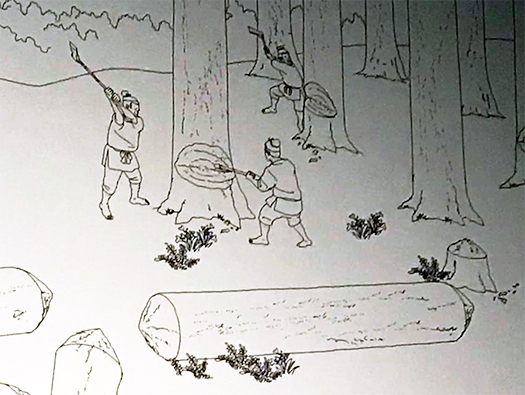
その疑問に対して、竹中大工道具館展示では上のイラスト表現を見た。
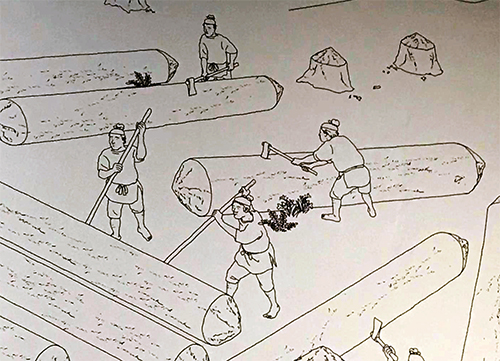
上の図のように大径木に対して石斧で切り倒した後、
楔を「木の筋」にそって割り入れていって、
それを木槌で叩いて割れ目にまっすぐな断面を作り拡大させていくことで、
製材化していくことが可能になっていった。
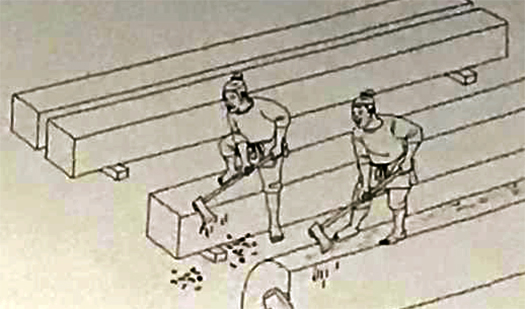
そのように「打ち割り」製材したあと、さらに多様な斧で表面を仕上げていき
一定寸法に則った製材に仕上げていった。
三内丸山の巨木建築構造物も、石器利用だけで成し遂げられていた。
このような気候風土、地形的条件、森林樹相、海洋資源環境などの
日本列島的諸条件が、日本人的なるものに深く関わり、
そしてそれを大きく涵養し育て上げてきたのではないか。
木を扱うということは日本人にとってかなり本然的なのではないか、
そういった強い思いがフツフツと沸き立ってきて止まない。

English version⬇

[Forest resources and lumber of the Japanese archipelago / Good Japanese houses ㊳-5]
I have seen Jomon, Yayoi, and Izumo as the theme of exploring the early days of wooden construction in Japan.
It seems that Japanese people have an ethnicity that is close to the belief in giant trees.
I feel that you can clearly see the tendency to be thick and tall.
In that sense, the DNA-like screams of the people sleeping at Izumo Taisha
I think it has settled down as a mother of “original Japanese” ethnicity.
A deep forest is imaged as the precinct environment of the shrine, and Sugi is an indispensable protagonist.
It makes me imagine that there is reasonable consistency there.
When modern humans arrived at this archipelago at the technical stage of the Stone Age about 30,000 years ago,
The westerlies that blow down from the Himalayas sandwich the Sea of ​​Japan from the Asian continent.
It provided a moderate thermal environment and humid climatic conditions.
As a result, the volcanic terrain of the archipelago would have been rich in forest resources.
There were many straight giant trees in some high-altitude mountains.
At the same time, the rich forest Megumi flows into the surrounding sea area,
It may have existed as one of the world’s leading “fishing resources”.
The height difference of the land due to the volcanic terrain creates many rivers
A rich “circulating environment” between land and sea was successfully realized.
As an animal protein that can be captured more easily than terrestrial animals as a means of obtaining food
It was a rare Shiawase that abundant fishery resources were obtained.
At the hunter-gatherer stage, “settlement” started as a Jomon culture.
I can imagine that it was the result of these conditions coming together.
It seems that the density of forest resources is related to the large number of Jomon archaeological sites in Hokkaido and the northeastern part of Japan.
Even in the archipelago environment, the existence of “tree fauna” nurtured in a climatic climate
I think it made people go to the development of wooden technology and architecture.
At the Jomon stage called Sannai Maruyama, there was already a technique for digging up a giant tree.

Under such circumstances, what was the technology for various lumber processing of wood?
In response to that question, I saw the above illustration expression at the Takenaka Carpentry Tools Museum exhibition.
After cutting down a large-diameter tree with a stone ax as shown in the figure above,
Insert the wedge along the “wooden streaks”
By hitting it with a mallet to create a straight cross section in the crack and enlarge it,
It became possible to make lumber.
After “splitting” lumber like that, we will finish the surface with a variety of axes.
The lumber was finished according to certain dimensions.
The giant tree building structure of Sannai Maruyama was also achieved only by using stone tools.
Such climate, topographical conditions, forest fauna, marine resource environment, etc.
The conditions of the Japanese archipelago are deeply related to the Japanese ones,
And I think they have cultivated and raised it greatly.
Isn’t it quite natural for Japanese people to handle trees?
Such strong feelings boiled up and I couldn’t stop.

【出雲大社古代社殿のロマン/日本のいい家㊳-4】


縄文と弥生の高層建築、そして石器時代由来の基本木工道具・石斧を見てきた。
竹中大工道具館展示ではこのあと、法隆寺の建築へと時代が移行する。
けれど、それにはどうも納得ができにくかった。
ヤマト朝廷の権力が確定して畿内地域で建築文化が展開する以前に
やはり八百万の神々の時代があり、その代表として出雲文化があったと思う。
そして四天王寺とか法隆寺とかの建築は輸入された「鎮護国家」思想による
仏教の影響の強いモノであり本来的列島社会の建築は古来の神社建築が
その様相を示唆しているように思われてならない。
そういう意味でも神社建築のまほろば・出雲は日本史のなかで孤高の存在。
初源の時期は記紀の記述にも登場する時代であり、
ヤマト王権成立以前にまでさかのぼることができるのだろう。
史書に残る記録でも平安中期にすでに「古格」として記述されている。
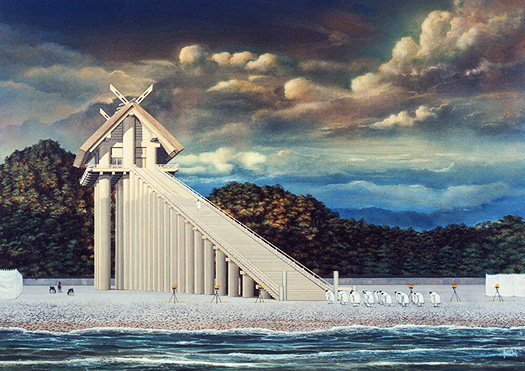
大国主命が国譲りして、その対価として「天にまで届く高さの神殿を」希望し、
ヤマト王権側はその申し出を了承して造営したという神話が残る。
創建時には高さ三十二丈(96m)という破天荒な高さの記述もあったとされるが
970年に著された源為憲「口遊〜くちずさみ〜」の記述では
奈良の大仏殿(十五丈)を上回っているとあるので、社伝の十六丈(48m)が
ほぼ妥当性があるとされているのです。
<データ・復元想像図類は大林組プロジェクトチーム+建築家・福山敏男氏
「古代出雲大社本殿の復元」によります>
大林組による古代出雲大社復元研究への着目、
その研究事跡の進展は2000年の出雲大社境内での巨大柱穴の新発見につながり、
「金輪造営図」という古社建築の設計平面図の記述の正しさを証明したという。
ポイントは使われた柱の巨木ぶり。以下島根県立古代出雲歴史博物館HPより。
〜平成12年から13年にかけて、出雲大社境内遺跡からスギの大木3本を1組にし、
直径が約3mにもなる巨大な柱が3カ所で発見された。これはそのうちの
棟をささえる柱すなわち棟持柱で古くから宇豆柱(うづばしら)と呼ばれるもの。

境内地下を流れる豊富な地下水のおかげで奇跡的に当時の姿をとどめて出土した。
直径が最大で約6mもある柱穴には人の頭の大きさかそれ以上の大きな石が
ぎっしりと積み込まれ、世界に例のない掘立柱の地下構造も明らかになった。〜

なんと最大の太さを持つ「岩根御柱」は直系3.6m、高さが36m、
他の柱も、直系3m高さ36〜42mという巨大さなのだという。
そしてその高層建築に対して上っていく「引橋」の長さは1町(109m段数170段)。
まことに古事記・日本書紀の記述が事実の建築としてあったことが裏付けられた。
この柱材の3.6mという巨大さについては3本の1m超の材を「金輪」という鉄材で
締め上げて緊結させた巨柱だったのだという。この技術がそのまま
「金輪造営図」という設計図名称になっていることから考えてキモになった技術。
竹中大工道具館での展示であえてこの出雲大社社殿について触れていないのは、
同業他社の大林組の研究成果、それが巻き起こした学術研究にリスペクトして
あえてスルーしたのではないかと思えてきます。
三内丸山の高層建築が前時代の石器時代の最高知見を動員した技術だったように
わたし的にはこの出雲神殿は三内丸山の縄文の高層建築技術、掘っ立て柱技術が
独自進化して成立したものと強く印象を持っています。
出雲大社社殿はなんども歴史上倒壊を繰り返してきたとされるけれど、
そのたびに古格に忠実に再建されてきたのだという。
戦国期の出雲阿国もこの再建費用を勧進する興業か。司馬遼太郎によれば、
出雲の、という名は「美人で誉れの高い」代名詞でもあったとされる。
そもそも出雲神殿の創建がいつにまでさかのぼるのかも不明ですが、
1万年前と想像の三内丸山から、輸入建築技術・畿内の寺院建築群の中間に
この出雲は位置し、日本独自建築技術の粋が懲らされていると思われます。

English version⬇

[Romance of the ancient shrine of Izumo Taisha / Good Japanese house ㊳-4]
I have seen the high-rise buildings of Jomon and Yayoi, and the basic woodworking tools and stone axes derived from the Stone Age.
At the Takenaka Carpentry Tools Museum exhibition, the era shifts to the architecture of Horyuji Temple.
However, it was hard to understand it.
Before the power of the Yamato court was confirmed and the architectural culture developed in the Kinai area
After all, there was an era of eight million gods, and I think there was Izumo culture as a representative.
And the architecture of Shitennoji and Horyu-ji is based on the imported “guardian state” idea.
The architecture of the archipelago society, which is strongly influenced by Buddhism, is the ancient shrine architecture.
It should not seem to suggest that aspect.
In that sense, the mahoroba and Izumo of shrine architecture are solitary in Japanese history.
The period of the first source is the period that appears in the description of Kiki,
It may be possible to go back to before the establishment of the Yamato kingship.
Even in the records that remain in historical books, it is already described as “old case” in the middle of the Heian period.
Okuninushi handed over the country, and in return he hoped for a “temple with a height that reaches heaven.”
There remains a myth that the Yamato royal authority accepted the offer and built it.
At the time of its construction, it is said that there was a description of a terrible height of 32 heights (96 m).
In the description of Tamenori Minamoto’s “Kuchiyu-Kuchizusami-” written in 970
It is said that it exceeds the Great Buddha Hall (15 length) in Nara, so the 16 length (48 m) of the company biography is
It is said to be almost valid.
According to “Restoration of the main shrine of ancient Izumo Taisha”
Focus on the restoration research of ancient Izumo Taisha by Obayashi Corporation,
The progress of the research trace led to the new discovery of a huge posthole in the precincts of Izumo Taisha Shrine in 2000.
It is said that it proved the correctness of the description of the design plan of the old company building called “Kinwa Zoukeizu”.
The point is the giant tree of the pillar used. Below Shimane Prefectural Ancient Izumo History Museum HP </ strong> From a>.
~ From 2000 to 2001, 3 large trees of Sugi were made into a set from the precincts of Izumo Taisha Shrine.
Huge pillars with a diameter of about 3 m were found in three places. This is one of them
The pillars that support the ridge, that is, the pillars that support the ridge, have long been called Uzubashira.

Thanks to the abundant groundwater flowing underground in the precincts, it miraculously retained its appearance at that time and was excavated.
In the pillar hole with a maximum diameter of about 6 m, there is a large stone that is the size of a human head or larger.
It was packed tightly, and the underground structure of the excavated pillar, which is unprecedented in the world, was revealed. ~

The thickest “Iwane Onbashira” has a direct line of 3.6m and a height of 36m.
The other pillars are also huge, with a direct line of 3m and a height of 36-42m.
The length of the “Hikibashi” that goes up to the high-rise building is one town (109m, 170 steps).
It was confirmed that the description of Kojiki and Nihon Shoki was a factual architecture.
Regarding the huge size of 3.6m of this pillar material, three lumbers over 1m are made of iron material called “Kinwa”.
It is said that it was a huge pillar that was tightened and tied together. This technology remains as it is
This is a technology that has become a key factor because it has the name of a blueprint called “Kinwa Zoukei-zu”.
The reason why I didn’t mention this Izumo Taisha shrine in the exhibition at Takenaka Carpentry Tools Museum is
Respect for the research results of Obayashi Corporation of other companies in the same industry and the academic research that it caused
I think I dared to go through it.
As if the high-rise building of Sannai Maruyama was a technology that mobilized the best knowledge of the stone age of the previous era
For me, this Izumo temple has the Jomon high-rise building technology and digging pillar technology of Sannai Maruyama.
I have a strong impression that it was established by unique evolution.
It is said that the Izumo Taisha Shrine has repeatedly collapsed in history,
It is said that it has been rebuilt faithfully to the ancient style each time.
Is Izumo no Okuni during the Warring States period also a business that promotes this reconstruction cost? According to Ryotaro Shiba
The name Izumo is said to have been synonymous with “beautiful and prestigious.”
It is unknown how long the construction of the Izumo Temple dates back to the first place.
From Sannai Maruyama, which was imagined 10,000 years ago, to the middle of imported building technology and temple buildings in Kinai
This Izumo is located, and it seems that the essence of Japan’s unique architectural technology has been disciplined.

【人類史と建築道具「石斧」/日本のいい家㊳-3】


縄文時代と弥生時代の「砦」のような高層建築を見てきたけれど、
いずれにせよ、その復元について確かなエビデンスは難しい。
状況証拠を丹念に探究していくしかないというのが科学の立場でしょう。
その建築道具として、斧というのは始原的存在であることは理解出来る。
人類の船の利用は、水辺という絶対必要環境で流木などが水に浮かんでいるのを見て
「あれに乗ることができれば・・・」と類推したに相違ないことを考えても
ごくごく始原的な動機に起因するだろうと思われる。
現生人類は「好奇心」において他の先行人類をはるかに超えていたと言われる。
群の中から、その流木にしがみついて遠隔地に出掛けて
また水の「流れ」を利用して帰還するなり、テリトリーを拡大する手段に
やがて採用することはごく自然に体得していったことは疑いがない。
ひょっとすると人類の「体毛の減少」とすら関係しているかも知れない。
最初期に石という「道具」を発見したときに、木という素材に対して活かすのは
これもまた人類史的な「進化」だったことも間違いない。
人類史のスタート時点からこうした進化方向は選択されていたと思える。

そういった人類がグレートジャーニーという世界各地への進出を果たすとき、
木に対して石を使って「船」として利用する加工技術は始原的だった。
その起源的な道具として「石斧」はあった。
自然にある固い樹種の枝を採取し、その切っ先に鋭利な石を加工すれば
木を切り倒して利用することが可能になる。
次に真ん中部分を「くり抜く」ことで木の上で安定的体動作が可能になるという
技術進化の流れは、動機も含めて自然なものだと思う。
アフリカから中東地域、そこで枝分かれしてヨーロッパ大陸に向かった一群と
ユーラシア大陸に拡散したグループに分かれたけれど、
ひとつはオーストラリア大陸に向かって他の人類とは道を異にした。
このひとびとも分かれるときに船を利用しただろう。
そしてわれわれアジア大陸に向かった一群はその最東端であった台湾から
日本列島の最西端地域に向かってフロンティアの「船出」をした。
3万年前、日本列島進出の経緯を想像したNHK番組で語られたテーマ。
もちろんエビデンスは完璧ではないけれど、蓋然性はきわめて高いと思う。
このような日本列島への人類進出と同時並行で「船を扱う」ことは
目的的に追究されたと考える方が自然ではないか。

この列島に来着してみると、周囲を海に囲まれて気候風土的に
格別な環境として豊かな森林資源があることは容易にわかったことだろう。
来着するのに木の船を利用してきた人々にとって、
この環境の中で「船大工」技術が「家大工」技術を生み出したことも自明。
そしてやがて1万年前の縄文の世、巨大柱穴が6つ残された木造構築物に至った。
石器時代由来の人類知の巨大集積「石斧」が縄文の建築を可能にした。
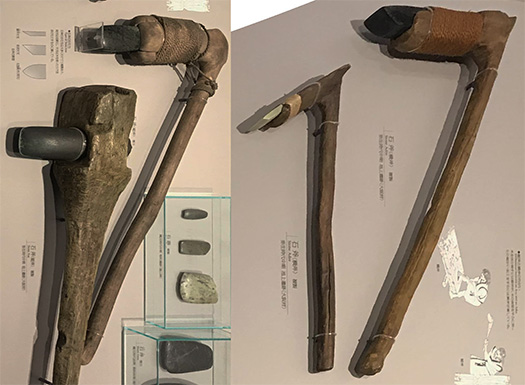
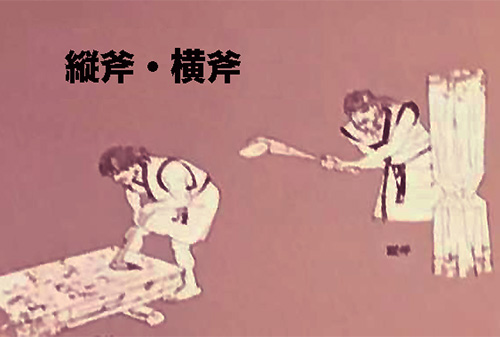
石斧はこのような発展経緯の中で「縦斧」と「横斧」に仕分けられた。
縦斧は「木を切り倒す」目的性が高く、
一方の横斧は木をくり抜くような用途合理性が高く、
次第に木を加工する仕上げ的道具として多様な発展を遂げていった。
手斧という形態で、より細かな仕事を可能にしていっただろう。
継ぎ手仕口という、木造進化の独自性がいつの時代から可能となってきたのか、
非常に深く刺激を受け続けております。
現代の建築史、建築学の総力を挙げての遺跡復元という探究成果に
それらは反映されているだろうと、わたしとしては受け止めております。

English version⬇

[Human history and building tools “Stone Ax” / Good Japanese house ㊳-3]
I’ve seen high-rise buildings like “forts” in the Jomon and Yayoi periods,
In any case, there is difficult solid evidence for its restoration.
The position of science is that there is no choice but to carefully explore circumstantial evidence.
It is understandable that the ax is a primitive existence as the building tool.
When using a human ship, see driftwood floating on the water in the absolutely necessary environment of the waterside.
Even if you think that you must have analogized “If you can ride that …”
It seems to be due to a very primitive motivation.
Modern humans are said to have far surpassed other predecessors in “curiosity.”
From the group, cling to the driftwood and go to a remote place
Also, as a means of returning home using the “flow” of water, it can be used as a means of expanding the territory.
There is no doubt that it was quite natural to adopt it in due course.
Perhaps it is even related to human “hair loss”.
When you first discovered a “tool” called stone, what you can use for the material called wood
There is no doubt that this was also an “evolution” in human history.
It seems that these evolutionary directions have been selected since the beginning of human history.

When such human beings make a foray into various parts of the world called the Great Journey,
The processing technology of using stones for wood as a “ship” was primitive.
There was a “stone ax” as its original tool.
If you take a branch of a hard tree species in nature and process a sharp stone on the tip
It will be possible to cut down trees and use them.
Next, by “hollowing out” the middle part, stable body movement is possible on the tree.
I think the flow of technological evolution is natural, including motives.
From Africa to the Middle East, where a group of branches headed for the European continent
Divided into groups that spread throughout the Eurasian continent,
One turned away from the rest of humanity towards the continent of Australia.
I would have used a ship when these people were separated.
And we, the group heading for the Asian continent, came from Taiwan, which was the easternmost point.
We made a frontier “departure” toward the westernmost region of the Japanese archipelago.
The theme told in an NHK program that imagined the process of expanding into the Japanese archipelago 30,000 years ago.
Of course, the evidence isn’t perfect, but I think it’s very likely.
“Handling a ship” at the same time as the advance of humankind into the Japanese archipelago
Isn’t it more natural to think that it was pursued for the purpose?

When you arrive at this archipelago, you will be surrounded by the sea and the climate will be
It would be easy to see that there are abundant forest resources as a special environment.
For those who have used wooden boats to arrive and arrive
It is also self-evident that “ship carpenter” technology created “house carpenter” technology in this environment.
Eventually, in the Jomon period 10,000 years ago, a wooden structure with six huge postholes left was reached.
A huge collection of human knowledge from the Stone Age, “Stone Ax,” made it possible to build Jomon.
The stone ax was classified into a “vertical ax” and a “horizontal ax” in this development process.
The vertical ax has a high purpose of “cutting down a tree”,
On the other hand, the horizontal ax is highly rational for use like hollowing out a tree.
Gradually, it has made various developments as a finishing tool for processing wood.
In the form of a hatchet, it would have enabled more detailed work.
When did the uniqueness of the evolution of wooden structures, called joint fittings, become possible?
I continue to be very deeply stimulated.
For the results of the quest to restore the ruins with all the power of modern architectural history and architecture
I accept that they will be reflected.