
「四百年間のいのちの履歴書」シリーズ。
わが家系史できわめてナゾ多き人物「原平七」の人生経歴(推定1676-1728年)について。9代前に生きた先祖ですが、伝承の「位牌」にはその名前がない。この人物から約100年後を生きた6代前先祖は、この平七さんの事跡を丹念に調査して古文書として残してくれている。
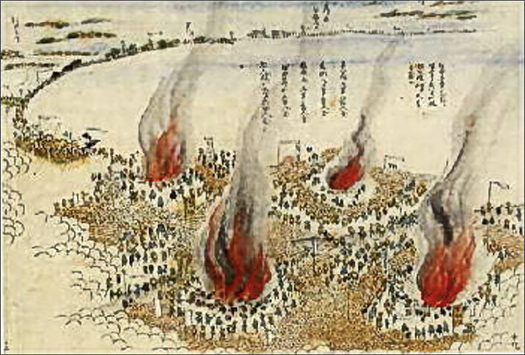
平七さんは広島浅野藩の地域支配機構で「所務役」として経済管理機能の中核を担っていた。藩経済の最重点・年貢管理で10000石近い石高相当の責任者で苗字帯刀を許される立場。それが収奪される百姓から「怨嗟」の対象とされ1718年に「一揆・打ち毀し」されてしまう。
そこでプッツリと消息が消え、その後息子の「源七」が隣藩の備後松永で塩田を営み、そこから政治力を発揮して福山藩武家との縁戚関係をつくると同時に尾道の商家株を入手している。
常識的に考えて、社会的立場の意識的転換・転身を結婚したての若者が容易にできるとは思えない。やはり父である平七が、きわめて大きな役割を果たしたと思われる。
そこまでの家系史の大転換を行ったけれど、位牌にすら原平七の名は記録されていない。
・・・という謎にひとつの気付き。
江戸期社会で藩の中核的経済情報を体現している人物が、他藩領に簡単に移転できるかという疑問。
現代人にはなんの抵抗感もないことだが、江戸期の時代背景を考えたら、藩をまたいで移転するなどは許されない「反逆的行為」だと気付いた次第。
封建体制社会ではたとえ「打ち毀し」被害者であっても藩をまたいだ転出は許されない脱法反逆的行為。浅野藩にして見れば藩の経済情報が他藩に漏洩するリスクに直結する。
しかしこういう周囲の状況の中で、打ち毀し被災として武家体制の厳しい限界を悟らされた平七先祖は、知恵を絞って別世界への子孫の解放を意図したのではないか。それが尾道商家株購入で「姓」までも同時に入手して、原姓を捨てて三木姓に転身した大きな動機だったのだと。
この目的完成のために原平七は、浅野藩領での自らの存在痕跡を消し去る手を打ったのではないか。
江戸期の庶民階層の、一族生き残り戦略・・・。この方向でさらに深く解明して行きたい。
<イラストは江戸期の百姓一揆絵図>
●お知らせ
拙書「作家と住空間」幻冬舎から電子書籍で発刊
お求めはAmazonで。
https://amzn.asia/d/eUiv9yO
English version⬇
【Asano Domain Territory: Secretly Transforming from Destruction Victim to Fukuyama Domain Resident?】
Having learned the harsh realities of shogunate-domain economic constraints through destruction, they erased their own traces while moving to another domain—a forbidden act—and transforming into merchants. A survival strategy for commoners…?
The “Four Hundred Years of Life’s Resume” Series.
The life history (estimated 1676-1728) of Hara Heishichi, an extremely enigmatic figure in our family history. Though he was an ancestor who lived nine generations ago, his name is absent from the traditional memorial tablet. An ancestor who lived about 100 years after him, six generations prior, meticulously investigated Heishichi’s deeds and preserved them as historical documents.
Heishichi served as a “local administrator” within the regional governance structure of the Hiroshima Asano domain, holding a central role in economic management. He was responsible for managing the domain’s most critical economic function—the collection of annual tribute taxes—equivalent to nearly 10,000 koku of rice yield. His position granted him the privilege of bearing a surname and wearing a sword. However, he became the target of resentment and grievances from the peasants whose resources he extracted. In 1718, he was killed in a peasant uprising.
His trail then abruptly vanishes. Afterwards, his son, Genjiro, operated salt fields in the neighboring Bingo Matsunaga domain. From there, he wielded political influence to forge kinship ties with the Fukuyama domain’s samurai class while simultaneously acquiring merchant shares in Onomichi.
Common sense suggests it’s unlikely a newlywed youth could easily achieve such a conscious shift in social standing and transformation. It seems his father, Heishichi, played an extremely significant role.
Despite orchestrating such a major shift in the family lineage, Hira-shichi’s name isn’t even recorded on the memorial tablet.
…This mystery led to a realization.
The question arose: could a figure embodying core economic information within a domain simply relocate to another domain’s territory in Edo period society?
While this seems perfectly natural to modern people, considering the historical context of the Edo period, I realized that moving across domain lines would have been an unforgivable “treasonous act.”
In a feudal system, even victims of “punishment by execution” were forbidden from moving across domain lines; doing so was an illegal, treasonous act. From the perspective of the Asano domain, it directly posed the risk of leaking the domain’s economic information to another domain.
Yet, amidst these circumstances, my ancestor Heishichi, having grasped the harsh limitations of the samurai system through his experience as a victim of the “demolition,” may have strained his ingenuity to liberate his descendants into a different world. This was the major motivation behind purchasing shares in an Onomichi merchant house, simultaneously acquiring a new surname, abandoning his original family name, and transforming into the Miki surname.
To achieve this goal, Hara Heishichi likely took steps to erase all traces of his existence within the Asano domain.
A survival strategy for commoners during the Edo period… I wish to explore this direction further and delve deeper into its implications.
●Notice
My book “Writers and Living Spaces” published as an e-book by Gentosha
Available for purchase on Amazon.
共有:

Posted on 2月 5th, 2026 by 三木 奎吾
Filed under: 未分類



コメントを投稿
「※誹謗中傷や、悪意のある書き込み、営利目的などのコメントを防ぐために、投稿された全てのコメントは一時的に保留されますのでご了承ください。」
You must be logged in to post a comment.