本文へジャンプ

【絶望の「なんだこれ?」 無人洗車機「対話」篇】


冬の高速道路では「凍結防止材」を撒いていますね。
高速で運転するときに路面にこれが撒いてあると非常に安心。
なんですが、その副作用としてクルマ表面に成分が付着して
長期的にはクルマの塗装面が障害を受けるようになる。
なので、なるべくこまめにクルマの洗浄することが望ましい。
で、わが家付近に無人洗車場があるので一度利用したいと考えた。
なんですが、パソコンその他IT機器対応でアタマが疲れる日々なので、
それ以外の機械操作ではなるべく時間節約、見て即判断系が望ましい。
むしろ現代人はマニュアル類は金輪際読みたくないようになっている。
たぶん人間の「判断能力」には許容限度があって、
そのキャパを超えると「なるべく考えない」ようになるのでしょうか。
恥ずかしながら、やってしまった失敗談篇であります(泣)。

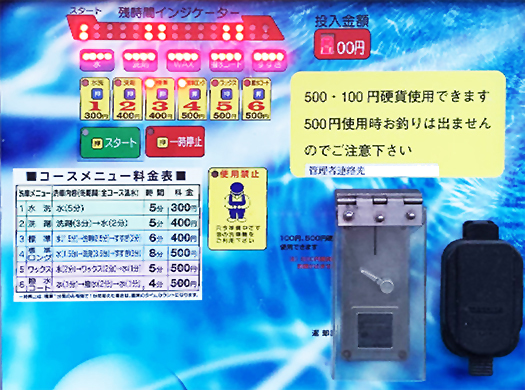
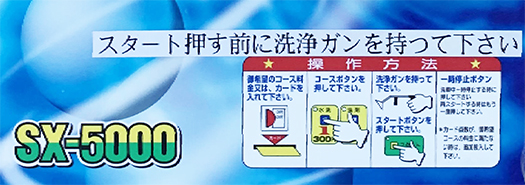
で、この無人洗車機の案内表示がこちらの写真。
1枚目写真でもかなりの情報量で、運転で疲れたアタマでは読みたくない。
その上、下の案内も表記されているので「早く洗浄ガンを持たねば」と焦らされる。
メニューがどうやら300円から500円で6種類あることがわかる。
そのそれぞれについて、細かい案内表示が小さい字で書いてあるけれど、
これはアタマには入りきらない。どうせ無人洗車なので、
ふつうの標準でわたしはいいのです。400円か、と。
ところがその右側に頭を下げたイラストがあり
「ただ今準備中なのでほかの機械をご利用ください」という案内表示がある。
その左手上部にはどうもON-OFFのランプ?
なぜこういう案内があるのか理解に苦しむ。「え、なに言ってんの?」
いまはランプが表示されていないけれど、
ランプが点灯しているかどうか、注意し忖度して判断せよということ?
しょっちゅう故障していてそのときには左上の赤ランプが点灯するのだろうか。
しかしもしそうでも、自販機としてはもっとわかりやすい表現をすべきでは?
まずはここで思考があれこれ混濁してくる。
で、今度はコイン投入口に蓋がしてあって、それを開けて投入することになる。
ご丁寧にその右側にはより混乱を誘うように「ブラックボックス」も併置されている。
一応確認はしたが、いまはもうなんだったかも忘れた。
あいにく100円硬貨が足りないので500円硬貨を使いたい。

投入口左側には100円・500円硬貨使用できます、と書いてある。ところがその上に
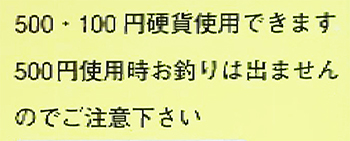
という表示がある。使えますと書いているのに、500円使用時お釣りがでない、とある。
ここで日本語受動能力の混乱がさらに高まる。
「使える」という表現の内容特定がこの機械運営者の恣意で決定されているのだ。
社会常識で言えば、使える、というのはもちろんお釣りも当然出てくるべきだ。
まさか500円硬貨が使えますと書いていて、
400円相当サービスがムリとは考えられないと常識判断が働く。
サービス業であれば顧客目線が当然で「お釣りが出ません」は理解を超える。
・・・まぁあとで気付いたけれど要するに自動機械側でお釣りシステム、
釣り銭返還システムを設備することをコストカットしていたのだろう。
たくさんのお釣り用の100円硬貨をあらかじめ充填させる必要もあるのでしょう。
そういうメンテ労役は確かにコストが相当掛かりそうだとは思う。・・・
しかし、自販機店舗で釣り銭システム導入をケチるとは常識で考えにくい。
「カネを払うのは自由だけれど、釣り銭は出ないよ」と公然と言っているに等しい。
自販機は対人コミュニケーションも担っている。
同じことを人間が言っている前提で顧客と「対話」する設計の必要があるだろう。
こういうコトバを人間が言ったら、相手は不快になるとまで考えていないのか。
はじめの「ただいま準備中」云々でも混乱しているので「なにこれ?」となる。
400円の標準コースに500円投入してお釣りが帰ってこないとは想定超。
ここまでで数分間、画面とのコミュニケーションに時間浪費。
わたしの常識判断力はここで停止してしまった・・・。

コインを入れたらすぐに洗車ガンを持てとも急かされる。
しかも後ろには、洗車を待っている車列もある。
「ええい、いいや、これ書き方オカシイだろ」と
なかば面倒くさくなって、ボタンを押して洗車を始めた・・・始まった。
洗車ガンからもう水が出ているけれど、お釣りは出てこない・・・。
完全に「面倒くさい」疾患にやられた心境。
まぁほんの100円損ということではありますが、これは老人性早とちり症候群(笑)。
この忍耐力減衰はコロナ禍ストレス由来か? 単純に脳味噌の疲れか。
今後に大いに教訓にしたいと固く心に誓った次第。う〜む100円の恨み(泣)。

English version ⬇

[Despair “What is this?” Unmanned car wash machine “Dialogue”]

You are sprinkling “antifreeze material” on the highways in winter.
It is very safe to have this scattered on the road surface when driving at high speed.
However, as a side effect, the ingredients adhere to the surface of the car.
In the long run, the painted surface of the car will be damaged.
Therefore, it is desirable to wash the car as often as possible.
So, there is an unmanned car wash near my house, so I wanted to use it once.
I’m tired of working with PCs and other IT equipment, so
For other machine operations, it is desirable to save time as much as possible and to make an immediate judgment system.
Rather, modern people do not want to read manuals at the edge of the gold ring.
Maybe human “judgment ability” has an acceptable limit,
If you exceed that capacity, will you “do not think as much as possible”?
I’m ashamed to say that this is a story of failure (crying).

And here is a picture of the information display for this unmanned car wash machine.
Even the first photo has a considerable amount of information, and I don’t want to read it if I’m tired of driving.
In addition, the guide below is also written, so it is impatient to say, “I have to have a cleaning gun as soon as possible.”
It can be seen that there are 6 types of menus, ranging from 300 yen to 500 yen.
For each of them, the detailed guidance display is written in small letters,
This doesn’t fit in my head. Because it is an unmanned car wash anyway
I’m fine with normal standards. Is it 400 yen?
However, there is an illustration with his head bowed to the right.
There is a guide saying “We are preparing now, so please use another machine.”
Is there an ON-OFF lamp on the upper left hand?
It is difficult to understand why there is such a guide. “What are you talking about?”
The lamp is not displayed now, but
Do you have to be careful and judge whether the lamp is on?
I wonder if the red lamp on the upper left lights up when it is out of order all the time.
But even so, shouldn’t it be an easy-to-understand expression for a vending machine?
First of all, my thoughts become cloudy here.
So, this time, there is a lid on the coin slot, and you will open it and insert it.
A “black box” is also carefully placed on the right side to cause more confusion.
I confirmed it, but now I forgot what it was.
Unfortunately, I don’t have enough 100-yen coins, so I want to use 500-yen coins.

It is written on the left side of the slot that you can use 100 yen and 500 yen coins. However, on top of that

Is displayed. It says that it can be used, but there is no change when using 500 yen.
Here, the confusion of Japanese passive ability further increases.
The content of the expression “usable” is specified at the discretion of the machine operator.
Speaking of common sense, it should be possible to use it, of course, and change should come out.
I wrote that I could use 500 yen coins,
Common sense judgment works that the service equivalent to 400 yen cannot be considered unreasonable.
In the service industry, the customer’s point of view is natural, and “no change” is beyond understanding.
… Well, I noticed later, but in short, the fishing system on the automatic machine side,
It would have cut the cost of installing a change return system.
It may be necessary to pre-fill a lot of 100-yen coins for fishing.
I think that such maintenance labor is certainly likely to cost a considerable amount.・ ・ ・
However, it is hard to think that the introduction of a change system will be stingy at vending machine stores.
It’s like saying openly, “I’m free to pay, but I don’t get any change.”
Vending machines are also responsible for interpersonal communication.
It will need to be designed to “dialogue” with customers on the premise that humans are saying the same thing.
Don’t you think that if a human says something like this, the other person will be uncomfortable?
The first “I’m preparing” is confusing, so I get “What’s this?”
It is more than expected that 500 yen will be put into the standard course of 400 yen and fishing will not come back.
Up to this point, I wasted time communicating with the screen for a few minutes.
My common sense judgment has stopped here …

As soon as you insert a coin, you will be rushed to have a car wash gun.
Moreover, there is a convoy waiting for the car to be washed in the back.
“Yes, no, this is a good way to write.”
I got tired of it, so I pressed a button and started washing the car … it started.
Water is already coming out of the car wash gun, but no change is coming out …
A feeling of being completely struck by a “cumbersome” illness.
Well, it’s only a 100 yen loss, but this is senile early and dust syndrome (laughs).
Is this patience decay due to corona stress? Is it simply tired of brain miso?
As soon as I firmly vowed to learn a lot in the future. Hmmm 100 yen grudge (crying).

【萱葺きと村落共同体/日本人のいい家⑳-5】


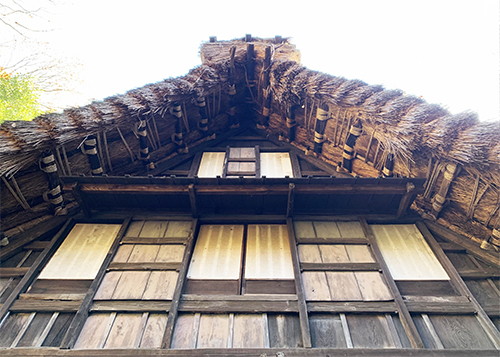
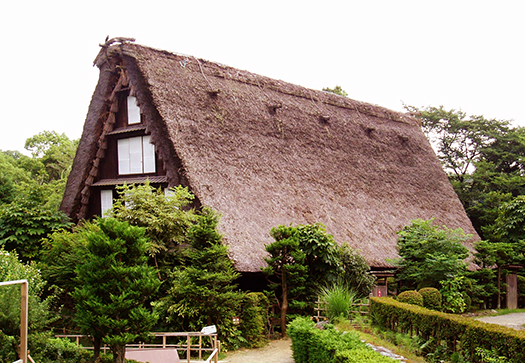
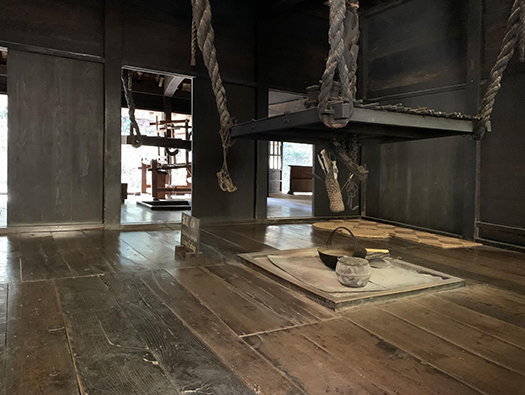
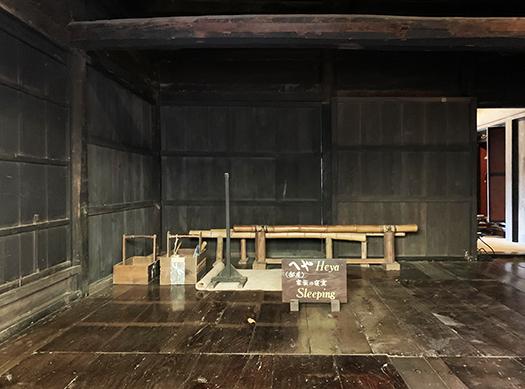
越中五箇山の江向家、とっつきとしてはいわゆる合掌造りがポピュラーすぎて
やや戸惑いながら写真に導かれて、詳細を追体験してみた最終回。
寒冷気候対応として、基本的に「閉じる建築」対応なので、
印象として閉塞感を感じながら始めたのだけれど、
深掘りするほど、日本人的な感性がひしひしと伝わってきてあふれるばかり。
こういう空間で耐える冬のくらしがどんな情念を日本人DNAに刻印したのか、
深く興味を持たざるを得ない。
日本人は現代で多地域間婚姻を通してDNAはブレンドされていっているので、
この五箇山での暮らしようにも、いまのわれわれに伝わるものがあるのだと思う。
基本は架構構造で、根曲がりの木材を梁として利用して大屋根を支える伝承技術。
地域で独自に気候風土に合致した家づくりを日本人は積層させてきた。
この多雪寒冷地域で、成長過程で矮化圧力にさらされ、それでもなお生長した木に
その耐久性に目を向けて活用した先人たちの叡智を思わされる。
このような工夫こそが、日本の「ものづくり」精神基盤を形成したのだと思う。

そして合掌造りと言えば、定期的に葺き替えられる茅葺き屋根。
この作業工程を地域住宅文化として継承させてきた先人の知恵には
やはり地域全体の家づくりの叡智を感じさせられる。
作業工程を職人に依存せず可能なようにひとつひとつ数学的に構想し、
地域全体の「結」の力で永続させてきた社会。
現代世界でわれわれは、地域市町村や国家に所属しているけれど、
この建物が永続してきた時代、われわれは村落共同体というマユで
大きく包み込まれていのちを繋いできた。


もちろん山深い飛騨白川地域では独特の「大家族制度」があって、
個人主義的な自由や家族制度とは隔絶した部分も、あったのだと言われる。
<これについて読者のT氏から資料をいただいた。機会を見て触れたい>
しかし江戸期の一般的な村落共同体ではムラには自主的指揮命令系統があって、
社会運営自体は非常に「民主的」に取り仕切られていた部分があったのだとされる。
先日、日本全国地図を江戸期に作成した伊能忠敬の事跡を知る機会があったが、
ムラ社会統率者のかれは測量技術で属した共同体発展に大きな遺産を残したという。
日本のムラ社会・村落共同体の実態についてもっと知りたくなった。
この村落共同体の力で江戸幕府政治支配は、ほぼ無関係に維持されてきたのかと。
五箇山のひとつひとつの合掌造りは、そういう村落共同体社会の
いわば「共同資産」として永く存続し続けてきたものなのだと思う。
現代全盛の個人主義だけが、社会のありようとしてより「進化」したものかどうか。
こうした建築が生きながらえてきた経緯を思えば、ふと疑問も湧いてくる。

English version⬇

[Thatched and village community / Japanese good house ⑳-5]

The so-called gassho-zukuri style is too popular for the Emukai family in Gokayama, Etchu.
The final episode where I was a little confused and guided by the photos to relive the details.
As it is compatible with cold climates, it is basically compatible with “closed architecture”.
I started with a feeling of blockage as an impression,
The deeper you dig, the more Japanese sensibilities are transmitted and overflow.
What kind of feelings did the winter life that endures in such a space imprint on Japanese DNA?
I have to be deeply interested.
Since the DNA of the Japanese is blended through multi-regional marriage in modern times,
I think there is something that can be conveyed to us today, even in the way we live in Gokayama.
The basic structure is a frame structure, which is a traditional technique that supports a large roof by using bent wood as beams.
The Japanese have been building houses that are unique to the region and that match the climate.
In this heavy snow and cold region, trees that have been exposed to dwarfing pressure during the growth process and still grow
It seems to be the wisdom of the ancestors who turned their attention to its durability and utilized it.
I think that this kind of ingenuity formed the spiritual foundation of Japan’s “manufacturing.”

Speaking of gassho-zukuri, thatched roofs are regularly re-roofed.
To the wisdom of the ancestors who have inherited this work process as a local housing culture
After all, you can feel the wisdom of building a house in the entire area.
Mathematically conceive one by one so that the work process can be done without depending on the craftsman,
A society that has been perpetuated by the power of “Yui” in the entire region.
In the modern world, we belong to local municipalities and nations,
In an era when this building was permanent, we were in Mayu, a village community.
It was wrapped up in a big way and connected the life.

Of course, there is a unique “large family system” in this mountainous area such as Hida Shirakawa.
It is said that there was a part that was isolated from individualistic freedom and the family system.

However, in the general village community of the Edo period, Mura had a voluntary command system.
It is said that the social management itself had a part that was very “democratic”.
The other day, I had the opportunity to learn about the history of Ino Tadataka, who created the first map of Japan.
He is said to have left a great legacy on the progress of the village community with his surveying techniques.
I wanted to know more about the actual situation of Japan’s uneven society and village community.
I wonder if the political system of the Edo Shogunate has been maintained almost independently by the power of this village community.
Each of Gokayama’s gassho-zukuri is a village community society.
So to speak, I think it has been a “joint asset” for a long time.
Whether only modern-day individualism is more “evolved” in the way society is supposed to be.
When I think about how such architecture has survived, I suddenly have questions.

【日本人と宗教・越中門徒の仏間/日本人のいい家⑳-4】


日本住宅の最近の傾向として神聖空間の空洞化、消滅がある。
核家族化が進行し「本家」意識での親戚の紐帯が縁遠くなってきている。
戦後の東京への一極集中の固定化の果てに首都周辺の住宅地に
核家族住宅としての住宅を持った世代が徐々に高齢化し、
その次の代に受け継がれて行くにつれ、いわば出身地域での地縁・血縁関係が
否応なく希薄化し始めているのだと思う。
新たに首都圏近郊で住宅を持った世代では、その帰るべき故郷の
「本家」自身も継続困難に陥ってしまい日本人の「家」意識が危機を迎えている。
経済構造が大転換して資本主義の世界競争に従属した結果、
地域の伝統的経済構造が破綻し、一方で戦後構造もより分散に向かっている。
遠くない将来、地縁血縁的な結びつきが消滅の危機になっていくのが趨勢。
現代では仏壇を持つ家は少数派であり、たとえあったとしても
その継承は難しく、家族関係の縮小化圧力で困難になりつつある。

しかしこの列島社会が発展してくるなかで
宗教が果たしてきた役割はさまざまな意味で非常に大きい。
この越中五箇山では「浄土真宗」本願寺が勢力を拡大した。
戦国期には守護大名の支配を凌駕する勢いを示し、
講を中心とした自治的な地域運営が実質支配であった故実もある。
まことに「生業」の必死さが色濃いこの家でも、突き出し的な
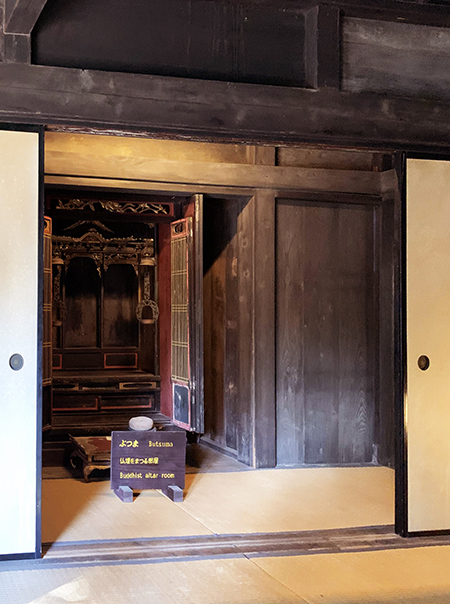
神聖空間「ぶつま」が、畳敷きの迎賓空間のさらに奥に端座している。
必死な生き方・機能最優先の住空間の中に最重視した空間痕跡。


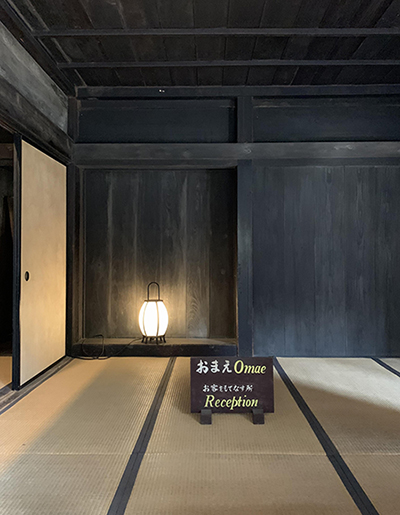
すぐ上の写真で「おまえ」という迎賓空間には先日確認した「押板」もみえる。
おまえとは「御前」という書き方が想定される神聖空間の暗示。
このような配置からはこの迎賓空間自体、宗教的「寄り合い」と
深く関わっていた実態を見せているように思う。
兵農分離されていない歴史段階ではこの宗教パワーは世を覆っていた。
わたしの家系も大阪石山に籠城した本願寺顕如勢力に
毛利と連合して支援し続けていた家系伝承がある。
その集会場とみなせる神社拝殿空間もいまに残っている。
「にっくき織田を殲滅するぞ」という反政府スローガンが聞こえてくるかと(笑)。
こうした宗教勢力の台頭に強い危機感を持って「根絶やし」に動いたのが
信長の政権だったのだろう。残虐を極めたとされる殲滅戦は、
宗教という巨大なパワーに立ちはだかった武家の恐怖心を逆に表している。
そのような草の根パワーが、この家の神聖空間を彩っている。

この家の生き様、生業の痕跡とともに、
こういった宗教空間への深い思いもこだましてくるように思う。
さてわたしたち現代住宅には稀少化したこういった精神的空間は
今後とも順調に消え去っていくのだろうか。
わたし自身で言えば、末子であり仏壇はないけれど、
個人的に親の記憶装置はいくつか考えているし、全国の神社巡りでの
神札収集は今後とも継続して神棚の充実(笑)に勤めたいと思っている。
宗教と日本人住宅の関係性は、単純に消え去っていかないのではないかと。

English version⬇

[Buddhist altar between Japanese and religion / Etchu monks / Good Japanese house ⑳-4]
The post-war society is largely divided from the pre-war society, but the symbol is the religious space. Can the “head family” continue to maintain the Buddhist altar?・ ・ ・

The recent trend of Japanese housing is the hollowing out and disappearance of the sacred space.
As the nuclear family grows, the ties of relatives with a “head family” consciousness are becoming far away.
In the residential area around the capital after the end of the postwar fixation of concentration in Tokyo
The generation with housing as a nuclear family housing is gradually aging,
As it is passed down to the next generation, so to speak, the territorial and blood relations in the area of ​​origin
I think it is inevitably beginning to dilute.
For generations who have new housing in the suburbs of the Greater Tokyo Area, their hometown
The “head family” itself has fallen into difficulty in continuing, and the Japanese “home” consciousness is in crisis.
As a result of a major transformation of the economic structure and subordination to the world competition of capitalism
The traditional economic structure of the region has collapsed, while the postwar structure is becoming more decentralized.
In the not too distant future, the trend is that kinship ties will be in danger of disappearing.
Today, there are a minority of houses with altars, even if they do.
Its inheritance is difficult and is becoming more difficult due to the pressure to shrink family relationships.

However, as this archipelago society develops
The role that religion has played is enormous in many ways.
In this Etchu Gokayama, the “Jodo Shinshu” Honganji Temple expanded its power.
During the Warring States period, it showed momentum that surpassed the rule of the guardian daimyo.
There is also the fact that autonomous regional management centered on lectures was the actual control.
Even in this house where the desperation of “living business” is really strong, it is sticky
The sacred space “Butsuma” sits further back in the tatami-matted guest space.
A space trace that emphasizes the highest priority in a living space that prioritizes desperate way of life and function.

In the guest space called “You” in the photo above, you can also see the “Oshiban” that I confirmed the other day.
You are a suggestion of a sacred space that is supposed to be written as “Gozen”.
From such an arrangement, the guest space itself is a religious “closeness”.
I think it shows the reality of being deeply involved.
This religious power overwhelmed the world in the unseparated historical stage.
My family is also a siege of Honganji Temple in Ishiyama, Osaka
There is a family folklore that has continued to support in association with Mouri.
The shrine worship space, which can be regarded as the meeting place, still remains.
I wonder if you can hear the anti-government slogan, “I’ll annihilate Nikki Oda” (laughs).
With a strong sense of crisis about the rise of these religious forces, they moved to “eradicate”.
It must have been Nobunaga’s administration. The annihilation war, which is said to have been extremely cruel,
It expresses the fear of the samurai who stood against the enormous power of religion.
Such grassroots power colors the sacred space of this house.

With the way of life of this house, the trace of living
I think that deep feelings for such a religious space also echo.
By the way, these spiritual spaces that have become rare in our modern houses
Will it disappear steadily in the future?
Speaking of myself, I am the youngest child and there is no Buddhist altar,
I personally think about some of my parents’ storage devices, and I visit shrines all over the country.
I would like to continue collecting the gods and work to enhance the Kamidana (laughs).
I think the relationship between religion and Japanese housing will simply not disappear.

【養蚕と機織り・女性たちの生業/日本人のいい家⑳-3】


古民家を集中して取材対象にして記事まとめをしていますが、
進めるほどに古民家の多様性、その「生業」の色濃さに驚く。
古民家というと、木質が囲炉裏火で長期燻煙の意匠性に目が行くけれど、
わたしの立場のように現代住宅との対比で見ると、
むしろそこでの人々の「生き様」、生業の痕跡に深く気付かされる。
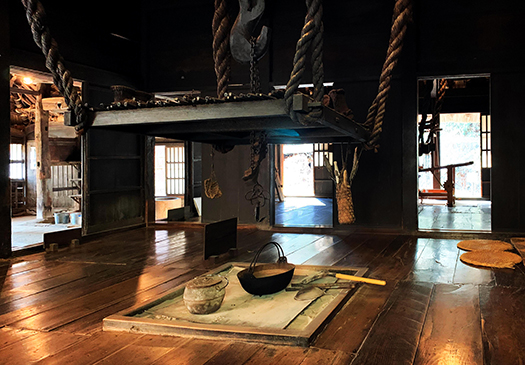
たしかに生命維持装置としての台所や食遊空間としての囲炉裏、
寝室、先祖崇拝の神聖空間、迎賓室など大きく変わらない機能装置は
現代住宅も引き継いでいるけれどそれは当たり前の人間活動保証部分。
一方で古民家を個性的に彩っているのは生業装置の部分。
土間が民の生きる糧を支える空間として機能し、
その住宅建築の「いのち」を保証していた様子が明瞭に伝わってくるのです。
現代住宅から大きく失われつつある、生業の要素が大きく浮かんでくる。
現代は職住がほぼ完全に分離してしまっているし、居住地域も
「専用住宅地」としての地域に偏在するようになっているけれど
古民家では「その地での生き方」に最適化された立地選択になっている。
いや、その土地で生き続けることに必死だった事実が跡づけられているのだ。

雪深い山村での暮らしは、広い農地面積を確保はできない。
戦前の軍事態勢のころまで、この越中五箇山からはコメの出荷はなかったとされる。
コメ生産は自分たちの食料分だけの農地しかなく、
男たちは冬場になれば仕事がなくなって、都会に出稼ぎに出るのが必然。
そういった地域にあって養蚕は最重要な経済活動であっただろう。
合掌造りによる高く大きな屋根景観はたしかに豪雪を落雪させる機能も持ったが、
それ以上にその小屋裏空間に養蚕の場を確保するというのが、
最大の起因だっただろうことは明白。
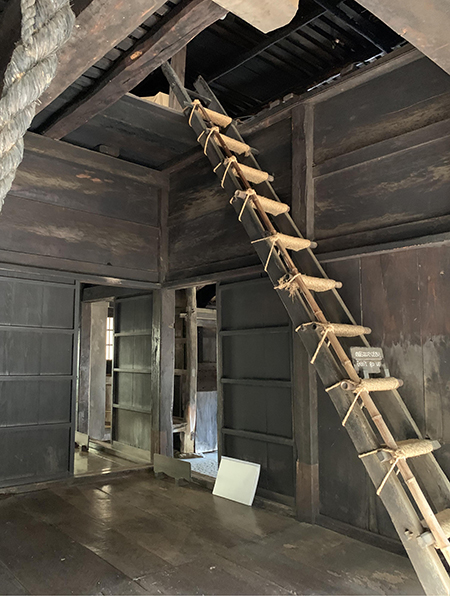
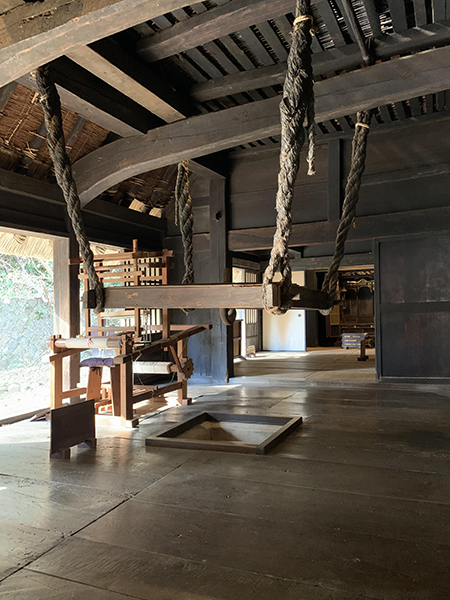
この家でも、いちばん上の写真のように土間を上がってすぐの居室から
2階へのハシゴが掛けられて蚕の世話が垣間見えている。
2階床面はスノコ状で様子は下階から様子をみることができる。
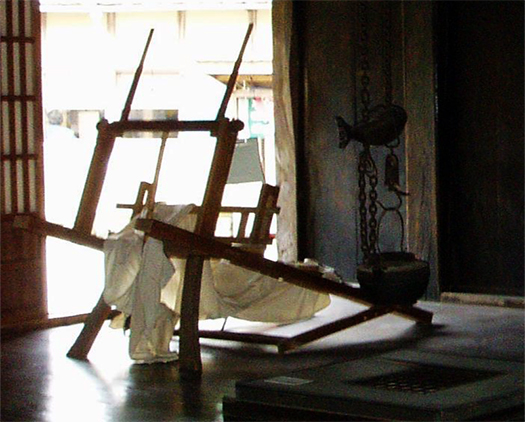
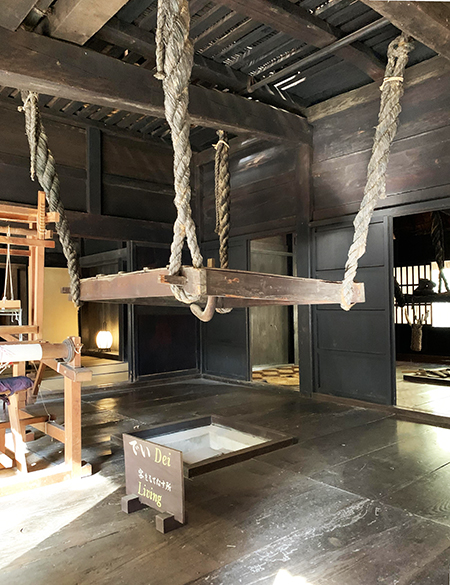
そして板敷きの生活空間では、機織りが大きな存在を占めている。
女性たちの機織りは、多くの日本民話にも登場するけれど、
日本で普遍的に行われてきた女性としての「生業」。
また養蚕の「蚕の世話」もいかにも母性を感じさせる生産営為。
日夜、養蚕業に勤しむ彼女たちの暮らしぶりが生き生きと甦る。
また、この家の日常生活空間からは土間での「紙すき」作業も
見晴らしよくコントロール下に収められている。

こういった生業主体の住宅には、強い永続性を感じる。
一方で、東京の戦前期などの「高級住宅」もたくさん見てきたけれど、
生命維持装置空間と対比的な「生業」空間はほぼないと言える。
あれらはやはり「武家住宅」の生まれ変わりのように思えてならない。
江戸期の武士とは生産活動と無縁でたんなる「搾取者」。
人間と経済活動にはまったく無能で、自らの階級誇示だけが目的に思える。
たしかに日本文化の粋を凝らした迎賓的空間は展開するけれど、
そのこと自体は、居住者の人格を保証するものではないだろう。
先祖崇拝空間でもない、床の間座敷のようなステータス部分にのみ、
一所懸命にこだわっている様子が顕著なのだと思う。
そして現代住宅は基本的に、そのような都市住宅の系譜に属している。
コロナ禍は家の存在価値をも再度ふるいに掛けようとしている。
いまや、生業はパソコンと通信で可能になっていくのが社会の方向性。
さてわたしたちの「住宅文化」はどういった方向に向かうのだろうか?

English version⬇

[Sericulture and weaving, women’s livelihood / Japanese good house ⑳-3]

I’m concentrating on old folk houses and summarizing the articles.
The more you proceed, the more you will be surprised at the diversity of old folk houses and the color of their “living business”.
Speaking of old folk houses, the wood is the hearth fire, and the design of long-term smoke is noticeable.
If you look at it in comparison with modern houses like my position,
Rather, people are deeply aware of the “lifestyle” and traces of their livelihoods.
Certainly the kitchen as a life support system and the hearth as a dining space,
Functional devices that do not change significantly, such as bedrooms, sacred spaces for ancestor worship, and guest rooms
The modern housing has been taken over, but that is the part that guarantees human activity.
On the other hand, it is the part of the livelihood equipment that uniquely colors the old folk house.
The dirt floor functions as a space that supports the livelihood of the people,
You can clearly see how the “life” of the residential building was guaranteed.
The element of livelihood, which is being greatly lost from modern housing, comes to the fore.
In modern times, work and residence are almost completely separated, and the area of ​​residence is also
Although it is unevenly distributed in the area as a “private residential area”
In the old folk house, the location selection is optimized for “the way of life in the area”.
No, the fact that he was desperate to stay alive in the land is traced.

Living in a snowy mountain village cannot secure a large agricultural land area.
It is said that rice was not shipped from Gokayama in Etchu until the time of the military situation before the war.
Rice production is limited to farmland for their own food,
It is inevitable that men will run out of work in winter and go to work in the city.
Sericulture would have been the most important economic activity in such areas.
The tall and large roof landscape created by the gassho-zukuri has a function to make heavy snowfall, but
More than that, securing a place for sericulture in the space behind the hut is
It is clear that it was probably the biggest cause.
Even in this house, as shown in the photo at the top, from the living room right after going up the dirt floor
A ladder is hung on the second floor to give a glimpse of the care of the silk moths.
The floor on the second floor is slatted and you can see the situation from the lower floor.
And weaving occupies a large part in the living space with planks.
Women’s weaving appears in many Japanese folk tales,
“Livelihood” as a woman that has been universally practiced in Japan.
In addition, “care for silk moths” for sericulture is also a production activity that makes you feel motherhood.
Day and night, the lifestyles of the women who work in the sericulture industry are revived.
Also, from the daily living space of this house, you can also do “papermaking” work in the soil.
It has a good view and is kept under control.

I feel a strong sense of permanence in these livelihood-based housing.
On the other hand, I’ve seen a lot of “luxury homes” in Tokyo before the war,
It can be said that there is almost no “living” space that contrasts with the life support system space.
They must not seem like a rebirth of a “samurai residence”.
An “exploiter” who has nothing to do with production activities with the samurai of the Edo period.
He is totally incompetent to humans and economic activity, and seems to have only the purpose of showing off his class.
It is true that a guest space with elaborate Japanese culture develops, but
That in itself would not guarantee the personality of the resident.
Only in the status part like the alcove, which is not an ancestor worship space
I think it’s remarkable that they are sticking to it very hard.
And modern housing basically belongs to the genealogy of such urban housing.
Corona is trying to sift the value of the house again.
Nowadays, the direction of society is that livelihoods can be made possible by communicating with personal computers.
What direction is our “housing culture” going in?

【積雪荷重を耐えるチョーナ梁と板倉/日本人のいい家⑳-2】


耳慣れない建材名、チョーナ梁。
名前だけ聞くと梁の木材表面を仕上げるのにチョーナ(釿)を使ったのか、と
想像させられるけれど、いわゆる「根曲がり」の木材を梁に使うことのようです。
出来上がったカタチがチョーナの形状に似ているということだろうか。
この江向家は18世紀初め300年前頃の創建と推定されますが、
雪深い越中の山岳地帯に建っていることから、冬期の積雪荷重が大きなテーマ。
基本は合掌造りで落雪させることを考えるけれど、この地域の重い雪質は
屋根にきびしい荷重をもたらし続ける。
その積雪をどう克服するか、という構造の工夫を考えていったとき、
受ける梁材に「根曲がり」の木を持ってきてねばりを発揮させた。
そもそも根曲がりの木とは、風雪でまっすぐに成長できず、
その根元部分で大きく矮化したことを表している。
そのように困難に「耐えて」それでも一定以上の成長を見せた木材であれば、
荷重に対してねばり続けてくれるという「木組みの知恵」。
外周側に根曲がりの部分が宛てられて、柱と組み合わさって家を支えている。
その湾曲ぶりが、いかにも「耐えて」いる力強さを伝えてくれる。

そして、そのチョーナ梁が家の中心部で柱と組み合うあたりでは、
この家では柱と柱の間には「板倉」で壁が構成されている。
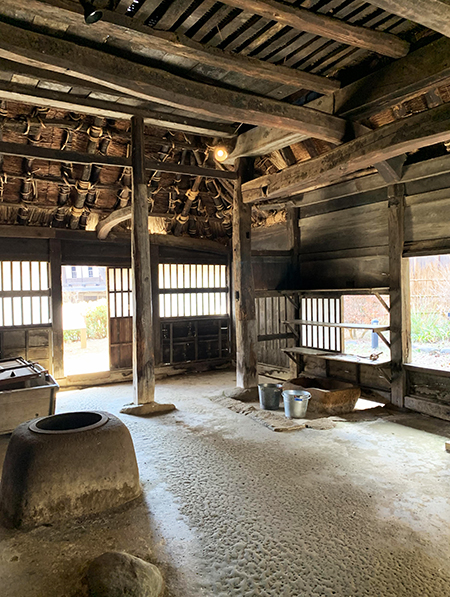
この上の写真では右側の壁がそうで、
柱間には幾重にも「貫」が貫通されていて、その貫間に板材が落とし込まれている。
山岳地帯であり、周辺に構造材は豊富にあるから、
たっぷりと木を使って、力強く構造を作り上げている。
まだ貫の構造耐力は西洋式の建築力学的に証明されきっていないとはいえ、
ごく自然な感覚として、もしも板倉壁ではなく塗り壁だとすると、
やや華奢と感じる。塗り壁はふつう細い木材で下地構造「木舞」をつくる。
場合によってはもっと簡素な竹小舞もある。
それに対してこのような板倉と貫の壁はまことに重厚。
構造的安定性を優先して考えれば、はるかに軍配の上がる選択。
その分、意匠性は欠けてまことに武骨だけれど、正直の美がある。

こちらの写真はきのう紹介したものですが、
チョーナ梁が建物の合掌造り本体と入口側差し掛け下屋的部分との結節点で
合掌造りの屋根荷重をしっかり受け止めている様が明瞭に見えています。
また、右側開口部の仕様を見ると、貫と板倉づくりが構造を支えているとわかる。
なんの装飾もなく木組みが素地のままに表されている。
この土間空間は「紙すき」の工場として機能して
冬場、男手が出稼ぎで不在の家を女性たちがこうした労働で繋いでいた様子も
空気感から伝わってくる。
雪と寒冷という北海道と同じような環境の中で、
日本人の古来からの対応方法をみる思いですね。
北海道は、寒冷に対して木造の高断熱高気密化に地域を挙げて開発努力し、
また、雪質はこのような日本海側高地とは違って湿度の少ない軽い雪であることから
「無落雪屋根」に向かっていった。
似ている部分と、まったく変容した部分。比較文化論的な深い興味を持つ。

English version⬇

[Chona beam and Itakura that can withstand snow load / Japanese good house ⑳-2]

Chona Liang, a building material name that is unfamiliar to you.
When I asked only the name, I wondered if I used chona (adze) to finish the wood surface of the beam.
As you can imagine, it seems to use so-called “bent” wood for the beams.
Does it mean that the finished shape resembles the shape of Chona?
The Emukai family is estimated to have been built around 300 years ago in the early 18th century.
Since it is built in the snowy mountainous area of ​​Etchu, the theme is the snow load in winter.
Basically, I think about making snow fall with gassho-zukuri, but the heavy snow quality in this area is
Continues to bring heavy loads to the roof.
When I was thinking about how to overcome the snowfall,
I brought a “root-bent” tree to the beam material to receive it and made it sticky.
In the first place, a tree with a bent root cannot grow straight due to wind and snow,
It shows that the root part has become greatly dwarfed.
If the wood “endures” such difficulties and still grows above a certain level,
“Wooden wisdom” that keeps sticking to the load.
The bent part is addressed to the outer circumference side, and it is combined with the pillar to support the house.
The curvature conveys the strength of being “bearing”.

And when the Chona beam joins the pillar in the center of the house,
In this house, a wall is composed of “Itakura” between the pillars.
In the photo above, the wall on the right is
There are many “Kan” piercings between the pillars, and the plate material is dropped between the kans.
Because it is a mountainous area and there are abundant structural materials in the surrounding area
The structure is powerfully constructed using plenty of wood.
Although the structural strength of Kan has not yet been proved in Western-style architectural mechanics,
As a very natural feeling, if it is a plaster wall instead of the Itakura wall,
I feel a little delicate. The plastered walls are usually made of thin wood to create the underlying structure “Kimai”.
In some cases, there is also a simpler bamboo komai.
On the other hand, the walls of Itakura and Kan are really heavy.
If you give priority to structural stability, it is a much better choice.
To that extent, it lacks design and is truly rugged, but it has the beauty of honesty.

This photo was introduced yesterday,
The chona beam is the node between the main body of the building’s gassho-zukuri and the entrance side of the building.
It is clearly visible that the roof load of the gassho style is firmly received.
Also, looking at the specifications of the opening on the right side, it can be seen that Kan and Itakura-zukuri support the structure.
The timber frame is displayed as it is without any decoration.
This earthen space functions as a “paper plow” factory
In winter, it seems that women were connecting the absent house with migrant workers through such labor.
It comes from the feeling of air.
In an environment similar to Hokkaido, with snow and cold,
I’m thinking of seeing how Japanese people respond from ancient times.
Hokkaido has made efforts to develop wooden structures with high heat insulation and airtightness against the cold.
Also, unlike the highlands on the Sea of ​​Japan side, the snow quality is light snow with low humidity.
I headed for the “no snowfall roof”.
A similar part and a completely transformed part. Has a deep interest in cross-cultural theory.

【越中五箇山合掌造・江向家/日本人のいい家⑳-1】


さて、民家と言えば合掌造りと相場が決まっているような刷り込みがある。
なぜなのか、よくわからない部分がある。
全国には固有の住文化を持った古民家があり、それぞれの気候風土対応がある。
沖縄や南島の住文化から、北海道島の竪穴復元住宅まで多種多様。
わたしなどは、北海道の縄文からオホーツク文化などを見続けているので
合掌造りもひとつのパターンとは思うけれど、
イコール古民家、というような感覚は持てない。
たぶん太平洋側文化が主流になって、逆に雪深い山里というイメージが
その三角屋根の美感とともにワンセットで刷り込まれたのか?
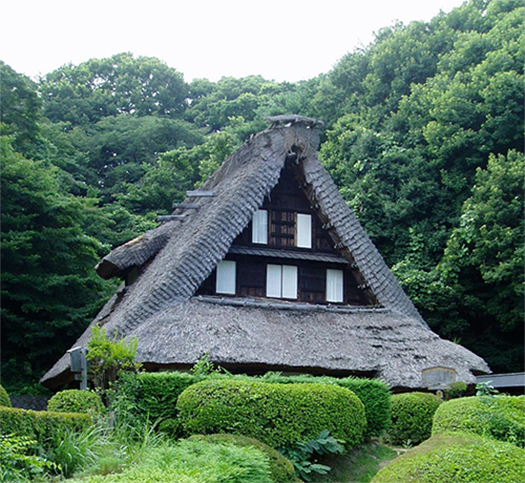
いまシリーズで探訪記録を書き続けている川崎の日本民家園でも
このような「合掌造り」建築が3棟立ち並んでいて、
そのうちの1軒は展示住宅のちょうど中間的な位置に建っていることもあり、
またそもそも移築前が合掌造りのおそば屋さんだった、ということから、
店舗として活用までされている。「おお、合掌造りのお店かぁ・・・」
日本民家園という全体景観のなかでももっともポピュラーな存在という刷り込み。
あるいは川崎という立地から、雪深い山国という縁遠さがシンボル化されたか。

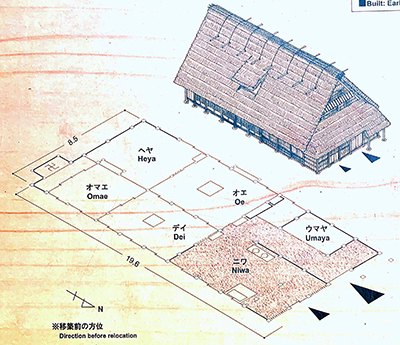
この江向家は1階の床面積が50坪を越える。
例によって土間が前面に展開しているけれど、
山岳地域での農業主体の民家では、それほど広い土間はないのだという。
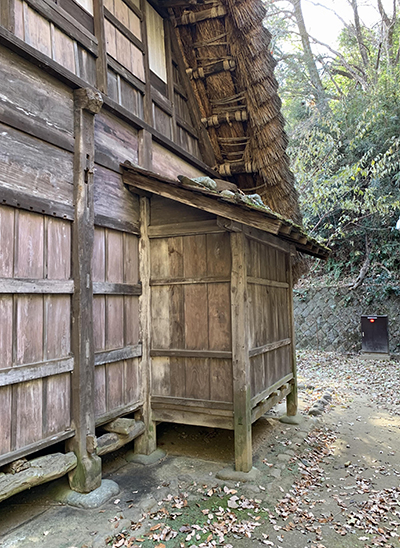
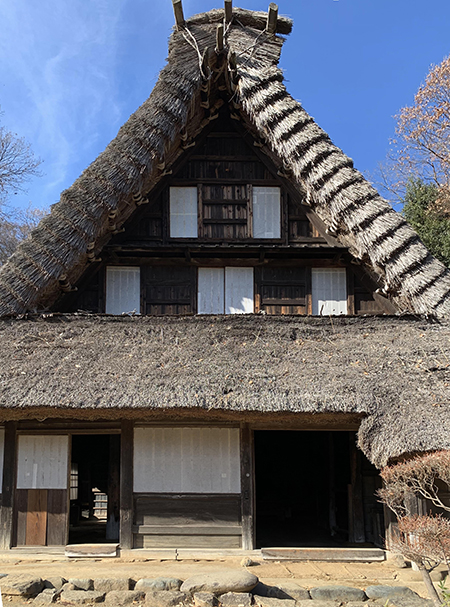
合掌造りの妻入りだけれど、その妻側に下屋が付属しているような形態。
その下屋部分に馬屋と紙すきの作業場となる土間が、
間に壁を仕切って配置されている。
このように入口側が壁重視型の間取りになっているのは、寒冷対策だという。


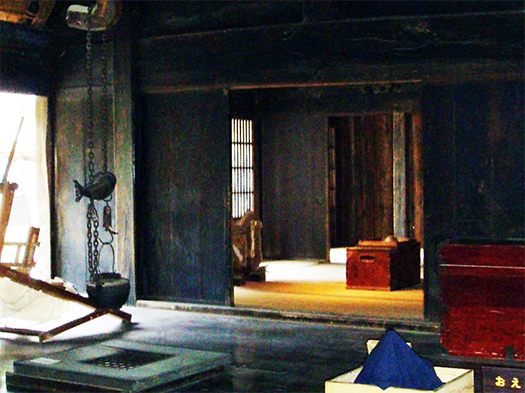
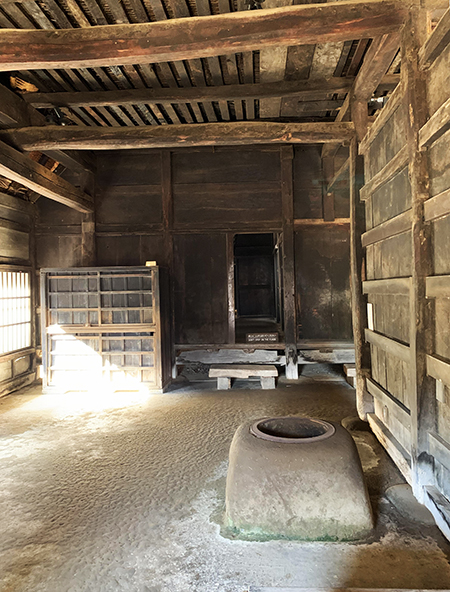
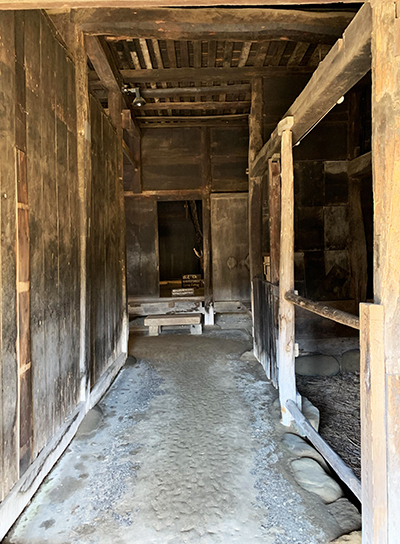
すぐ上の写真は、その馬屋を右手に見た入口側からの様子。
外観としては妻入りで左右2箇所からの出入りが意図されている。
この土間空間を真ん中で左右に壁が仕切っているのだ。
さらに上写真では馬屋の奥の床板敷空間も壁や板戸で仕切られている。
非常に閉鎖的な造作で、冬期の寒冷への対応が重厚な仕様。
作業場としての土間がそれほど広くないのは、平地の農家住宅と違って
それほどには収穫・生産性が高くないので、作業自体がそう多くないのだと。


紙すきが重要な副業とされていた。
また、板敷きの室内には機織りも展示配置されていた。
農業作業の主体である男性の仕事がそう多くはなく、
かれらは「出稼ぎ」に出ることが多く、留守を預かる女性たちが
家計を支える内職的な仕事として、紙すきや機織りを活発に営んでいたという。
また合掌造りの高い屋根を活かした上階空間では養蚕が行われていた。
それが機織りにも繋がっている。
まことに必死な生活の生業の様子がヒシヒシと伝わってくる。
同じ雪国という北海道人だけれど、雪の「重さ」に違いがあって
軽い北海道の雪とは違った湿度たっぷりの雪質が育む情念を感じさせられる。

English version⬇

[Etchu Gokayama Gassho-zukuri / Emukai Family / Good Japanese House ⑳-1]

By the way, speaking of private houses, there is imprinting that the market price is fixed as well as gassho-zukuri.
I’m not sure why.
There are old folk houses with unique living cultures all over the country, and each has its own climate.
A wide variety of homes, from the living culture of Okinawa and the South Island to the restored pits on Hokkaido Island.
Since I and others continue to see the Okhotsk culture from the Jomon period in Hokkaido,
I think gassho-zukuri is also a pattern,
I can’t feel like an old folk house.
Perhaps the Pacific culture has become mainstream, and on the contrary, the image of a snowy mountain village
Was it imprinted in one set with the beauty of the triangular roof?
Even at the Japanese folk house garden in Kawasaki, which is currently writing exploration records in the series
There are three such “gassho-zukuri” buildings lined up.
One of them may be located just in the middle of the exhibition house,
Also, since it was a gassho-style soba shop before the relocation,
It is even used as a store. “Oh, it’s a gassho-style shop …”
Imprinting that it is the most popular existence in the whole landscape of Japanese folk house garden.
Or was the remoteness of a snowy mountainous country symbolized from the location of Kawasaki?

This Emukai family has a floor area of ​​over 50 tsubo on the first floor.
As usual, the dirt floor is on the front,
It is said that there is not so much soil in a private house that is mainly agricultural in mountainous areas.
It has a gassho-style wife, but it looks like a lower house is attached to the wife’s side.
In the lower part of the house, there is a horse shop and a dirt floor that serves as a papermaking workshop.
It is arranged by partitioning the wall between them.
It is said that the wall-oriented floor plan on the entrance side is a measure against cold weather.

The photo above is from the entrance side when you see the barn on your right.
As for the appearance, it is intended to enter and exit from two places on the left and right with a wife.
A wall divides this dirt space on the left and right in the middle.
Unlike farmhouses on flat land, the soil floor as a work place is not so large.
The productivity of harvesting is not so high, so the work itself is not so much.

Papermaking was regarded as an important side business.
In addition, weaving was also exhibited in the boarded room.
There are not so many men’s jobs that are the main body of agricultural work,
They often go to “migrant workers”, and women who are away from home
It is said that he was actively engaged in papermaking and weaving as an internal job to support the household budget.
In addition, sericulture was carried out in the upper floor space that made use of the high roof of the gassho style.
That also leads to weaving.
The state of the life of a desperate life is transmitted with a rush.
Although they are Hokkaido people who are the same snow country, there is a difference in the “weight” of snow.
You can feel the passion of nurturing the humidity of the snow, which is different from the light snow of Hokkaido.

【WHO「武漢調査」開始直前に武漢市長辞任】


しばらくぶりに時事ネタを書きます。
ついに全世界での感染者が1億人を超えてしまったパンデミック。
その発生源についての国際調査がWHOによってきょう28日から開始される。
中国入国から2週間の防疫管理期間がようやく満了する。
「どうせ隠蔽しまくりで期待できない」という諦めからか、
あるいは中国に忖度してか、ほとんどの日本のメディアから注目されていない
調査ですが、わたしはそれなりに注目している。
中国側の対応として、隠蔽に全力を挙げたのは国際常識だし
調査日程も大きく後ろ倒しになった。直前になってWHOのテドロス事務局長ですら
中国側の隠蔽的対応姿勢に「失望した」というコメントも行った。
あのテドロス事務局長が、であります。
しかしそれでも日本を含めた先進国のWHOの実務者・感染症専門家たちが、
2週間の足止め後、そのプライドを賭けてどういった「調査活動」を行うのか?
あるいは解明の糸口すら見いだせないのか?
世界の多くのひとびとの素朴な疑問、発生源の実態を
あきらかにできるかどうか、冷静にその活動に注目したいと思っている。
願わくば中国当局との情報をめぐる戦いで一定の成果を期待したい。

そういった情勢下、2週間の防疫管理期間終了まで数日の時点で
今度は「武漢熱」発生当時の市長が辞任したというニュースが入ってきた。
読売新聞WEBでは以下のような報道。
〜中国・武漢市長が辞任…情報公開巡り、中央政府の責任に言及で話題に
2021/01/22 21:09読売新聞(要旨)
22日中国湖北省武漢市人民代表大会常務委員会は周先旺市長辞任を承認。
辞任の理由は不明。周氏は昨年1月末、情報公開を巡る批判を受け、
中国中央テレビの取材に「遅れていた一面があった」と非を認めた。
「地方政府は権限を与えられて初めて発表できる」とも述べ、
暗に中央政府の責任に言及したとして話題となった。〜
たしかに情報取材活動には多くの制約があることは承知できるけれど、
タイミング的にあきらかに符合するWHO調査との関連性を
なぜ記事テーマにしないのか? あるいはできないのか?
ふつうの常識的解釈からすればあらかじめの「口封じ」とも取れる。
「かれはいま立場を離れている」とWHO調査に対して理由を示せるのだろう。
多くの疑問を持ったけれど、まだしも報道するだけマシではある。
北京に報道支局を派遣するためには事実上中共独裁権力に忖度しなければ
維持できないという日中間「報道協定」があるとされる。骨抜き制度。
報道されないことでインターネット全般をチェックしない層は
今後の展開にとっての非常に重要な前提情報について知り得ないことになる。
しかしこういう協定はどうやら欧米メディアでは効力が弱いのかも知れない。
ここ1両日のYahooニュースページを確認したら、
武漢で「コロナはどこから来たか?」と質問したBBC記者が「集中非難」遭う
という記事。武漢の「市民」から「このウィルスは外国から来たものだ」と記者が
集中非難されたということ。さてこの市民とはどういう存在なのか。
またさらに、●口封じされる武漢のコロナ遺族 WHOの起源調査開始目前
というAFPの記事も発出された。
まことに前途暗澹たる思いが強まりますが、調査活動の無事と成果を願いたい。
冷静にその状況、結果を見守りたいと思います。
なんといっても、これだけのパンデミックについての国際的発生源調査が、
発生から1年もかかったという異常性。
現代社会がどうなっていくか、非常に分水嶺的な事象だと思われます。

English version⬇

I will write current affairs for the first time in a while.
At last, the number of infected people in the world has exceeded 100 million.
An international investigation into its source will begin today by WHO on the 28th.
The two-week epidemic prevention management period has finally expired since entering China.
Perhaps because I gave up saying “I can’t expect it because I hide it anyway”
Or maybe because of China, it has received little attention from the media.
It’s a survey, but I’m paying close attention to it.
It is international common sense that the Chinese side made every effort to conceal.
The survey schedule was also greatly delayed. Just before, even WHO Secretary-General Tedros
He also commented that he was “disappointed” with the concealed attitude of the Chinese side.
That Tedros Secretary-General is.
However, even so, WHO practitioners and infectious disease experts from developed countries, including Japan,
What kind of “investigation activity” will you bet on that pride after two weeks of stagnation?
Or can’t we even find a clue to elucidation?
Simple questions of many people in the world, the actual situation of the source
I would like to calmly pay attention to the activity to see if it can be clearly done.
Hopefully, we can expect some results in the battle for information with the Chinese authorities.

Under such circumstances, within a few days until the end of the two-week epidemic prevention management period
This time, news came in that the mayor at the time of the “Wuhan fever” resigned.
There is no commentary from the Japanese media, only the announcement from the Chinese side is transmitted.
The Yomiuri Shimbun WEB reports as follows.
~ Mayor of Wuhan, China resigns … Information disclosure, mentioning the responsibility of the central government
2021/01/22 21:09 Yomiuri Shimbun (Summary)
On the 22nd, the Standing Committee of the Wuhan City People’s Congress in Hubei Province, China, approved the resignation of Mayor Zhou Xianwang.
The reason for his resignation is unknown. Mr. Zhou received criticism over information disclosure at the end of January last year.
He admitted that “there was one side that was late” in an interview with China Central Television.
“Local governments can only make announcements when they are empowered,” he said.
He was talked about as implicitly referring to the responsibility of the central government. ~
I understand that there are many restrictions on information gathering activities, but
Relevance to WHO surveys that clearly match in timing
Why not make it an article theme? Or can’t it?
From a common sense interpretation, it can be taken as a “sealing” in advance.
“He’s out of position now,” he could give a reason to the WHO survey.
Not surprisingly, the Chinese asylum seekers and Chinese watchers on this matter
Mr. Hei Seki was pointed out on his own website as being related to the WHO survey.
In a dictatorship, international hearings of this person will be slaughtered.
I had a lot of questions, but it’s still better to report.
In order to dispatch a press bureau / expatriate to Beijing, it is necessary to have virtually the power of dictatorship between China and China.
It is said that there is a “press agreement” between Japan and China that it cannot be maintained.
Those who do not check the Internet in general because they are not reported
You will not be able to know the very important prerequisite information for future development.
However, such agreements may be weak in foreign media.
After checking the Yahoo news page for the past one or two days,
A BBC reporter who asked “Where did Corona come from?” Concentrated blame “encounter
Article. A reporter said from a “citizen” in Wuhan that “this virus came from a foreign country.”
It was blamed for concentration. What kind of existence is this citizen?
Furthermore, ● Wuhan’s Corona bereaved family WHO’s origin investigation is about to begin
An AFP article was also published.
It really makes me feel gloomy, but I hope that the research activities will be safe and successful.
WHO’s activity to investigate the source of Wuhan, what kind of shape it will be
I would like to calmly watch over the situation and results.
After all, an international source survey on such a pandemic
Anomalous that it took a year from the outbreak.
What will happen to modern society seems to be a very watershed event.

【転んでうれしい(笑)骨密度測定結果】

ついにやってしまった・・・。
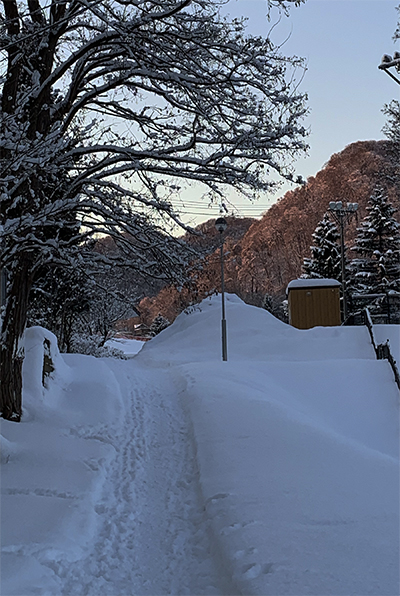
毎日の朝散歩、ついに完全越冬態勢で絶賛継続中ですが、
一昨日ツルツルの横断歩道から歩道に上がる箇所で
思った以上に圧雪氷の厚みがあって、右足がそこにつまずいて
前方向に全身が叩き付けられるような衝撃を受けてしまった。
右足が蹴つまづいて、その拍子で左足の膝部分がカクッときて
路面に激突し、そこを支点にしてそこから上の全身が前倒しになった。
あっと、気付いたときには目の前に路面があり、
ちょうど右側おでこで受け身を取ったような態勢でした。
激痛が走ったので、とりあえず体勢を上向きにして痛みをこらえた。
朝の6時ころの札幌円山公園内だったので、
交通車両はまったくなく、また位置的には歩道だったので、
あわてずに安静の体勢で状況把握をしていた次第。
とりあえずは膝とおでこの激痛がありました。
しかし、膝はダウンのパンツを穿いているし、その下着も履いている。
感覚的には出血の心配はなさそうでした。
また、おでこの方が痛みは激しかったけれどこちらも
ダウンのジャケットフード、その下には毛糸の帽子を被っていて
それが辛うじてクッション役を果たしてくれている様子。
数十秒後、これらの認識結果&推測に基づいて立ち上がってみた。
痛みは強く感じたけれど、どうも感覚的には打撲の自己認識。

「イテテ」となさけない弱音は人知れず吐いていましたが(笑)、
それでも歩行にも問題はないということで散歩を継続しながら帰路に。
で、カミさんに報告したら「念のため病院に」という指示。
カミさんの母親は晩年「骨密度」が低下して老衰が進んだこともあり、
「必ず骨密度も測ってもらって」という追加指示。
ありがたい指示ということで、過去数回お世話になっている整形外科に。
午前10時半頃に行って、全て終わったのが12時過ぎでしたので、
非常にスムーズに診ていただけた次第であります。
自己診断通り、「骨に異常はありません、打撲ですね」という見立て。
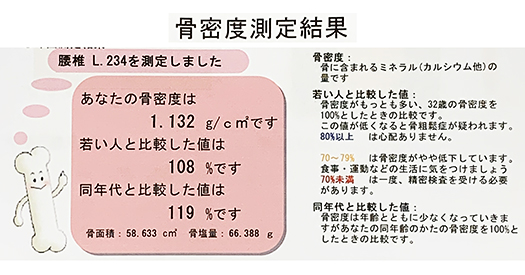
ひと安心、というところでさらにいただいたのが写真資料。
一応、個人情報ですが、抜粋画面です。
カミさんから言われた「骨密度」の腰骨検査結果。
なんと、骨密度がもっとも多い32才の骨密度を100%とした比較で
わたしは108%という若々しさであります(エヘン)。
同年代との比較では119%ということなので、2割ほど上回っている。

ということで帰ってカミさんに報告も上機嫌でありました。
ケガの功名、というコトバがありますが、
少し意味合いは違うけれど、病院に行ってむしろ喜ばしい結果が得られた。
冬道歩行は要注意ではあるけれど、まだまだ元気いっぱいだという
お墨付きも得られたことで、勇気百倍であります。
しかし咄嗟の時に手で受け身できなかったことはやや無念。
お医者さんからのコメントでは
「これからもバランスの良い食事や適度な運動を」ということ。
言われるまでもなく、コロナ禍を吹き飛ばすように健康生活がんばります。

【今生と他生〜こんじょうとたしょう〜】


「袖ふれあうも他生の縁」というコトバがある。
この「他生」というフレーズはよく誤解される。
多少というように、ほんの少しというような意味合いで捉えられることがある。
多くの人に問いかけると、みごとにこの誤解が広がっている(笑)。
日本語の危機でもあり、また「進化」でもあるのかも知れない。が、やはり違う。
コロナ禍のストレス発散で冬の雪道を散歩する毎日。
人が通れば道になる、というような格言通り、いろいろな広さの道ができる。
こういう雪道は北国らしい冬の楽しみでもあるかも知れない。
人間一人がようやく通れるくらいの広さは、
たぶん30cmくらいの広さになっている。このくらいの広さを1尺という。
ただ、これくらいの道幅だとすれ違うことが困難。
で、どちらともなく「譲り譲られ」というコミュニケーションが成立する。
譲っても譲られても、お互いに会釈することになる。
「ありがとうございます」
「いえ、どういたしまして」
・・・というときに、先述のコトバがアタマのなかに生起する。
一期一会だけれど、同じような道を通って同じ時間を共有する。
他生というのは、〜今生(こんじょう)に対し、現在の自分がその生れ変りである
過去の生、および生まれ変わって行く未来の生。前世および来世〜。
そういうことをこういう出会いに掛け合わせる精神性。

不思議なもので、この30cmくらいの道幅を超えると
すれ違うことができるからか、そういった心情を持つことはない。
1尺という単位はよくできた単位で、次に多くなるのは2尺程度の道幅。
これだとなんとかすれ違うことができるので、なにも感慨を生み出さなくなる。
それ以上の道幅となると機械除雪が入って、ほぼ135cm程度の道幅になる。
で、1間となるとほぼ1.8m。あるく道としてはおおむね用を足せる。
奈良の都の造営とほぼ同時期に日本の街道が整備されたという。
どんなカタチだったかといえば、以下のようなWEB上の記述がある。
〜その本来の姿は平地では両側溝を備え、その幅は側溝間の芯々距離で
六・九・一二メートルなどが多く、いずれも丈(約三メートル)の倍数が多い。〜
<みやこ町歴史民俗博物館/WEB博物館「みやこ町遺産」 >
律令国家を志向した日本社会はまずまっすぐな大道を作り始めた。
律令という社会の規範を通すということと道をつくることが重なった。
道とひとのいのちとは、どうも昔から縁の近い捉え方をされてきたといえる。
先人の考えたことというのは、人間の真実が宿っている。

冬の雪国では、こういう「還元的原点回帰」を容易に経験できる。
ただ、最近加齢とともに「他生」というコトバに強く反応するようになった。
だれかが最初に歩いた道を、ゆっくりと踏みしめながら歩く。
それもまた他生の感じ取り方なのかも知れない。

<英語版は諦めました(笑)。こういう定型日本語フレーズはAI理解不能のよう>

【床の間前身「押板」と生活文化/日本人のいい家⑲-4】


わたしは箱木千年家というようなホントに1000年以上実在の古民家も
見学取材してきていますが、
この「九十九里の網元」作田家も17世紀1600年代後期ということで、
350年前後以前の建物。さすがにこういう時期の建物はめったに見られない。
本日は4回目、最終回です。
日本住宅の様式的装置として、床の間がありますが、
民家で床の間というのはこの時期としてはあまり見られず、
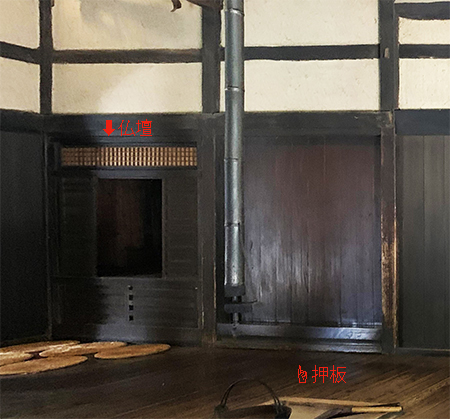
その「前身」といわれる「押し板」という建築意匠がこの「カミ」空間に
造作の仏壇と併置されていました。
押板は仏壇とともに宗教的祭祠の場だったのかも知れないのかと。
〜中世の座敷飾りで壁下に作り付けた奥行きの浅い厚板。
現在の床の間の前身。〜というような百科事典での説明文。
床はだんだんと奥行きが増していって「床の間」になったようですね。
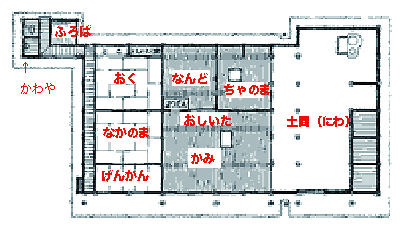
こちらでは裏に隠居部屋「ナンド」があって、カミの空間でその方向に
仏壇と押し板がある。仏壇も一定の奥行きがあるようなので、
それと同じくらいの「床」+間があったものかと思われる。
ただし、その後の後世に「オク」という座敷に本格的な床の間が造作されている。
床の間と押板が併存していた様子がわかります。
押板、という表現からするとただの壁の一種というように受け取られますが、
左側の仏壇(薄手に感じる)とのセットで発展した様子がしのばれる。
同じように柱の間隔にそろえた幅を持っていて、
造作で作られていた様子がよくわかる。
やがて仏壇が徐々に奥行きを持ち始めてそれにつられ床も「間」を持つようになった?
先祖崇拝が基本の「家」文化のなかで仏壇が主導するかたちで、
日本建築のコア部分となっていったものではないか。
いずれにせよ、そういう事情が痕跡として保存されているのは貴重。
現代では仏壇というものは高級専門家具としてかなりの「奥行き」を持っている。
まるで奥行きがその家の歴史の古さを象徴するかのようだ。
ものには発展の「方向性」のようなものが表現されていると考えれば、
写真のような薄い柱間利用からスタートした文化空間が、
そういった方向に進化していったと想像が湧いてくる。興味深い。

一方こちらは「チャノマ」とされる土間隣接の空間。
チャノマは囲炉裏を中心に日常生活が営まれる所で、もっと古い時期にはおそらく
カミとの仕切りはなかっただろうと推測されている。
左手の引き戸建具の奥は「ナンド」と呼ばれる隠居老人室。
右側にはやや出っ張った空間として収納空間がある。
間取りを確認すると、ナンドのさらに奥にオク座敷があって床の間が並行。
押板とは別に造作された「床の間」に相応している。
とくに増築のことは調査報告からは記述がないので、
創建時350年程前には床の間は成立していて、押板はもう少し違う用途が
考えられていた空間だった可能性もある。

さらにこちらは、ちょうど仏壇・押板と対面する位置のカミの開口部に
まるで木製建具のように造作された前面の3間の格子窓。
この時期の関東の古民家に共通する構えであるとされている。
下の写真は、この「格子窓」をオモテ側から見た様子。

用途としては「間の戸」ということが想像できる。
日本の窓はこの「間の戸」の発展形であり西洋の窓は風穴Wind+owと言われる。
たぶん寒季にはこのように閉じ、暖季には外して開放していたのではないか。
もっと格式の高い建築であれば縁が回されて、室内との仕切りには
障子建具などが作られたところ、折衷的な建築表現で採用されたか。

やはり古民家・古建築には
日本人が親しんできた生活文化が明瞭に刻印されていることがわかる。
もっと全国各地への探究への思いは強まるばかり。
コロナ禍がほとほと恨まれるばかりであります・・・。

English version⬇

[Tokonoma predecessor “Oshiban” and lifestyle / Japanese good house ⑲-4]
The core part of Japanese architecture along with the Buddhist altar in the “house” culture, which is based on ancestor worship. Life culture that Japanese people have been familiar with.・ ・ ・

I’m a Hakogi Millennium House, and there are also old folk houses that have existed for more than 1000 years.
I have been interviewing for a tour,
This “Kujukuri Amimoto” Sakuda family is also in the late 17th century 1600s.
Building before around 350 years. As expected, buildings of this period are rarely seen.
Today is the 4th and final round.
As a stylized device for Japanese houses, there is an alcove,
Tokonoma in a private house is rarely seen at this time,
The architectural design called “push plate”, which is said to be the “predecessor”, is in this “kami” space.
It was juxtaposed with the built-in Buddhist altar.
I wonder if the push board was a place for religious rituals along with the Buddhist altar.
~ A shallow plank built under the wall with a medieval tatami room decoration.
The predecessor of the current alcove. An explanation in an encyclopedia such as.
It seems that the floor gradually increased in depth and became a “tokonoma”.
Here, there is a retired room “Nando” in the back, and in that direction in the space of the kami
There is a Buddhist altar and a push plate. The Buddhist altar also seems to have a certain depth, so
It seems that there was about the same “floor” + space.
However, in later generations, a full-fledged alcove was built in a tatami room called “Oku”.
You can see that the alcove and the push plate coexisted.
From the expression “push plate”, it is perceived as just a kind of wall,
You can see how it developed as a set with the Buddhist altar on the left side (it feels thin).
In the same way, it has a width that matches the distance between the pillars,
You can see how it was made by the structure.
Eventually, the Buddhist altar gradually began to have depth, and along with it, the floor also had a “pause”?
In the form of a Buddhist altar in the “house” culture, which is based on ancestor worship,
Isn’t it the core part of Japanese architecture?
In any case, it is valuable that such circumstances are preserved as traces.
In modern times, Buddhist altars have a considerable “depth” as luxury furniture.
It’s as if the depth symbolizes the history of the house.
If you think that things express something like the “direction” of development,
The cultural space that started from the use of thin pillars as shown in the photo
Imagine that it has evolved in that direction. Interesting.

On the other hand, this is the space adjacent to the dirt floor, which is called “Chanoma”.
Chanoma is a place where daily life is carried out around the hearth, probably in older times.
It is speculated that there would have been no partition with the kami.
Behind the sliding door fittings on the left is a retired old man’s room called “Nando”.
There is a storage space on the right side as a slightly protruding space.
When I checked the floor plan, there was an ok tatami room further back in Nando, and the alcove was parallel.
It corresponds to the “tokonoma” that was created separately from the push plate.
In particular, there is no description of the extension from the survey report, so
The alcove was established about 350 years ago when it was built, and the push plate has a slightly different purpose.
It may have been the space that was being considered.

Furthermore, this is the opening of the kami just facing the Buddhist altar and push plate.
A three-storied lattice window on the front that looks like a wooden fitting.
It is said to be a common stance for old folk houses in the Kanto region during this period.
The photo below shows this “lattice window” seen from the front side.

It can be imagined that it is used as a “door between”.
Japanese windows are a development of this “Mado”, and Western windows are called wind holes Wind + ow.
Maybe it was closed like this in the cold season and opened in the warm season.
If it is a more prestigious building, the edge will be turned, and it will be a partition from the room
When shoji fittings were made, was it adopted in an eclectic architectural expression?

After all for old folk houses and old architecture
It can be seen that the lifestyle culture that Japanese people have been familiar with is clearly engraved.
My desire to explore all over the country is only getting stronger.
The corona wreck is just a grudge …