本文へジャンプ

【分断国家の国境38度線・イムジン河から】


東アジアの情勢は、世界の中でも相当ホットな状況にありつつあります。
相変わらず北朝鮮は核開発を手放さないし、
それを使う攻撃手段としてミサイルなどの実験を繰り返している。
背後の中国も週明けには巨大不動産企業のバブル破綻が目前に迫っているという。
もし共産党独裁体制下の資本主義でコントロールが困難な局面を迎えたら
戦前期の日本のように追い詰められていって
どういった行動を取っていくのか、予断が難しいでしょう。

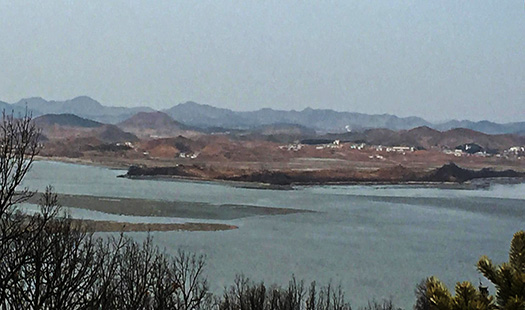
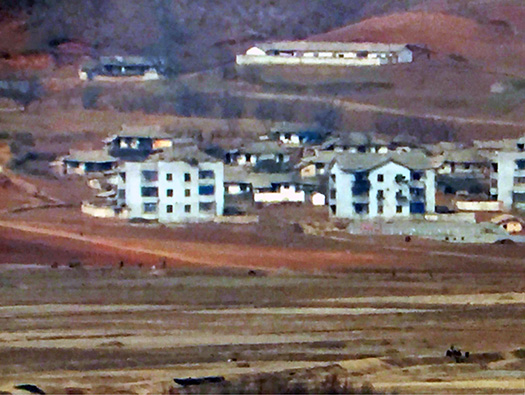
そういうことで韓国訪問時にイムジン河に面した烏頭山(オドゥサン)統一展望台に
行ってきました。板門店もほど近い距離。
トランプ元大統領が「これから行くよ」と連絡して
金正恩と会談したのは記憶に新しいけれど、ああいうパフォーマンスで
対立構図が軽々に変わると言うことはない。
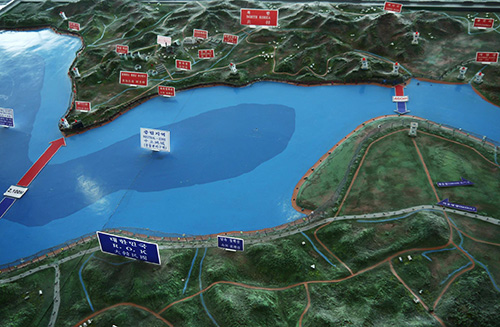
展望台は漢江とイムジン川が合流する地点。潮の干満の影響で水量が増減する。
川の真ん中が軍事境界線。向こう岸まで460m、遠いところで3.2kmとのこと。
展望台の中には、北朝鮮の一般人の家の部屋が再現されている。
家の中に掛かっているカレンダーは金日成の誕生年を元年にしているのだという。
21世紀の現代でもこういう現実に閉塞されている人々が存在する。
最近、習近平も小学校教育に自身を登場させ賛美させているという。
まことにやっかいな独裁専制国家が東アジアに現に存在している。

わたしは敗戦から7年後生まれという戦後世代なので
実家がお金持ちという親しい友人は
「ソ連が侵攻してきたら本州に逃げる」との親の話をよく聞いていたという。
北海道はそういう危機が現実感を持っていた数少ない国内地域。
そういう第2次大戦時の状況の残滓が北方領土問題で残ってもいる。
もしそうなっていたら、津軽海峡が国境線になったか、
あるいは北海道内の石狩川がそうなっていた可能性もあったのでしょう。
日本は北方領土の問題はあるけれど、基本的な統一国家の姿は
保持されて戦後以降の時代を過ごしてきた。
しかし東アジアの現実の状況は非常に困難が進展している。
戦争の危機は常に存在し、かつ現代ではそのカタチもまた変化するのでしょう。
海によって囲まれた島国国家とはいえ、地政学的には
これからの時代にも厳しい環境にあるということは自覚が必要。

English version⬇

[From the 38th parallel of the divided nation, Rimjingang]
The situation in East Asia is becoming quite hot in the world.
As usual, North Korea will not let go of nuclear development,
Experiments such as missiles are repeated as an attack means to use it.
China behind it is said that the collapse of a huge real estate bubble company is imminent at the beginning of the week.
If capitalism under the Communist dictatorship makes it difficult to control
Being cornered like Japan in the prewar period
It will be difficult to predict what kind of action will be taken.

Therefore, when visiting Korea, I went to the Odusan Unification Tower facing the Rimjin River.
I went. Panmunjom is also close by.
Former President Trump contacted me, “I’m about to go.”
I remember meeting with Kim Jong Un, but with that kind of performance
It cannot be said that the composition of the conflict changes lightly.
The observatory is the point where the Han River and the Imjin River meet. The amount of water increases or decreases due to the influence of the ebb and flow of the tide.
The middle of the river is the military demarcation line. It is 460m to the other side and 3.2km far away.
Inside the observatory, the room of a North Korean ordinary person’s house is reproduced.
The calendar hanging inside the house is said to have Kim Il Sung’s birth year as the first year.
Even in the 21st century, there are people who are blocked by this reality.
Recently, that Xi Jinping is also to appear itself to the elementary school education.
A truly annoying dictatorship nation actually exists in East Asia.

I’m a post-war generation born seven years after the defeat
A close friend whose parents are rich
He often heard the story of his parents saying, “If the Soviet Union invades, I will flee to Honshu.”
Hokkaido is one of the few domestic regions where such a crisis had a sense of reality.
The remnants of the situation during World War II are also left behind due to the Northern Territories issue.
If so, did the Tsugaru Strait become a border line?
Or maybe the Ishikari River in Hokkaido was like that.
Japan has problems with the Northern Territories, but what is the basic picture of a unified nation?
It has been retained and has spent the postwar era.
However, the actual situation in East Asia is becoming extremely difficult.
Geopolitically, even though it is an island nation surrounded by the sea
It is necessary to be aware that we are in a harsh environment in the coming era.
The crisis of war always exists, and its shape will change in modern times.

【宗教建築の「見上げ」部位 法隆寺と仏国寺-6】


古代国家、600年代と700年代の日韓での仏教公布期の建築比較。
ふつうの住宅などでは天井とか、軒天などの部位は
機能やコスト最優先でそこにデザインを施す、あるいは凝るというのは
あんまり考えることが少ないでしょう。
でも、やってみると天井部分ってまことに意義深い。
わが家では木組みの格子天井を特定部位で試みたけれど、
はじめて家で寝たときに家族全員で「いいよね〜(笑)」と感動した。
なんというか、そのまま眠りに落ちる、あるいは目覚める瞬間の
目に飛び込んでくる光景というのがのっぺりとした単色ではなく、
質感豊かな素材であるということは毎日の暮らしの句読点と強く感じた。
感受性とか、心のひだというような部分で有為な部位と感じたのです。

そういう見上げの部位でさすがに伝統的文化建築では粋が懲らされている。
東アジアの日韓両国の精神性を表現する2つの寺の部位。
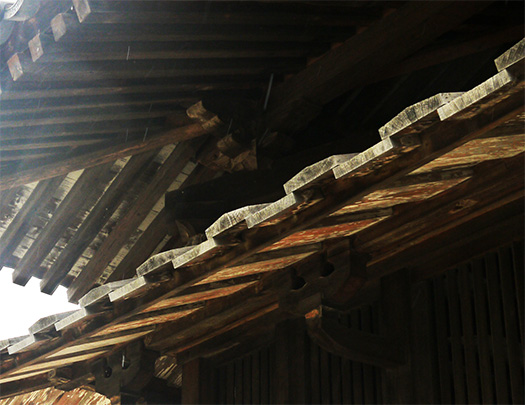
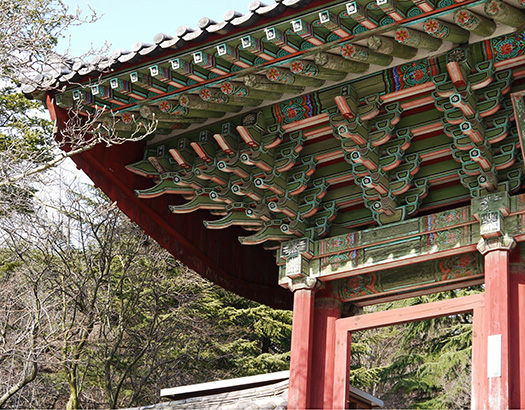
上の写真は韓国仏国寺の軒天部位と殿舎内部の格天井。
屋根が軒の部分であらわになるところへの装飾として
「組物」と呼ばれるマジカルな意匠が連続している。
機能としては差し掛かってくる屋根の傾斜部分を保守する役割ですが、
まことにカラフルな色合いが圧倒してくる。
印象としてはここで使われている色合いがどうも日韓で嗜好性が違うと思う。
韓国の場合は緑が基層的カラーとして曼荼羅感が構成されているように思う。
一方、殿舎内部の格天井といわれる格子状の連続の構成。
そこにさまざまな意味合いが掛けられているように思われる。
いかにも仏教思想のさまざまな概念世界が表現されているのだろうか。


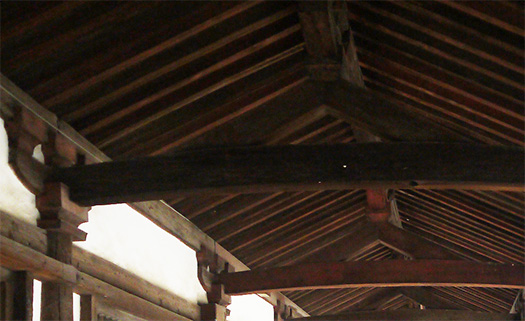
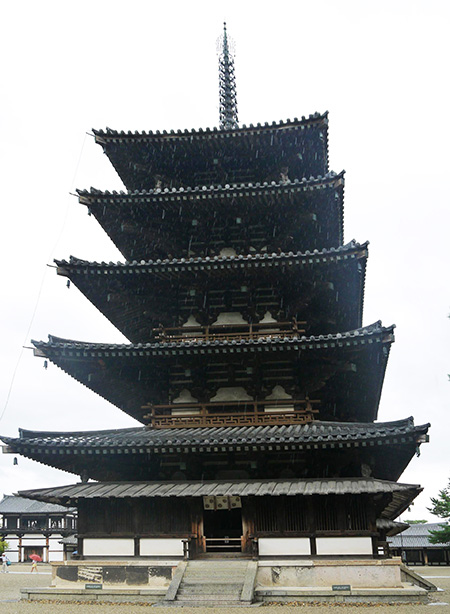
こちらは日本の法隆寺の軒天部分の写真です。
内部については「撮影不可」だった記憶があり、探してもなかった。
一応回廊部の天井の様子を挙げてみました。
韓国では丸い部材が多用されて構造材を構成しているけれど、
法隆寺では基本的に角材使用で、約150年の歴史時間でより古いということからか、
シンプルな構造用途として非装飾的な仕上げだと感じられます。
言ってみれば「素材の味わい」を楽しんでいるようにも感じられる。
屋根の最下段部分で木材の重ね方に面白い木組み手法が見られます。
日本は多雨気候なので、水仕舞いの工夫としての仕上げのようにも思えます。
最初期の木造寺院である四天王寺は朝鮮からの大工集団・金剛組が施工指揮。
その後、日本に帰化したとされるけれど、
この法隆寺はどういった施工者があたっていたのか興味深い。
建物内部の写真を写した「原色日本の美術2(小学館)」を参照すると
薬師三尊を安置する大講堂にはシンプルな格子天井が丹色に彩色されている。
150年後の韓国仏国寺のカラフルさとはかなり印象が違います。

どうも法隆寺の方の、素材の古美をそのまま顕す感受性が
日本人には似つかわしいのではないかとも想像されるけれど、
これは観察者としての印象論。興味深いですね。

English version⬇

[“Looking up” part of religious architecture Horyuji Temple and Bulguksa Temple-6]
A comparison of architecture during the promulgation of Buddhism in Japan and South Korea in the 600s and 700s, an ancient nation.
In ordinary houses, parts such as the ceiling and eaves are
Designing or elaborating there with the highest priority on function and cost
You don’t think much about it.
But when I try it, the ceiling is really meaningful.
At my home, I tried a wooden lattice ceiling at a specific part,
When I slept at home for the first time, the whole family was impressed with “I like it (laughs)”.
Somehow, the moment you fall asleep or wake up
The spectacle that jumps into your eyes is not a flat single color, but
I strongly felt that the material is rich in texture as a punctuation mark in everyday life.
I felt that it was a significant part in terms of sensitivity and folds of the heart.

In such a part of looking up, the chic is disciplined in traditional cultural architecture.
Two temple parts that express the spirituality of both Japan and South Asia in East Asia.
The photo above shows the eaves of Bulguksa Temple in Korea and the ceiling inside the shrine.
As a decoration where the roof is exposed in the eaves
A series of magical designs called “kumimono”.
The function is to maintain the sloping part of the roof that is approaching,
The colorful shades are overwhelming.
The impression is that the colors used here have different tastes in Japan and Korea.
In the case of South Korea, it seems that green is the basic color and the mandala feeling is composed.
On the other hand, there is a continuous grid-like structure called the case ceiling inside the shrine.
It seems that there are various implications.
Is it really expressing the various conceptual worlds of Buddhist thought?

This is a picture of the eaves of Horyuji Temple in Japan.
As for the inside, I remember that it was “not possible to shoot”, so I didn’t even look for it.
For the time being, I have listed the state of the ceiling of the corridor.
In Korea, round members are often used to form structural materials,
Horyuji Temple basically uses square lumber, which is older than about 150 years of history.
It feels like a non-decorative finish for simple structural applications.
It feels like you are enjoying the “taste of the ingredients”.
At the bottom of the roof, you can see an interesting timber construction method for stacking wood.
Japan has a heavy rainy climate, so it seems like a finishing touch to the water.
Shitennoji, the earliest wooden temple, was constructed and directed by Kongo Gumi, a group of carpenters from Korea.
After that, it is said that it was naturalized in Japan,
It is interesting to see what kind of builder was at this Horyuji Temple.
If you refer to “Primary Color Japanese Art 2 (Shogakukan)”, which is a photo of the inside of the building
The large auditorium where the Yakushi Sanson is enshrined has a simple lattice ceiling colored in tan.
The impression is quite different from the colorfulness of Bulguksa Temple in Korea 150 years later.

Apparently at least the sensitivity to reveal the ancient beauty of the material of Horyuji Temple
I can imagine that it looks like a Japanese person,
This is an impression theory as an observer. It’s interesting.

【新羅国の石工技術・宝塔2基 法隆寺と仏国寺-5】


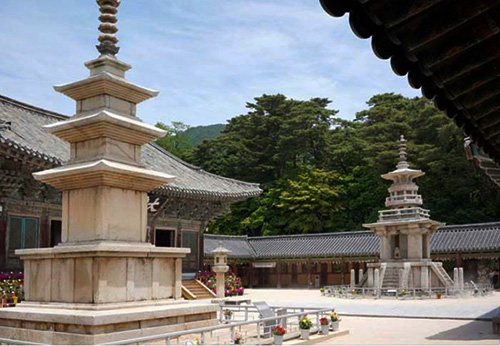
さて先日は韓国仏国寺での多宝塔と法隆寺の五重塔の対比を観ました。
日本では石仏は一般的にはお地蔵さんなどはあっても、
お寺の重要施設としてはあまり多くはありませんね。
木彫りの像というのが多いのだと思います。
石仏文化というものが日本ではあまり発展しなかったと言われますね。
さて、なぜなんでしょうか?
で、韓国では新羅時代など石工技術が隆盛したといわれる。
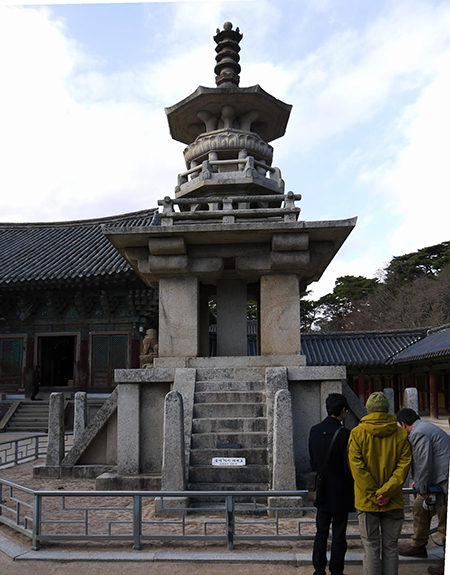
〜釈迦塔は法華経を説く釈迦如来を、多宝塔は釈迦如来の説法が真理であることを
過去仏の多宝如来が証明するという経典の内容を表現している。
単調だが完璧な均衡の美を有する釈迦塔と、七宝で飾られた華やかな多宝塔は、
新羅の優れた石工技術を示すもので、釈迦塔の二層目から見つかった
無垢浄光大陀羅尼経は、世界最古の木版印刷物である。〜という説明。

この石工の宝塔2基は仏国寺創建の750年頃のものと思われる。
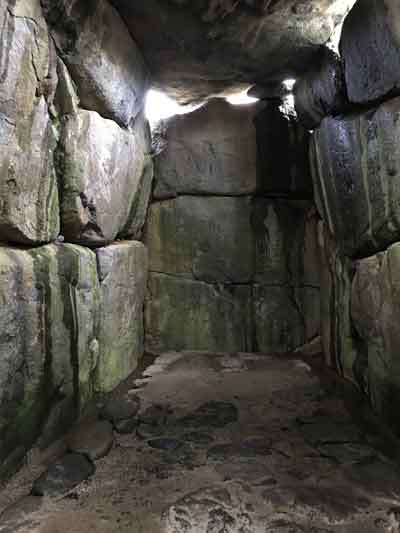
この時代前後の日本での石工技術と言えば飛鳥の石舞台が相当するかと思えます。


この石舞台の創建は蘇我氏の未完成古墳という説があります。
石で組み上げられた玄室というイメージで
この主室を覆いつくすように土で被覆されれば古墳になったけれど、
ある政治的変動があってその工事が中断されたという解説なのですが、
ありそうな話だとは思いますね。
実際にこの内部も入ることができてわたしも実体験できたのですが、
この説に同意できるなぁと強く思わされました。
石工技術と言うよりも、巨石文化の残滓のように思われる。
こまかく石を加工するという意識よりも
土木工事の重要部分として巨石を利用するという社会的志向性。
で、こうした技術は日本ではその後城郭建築へと発展したのだと思います。
巨石を組み上げた石垣ではその巨石を運搬するのに
修羅といわれる大量人力による運搬が使われたことでしょう。
日本では石工技術はそういった方向に発展していって
上の韓国・仏国寺のような細かな石工技術には向かわなかったように思う。

石工というのはそれこそ石器時代からの技術体系のように思うけれど
日本列島に人間が暮らすようになった3万年前、あるいは縄文的定住が始まった
1万数千年前からでは列島には巨木の森が広がっていて
石に比べてはるかに加工しやすい木工技術の方が発展動機が高かったのではないか。
仏像や宗教的造作物でも木彫刻の方がより繊細な表現も可能。
韓国ではこうした繊細な宗教概念を石工で作り、ながく尊崇してきたということが、
ある種、異文化性として強く感じさせられました。

English version⬇

[Silla country masonry technology, 2 treasure towers Horyuji Temple and Bulguksa Temple-5]
By the way, the other day, I saw the contrast between the Tahoto at Bulguksa Temple in Korea and the five-storied pagoda at Horyuji Temple.
In Japan, stone Buddha generally has Jizo, etc.
There are not many important facilities in the temple.
I think there are many wood carving statues.
It is said that the stone Buddha culture did not develop much in Japan.
Well, why? Twice
So, it is said that masonry technology flourished in Korea during the Silla era.
~ Shaka Nyorai preaches the Lotus Sutra, and Tahoto says that Shaka Nyorai’s preaching is the truth.
It expresses the contents of the scripture that the past Buddha’s Prabhutaratna proves.
The monotonous but perfectly balanced beauty of the Shaka Tower and the gorgeous Tahoto decorated with cloisonne
It shows Silla’s excellent masonry technique and was found in the second layer of the Buddha Tower.
Innocent Joko Daidharani Sutra is the oldest woodblock print in the world. Explanation of.

These two masonry treasure towers are believed to date from the founding of Bulguksa Temple around 750.
Speaking of masonry technology in Japan around this time, it seems that Asuka’s stone stage is equivalent.

There is a theory that the construction of this stone stage is an unfinished tumulus of Mr. Soga.
With the image of a stone-built chamber
If it was covered with soil so as to cover this main room, it would have become an old burial mound,
The explanation is that the construction was interrupted due to some political change.
I think it’s a likely story.
I was able to actually enter this inside and I was able to actually experience it,
I strongly felt that I could agree with this theory.
It seems more like a remnant of megalithic culture than a masonry technique.
Rather than the consciousness of processing fine stones
Social orientation to use megaliths as an important part of civil engineering work.
So, I think that these technologies have since evolved into castle architecture in Japan.
To assemble the megaliths To carry the megaliths of the stone wall
It is probably that a large amount of human transportation called Shura was used.
Masonry technology is developing in that direction in Japan
I don’t think I was able to go for the detailed masonry techniques of Bulguksa Temple in South Korea.

I think that masonry is a technical system from the Stone Age.
30,000 years before humans began to live in the Japanese archipelago, or Jomon settlement began
From 10,000 years ago, there was a forest of giant trees on the archipelago.
The woodworking technology, which is much easier to process than stone, may have been more motivated to develop.
Even for Buddhist statues and religious artifacts, wood carving can be used for more delicate expressions.
The fact that Korea has created such a delicate religious concept with masonry and has long revered it.
It made me feel strongly as a kind of cross-culturality.

【切妻妻面の「鼻隠し」巨大化? 法隆寺と仏国寺-4】

霊廟建築の象徴意匠?


仏国寺の殿舎群のなかで意匠的に初めて見たようなのが、こちら。
写真では上矢印をマークしましたが、どうも不明であります。
意匠的にかなり明確な意図を感じさせられるものであり、
注意してみたらほかの韓国国内の旧跡建築では霊廟建築にみる気がします。
2枚目の写真は仏国寺の山門ですが、こちらでもこの意匠が見られる。

機能性として考えると妻面は屋根から基壇まで
壁面がのっぺりと剥き出しになるのでその外壁面の汚損への回避策か。
壁と屋根面の接点の雨水防御性はデリケートではあるので、
それへの重厚な予防作戦であるのでしょうか。
切妻という屋根の掛け方はそれこそ人類普遍的なものだと思いますが、
韓国朝鮮でだけこういった意匠が好まれたのでしょうか。
そして気付いたのは霊廟的目的の建築に多いのにはどういう意味があるのか。
直接関係があるかどうか不明だけれど、
韓国では「泣き女」というほぼ典型的な社会的役割として
盛大に葬儀でその悲しみを最大化する存在があるとされている。
民族的に独特な鎮魂への感受性があるのだと思うけれど、
そういったコンテキストが社会的に存在している可能性も感じられる。

建築意匠としては屋根面から一定の高さで楕円状に切りそろえられている。
屋根頂部からちょうど扇を開いたようなフォルム。
外形的には反対側の壁面にも左右同一で仕上げられている。
殿舎には羅漢殿という建築名称の掲額がある。
羅漢とは悟りを開いた高僧のこと。
サンスクリットのアルハンの音訳を阿羅漢として略称にしたものが羅漢です。
釈迦の直弟子のうちでも位の高いものは阿羅漢で弟子の中でも最高の階位。
羅漢とは煩悩をすべてなくした人のことで、小乗の悟りを得た聖者のこと。
また大乗仏教では小乗の修行者という意味で否定的に使うこともある。
・・・というようなことですが、一般的仏教名称。
この意味合いと建築意匠との連関性は不明であります。
もし読者の方で情報をお持ちの方は教えてください、よろしくお願いします。
う〜む、気になってよく眠れない・・・。
切妻とか建築専門用語の英訳、難しいので翻訳はありません、悪しからず。

【伽藍配置の決定思想って? 法隆寺と仏国寺-3】

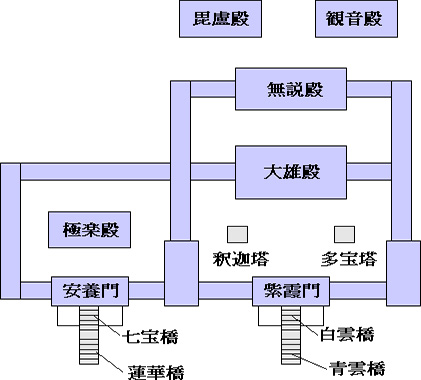
法隆寺西院伽藍配置図

仏国寺伽藍配置図

法隆寺と150年ほど遅れて創建の韓国仏国寺の建築文化比較検証シリーズ。
いまから1400年ほど前の法隆寺建築ですが、訪れるといまでも
訪れる者に畏敬の念を抱かせる名建築であることが伝わってきます。
現代でこそ木造建築はごく普通の建築だけれど、
このころの国家事業としての木造建築、しかも五重塔のような多層階まで実現する
技術の粋を凝らした最先端建築であったことが伝わってくる。
庶民は竪穴住居に暮らし、屋根は土屋根・茅葺きが一般的な時代。
もちろん床上げもしていなくて土座の暮らし方だった。そういう状況の中で
基礎も石場立てで長期的耐久性を考慮し、屋根には瓦が葺かれていた。
なによりこの世に涅槃の境地を現出させるという象徴性・コンセプト建築。
五重塔ははるかな未来ランドマークとして見られていたでしょう。
パリのエッフェル塔並みのシンボルとして社会の支配的イデオロギーを表現していた。
「こういう権力であれば受け入れるべきだな」と思わせる威信があった。
古代統一国家として律令制とともに仏教寺院を建立し鎮護国家思想を普及するという
2つの国策は今日の「資本主義と民主主義」と同等の普遍的価値観だったのでしょう。
世界最先端の仏教寺院としてこの法隆寺を建設し、
さらに奈良東大寺をも建立させて統一国家の正統性を表現していった。
過酷な収税と引き換えに思想的正統性を植え付けていったのでしょう。
「このようにありがたい趣旨であるので喜んで税を納めよ」
創建時の仏国寺も新羅国家の同様の目的的建築だったといえる。

さて建築として考えると興味深いのはその「配置構成」。
土塀などで結界を構成してその内部で地上での黄金空間を志向し
そこにいろいろな宗教上のコンセプト建築を配置していっている。
いわゆる「伽藍配置」というものであります。
この配置についての各寺院毎の思想的変化にオモシロさを感じる。
こういう全体としての空間構成という概念はいったいどうやって形成されたのか。
まぁ基本的には仏教の理想世界への考え方なのでしょうが、さて。
あるいは東アジア的な地割り・建築決定論、風水的なものだったのだろうか?
権力は古代以来、王権空間とは別にこのような空間を作っていたという。
日本古代の古墳とは仏教のような世界宗教が受容される以前、
王権の正統性を示す宗教的権威性を訴求するものだったという説が強い。
仏教寺院が日本社会に導入されて以降、神社が建築空間としてのありようを
変えていったことと強く関係しているように思われる。
古墳が徐々に姿を消していったことと、法隆寺のような仏教寺院が
多数建築されていったことには同時平行性が強い。
現世権力は常にこうした正統性を顕示する宗教的空間を持っている。

English version⬇

[What is the deciding idea of ​​the cathedral arrangement? Horyuji Temple and Buddhist Temple-3]
A series of architectural and cultural comparison verifications of Korean Bulguksa Temple, which was built about 150 years later than Horyuji Temple.
It was built at Horyuji Temple about 1400 years ago, but even now when I visit it.
You can see that it is a famous building that makes visitors feel awe.
Wooden architecture is very ordinary in modern times, but
A wooden building as a national project around this time, and even a multi-story floor like a five-storied pagoda
You can see that it was a state-of-the-art architecture with elaborate technology.
The common people lived in pit-houses, and the roofs were generally earthen roofs and thatched roofs.
Of course, I didn’t raise the floor and it was a way of living in Tsuchiza. In such a situation
The foundation was also a stone yard, and the roof was tiled for long-term durability.
Above all, the symbolic and concept architecture that reveals the state of Nirvana in this world.
The five-storied pagoda would have been seen as a landmark of the far future.
It expressed the dominant ideology of society as a symbol of the Eiffel Tower in Paris.
There was prestige that made me think, “If you have this kind of power, you should accept it.”
It is said that a Buddhist temple will be built along with the decree system as an ancient unified nation and the idea of ​​a nation of protection will be disseminated.
The two national policies would have been the same universal values ​​as today’s “capitalism and democracy.”
Built this Horyuji temple as the world’s most advanced Buddhist temple,
In addition, Nara Todaiji Temple was built to express the legitimacy of a unified nation.
Perhaps they planted ideological legitimacy in exchange for harsh tax collection.
“I am grateful for this, so please pay the tax.”
It can be said that Bulguksa Temple at the time of its construction was a similar purposeful building of the Silla nation.

What is interesting when considering architecture is its “arrangement and composition”.
A barrier is formed with an earthen wall, and inside it, the golden space on the ground is aimed at.
Various religious concept architectures are arranged there.
This is the so-called “cathedral arrangement”.
I feel that the ideological changes of each temple regarding this arrangement are interesting.
How was this concept of spatial composition as a whole formed?
Well, it’s basically a way of thinking about the ideal world of Buddhism, but by the way.
Or was it East Asian land allocation / architectural determinism, feng shui?

It is said that power has created such a space separately from the kingship space since ancient times.
The ancient Japanese burial mound was before the acceptance of world religions such as Buddhism.
There is a strong theory that it was an appeal for religious authority that shows the legitimacy of the kingship.
Since the introduction of Buddhist temples into Japanese society, the shrine should be an architectural space
It seems to be strongly related to what has changed.
The tumulus gradually disappeared, and Buddhist temples like Horyuji Temple
Simultaneous parallelism is strong in the fact that many were built.
This world power always has a religious space that reveals this legitimacy.

【石造多宝塔と木造五重塔 法隆寺と仏国寺-2】


寺院建築って修学旅行で法隆寺とか見学するけれど、
ああいうのは鎮護国家思想以来の日本教育の定番なのでしょうか。
まぁ若いときには夜の枕投げが楽しみ(笑)で、見学時はほぼボーッとしている。
建築教育的にはたいへんもったいない極みだと思うのですが、
それでも若いときに上の空でも訪問体験を持つというのはなにがしか、
リスペクトできる民族文化を体験するという意味でいいことですね。

たまたま法隆寺と同時代の韓国の対照的な仏国寺も体験して
両方に共通するもの、そうでないものを見る機会を得て興味が深まった。
東アジア世界での仏教思想の拡散という事態は、
今日で言えば資本主義と民主主義みたいに律令主義とワンセットだったと思える。
この時代での最先端の「国際主義」の象徴であり、
だからこそ奈良東大寺大仏開眼会には遠くインドからも国際使節団が来朝した。
韓国社会からも新羅の王子を首席とする祝賀訪問があった。
日本ではこの鎮護国家思想は同時に統一国家体制の確立でもあった。
鍍金された黄金仏の様子が後代のマルコポーロ・東方見聞録に記事反映され
ヨーロッパ世界の大航海時代突入を導いたともいえる。
法隆寺は創建からながく日本社会の精神的基軸として人々の拠り所となったが、
一方で韓国仏国寺ではそのようではなく廃寺状態が永かったとされる。
韓国・朝鮮では大陸国家中国と陸続きの半島国家なので、
政治争乱で仏教はそのときどきの独裁国家から迫害されることも多く、
その情勢変化に敏感に反応せざるを得ずに迷走があったのでしょう。
むしろ仏教よりも儒教の方が「国教」ともいえる存在だった。
日本における法隆寺のような国家社会的なシンボル性は持ち得なかった。
世界的にはこの二つの寺院建築は世界遺産とされているけれど、
国民統合のひとつの象徴とまでされてきた法隆寺の独自性が際だつ。

仏教の教えにおける「塔」というものの役割について
この仏国寺多宝塔と、法隆寺五重塔は意味合いとしては似ているそうです。
寺院建築の「伽藍配置」にとって決定的な意味合いを持っていたことはわかる。
キリスト教世界での十字架を乗せた塔と似た象徴性がある。
五重塔に対してほかの建築群とは隔絶した象徴性を日本人は感じている。
仏国寺の石造りの多宝塔も創建時以来、焼失などの危機からも生き延びている。
きわめて重要な国宝とされてきています。
日本社会ではこうした建築が木造で建てられたことで、
大工技術職の永続的な存続が可能になってきたとも言われる。
各地の寺院でのお抱え大工職・宮大工の地位について
歴世、裁判にまでなっている事実があるのですね。
大工技術職というのは大組織化は難しいものであって基本は徒弟的伝承。
だから不安定なその時々の建築需要対応だけでは永続が難しかったのでしょう。
宮大工職が技術伝承にとっても貴重だったのだとわかります。
韓国・朝鮮で仏教寺院が社会的にも衰退を繰り返したと言うことから
木造建築技術伝承も危機にさらされてきたということなのでしょう。

English version⬇

[Stone Tahoto and Wooden Five-storied Pagoda Horyuji Temple and Bulguksa Temple-2]
I visit Horyuji Temple on a school trip for temple architecture,
Is that the standard of Japanese education since the chingo kokka idea?
Well, when I was young, I was looking forward to throwing pillow fights at night (laughs), and when I visited, I was almost dumb.
I think it’s a great waste in terms of architectural education,
Still, it ’s kind of like having a visit experience even in the sky when you ’re young.
It’s good in terms of experiencing a respectable ethnic culture.

I happened to experience the contrasting Bulguksa temple in Korea, which was the same period as Horyuji.
I got the opportunity to see what is common to both and what is not, and I became more interested in it.
The spread of Buddhist thought in the East Asian world
Today, I think it was a set with ritualism like capitalism and democracy.
It is a symbol of cutting-edge “internationalism” in this era,
That is why an international delegation from India came to the morning at the Todaiji Daibutsu Opening Party in Nara.
There was also a celebration visit from Korean society with the Prince of Silla as the chief.
In Japan, this idea of ​​a state of protection was also the establishment of a unified national system.
The appearance of the plated golden Buddha is reflected in the article of the later Marco Polo, The Travels of Marco Polo.
It can be said that it led to the entry into the Age of Discovery in the European world.
Horyuji Temple has been a base for people as a spiritual axis of Japanese society since its foundation.
On the other hand, at Bulguksa Temple in Korea, it is said that the temple was abandoned for a long time.
In South Korea, it is a peninsula nation connected to the continental nation China, so
Buddhism is often persecuted by dictatorships from time to time due to political conflicts,
Perhaps there was a stray because he had to react sensitively to the changes in the situation.
Rather, Confucianism was more of a “state religion” than Buddhism.
It could not have the national social symbolism of Horyuji Temple in Japan.
Although these two temple buildings are regarded as World Heritage Sites worldwide,
The uniqueness of Horyuji Temple, which has been regarded as a symbol of national integration, stands out.

About the role of the “tower” in Buddhist teaching
The Bulguksa Temple Tahoto and the Horyuji Five-storied Pagoda are similar in meaning.
It can be seen that it had a decisive meaning for the “cathedral arrangement” of temple architecture.
It has a symbolism similar to that of a tower with a cross in Christendom.
The Japanese feel that the five-storied pagoda is a symbol that is isolated from other buildings.
The stone Tahoto of Bulguksa Temple has survived the crisis such as burning since its foundation.
It has been regarded as an extremely important national treasure.
In Japanese society, these buildings were built with wooden structures,
It is also said that the permanent survival of carpentry engineers has become possible.
About the status of carpenters and palace carpenters in various temples
There is a fact that it has been tried in the past.
It is difficult for a carpenter to organize a large organization, and the basics are apprenticeship.
Therefore, it would have been difficult to perpetuate just by responding to the unstable construction demand at that time.
You can see that the Miya carpenter was also valuable for the transfer of technology.
From the fact that Buddhist temples have repeatedly declined socially in South Korea
It seems that the tradition of wooden construction technology has also been in jeopardy.

【法隆寺と韓国・仏国寺の木組み】


東アジアの建築の比較検討って興味深い。
先般の韓国訪問・安東河回村探訪記シリーズでかなり日韓・日朝の
相似性と相違性をいろいろに考えさせられた次第。
その余韻からまだ抜けきっておりません(笑)。

で、木造建築ということを考えて行くと当然、宗教建築も興味を持つ。
そこで韓国でも最古級の寺院建築「仏国寺」を見た。
いろいろな異国情緒を味わってきたのですが、
木材加工への意識の違いが色濃く感じられてならない。
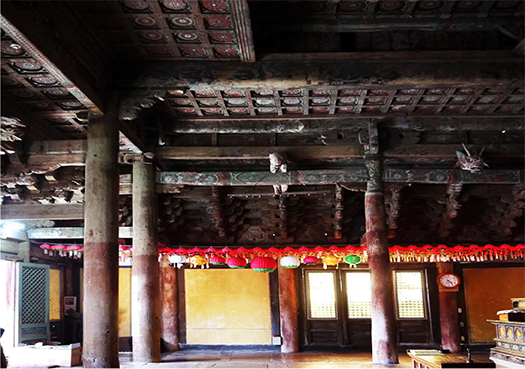
上の写真は仏国寺の「大雄殿」の内観写真です。
韓国の木造建築を見続けてきて、建築素材の「加工」において
自然の樹相そのままの微妙なねじれやソリをそのままにして
樹皮を剥いだそのままに使うという傾向を強く感じる。
もう少し細い構造材でも丸太まんまという使用状況がわかる。
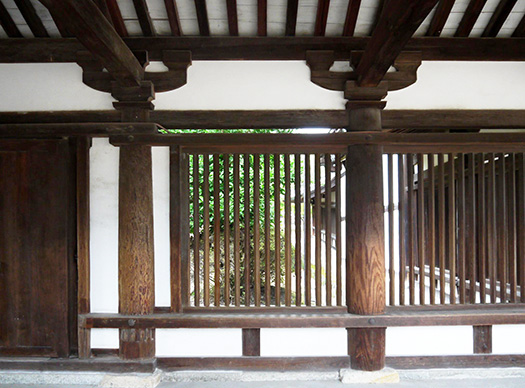
一方下の写真は法隆寺の回廊部分の木組みの写真。
柱には「エンタシス」と呼べる中太りの加工が施されている様子がわかる。
創建年代は法隆寺と仏国寺では150年ほど違いがあって
法隆寺創建は607年とより古いけれど、ディテール完成度がむしろ高いように感じる。
むろん仏国寺は文禄の役の秀吉の朝鮮出兵時の戦争で焼失し
建築はその後の再建であるという事情はあるけれど、
それはむしろより進化した木造技術が付与される方向に働く機縁だと思うけれど、
かえってより始原的な印象が強く感じられる。
このことはどういうことをあらわしているのだろうか。

現地見学時にはそこまで気付きを得ることはできなかったのですが、
そのときの体感印象をベースにして写真データを参照してると
こういった気付きが強くなってきた次第なのです。
現代では韓国の木造軸組建築伝統・韓屋は廃れる一方だったとされるのですが、
この分野でも日韓の微妙な関係からか、交流は不活発のようです。
むしろ中国とは日本の国交省関連団体がほぼ消滅していた木造技術の
復元に技術面で支援を行ってきていたり、
台湾とは民間団体レベルでも現地に残る日本統治時代の在来木造建築を
保守したりあらたに新築住宅として建築が活発化するなどしている。
韓国の木造の状況の研究領域でも日本には断片的に論文もあるけれど、
韓国側での研究成果を確認することはできていません。
想像としては日本よりも森林の生育復元環境では不利な条件下で
薪バイオマスを大量使用するオンドル暖房が森林荒廃を呼び
木材加工技術が社会から失われていった可能性が浮かんでくるように思う。
日本の場合には旺盛な木造建築需要に支えられて
木材の加工技術・木挽き技術が発達して行った様子がわかる。
現場での施工性・作業効率性がより高いと思われる「角材」もしくは
この法隆寺エンタシスのような加工を施した建材を使うようになった。
韓国・朝鮮ではそれなりの味わいの深い、素材そのままではあるけれど、
不揃いの生成り建材は現場で納めるには非常に困難だっただろうと推測できる。
まぁだからそれほど木造技術が発展しなかったとも考えられるのだろうか。
写真を見比べてみて、両国の先人たちの状況を想像させられる次第。

English version⬇

[Wood processing technology of Horyuji Temple and Bulguksa Temple, South Korea]
It is interesting to compare East Asian architecture.
In the recent visit to South Korea and the Andong Hahoe Village Exploration Series, it was quite Japan-Korea and Japan-North Korea.
As soon as I was made to think about similarities and differences.
I haven’t come out of that lingering sound yet (laughs).

So, of course, when I think about wooden architecture, I’m also interested in religious architecture.
There, I saw the oldest temple building in Korea, “Bulguksa Temple”.
I have experienced various exoticisms,
The difference in consciousness about wood processing should not be felt strongly.
The photo above is an inside photo of the “Daioden” at Bulguksa Temple.
Continuing to look at Korean wooden architecture, in the “processing” of building materials
Leave the subtle twists and warps of the natural foliage as it is
I strongly feel the tendency to use the bark as it is.
You can see the usage situation of log manma even with a slightly thinner structural material.
On the other hand, the photo below is a photo of the half-timbered part of the corridor of Horyuji Temple.
You can see that the pillars are processed to be medium-thick, which can be called “entasis”.
There is a difference of about 150 years between Horyuji Temple and Bulguksa Temple.
Horyuji Temple was built in 607, but I feel that the details are rather complete.
Of course, Bulguksa Temple was burnt down in the war when Hideyoshi, who played the role of Bunroku, was dispatched to Korea.
Although there are circumstances in which the architecture is a subsequent reconstruction,
I think it is a mechanism that works in the direction of giving more advanced wooden technology,
On the contrary, it gives a stronger impression of primitiveness.
What does this mean?

I didn’t notice that much when I visited the site,
If you refer to the photo data based on the impression you experienced at that time
This kind of awareness has become stronger.
It is said that the traditional Korean wooden frame architecture, Hanok, has been obsolete in modern times.
Even in this field, exchanges seem to be inactive, probably because of the delicate relationship between Japan and South Korea.
Rather, in China, Japanese Ministry of Land, Infrastructure, Transport and Tourism-related organizations have almost disappeared.
We have provided technical support for restoration,
With Taiwan, the traditional wooden architecture of the Japanese colonial era that remains in the field even at the level of private organizations
It is being maintained and new construction is becoming more active as a new house.
Even in the area of ​​research on the situation of wooden structures in South Korea, there are fragmentary papers in Japan,
We have not been able to confirm the research results on the Korean side.
Imagine that under conditions that are more unfavorable in a forest growth restoration environment than in Japan.
Ondol heating, which uses a large amount of firewood biomass, calls for forest devastation
I think it is possible that wood processing technology has been lost from society.
In the case of Japan, supported by strong demand for wooden buildings
You can see how the wood processing technology and wood grinding technology have developed.
Square lumber that seems to have higher workability and work efficiency on site
I came to use building materials that had been processed like this Horyuji entasis.
In South Korea, the ingredients have a deep taste, but the ingredients are the same.
It can be inferred that uneven building materials would have been extremely difficult to deliver to the site.
Well, is it possible that the wooden technology did not develop so much?
As soon as you can compare the photos and imagine the situation of the ancestors.

【テレワーク「書院」か? 先人の知的生産スペース】


みなさんはテレワークでの自宅での仕事環境、どう構築してますか?
わたしの場合は、職住一体での事務所環境なので、
今回の行動抑制局面もそれまでからの連続ではあるのですが、
たぶん多くのみなさんは「え、自宅で働くの?」と戸惑いもあったでしょう。
現代のオフィス環境条件というのは立地がまずは検討されて
それぞれの企業活動にとって最適な、あるいはそれにほぼ近い環境が選択され
生産のための人員確保、かれらの労働生産性の最適化が
企業経営者の合理的判断でしつらえられることが一般的だった。
それがやむを得ざる理由から、テレワークが推進されその条件が大変革した。
企業側にとって社員スタッフの住環境もそこはかとなく考える必要に迫られる。

仕事自体はパソコンで可能な職種と、そうでない職種に分かれるけれど、
まぁわたしどものような職種、情報製造業においては、
もう20-30年近くDTP化というパソコン+サーバ+通信環境が定着していた。
なので、パソコンの種類を一部スタッフについてデスクトップからノートに
機種変更させるということはありましたが、
仕事の流れ自体はテレワークには比較的スムーズに対応できている。
毎朝、Zoom会議でその日のToDo確認事項を全スタッフで確認し合って、
意思統一して各自の環境で仕事を進めるというスタイル。
このように変化してくると、各自の自宅環境について応相談ケースもある。
まぁ通信環境の整備と事務所側での通信環境更新はすぐに行った。
そこから先は各自の自宅環境のことになってくるので
個人の自由の領域になるため機能面に局限される。
しかし、住宅メディア人としてはこういう新たな社会ニーズでの
住環境変化について強い興味を持つようになります。

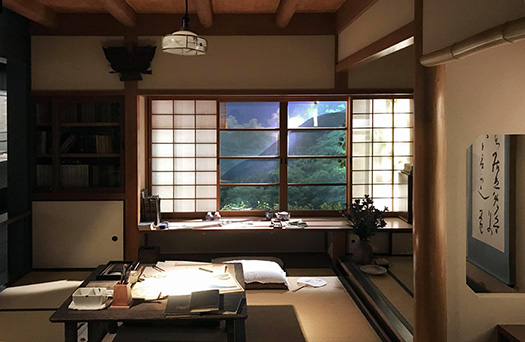
写真は民俗学者・折口信夫先生の和室書斎環境再現であります。
氏が勤務されていた國學院大學の一般公開スペースで展示されています。
先生は明治・大正・昭和と活躍されましたが、主にこの場所が
「知的生産活動」の拠点として使われていた、
イマドキで言えば「テレワーク」環境の先行事例ということになります。
このような造作仕様を書院と呼べる。室町から近世初頭に成立した様式。
寝殿を中心とした寝殿造に対して、書院を建物の中心にした住宅形式のことで、
書院は書斎を兼ねた居間の中国風呼称。和風住宅は書院造の強い影響を受ける。
ちなみに中国や朝鮮では科挙制度が深く根付いた社会なので
「書院」は地域での受験のための学校という側面が強かった。
日本は書院はあくまでも個人の思索的生活空間という発達を見せた。
機能面から見ると、書物を見るための大きな採光空間がまず確保されている。
その窓に向かって書見台としての平面が用意され座布団で座っている。
振り返って背面側には座テーブルが置かれて多目的利用が図られている。
日常食事の用に使われたり、接客もあったかも知れないし、作業も行われた。
一方、右側には段違いの床の間があり椅子のように機能したかも知れないが、
知的生産活動のための物品の一時置き場だったりした。
またいわゆる「座右の銘」として掛け軸が掛けられ精神を鼓舞していた。

書見台の先の障子窓からははるかな遠景が眺望されて
目の疲れを癒す装置として活用されていたと想像するに難くない。
全体スペースとしては床の間別で6畳程度かと。左手には書庫も造作。
こういう空間で家人との視線を襖などで遮断させれば知的生産活動は
非常に生産効率が高かったように思われる。
今日的なテレワーク・パソコン仕事環境としてもなかなか秀逸。
多くの先人が考えてきたスペース合理性が伝わってくる気がします。

English version⬇

[Telework “Shoin”? Intellectual production space of ancestors]
How do you build your teleworking home work environment?
In my case, it’s an office environment where work and residence are integrated, so
This behavioral restraint phase has been continuous since then,
Perhaps many of you were confused as to, “Well, do you work at home?”
As for the modern office environment conditions, the location is first considered.
An environment that is optimal or close to that for each corporate activity is selected.
Securing personnel for production, optimizing their labor productivity
It was common for business owners to make reasonable judgments.
For unavoidable reasons, telework was promoted and the conditions changed drastically.
For companies, it is necessary to think about the living environment of employee staff.

The work itself is divided into occupations that can be done with a personal computer and occupations that are not,
Well, in occupations like ours, in the information manufacturing industry,
For almost 20-30 years, the personal computer + server + communication environment of DTP has been established.
So, change the type of computer from desktop to notebook for some staff
I had to change the model, but
The work flow itself is relatively smooth for teleworking.
Every morning, at the Zoom meeting, all the staff confirm the ToDo confirmation items of the day,
A style of unifying the intentions and working in each environment.
When it changes in this way, there are cases where each person consults about their home environment.
Well, the communication environment was improved and the communication environment was updated immediately on the office side.
From that point on, it will be your own home environment.
Since it is an area of ​​personal freedom, it is limited to functional aspects.
However, as a housing media person, it is in response to these new social needs.
You will become very interested in changes in the living environment.

The photo is a reproduction of the Japanese-style study environment of folklore scholar Shinobu Orikuchi.
It is exhibited in the open space of Kokugakuin University where he worked.
The teacher was active in the Meiji, Taisho, and Showa eras, but this place is mainly
It was used as a base for “intellectual production activities”
In Imadoki, it is a precedent for a “telework” environment.
Such a structure specification can be called a Shoin. A style established from Muromachi in the early modern period.
In contrast to Shinden-zukuri, which is centered around Shinden-zukuri, it is a residential style with the Shoin as the center of the building.
Shoin is a Chinese-style name for a living room that doubles as a study. Japanese-style houses are strongly influenced by Shoin-zukuri.
By the way, in China and Korea, the examination system is deeply rooted.
“Shoin” had a strong aspect of being a school for taking exams in the area.
In Japan, the Shoin has developed as an individual’s speculative living space.
From a functional point of view, a large lighting space for viewing books is first secured.
A flat surface as a lectern is prepared toward the window, and he sits on a cushion.
Looking back, a sitting table is placed on the back side for multipurpose use.
It may have been used for daily meals, there may have been customer service, and work was done.
On the other hand, there is a tokonoma on the right side, which may have functioned like a kind of chair,
It was also a temporary storage place for goods for intellectual production activities.
In addition, a hanging scroll was hung as a so-called “Zaemon inscription” to inspire the spirit.
A distant view can be seen from the shoji window at the end of the lectern.
It is not difficult to imagine that it was used as a device to heal eyestrain.
The total space is about 6 tatami mats, separated by alcove. The library is also on the left.
Intellectual production activities can be achieved by blocking the line of sight with the family members with sliding doors in such a space.
It seems that the production efficiency was very high.
It is quite excellent as a modern telework / computer work environment.
I feel that the space rationality that many ancestors have thought about is conveyed.

【日本人の仮想現実・ファンタジーへの態度】


昨日Zoomなどでのコミュニケーションのことを書いたら
読者の方から「ひょっとして相方はAIだったりして」みたいな投書をいただいた。
そういった仮想現実的発展が今後進んでいく可能性は高いと思います。
テクノロジーの進化としては通信とWEBという方向が顕著なので、
いわゆるヴァーチャル化が目指されるひとつの大きな流れでしょう。
そういうときに民族による「受容性」を考えてみると
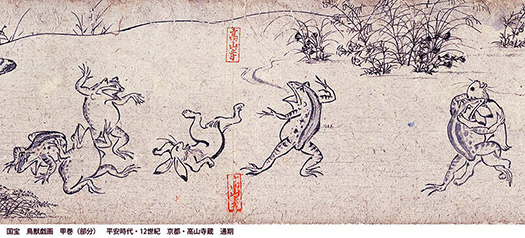
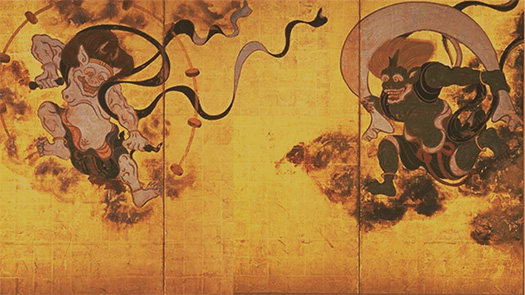
上のような鳥獣戯画とか、風神雷神図の日本人の仮想現実対応力を思い浮かべた。

どちらもわたしの大好きな至極の芸術作品。
世界中の絵画を見渡してみても、ここまで突き抜けた世界の表現は
日本人の感受性の中に特徴的なものなのだと思います。
鳥獣戯画はいまから800年前ころ、源平争乱時期の作品と言われます。
一方の風神雷神図は江戸時代初期、いまから約400年前の作品。
前者は高山寺の縁起をあらわしたもので純粋のファンタジー。
風神雷神図は菅原道真の怨霊の祟りと受け取られた皇居宮殿落雷事件が題材。
それをこちらも寺院からの依頼で俵屋宗達が描き上げた。
後の世になって尾形光琳が激しく刺激されてまったくコピーのように描いた。
皇居宮殿への落雷事件というもののインパクトから
雷神の存在がリアリティを得て表現者たちの感性を激しく刺激したのでしょう。
落雷当時の絵にも雷神が描かれているので、
それが一種の符号のように伝承されてきた事柄なのでしょう。
日本の天皇権力は古代からの「神聖」性を大切にしてきた権力なので
こういったファンタジー性が根深く刻印もされているのでしょう。
国産みの神話群や、天孫降臨、神武東征神話など
事実性よりも神話的象徴性に強いアイデンティティを持っている。
同時に日本人の感受性の中にそれを素直に受け入れる部分が強いことを表わす。
日本史ではこういう古代王権がながく存続してきた理由があるのだと思う。
人間社会に必要な秩序感覚とか、倫理観などの基礎部分で
欧米が基本にしているキリスト教信仰に十分に対置できる存在。
そしてけっして排他的とは言えないので欧米も物珍しそうに受容可能。
この独特の日本的精神性にこれら絵画群の根拠もあるように思う。

いま時代はヴァーチャルな部分に次代の可能性が見えている。
現在の行動抑制強制力の強い社会でこの傾向は加速しつつある。
そういう時代にあってファンタジー許容力のようなものが
次の主導的な文化基盤になっていくのではないだろうか。
そんな妄想を抱き続けてきております。

English version⬇

[Japanese attitude toward virtual reality and fantasy]
If I wrote about communication on Zoom etc. yesterday
I received a letter to the editor from a reader, such as “Maybe my partner is AI.”
I think there is a high possibility that such virtual reality development will progress in the future.
As the evolution of technology, the direction of communication and WEB is remarkable, so
It will be one big trend aiming for so-called virtualization.
At that time, if you think about “acceptability” by ethnic groups
I thought of the above bird and beast caricatures and the Japanese virtual reality responsiveness of the wind god and thunder god.

Both are my favorite works of art.
Even if you look around the paintings around the world, the expression of the world that has penetrated so far is
I think it is characteristic of the sensitivity of Japanese people.
Choju-Giga is said to be a work during the Genpei War, about 800 years ago.
On the other hand, Fujin Raijinzu is a work from the early Edo period, about 400 years ago.
The former is a pure fantasy that represents the auspices of Kosanji Temple.
The theme of the wind god and thunder god folding screen is the lightning strike at the Imperial Palace, which was perceived as the curse of Sugawara no Michizane.
This was also drawn by Tawaraya Sotatsu at the request of the temple.
In later life, Korin Ogata was violently stimulated and drew like a copy.
From the impact of a lightning strike on the Imperial Palace
The existence of the god of thunder may have gained reality and stimulated the sensibilities of the artists.
Since the god of thunder is also drawn in the picture at the time of the lightning strike,
It must be something that has been handed down like a kind of sign.
Because the emperor’s power in Japan has been a power that has valued “sacredness” since ancient times
Perhaps this kind of fantasy is deeply engraved.
Domestic myths, Tenson Korin, Jinmu’s Eastern Conquest myths, etc.
He has a stronger identity in mythical symbolism than in factuality.
At the same time, it shows that there is a strong part of the Japanese sensitivity that accepts it obediently.
I think there is a reason why such ancient kingship has survived for a long time in Japanese history.
In the basic part such as the sense of order necessary for human society and ethics
Existence that can sufficiently oppose the Christian faith that is the basis of the West.
And since it can never be said to be exclusive, it can be accepted in Europe and the United States as if it were unusual.
I think that this unique Japanese spirituality is also the basis for these paintings.

In this era, the possibility of the next generation can be seen in the virtual part.
This tendency is accelerating in today’s society with strong behavioral restraint coercion.
In such an era, something like fantasy tolerance
I think it will become the next leading cultural foundation.
I continue to have such a delusion.

【Zoom普及での人間コミュニケーション進化の未来】


きのうははじめて会う方といきなりのZoom面談。
いつもはまったく初めての方というのはレアケースで
そういう場合はどうしても心底がわからない怖さがあって、
踏み込んだ話し方ができないうらみがあり警戒心が強く働いてしまう。
すでに人間関係ができている関係についてはオンライン面談は便利だけれど、
「腹を割って」の話合いというのが難しい。
ところがきのうの面談ではかなり手応えを感じられた。

感覚的には実際の面談では、握手をしてから話し合いする、
日本人同士では握手習慣がなくても実質的な「握手」感覚がある。
それはなにかと言われてもよくわからないけれど、
やはり「雰囲気を和らげる」というコミュニケーション能力を
それぞれの人なりに磨き上げてきている部分があって、
その雰囲気というのはやはり実際に会って話さなければ伝わらないのでしょう。
言ってみれば「人間への興味」みたいな部分であって
用件を話している以上に、人間的対話というのがはるかに面白いのでしょう。
話が済んだあと興が乗って、「このあと一杯いかがですか」
というようなくだけた人間同士の付き合いに進むという興味部分でしょうか。
こういう「対面」のコミュニケーションでの優れたポイントを
ふつうに実現させられるか、Zoom面談という環境でそれが実現できるか。
今回の事態で、どうも対面コミュニケーションの中身、特異性を
分析し、解明して行く必要性が高まってきているのではないか。
この特異な状況が徐々に沈静化していってリアルな対面環境が戻って来たとき
逆にZoom面談の方がやりやすい部分というのも育ってきて
人間のコミュニケーション能力がより磨き上げられていくのだろうか。
そんな気付きを得られたように思っています。

コミュニケーションを仕事にしているワケですが、
人間同士の多様な対話というものをさらに進化させる機会が
今回の事態の前向きな意味合いなのかとも思えるようになってきた。
まだ「手探り」段階のことがらですが、
社会の次の発展にとって非常に重要なポイントだと思われます。
経済成長戦略の大きな要素になっていく可能性も高いのではないでしょうか?

English version⬇

[Future of human communication evolution with the spread of Zoom]
Yesterday I had a sudden Zoom interview with someone I met for the first time.
It ’s a rare case that you ’re always the first person.
In such a case, there is a fear that I can not understand the bottom of my heart.
There is an envy that he cannot speak in depth, and he is very cautious.
Online interviews are useful for relationships that already have relationships,
It’s difficult to talk about “breaking your stomach”.
However, at the interview yesterday, I felt a good response.

In the actual interview, sensuously, shake hands before discussing.
Even if Japanese people do not have a handshake habit, they have a substantial “handshake” feeling.
I’m not sure what it is, but
After all, the communication ability to “soften the atmosphere”
There is a part that each person has been refining,
The atmosphere will not be conveyed unless you actually meet and talk.
It ’s a part like “interest in humans”
Human dialogue is far more interesting than talking about business.
After the talk was over, he got on board and said, “How about a drink after this?”
Is it the part of interest that goes on to interact with other human beings?
Excellent points in such “face-to-face” communication
Can it be achieved normally, or can it be achieved in the environment of a Zoom interview?
In this situation, the content and peculiarity of face-to-face communication
I think there is an increasing need to analyze and elucidate.
When this peculiar situation gradually subsides and the real face-to-face environment returns
On the contrary, the part where Zoom interview is easier to do has also grown up.
Will human communication skills be further refined?
I think I got that kind of awareness.

I’m working on communication, but
Opportunity to further evolve the diverse dialogue between humans
I have come to think that it is a positive meaning of this situation.
It’s still in the “groping” stage,
It seems to be a very important point for the next development of society.
Isn’t it likely that it will become a major element of economic growth strategy?