本文へジャンプ

【継手仕口の進化・吉野ヶ里高層建築/日本のいい家㊳-2】


1万数千年続いた縄文時代は定住という人類生存形式、社会の形成と
画期的な時代だったと言えるのだと思います。
日本列島に渡ってきた現生人類は海を超えるのに木を伐採利用した船を使った。
四周を海で囲まれた列島の環境に適合した狩猟採集が漁業生業をもたらした。
食料獲得手段としては海生動物の採取、漁業が基本的な生業社会。
それまでの陸生動物主体の狩猟生活の場合でも一定の居住エリア認識はあったが、
獲物の移動にあわせてキャンプや洞窟などを転々としたのでしょう。
そういった暮らし方と対比すると船を使って海上を移動する、
陸生動物よりも「定置的」な海生動物漁業採取が生業化したことで、
主に海岸線地域竪穴住居暮らしが始まった。
そこでの実際の人間行動、定住の実態はどうだったか非常に興味深い。
というのは、生業の欠かせないツールとして船を使ったという点です。
定住というライフスタイルと移動の快適性が同時に獲得できたのだと思うのです。
大工の起源が船大工が先行し、家大工は定住後発生したとされる。
木工技術は船の造作が先で、そこでの蓄積技術が定住の建築に活かされた。
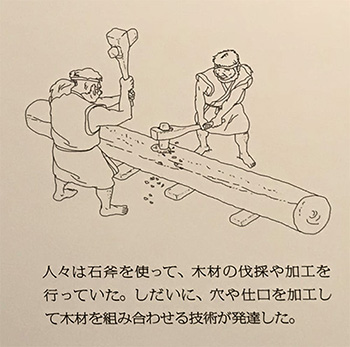
建築道具の上では前時代の石器時代に開発された石斧が主役だった。
現生人類がそれまでの先行の人類に対して優越していたのは、
この石器開発が飛躍的に発展したから、と言われるのが最近の説。
より鋭利であったり、有用性に即している素材開発が進んでいたのだと言われる。
世界的な生存競争が熾烈に繰り広げられていたのでしょう。
現生人類が他の人類との生存競争を勝ち抜く基本的生存戦略だったともいえる。
そう考えると木を伐採して建築架構することは人類レベルで決定的素因だったのかも。
石斧の発展によって船大工の技術レベルが革新されていったことで、
人類の世界全域への拡大が図られていった。
世界制覇した稀有な存在になれたのは、木を利用できる人類知が決定的だったか。

そういう縄文期を経て次にこの列島で革命が起こったのは、
やはり農耕定住と鉄器利用ということになる。
縄文はたしかに「定住革命」ではあったけれど、
ひとびとの生業は漁業であり、船による移動というライフスタイルが基本。
活発な列島社会内交流痕跡は多数発見される。かなり流動性の強い社会。
船による移動が石器時代以来の「伝統的」生き方だったのではないか。
農耕社会のような「一所懸命」型ではないのが生活伝統だったと思える。
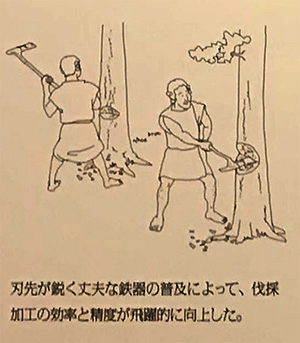
それに対して弥生時代は石斧段階からより鋭利な鉄器利用が普及していった。
石斧段階とは利用可能な樹種が大きく変化しあらゆる樹種に拡張したとされる。
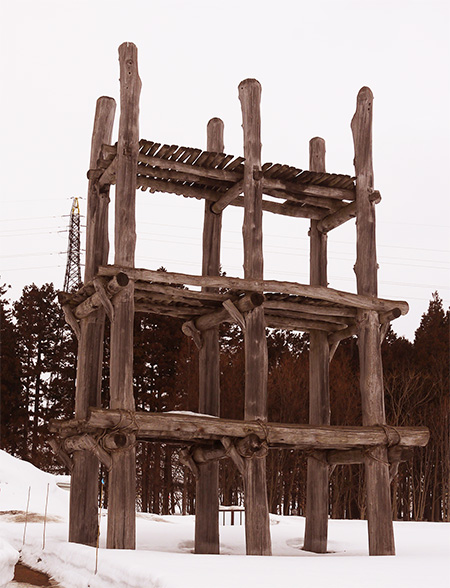
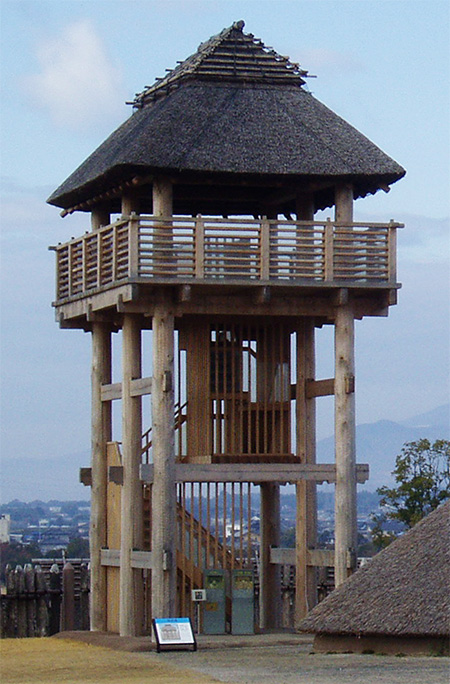
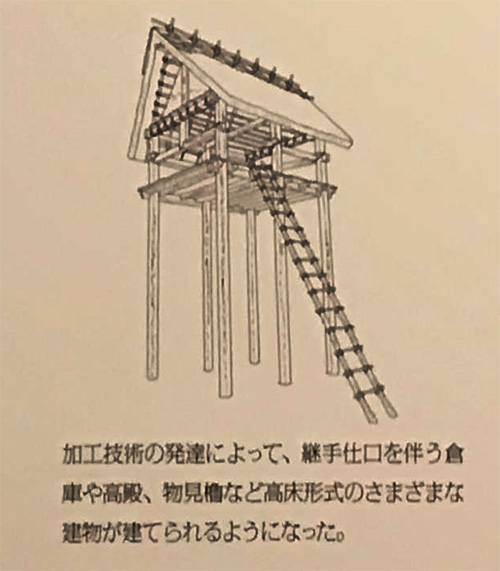
写真は吉野ヶ里の高層建築ですが、きのう見た縄文の木組みと違って
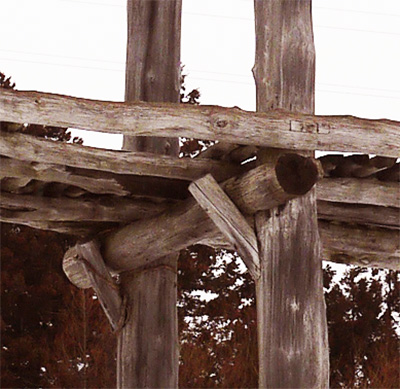
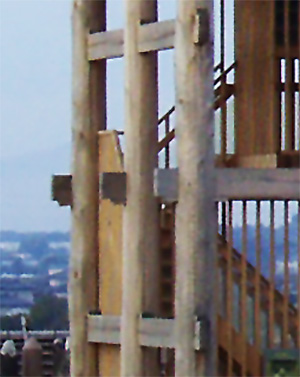
木材同志を相互に貫通させる技術が飛躍的に高まっている。継ぎ手仕口という
加工技術が本格的に始まってきている様子がわかるけれど、
その道具的進化が鉄器利用の拡大によって実現したとわかるのです。
吉野ヶ里遺跡では鉄を加工する専門の工房が集落の権力者のもとにあったという。
そういう権力者が鉄器の農器具も管理していたといわれる。
石斧に比べて道具としての有用性・合理性が異次元的に拡張された。
被支配層は集団的営農にもっぱら専念し「一所懸命」ライフスタイルに移行した。
鉄器は建築を高度化させたと同時に支配—被支配の社会関係を生み
同時に集落間での争闘、クニ同士の争い、戦争も常態化したと言われる。
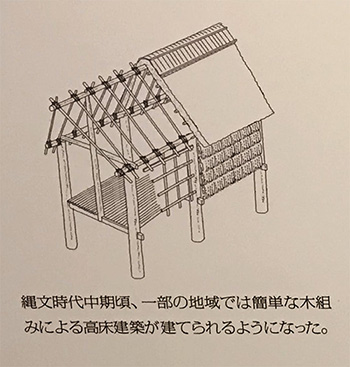
吉野ヶ里では高床式の権力者建築も登場した展示が明示されている。
卑弥呼のような存在に対して拝跪するマネキン展示まであるのですね。

進化は同時に社会の格差を拡大する原動力にもなっていったのか。
しかしその結果として共同体の拡大、人口増加も進んでいった。
人類進化、技術発展の原動力があくなき人間の欲望であることも間違いないのでしょう。

English version⬇

[Wooden evolution process, Yoshinogari skyscraper / Japanese good house ㊳-2]
In the Jomon period, which lasted for more than 10,000 years, the form of human survival, the formation of society, was settled.
I think it was an epoch-making era.
The modern humans who came to the Japanese archipelago naturally used a ship that cut down trees to cross the sea.
The environment-friendly hunter-gatherer of the archipelago, which is surrounded by the sea on all four sides, has brought about a livelihood of fishing.
As a means of obtaining food, the basic livelihood society is the collection of marine animals and fishing.
Even in the case of terrestrial animal-based hunting until then, there was a certain recognition of the living area, but
Perhaps they moved around camps and caves as their prey moved.
In contrast to such a way of living, while traveling on the sea using a ship,
With the commercialization of marine animal fishing, which is more “stationary” than terrestrial animals,
It mainly means that the pit-house living in the coastline area has begun.
It is very interesting how the actual human behavior and the actual situation of settlement were.
That is, I used the ship as an indispensable tool for my livelihood.
I think I was able to acquire the lifestyle of settling and the comfort of traveling at the same time.
It is said that the origin of the carpenter was the ship carpenter, and the house carpenter occurred after the settlement.
As for woodworking technology, ship construction came first, and the accumulated technology there was utilized in the construction of settlement.
On the building tools, the stone ax developed in the Stone Age of the previous era was the leading role.
It was the fact that modern humans were superior to the previous humans.
The recent theory is that it is said that this stone tool development has developed dramatically.
It is said that the development of materials that are sharper and more useful is in progress.
The global competition for survival would have been fierce.
It can be said that modern human beings were the basic survival strategy to win the survival competition with other human beings.
Given that, cutting down trees and building structures may have been a decisive factor at the human level.
The development of the stone ax has revolutionized the technical level of ship carpenters.
The expansion of humankind to the entire world was planned.
Was it decisive for human beings to be able to use trees to become a rare animal species that conquered the world?

After the Jomon period, the next revolution in this archipelago was
After all it will be farming settlement and use of ironware.
The Jomon period was certainly a “settlement revolution,” but
People’s livelihood is fishing, and the basic lifestyle is to move by boat.
Many traces of active exchanges within the archipelago are found. A fairly fluid society.
Isn’t traveling by boat the “traditional” way of life since the Stone Age?
It seems that it was a tradition of life that it was not a “hard” type like an agricultural society.
On the other hand, in the Yayoi period, the use of sharper ironware became widespread from the stone ax stage.
It is said that the available tree species changed significantly at the stone ax stage and expanded to all tree species.
The photo shows a high-rise building in Yoshinogari, but unlike the Jomon woodwork I saw yesterday.
The technology for penetrating woods from each other is dramatically increasing. Called a joint
You can see that the processing technology has begun in earnest,
It turns out that the instrumental evolution was realized by the expansion of the use of ironware.

At the Yoshinogari ruins, it is said that there was a workshop specializing in iron processing under the authority of the village.
It is said that such a person in power also managed the agricultural equipment of ironware.
Compared to the stone ax, its usefulness and rationality as a tool have been expanded in a different dimension.
The controlled people have shifted to a “hard” lifestyle, devoting themselves exclusively to collective farming.
Ironware sophisticates architecture and at the same time creates a dominant-controlled social relationship
At the same time, it is said that the struggle between the villages, the struggle between Kuni, and the war have become normal.
At Yoshinogari, an exhibition that also features a stilt-type powerful building is clearly shown.
There is even an exhibition of mannequins that worships something like Himiko.

Did evolution also become a driving force for widening social disparities?
However, as a result, the community expanded and the population increased.
There is no doubt that the driving force of human evolution and technological development is the desire of human beings.

【日本の木組み紀行〜縄文/日本のいい家㊳-1】


さてきのうはわが家周辺でのクマ出没情報で中断の日本のいい家シリーズ。
神戸の竹中大工道具館での展示・インスピレーションからの木造技術探検。
日本列島に人々が定住をはじめたのは縄文期から。
石器時代の痕跡も発掘されるけれどやはり文化と言えるのは縄文から。
とくに三内丸山遺跡が発見されて以降、その長期的な集落維持、
そして「社会の存在」「クリの栽培」など驚愕すべき歴史が掘り起こされた。
上の写真は三内丸山の物見櫓建築。
クリの巨木が6本立てられて復元されている。
木はあまりに巨大で復元に当たってはロシア極東奥地まで伐採に向かったという。
現在とはだいぶ様相の違う気候風土で温暖な気候だったとされる。
青森県青森市大字三内字丸山の縄文時代前期中頃から中期末葉の大規模集落跡。
沖館川右岸の河岸段丘上に立地する。一昨日には正式に世界遺産登録された
北海道北東北の縄文遺跡群の中心的な存在。
オリンピックが終わったら本格的にみなさん訪ねていただきたいと思います。

で、わたし的にはいまから1万年近い昔の木組み技術に深い興味。
写真は全景とその木組み箇所の拡大図なのですが、
復元としてはこのような木組み接合方法が提示されている。
たぶん相当の学術的検証、建築史的な知見も動員されて
このような方法が採択されたモノと思われます。
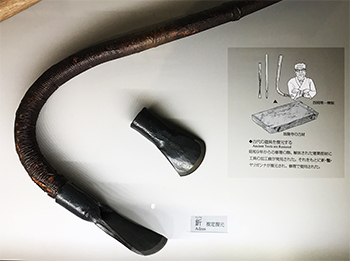
当時の道具は石斧の立て斧、横斧、その大小などが使われたと推定される。
挟んでいるイラストは竹中大工道具館展示であります。
石斧で巨木を切り倒していくつもの丸太をコロとして使って
伐採〜運搬したものと思われます。
石斧は日本列島に人類が進出するときには丸木舟は作られていたでしょうから
相当の人類的知見が集積していたことが確実視されます。
船にする為には伐採からくり抜きのプロセスで横斧である手斧が利用された。
その手斧を使えば、この接合部のような木組みが可能だったでしょう。
巨大柱の接合部付近に穴を掘り込みそこに受け材を差し込み横架材を受けた。
固定には樹皮ロープなどでグルグル巻き手法がとられたか。
個人的に気になるのが6本柱という点。
4本で構造させることはできるだろうと思いますが、
単純に平面を拡張させる意味合いかどうか。
6本を選ぶのにはなにか「民族性」がそこにあるのかと妄想させられる。
柱を立てる工法として「掘っ立て柱」工法が日本では進化している。
はるかな後年、わが家事務所で掘立電柱を列柱として立てたとき、
その奥行きに触れたような気がしたことを思い起こします。

古来から日本海沿いの南北間でいろいろな古代の交流が行われていた。
太平洋側と比べて波濤が穏やかで常に陸地を確認しながら航海できた、
環日本海交易圏で、縄文期にも活発な交流痕跡。
津軽海峡も後世居住民・アイヌの「塩っぱい川」という呼び名があるように
列島のまほろばとして、北海道北東北は列島での人間居住のマザーだった、
そんなように思われてなりません。この物見櫓と集会場のような大型竪穴住居。
先人たちのはるかな建築営為が新鮮な感動を呼び起こしてくれます。

English version⬇

[Japanese wooden frame travelogue-Jomon / Japanese good house ㊳-1]
A series of good Japanese houses that were interrupted by information on the appearance of bears around my house.
Exploration of wooden technology from exhibition and inspiration at Takenaka Carpentry Tools Museum in Kobe.
People began to settle in the Japanese archipelago from the Jomon period.
Traces of the Stone Age are also excavated, but it is still from the Jomon period that it can be said to be a culture.
Especially since the discovery of the Sannai Maruyama Site, its long-term settlement maintenance,
And astonishing history such as “existence of society” and “cultivation of chestnuts” was unearthed.
The photo above is the Sannai Maruyama turret architecture.
Six giant chestnut trees have been erected and restored.
It is said that the trees are so huge that they went to the interior of the Russian Far East for logging.
It is said that the climate was warm with a climate that was quite different from the present.
A large-scale settlement trace of leaves from the middle to the end of the middle of the Jomon period in Maruyama, Oaza Sannai, Aomori City, Aomori Prefecture.
It is located on the river terrace on the right bank of the Okidate River. Officially registered as a World Heritage Site the day before yesterday
The central existence of the Jomon archaeological site in the northeastern part of Hokkaido.
I would like everyone to visit us in earnest after the Olympics.

So, personally, I am deeply interested in the woodworking technology of nearly 10,000 years ago.
The photo is an enlarged view of the whole view and its timber frame.
As a restoration, such a wooden frame joining method is presented.
Perhaps considerable academic verification and architectural historical knowledge were also mobilized.
It seems that such a method was adopted.
It is presumed that the tools used at that time were the vertical ax of the stone ax, the horizontal ax, and the size of the ax.
The illustration in between is the Takenaka Carpentry Tools Museum exhibition.
Cut down a giant tree with a stone ax and use a number of logs as rollers
It seems that it was cut down and transported.
The stone ax would have been a dugout canoe when humans entered the Japanese archipelago.
It is certain that a considerable amount of human knowledge was accumulated.
A hatchet, a horizontal ax, was used in the process of logging and hollowing out to make a ship.
With that hatchet, it would have been possible to build a wooden structure like this joint.
A hole was dug near the joint of the huge pillar, and a receiving material was inserted there to receive the horizontal material.
Was the method of wrapping around with a bark rope etc. taken for fixing?
I personally care about the six pillars.
I think it would be possible to make it with four, but
Does it mean simply expanding the plane?
It makes me wonder if there is any “ethnicity” in choosing six.
The “digging pillar” construction method is evolving in Japan as a construction method for erecting pillars.
A long time later, when I set up a digging utility pole as a colonnade at my office,
I remember feeling like I was touching that depth.

Since ancient times, various ancient exchanges have been held between the north and south along the Sea of ​​Japan.
Compared to the Pacific side, the waves were calm and I was able to sail while always checking the land,
Traces of active exchange during the Jomon period in the Pan-Japan Sea trade area.
The Tsugaru Strait is also called the “salt river” of the Ainu, a posterior resident.
As a mahoroba of the archipelago, northeastern Hokkaido was the mother of human settlement in the archipelago,
It shouldn’t seem like that. A large pit-house like this turret and assembly hall.
The far-reaching architectural activities of our predecessors evoke a fresh impression.

【ヒグマ目撃情報 in わが家周辺住宅街 7/29】


ことしの夏は厳しい暑さが続いている札幌。
行動抑制もあり運動不足解消で日中の暑さを避け早朝散歩される方も多い。
わたしは大体、朝5時半頃に出掛けて7時過ぎに帰宅が日課。
札幌は石狩平野の西南側に位置して大きな山塊群が南側を囲んでいる。
この山塊に抱かれた里山地域は緑も多く、地盤も安定しているので、
宮の森、北海道神宮、旭が丘、山の手地域と札幌有数の住宅街。
島義勇開拓判官がこの山塊群のなかで平野部に近い場所・円山山麓に
北海道神宮を勧請したのは、地形的に妥当性が高いと思えます。
わたしどもの社屋もこの山の手地域に建っているのですが、
そういう緑豊かな環境から、当然のようにヒト以外の動物もテリトリー。
キツネが山地から降りてきてわが家周辺を朝、徘徊する様子もよく散見。

以下はYahooニュースページにも掲載された地元テレビ局HBCの情報要旨。
〜「家の中から5~6メートル先にクマが見える」札幌市西区住宅街で目撃情報
28日夜札幌市西区の住宅街でクマが目撃された。警察や札幌市が周辺住民に
注意を呼びかけ。28日午後10時15分札幌市西区山の手7条8丁目の住宅の女性が
「家の中から5~6メートル先にクマが1頭いるのが見える」と警察に通報した。
通報を受け警察と札幌市職員が周辺を見回りましたが、クマの姿や被害は
確認されていません。目撃されたクマは体長1メートルで住宅街に沿って流れる
「琴似発寒川」の方へ向かって行ったということです。
目撃された現場は「北1条・宮の沢通」にある「山の手橋」南側にあります。
住宅だけでなく病院や学校なども建ち並ぶ一方、山や森も近いエリア。
警察と札幌市は目撃された現場周辺をパトロールしたり、
住民に注意を呼びかけたりして警戒にあたっています。〜
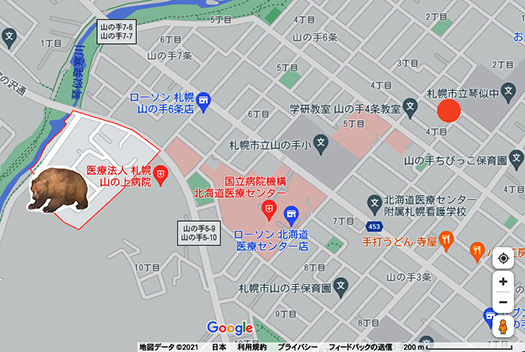
ということで、目撃情報のあった地域にクマさんのイラスト画像を。
で、当社の社屋所在地は赤丸表示箇所であります。
おおむね直線距離で1km程度の至近地域に当たっております。

ことしは先日お伝えの東区で4人が被害を受けたクマ出没や旭が丘公園など
札幌市街地でも出没情報が多発しています。
「気をつける」と言っても早朝や夜間の当該地域周辺には足を向けない、
くらいの対策しか思い浮かびません。夜間の方はここしばらくわたしは無縁。
わたしの場合は早朝散歩で「琴似発寒川」の緑地は1日おきくらいに散歩。
河川方向に向かっていったとのことですが、
この場所では目撃情報もあったし先日の東区や旭川のケースでも、
川はかれらの動線でもあるとされる。エリアとして近づかないように注意。
まぁ、この目撃情報のあった地域は山塊群の縁辺に位置するので
豊かな森林環境が展開している。かれらにはギリギリ行動範囲テリトリー。
しかし、ここまで頻繁に目撃情報が出てくるのは、個体数が増えてきて
若いクマたちが新たにテリトリー拡張行動を活発化させているのでしょう。
こういうことが起こると自然保護とのバランスが論議されるけれど、
猟友会や警察、市担当セクションのみなさんにはご苦労様ですが、
住民としてはクマと遭遇しないような環境整備をお願いしたいところ。
人命が最優先であることは自明だと思います。

English version⬇

[Brown bear sighting information in Nishi-ku, Sapporo residential area 7/29]
Sapporo has been experiencing severe heat this summer.
There are also many people who take a walk early in the morning to avoid the heat during the day by resolving lack of exercise due to behavioral restraint.
I usually go out around 5:30 in the morning and come home after 7 o’clock.
Sapporo is located on the southwest side of the Ishikari Plain, and a large massif surrounds the south side.
The area surrounded by this massif has a lot of greenery and the ground is stable, so
Miyanomori, Hokkaido Jingu Shrine, Asahigaoka, Yamanote area and one of Sapporo’s leading residential areas.
Judge Yoshitake Shima is at the foot of Mt. Maruyama, a place near the plains in this massif group.
It seems that the solicitation for Hokkaido Jingu Shrine is topographically valid.
Our company building is also built in this Yamanote area,
Naturally, animals other than humans are also territories from such a lush environment.
I often see foxes coming down from the mountains and wandering around my house in the morning.

The following is a summary of information on the local TV station HBC, which was also posted on the Yahoo news page.
~ “A bear can be seen 5 to 6 meters away from the house” Witness information in a residential area in Nishi-ku, Sapporo
A bear was witnessed in a residential area in Nishi-ku, Sapporo on the night of the 28th. Police and Sapporo city to local residents
Call attention. 28th 10:15 pm A woman in a house in Yamanote 7-jo 8-chome, Nishi-ku, Sapporo
She reported to the police, “I see a bear 5 to 6 meters away from my house.”
Upon receiving the report, the police and Sapporo City officials looked around the area, but the appearance and damage of the bear
Not confirmed. Witnessed bears are 1 meter long and flow along a residential area
It means that we went toward “Kotonihassamugawa”.
The site that was witnessed is on the south side of “Yamatebashi” in “Kita 1jo Miyanosawa Dori”.
Not only houses but also hospitals and schools are lined up, while mountains and forests are also nearby.
Police and Sapporo City patrol the area around the sighted site,
We are on the alert by calling attention to the residents. ~
So, I put an illustration image of Mr. Kuma in the area where the sighting information was.
The location of our company building is indicated by a red circle.
It hits the nearest area of ​​about 1km in a straight line.

This is the bear infestation and Asahigaoka Park where four people were damaged in Higashi Ward, which I reported the other day.
Haunting information is also frequent in downtown Sapporo.
Even if you say “be careful”, do not go to the area around the area early in the morning or at night.
I can only think of a few measures. At night, I haven’t been involved for a while.
In my case, I take a walk early in the morning and take a walk in the green area of ​​”Kotonihassamugawa” about every other day.
You said that you went in the direction of the river,
There was sighting information at this place, and even in the case of Higashi Ward and Asahikawa the other day,
The river is also said to be their flow line. Be careful not to approach as an area.
Well, the area where this sighting information was located is located on the edge of the massif group.
A rich forest environment is developing. They have a range of action territory.
However, the fact that witness information comes out so frequently is that the number of individuals is increasing.
Young bears may be activating new territory expansion behavior.
When this happens, the balance with nature maintenance is debated,
Thank you to everyone in the hunting club, the police, and the city section.
As a resident, I would like to ask you to improve the environment so that you will not encounter bears.
I think it is self-evident that human life is the highest priority.

【縁起絵巻にみる1100年前の社会/日本のいい家特別篇㊲-6】


さて木造建築の工程が視覚化されている松崎天神縁起絵巻をみてきましたが、
この絵巻では当時の社会の様子がうかがえるような描写もある。
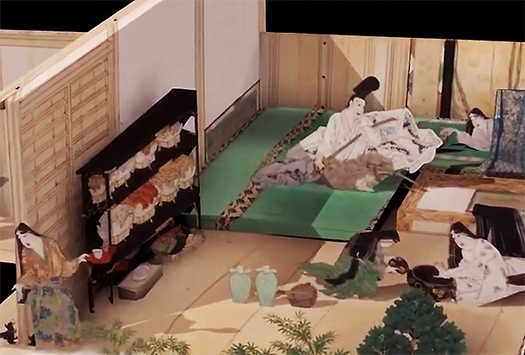
上の絵巻絵は菅原道真が多くの人に加護を与えた奇譚が描写されている。
〜巻5 【天神様のご利益】
天神さまはあらゆる願いを叶えて下さる神となりました。
ある時は濡れ衣を晴らし、ある時は極楽往生を助け、ある時は良縁を授け、
またある時は病を払って下さいます。巻4の後半と巻5では、
天神様が叶えた数々の不思議とご利益が綴られます。〜
・・・ということでこの絵では継子いじめにあっていた姉妹が
道真の加護を受けて玉の輿に乗るお話しを描いているとされる。
3場面もの長さで語られていて、当時の社会の「憧れ」の事件だったことがわかる。
平安中期を生きた人びとにとって、菅原道真という存在は
ある種の結界装置のように受け止めていた可能性がある。
宮廷社会は一般庶民のくらしの遙か上層で「上級国民」が繰り広げる世界。
その影響はさまざまに民の暮らしにも出ていただろうけれど、
その世界とのバイパス的な機縁を菅原道真にみていたのではないだろうか。
後の世での義経にも似た民衆の仮託対象であったように感じる。
絵巻を編纂するにあたって、この社をひとに紹介するのに、
「あのお話」というキーワード的な事件性がこの絵には込められたのではないか。
日本社会は比較的に身分階層の対流性のいい社会だと思うけれど、
学問というのは、そういう対流性がもっとも大きかったものであり、
その天才としての菅原道真であれば超越的に対流を起こせると夢見させたのか。
奇跡のような身分上昇を現出させた事実があったに違いない。
やがて時代は武士階層の勃興によって、宮廷政治は力を失っていくけれど、
人々はこういう上級国民層に退廃を強く感じ続けていたように思える。

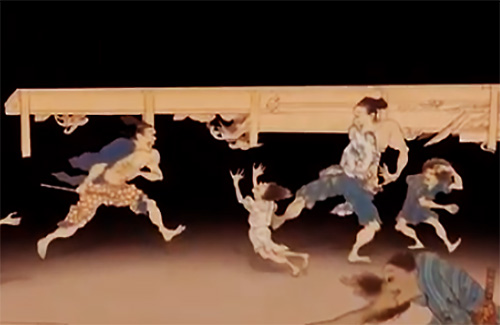
下の絵は工事現場絵巻の一部分にみえたワンシーン。
工事現場で作業していた職人さんがわが子が大人に足蹴にされているのを見て
いまにもつかみかからんばかりの勢いで向かっていっている。
「うっせーな、このガキ、すっこんでやがれ!」
(足蹴)
「おい、このヤロー、ウチの坊主に何しやがんでぇ」
っていうようなケンカ沙汰が1100年の時代を超えてコダマしてくる(笑)。
足蹴にしているオトナの手にはなにかが抱えられているので、
あるいは子どもからなにか大事なモノを奪い取ったのかもしれない。
木工職人としての父親が近くにいたということは、
どういうことか? ひとつの推定として職人は地元で工事に採用された人間で
家の近所が工事現場という環境で子どもたちは父親の仕事ぶりを見学して
一子相伝の技術伝授を行っていた最中であったかも知れない。
そういうマジメな研修の合間に悪ガキ仲間でつるんで悪さをしたのかも。
もしそうであると、犯罪者は逆であるかも知れない。
時空間を越えた第3者としてはうかつには正邪の判定は付きにくい。
しかし「足蹴」の時点でオトナには非があることは疑いない。

こういう社会のリアルな姿の一端が、
絵巻物に表現されているというのは現代人にも親近感が湧く。

English version⬇

[Society 1100 years ago in the lucky picture scroll / Special edition of a good house in Japan ㊲-6]
Now, I have seen the Matsuzaki Tenjin Engi Emaki, which visualizes the process of wooden construction.
In this picture scroll, there is also a depiction that shows the state of society at that time.
The picture scroll above depicts the miracle that Sugawara no Michizane gave blessings to many people.
~ Volume 5 [Benefits of Tenjin]
Tenjin has become a god who grants all wishes.
Sometimes I get rid of my wet clothes, sometimes I help paradise, and sometimes I give a good match,
At other times, please pay for the illness. In the second half of Volume 4 and Volume 5,
Many wonders and benefits that Tenjin has fulfilled are spelled out. ~
So, in this picture, the sisters who were being bullied by stepchildren
It is said that he is drawing a story about riding a ball with Michizane’s blessing.
It is told in three scenes in length, and it can be seen that it was a “longing” case of society at that time.
For those who lived in the middle of the Heian period, the existence of Sugawara no Michizane
He may have taken it like a barrier device of some sort.
The court society is a world where “senior citizens” unfold, far above the lives of ordinary people.
The influence would have been in the lives of the people in various ways,
Perhaps Sugawara no Michizane was looking at a bypass-like relationship with that world.
I feel that it was a temporary subject of the people, similar to Yoshitsune in the later world.
To introduce this company to people when compiling picture scrolls
I think this picture has the keyword “that story”.
I think Japanese society is a society with relatively good convection in the social class,
Academics are probably the ones that had the greatest convection.
Did you dream that Sugawara no Michizane as a genius would be able to transcend convection?
There must have been a fact that a miraculous rise in status was revealed.
Eventually, due to the rise of the samurai class, court politics lost its power,
It seems that people continued to strongly feel the decadence of these senior citizens.

The picture below is a scene that looks like a part of a construction site picture scroll.
A craftsman working at a construction site sees his child being kicked by an adult
He is heading with a momentum that he can’t grasp at any moment.
“Usseewa, this kid, go ahead!”
(kick)
“Hey, this yarrow, what’s wrong with my shaven?”
That kind of quarrel has gone beyond the 1100 era (laughs).
Something is held in the hand of the adult who is kicking, so
Or it may have stolen something important from the children.
The fact that his father as a woodworker was nearby
What do you mean? One estimate is that the craftsman is a locally hired person for construction.
In an environment where the neighborhood of the house is a construction site, children observe the work of their father
It may have been in the middle of teaching the technique of Ichiko Soden.
Perhaps he did something wrong by hanging out with his bad boys during such serious training.
If so, the criminal may be the other way around.
As a third party who transcends time and space, it is difficult to judge whether it is right or wrong.
However, there is no doubt that there is something wrong with adults at the time of “foot kick”.

A part of the real appearance of this kind of society
It is very interesting that it is expressed in a picture scroll.

【職人仕事の工夫と技術継承/日本のいい家特別篇㊲-5】


日本木造建築の進化プロセスにとっては神社仏閣は格別の存在。
国家プロジェクトとして取り組まれる大型建築は鎮護国家建築であり、
政争の結果、しばしば消失することのある政治的象徴建築や城郭と比べて
比較的長期間にわたって建ち続けることが多い。
法隆寺がその最たるものと言われるが建築では四天王寺が時代を画する存在。
この日本最初の仏教寺院は聖徳太子に起源が求められ、
事実、境内には日本の大工仕事の守護神として聖徳太子が祀られている。
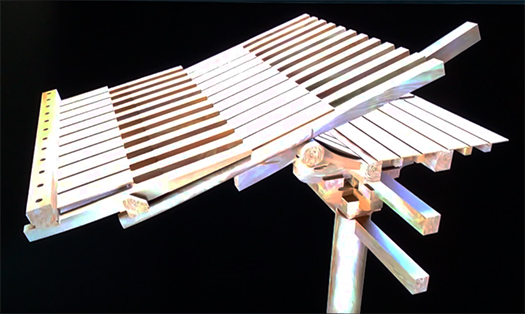
それまでの日本の建築にはなかった装飾性の高いデザイン、むくり屋根などが
特徴的な端部として、日本建築に受容されていった。
上の写真は竹中大工道具館ムービー展示で示されていたその箇所。
朝鮮から四天王寺建設のために来日した木造技術者が日本最古の工務店、
金剛組として現代にまで存続してきているけれど、
こういった端部での仕上げ加工技術の重厚さに驚かされる。
結局は肉体化された職人技術としてしか継承存続できない。
その必然として小人数での相伝的な組織形態を取っていくことになる。
この技術伝承スタイルは日本人にはある意味、似合っているのかも知れない。

この菅原道真の魂魄を鎮魂する天神社でもその技術の粋が懲らされた。
マザーの三内丸山、縄文時代からの木造伝統が強く存在する技術風土に
大陸・半島から宗教建築の技術が加わっていったのでしょう。
中国・朝鮮・日本で木造技術の発展の仕方は大きく相違する。
そもそも今日社会まで存命し続けてきたのは日本だけ。
現在中国国内に残る木造建築は日本の技術支援がなければ存続し得ない。
中国の場合、政治体制が常に「独裁」であり、ときの皇帝型権力の恣意で
宗教弾圧が行われ、宗教施設にまで迫害が及んでしまう。
直近では文化大革命によって宗教は極限的に痛めつけられた。
朝鮮社会でも事情は類似していて確固たる木造技術蓄積に乏しい。
ひとり日本だけもともとの縄文的木組み技術があってそれに刺激として
大陸・半島からの技術が加わっていったのでしょうが、
既存のものと渡来技術が融合していったのが日本木造なのでしょう。
だから東アジア世界の中で日本は独自の技術体系を構築し得た。
ただ先述の技術伝承スタイルが前提としていた日本人的精神風土が
現代世界の普遍的な西欧的個人主義とのせめぎ合いの中で
複雑精緻なディテール技術を今後とも存続させられるのかどうか、
あやうさも持っているように思われてならない。

日本社会は外からの文化刺激を柔軟に血肉化することが巧みで
その「融合力」といえる自然な復元機能が働いてくれる気もする。
世界に開かれたガラパゴス的な咀嚼パワー。
なんとも不思議な日本のありようをはるかな時間経過の中で
絵巻物文物から教えられているように思います。

English version⬇

[Ingenuity of craftsmanship and inheritance of technology / Special edition of Japanese good house ㊲-5]
Shrines and temples are exceptional for the evolutionary process of Japanese wooden architecture.
The large-scale architecture that is being tackled as a national project is such a guardian national architecture.
Compared to political symbolic architecture and castles that often disappear as a result of political disputes
It often continues to be built for a relatively long period of time.
Horyu-ji is said to be the best, but in architecture, Shitenno-ji is the one that sets the era.
The origin of this first Buddhist temple in Japan is sought from Prince Shotoku,
In fact, Prince Shotoku is enshrined in the precincts as the guardian deity of Japanese carpentry.
Highly decorative design, rolled roof, etc. that were not found in Japanese architecture until then
As a characteristic end, it was accepted by Japanese architecture.
The photo above is the part shown in the Takenaka Carpentry Tools Museum movie exhibition.
A wooden engineer who came to Japan from Korea to build Shitennoji is Japan’s oldest construction shop.
Although it has survived to the present day as Kongo Gumi,
I am amazed at the profoundness of the finishing technology at these edges.
In the end, it can only be inherited as a physical craftsmanship.
Inevitably, we will take a traditional organizational form with a small number of people.
However, this technique transfer style may suit Japanese people in a sense.

The essence of the technique was also disciplined at the Tenjinsha Shrine, which requiescats the soul of Sugawara no Michizane.
Originally Sannai Maruyama, in a technical climate where the wooden tradition from the Jomon period strongly exists
The technology of religious architecture may have been added from the continent and peninsula.
The way of developing wooden technology is very different between China, Korea and Japan.
In the first place, Japan is the only country that has survived to society today.
Today, the wooden buildings that remain in China cannot survive without Japanese technical backup.
In the case of China, the political system is always “dictatorship”, and at the time of emperor-type power.
Religious repression is carried out, and persecution extends to religious facilities.
Most recently, the Cultural Revolution has severely damaged religion.
The situation is similar in Korean society, and there is little solid accumulation of wooden technology.
Only in Japan alone, there was the original Jomon woodworking technique, and as a stimulus to it
Technology from the continent and peninsula may have been added,
It is probably Japanese wooden construction that the existing ones and the traditional technology were fused.
Therefore, Japan was able to build its own technical system in the East Asian world.
However, the Japanese spiritual climate that was premised on the above-mentioned technical tradition style
In a conflict with the universal Western individualism of the modern world
Whether complex and elaborate things such as braids can be kept alive in the future
Don’t seem to have a suspicion.
Japanese society is skillful in flexibly fleshing out cultural stimuli from the outside.
I feel that the natural restoration function, which can be said to be the “fusion power”, works.

Galapagos-like chewing power open to the world.
What a mysterious state of Japan in the distant passage of time
I think it is taught from picture scrolls and antiques.

【903年の神社建築工事現場/日本のいい家特別篇㊲-4】


山口県防府市松崎の旧称「松崎天神社」創建時の工事取材。
縁起絵巻に当時の建築工事の様子が残されていることで、
竹中大工道具館に展示されていて、その道具などの詳細も検証されている。
大和絵・絵巻表現はイマドキのマンガのように表現が生き生きとしていて、
時空間をはるかに超えたリアリティがあって魅了される。
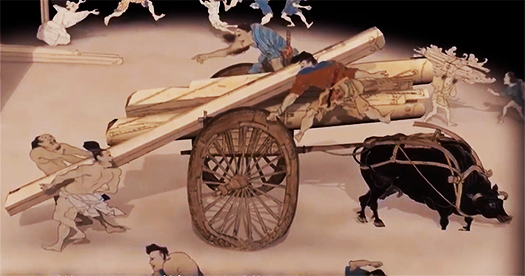
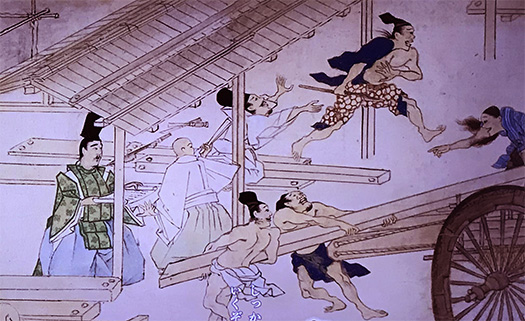
上の絵巻絵は柱・梁の構造建材が牛車に乗せられて荷下ろしされている様子。
903年段階の時代のことなので、資材は近隣の山から木樵と大工棟梁とで物色して
現地で伐採され運ばれてきたモノでしょう。
牛1頭で運べる重量には一定性があるだろうから、この数量程度が限界なのか。
また、牛車の車輪が動かないようにバランスを取っている様子もわかる。
建築工事関係の人物は荷物を下ろそうと諸肌脱ぎになっているけれど、
車上の2人は服を着ているので、運搬事業者であると推定できる。
運搬事業者にとっては材よりも牛車の保全が大切でもあっただろう。
とくに車軸のからむ車輪が牛車最大のウィークポイントであろうこともわかる。
ここは山口県なので都とは違い、こうした牛車運搬の需要はどれくらいあったか、
しかしこういう専業とおぼしき様子から推定も膨らんでくる。
この運搬距離によって掛かる人足経費が大きく違っただろう。
構造材はその長さが一定に切りそろえられているように見える。
棟梁の指示で部材の基本サイズが指示されて搬入されたものでしょう。
よく見ると丸太材と角材の両方があることがわかる。
丸太材は断面部がちょうど斧で切り落としたままの形状に見える。
角材の方は、楔を使って「打ち割り」製材としたものだろうか。
日本で大鋸が導入されて板材が大量に流通するようになるのは室町期。
平安期のこの時期には角材・板材にするのは大変な労力がかかっただろう。
どうも神社建築でもあり丸太材は柱に、角材は横架材にという仕分けかも。
いずれにせよ、現場でチョンナなどで丹念に仕上げる必要があった。
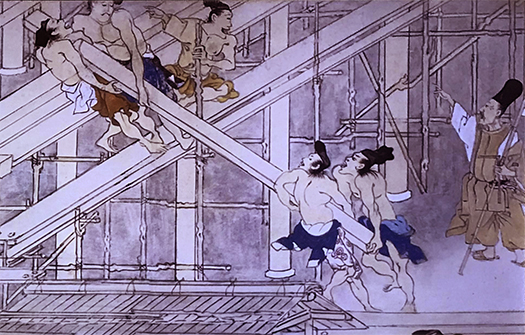
次の絵巻絵は全画面中、もっとも迫力がある構造材の階上げの様子。
見た感じ5−6mほどの角材を4人ほどの力自慢たちが呼吸をそろえて
持ち上げようとしている。力が思わず入ってくるシーン(笑)。
ここで気がつくのは柱の基底部に石場が見えること。
さすがに重要性の高い建物では長期耐久性を考えて基礎が重厚に造作されている。
この礎石に先述のような丸太材が柱として建てられているように見える。
この安定のために多様な工夫努力が積層していることも伝わってくる。
職人さんたち、工事関係者のみなさんの熱い労力が自明ですね。
また、足場板が仮設組みに渡されてもいる。
階下では棟梁とおぼしき服装の紳士が仮設足場の上の現場管理者に指示を出している。
「この角材は、◎◎の部位に使うモノだからな」
「了解です。あの◎◎ですね、いまは受け材に加工させているところです」
みたいな会話が聞こえてくるかのようです。


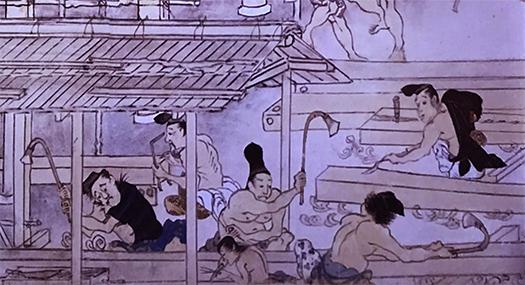
さてこちらは手斧・チョンナでの面仕上げ加工の様子。
斧の一種で斧としては横斧に分類される。鉋が普及する以前は木材の荒削り用として
世界各国で使われていた。石器時代から存在する歴史のある工具。
運ばれてきた材木を細く「打ち割り」この手斧・チョンナではつって形を整え
その後ヤリカンナで仕上げ加工することになる。
木を使って建築を作るプロセスには人類の長い営為が凝縮しているとわかる。

English version⬇

[Shinto shrine construction site 1117 years ago / Japanese good house special edition ㊲-4]
Construction coverage at the time of the construction of the former name “Matsuzaki Ten Shrine” in Matsuzaki, Hofu City, Yamaguchi Prefecture.
The state of the construction work at that time is left in the lucky picture scroll, so
It is exhibited at the Takenaka Carpentry Tools Museum, and details such as the tools have been verified.
Yamato-e and picture scroll expressions are as lively as Imadoki’s manga.
I am fascinated by the reality that goes far beyond time and space.
The picture scroll above shows the structural building materials of columns and beams being placed on a cow wheel and unloaded.
Since it was in the 903 stage, the materials were sought from the neighboring mountains with a lumberjack and a carpenter’s builder.
It must have been cut down and carried locally.
Since the weight that one cow can carry will be constant, is this quantity the limit?
You can also see how the wheels of the ox cart are balanced so that they do not move.
People related to construction work are taking off their skin to unload their luggage,
Since the two people on the car are dressed, it can be presumed that they are carriers.
For the carrier, the maintenance of the ox cart would have been more important than the lumber.
In particular, it can be seen that the wheels entwined with the axles are the weak points of the trader.
Since this is Yamaguchi prefecture, unlike the capital, how much was the demand for such ox cart transportation?
However, the estimation also expands from the appearance that seems to be such a full-time job.
The cost of manpower would have differed greatly depending on this transportation distance.
The structural material appears to have a constant length.
The basic size of the members was instructed by the instructions of the builder, and it was probably brought in.
If you look closely, you can see that there are both log lumber and square lumber.
The log has a cross section that looks just like it was cut off with an ax.
Is the square lumber made into “split” lumber using wedges?
It was during the Muromachi period that Daigiri was introduced in Japan and a large amount of plate materials began to be distributed.
At this time of the Heian period, it would have taken a lot of effort to make square lumber and board.
It’s also a shrine building, so it may be that logs are used as pillars and square lumber is used as horizontal lumber.
In any case, it was necessary to carefully finish it on site with a cheongna.
The next picture scroll is the most powerful structural material upstairs on the full screen.
Feeling that I saw about 5-6m of square lumber, about 4 people bragging about their strength breathe together
I’m trying to lift it. A scene where power comes in unintentionally (laughs).
What you notice here is that you can see the stone field at the base of the pillar.
In buildings of high importance, the foundations are heavily constructed in consideration of long-term durability.
It seems that the above-mentioned log lumber is built as a pillar on this cornerstone.
It is also transmitted that various ingenuity efforts are piled up for this stability.
It is obvious that the craftsmen and the people involved in the construction work are working hard.
In addition, scaffolding boards are also handed over to the temporary assembly.
Downstairs, a gentleman dressed as a builder gives instructions to the site manager on the temporary scaffolding.
“Because this lumber is used for ◎◎ parts.”
“I understand. That ◎◎, right now, I’m processing it into a receiving material.”
It’s as if you can hear a conversation like this.

By the way, here is the state of surface finishing with a hatchet, Chongna.
It is a type of ax and is classified as a horizontal ax. Before the spread of planes, it was used for rough cutting of wood.
It was used all over the world. A historic tool that has existed since the Stone Age.
“Cut” the lumber that has been carried into thin pieces. With this hatchet, Chongna, shape it.
After that, it will be processed with Yarikanna. Make architecture using wood
It can be seen that the long activities of mankind are concentrated there in the process.

【1000年超の大工技術と道具取材/日本のいい家特別篇㊲-3】


きのうはこの松崎天神社建築に至る政治社会状況、いわば背景をみた。
当時の日本人口は推計で650万人程度といわれる。
北海道の現在人口はおおむね550万人なので、同程度。
そういう社会の最先端建築技術としての木造専門職人はどの程度いたか。
もともと三内丸山や出雲大社などの大型建築はこなしていた社会。
そこに本格的仏教寺院・大阪四天王寺建設(593年)があってデザイン面を含めた
大陸からの木造技術導入も。そのとき最古の技術集団・金剛組が578年に創業記録。
この松崎天神社の創建は903年で菅原道真自身がこの地で葬られることを望んで
死の翌年にこの地に建てられたということですが、一方で縁起絵巻の成立は
1311年と記録されているので、タイムラグがある。
想像できるのは、創建時にはもっと小ぶりな建築であって、
その後、怨霊信仰が社会に根付いてから最初期の「天神社」として重要性が高まり
徐々に本格的建築になっていった可能性。
したがって、この絵巻での建築の様子がどの年代か詳細は不明。

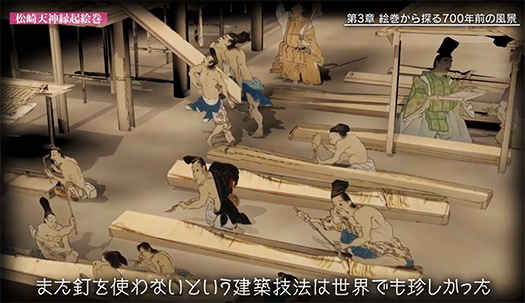
上の写真2枚は竹中大工道具館展示からの画像で、なんといっても
世界的に珍しい「釘を使わない木造技術」がこの段階で確認できるとされる。
縄文の三内丸山遺跡の巨大木組み構造物は材同士は貫通させていない。
接合部に枝のように受け材を取り付け、横架材を柱材に組み合わせている。
一方、吉野ヶ里では材同士で貫通によって木組みが行われている。
この木組みの進化プロセスが日本の木造技術の進化を表現しているとされる。
建材としての木材を組み合わせて「軸組」していくときに
その材木ごとに性格を把握して、接合部の継ぎ手・仕口を考え加工していく。
棟梁技術者は全体としての構造構想をアタマに入れて建材を選び抜き、
それを誤りなく各ディテールごとに組み合わせられるように職人に指示する。
柱に使う材、梁に使う材、その木の生育した環境に合わせたソリの傾向を把握して
適材適所を心がけて行くことになる。当然現場大工もそれを頭に入れて作業する。
微妙な組み合わせ仕口を丹念に造作していく。
人間の手の化身としての道具が選択され、その性能を余すところなく発揮する。
当時の社会では、こういう営為は総合芸術に近いものだったように思える。
建築のための道具は木を切る石斧がすべてのスタートだった。
石器時代から鉄を利用する時代に移行していって
その最先端の道具を利活用していたのが木造大工職人だと思われる。
立派な建築は権力機構のものであったり、宗教的なものであったり、
その存在自体が民への支配の実態でもあっただろう。
そういう建築専門の職人という意味では今日のIT技術者と同等レベルの技術職。


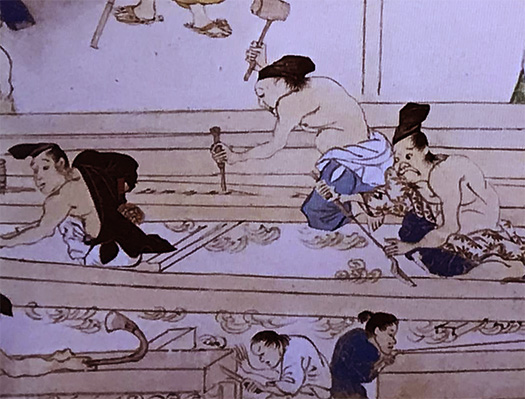
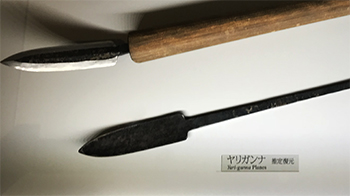
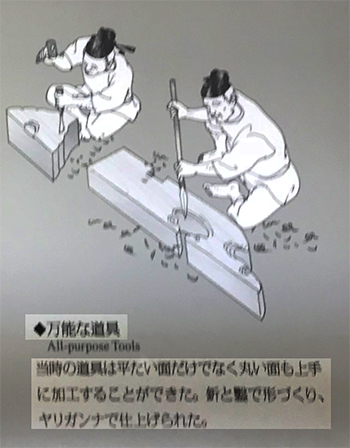
絵巻絵はとくに「ヤリカンナ」を使っている職人さんをクローズアップ。
今日このヤリカンナは実用されることはなくなっているということですが、
写真のような道具で、継ぎ手仕口の細部加工などに多用されていた。
釘を使わないのが基本である木造技術では、こうした木組みが
構造耐力をしっかり確保できるかどうかのキモ部分。
熟練の木造技術者=大工の技量がもっとも発揮された部位だった。
図のように「鑿」とヤリカンナの加工工程が木組みのコア部分だったと推定できる。
はるかな時間を越えて「建築取材」の実感が徐々に強まってくる・・・。

English version⬇

[Over 1000 years of carpentry technology and tool coverage / Japanese good house special edition ㊲-3]
Yesterday I saw the political and social situation leading up to the construction of this Matsuzaki Tenjin shrine, so to speak, the background.
The population of Japan at that time is estimated to be about 6.5 million.
The current population of Hokkaido is about 5.5 million, so it’s about the same.
How many wooden craftsmen were there as cutting-edge construction technology in such a society?
Originally, a society that was able to handle large-scale buildings such as Sannai Maruyama and Izumo Taisha.
There was a full-scale Buddhist temple, Osaka Shitennoji (593), including the design aspect.
Introducing wooden technology from the continent. At that time, the oldest technical group, Kongo Gumi, was founded in 578.
This Matsuzaki Ten Shrine was founded in 903, hoping that Sugawara no Michizane himself would be buried here.
It is said that it was built here the year after his death, but on the other hand, the establishment of the lucky picture scroll
Since it is recorded as 1311, there is a time lag.
I can imagine a smaller building at the time of its construction,
After that, it became more important as the earliest “Tenjinsha” after the spiritual belief took root in society.
It is possible that the building gradually became full-scale.
Therefore, it is unclear what age the architecture in this picture scroll was.

The above two photos are from the Takenaka Carpentry Tools Museum exhibition, after all.
It is said that the world-rare “wooden technology that does not use nails” can be confirmed at this stage.
The huge timber structure at the Sannai-Maruyama site in Jomon does not allow the timbers to penetrate each other.
A receiving material is attached to the joint like a branch, and the horizontal material is combined with the pillar material.
On the other hand, in Yoshinogari, woodwork is done by penetrating the materials.
It is said that the evolution process of this wooden structure expresses the evolution of Japanese wooden technology.
When combining wood as a building material to “frame”
We will grasp the character of each lumber and consider the joints and joints of the joints for processing.
The builder engineer puts the overall structural concept into the head and selects the building materials,
Instruct the craftsmen to combine it for each detail without error.
Understand the lumber used for pillars, the lumber used for beams, and the tendency of sleds according to the environment in which the tree grew.
I will keep in mind the right person in the right place. Of course, the on-site carpenter also keeps that in mind when working.
We will carefully create a delicate combination.
A tool as an incarnation of the human hand is selected, and its performance is fully demonstrated.
In the society at that time, it seems that such activities were close to general art.
A stone ax that cuts wood was the starting point for all the tools for construction.
Moving from the Stone Age to the era of using iron
It seems that the wooden carpenter was making good use of the cutting-edge tools.
Good architecture may be of power organization, religious,
Its existence itself would have been the reality of control over the people.
In the sense of such a craftsman specializing in architecture, he is a technical worker at the same level as today’s IT engineers.

The picture scroll picture is a close-up of the craftsmen who use “Yarikanna” in particular.
It is said that this spear canna is no longer in practical use today,
It was a tool like the one in the photo, and was often used for detailed processing of joint joints.
In the wooden technology, which is basically not using nails, such a wooden structure is used.
The key part of whether or not the structural strength can be secured firmly.
Skilled wooden engineer = the part where the carpenter’s skill was most demonstrated.
As shown in the figure, it can be estimated that the processing process of “chisel” and spear canna was the core part of the wooden frame.
Over a long period of time, the realization of “architectural coverage” gradually strengthens …

【菅原道真という権力内「怨霊」現象/日本のいい家特別篇㊲-2】


わたしは日本史・歴史が好きではありますが、
どうしても興味分野として時代区分的には興味の薄い時代がある。
それがちょうど宮廷内の人事抗争が主眼になっている平安期。
藤原氏による「摂関」政治に向かっていくプロセスの時代には
なんだかなぁ・・・という心理が否めず、ほとんど興味を持てなかった。
菅原道真のストーリーにはそれこそ上級国民貴族間のいざこざ感が否めず、
どうでもいいんじゃないか、という心理が抜けない。しかし、
今回、建築の様子が記録されている松崎天神縁起絵巻の伏線ストーリーとして
この菅原道真の事跡をあれこれ探索しております。
そこで興味を持てたのは、道真が本州を離れる現山口県・防府の松崎で
「同族の土師氏」の接遇を受けたという歴史事実であります。
きのうのブログで触れたのですが、本州島最西端の同族支配の土地で
恨み骨髄の心境を述べて「ここに住みたい」という嘆きをつぶやいていたという。
901年に菅原道真は左遷されて九州太宰府に移動していく。
で、彼の地で903年2月に死んでいる。
一方で菅原道真の「怨霊」信仰の発生きっかけとなった事実は以下のよう。
〜908年左遷の悪役・藤原菅根が病死。909年政敵・藤原時平が39歳で病死。
913年同・右大臣源光が狩りの最中に泥沼に沈んで溺死。
923年醍醐天皇の皇子で東宮の保明親王が薨御。日本紀略は道真の恨みとする。
923年5月には道真は従二位大宰員外師から右大臣に復され、正二位を贈られた。
930年皇居清涼殿が落雷を受け大納言はじめ朝廷要人に多くの死傷者が出た
(清涼殿落雷事件)上に目撃した醍醐天皇も体調を崩し3ヶ月後に崩御。〜
2枚目の絵巻絵はこの清涼殿落雷事件を伝える「北野天神縁起絵巻」。
予断だがこの絵柄が後に国宝絵画「風神雷神図屏風」のモチーフになる・・・。

こういう経緯から考えて、死後1年の904年に松崎天神は建築創建されている。
怨霊とされる事件が起こる前からすでに建築開始しているのですね。
それも「同族」の国司が在住する松崎の地で建築されたというのが象徴的。
日本史事実では平将門誕生も903年とされている。
939年には平将門が決起して反乱を起こしているので、
その後の歴史推移を考えて行けば、中央での上級国民貴族での政権運営が
まったく地方の経済勃興、政治支配の用には適合しなくなっていた。
土師氏という地域支配者は、こういう地方の声を自覚していて
ときの権門勢力の思惑とは離れ菅原道真のための天神社建築を始めたのだと推測。
天皇を中心とする貴族政治が社会の進歩発展とミスマッチしていたのではないか。
菅原道真への怨霊信仰というのは、政治体制への非常ベルだったのではと思える。
そのように考えて行くと、興味を持ちにくかった時代相に
ある軸線が生まれてくるような気がしてきます。
あるいは怨霊信仰が燃えさかっていくのには時の宮中政治争闘も関係して
この松崎天神の建築過程に大きな政治的力が働いていたとも思われる。
周防国の土師氏国司の負担だけでこの天神社が作られたとは考えにくい。
縁起からの周辺事実、政治動向へとスピンアウト気味ですが、
建築はこのような環境状況の中に作られたという意味で背景理解に役立つ。
上の絵巻絵は建築工事を監督している国司・土師氏かと思えますね。・・・

English version⬇

[Sugawara no Michizane’s “Grief” Phenomenon / Japanese Good House Special Edition ㊲-2]
I like Japanese history and history,
There are times when there is little interest in terms of era as an area of ​​interest.
That is the Heian period, when personnel conflicts in the court are the main focus.
In the era of the process of moving toward “customs” politics by Mr. Fujiwara
I couldn’t deny the psychology of what it was, and I was hardly interested in it.
In the story of Sugawara no Michizane, it is undeniable that there is a sense of turmoil among senior national aristocrats.
I can’t get rid of the psychology that it doesn’t matter. but,
This time, as a hint story of Matsuzaki Tenjin Engi Emaki, which records the state of architecture
We are exploring the traces of Sugawara no Michizane.
What I was interested in was Matsuzaki in Hofu, Yamaguchi Prefecture, where Michizane left Honshu.
It is a historical fact that he was treated by the “Haji clan of the same family”.
As I mentioned in yesterday’s blog, in the westernmost land of Honshu Island, which is controlled by the same family.
It is said that he muttered a grudge saying “I want to live here”, stating the feelings of the bone marrow.
In 901, Sugawara no Michizane was relegated to Dazaifu, Kyushu.
And he died in his land in February 903.
On the other hand, the facts that triggered the emergence of Sugawara no Michizane’s “Goryo” belief are as follows.
~ 908 The villain of the relegation, Sugane Fujiwara, died of illness. In 909, Fujiwara no Tokihira, a political enemy, died of illness at the age of 39.
In 913, the Minister of the Right, Minamoto no Hikaru, sank in a swamp and drowned while hunting.
In 923, the prince of Emperor Daigo and Yasuakira-shin of the Togu. Nihon Kiryaku is a grudge against Michizane.
In May 923, Michizane was reinstated by the Minister of the Right from the second rank lieutenant, and was awarded the second rank.
In 930, Seiryoden Hall of the Imperial Palace was struck by lightning, causing many casualties to the court officials, including Dainagon.
(Seiryoden lightning strike incident) Emperor Daigo, who witnessed the above, also became ill and died three months later. ~
The second picture scroll is “Kitano Tenjin Engi Emaki,” which tells the story of the Seiryoden lightning strike.
Although it is a prejudice, this pattern will later become the motif of the national treasure painting “Fujin and Raijin Zuhoufu”.

Considering this background, Matsuzaki Tenjin was built in 904, one year after his death.
You have already started construction before the incident that is considered to be a grudge.
It is also symbolic that it was built in Matsuzaki, where the “family” Kokushi lives.
According to Japanese historical facts, Taira no Masakado was born in 903.
In 939, Taira no Masakado was upset and rebelled, so
Considering the history transition after that, the administration of the senior national aristocrats in the center
It was completely unsuitable for local economic rise and political control.
The local ruler, Mr. Haji, is aware of these local voices.
It is speculated that he started building a Tenjin shrine for Sugawara no Michizane, apart from the speculation of the powers of the time.
The aristocratic politics centered on the emperor may have been mismatched with the progress and development of society.
It seems that the grudge faith in Sugawara no Michizane was an emergency bell for the political system.
Thinking that way, it was difficult to get interested in the times.
I feel like a certain axis is born.
Or the burning of the ghostly belief is related to the political struggle of Miyanaka at that time.
It seems that a great political force was working in the construction process of Matsuzaki Tenjin.
It is unlikely that this Tenjin shrine was built solely at the expense of Mr. Haji Kokushi of Suo Province.
Peripheral facts from auspiciousness, it seems to spin out to political trends,
Architecture is useful for understanding the background in the sense that it was built in such an environmental situation.
I think the picture scroll above is Mr. Haji, the Kokushi who oversees the construction work.・ ・ ・

【松崎天神縁起絵巻より/日本のいい家特別篇㊲-1】


さて再び「日本のいい家」シリーズ復帰であります。
神戸の竹中大工道具館展示は木造建築のコアな部分を知れる博物館。
近くにあれば相当に通って耽溺していたい場所なのですが、
こういうご時世でもあり、訪問時の写真記録などをよすがに再構成していくしかない。
しかし逆に訪問出来ないことで資料を整理していわば掘り下げることができる。
その展示の中で教えられたのが、大工仕事を図解している古絵巻、
表題の「松崎天神縁起絵巻」のことであります。

松崎天神というのは、現在の山口県防府市松崎町の防府天満宮のこと。
創建時にはこの名前だったものが変遷していったということ。
菅原道真公を祀った最初の「天神さん」として知られている。
天神さんは約1万2千社が全国にあるということなので、いわばルーツの社。
道真は九州大宰府へ西下の途中、周防国国司・土師氏(道真と同族)を頼り、
本州最後の寄港地となる防府の勝間の浦に御着船になり、
「此地未だ帝土を離れず願わくは居をこの所に占めむ」(この港を出発すれば
いよいよ九州であるがこの防府の地は天皇のいる京の都とまだ地続きである。
願わくはこの地に住まいを構え「無実の知らせ」を待っていたい。)と願い
九州へと旅立った。大宰府で薨去したその日、防府勝間の浦に神光が現れ、
酒垂山(現・天神山)に瑞雲が棚引き人々を驚かせた。国司を始め里人たちは
道真公の御霊魂が光となり雲となって「此地」に帰ってこられたと悟り、
翌年の延喜4年(904年)道真の願った通り、御霊魂の居をこの松崎の地に建立し
「松崎の社」と号した、といわれる縁起を持つ。
ということで創建から1,117年の歳月が流れている古社。

この古社の縁起として伝承されてきた絵巻その3に建築の様子が描かれている。
神社建築とは、最上級の威信材建築であり建築技術の当代最高水準が示される。
一般住宅はもちろん竪穴住居であり簡易な小屋がけで床も土座が基本だった。
建物内部はすべて床上げされたまさに威信材建築。
構造はもちろん、組手といわれる装飾材も重厚に組み上げられていた。
上の写真は地元放送局制作の番組からの動画から。
絵巻の図柄をマザーにしながらCG技術で3次元化を試みている。
松崎天神社建築に当たって、多くの大工仕事が施された様子が活写される。
木を加工する技術はたぶん当時の社会では最先端技術であったに違いない。
というのは一般住宅はそうした技術職人は関与することはなく
住民自身が「結」を組んで素人の人海戦術で建てるのが一般で
専門の技術者は、各地で建てられる神社仏閣建築に集中されていただろう。
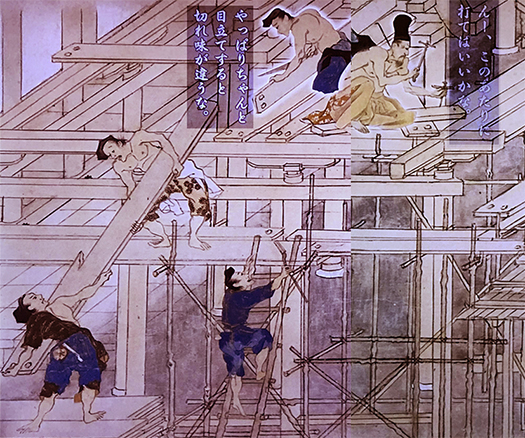
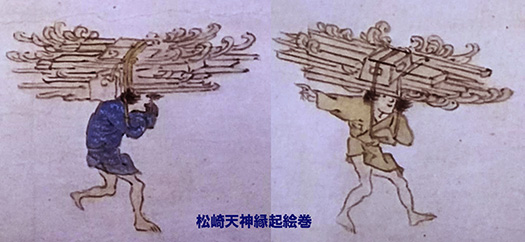
面白いのは2枚目の絵柄で、この古社の装飾材を運んでいる様子。
軽量の組み手装飾部材を頭に乗せてバランスを取りながら運搬している。
日本女性の荷物運搬ではこういうポーズも知られているけれど、
建築に関連する部材を運ぶ様子として興味深い。
・・・この絵巻を巡っての建築の様子を掘り下げてみたい。

English version⬇

[From Matsuzaki Tenjin Engi Emaki / Japanese Good House Special Edition ㊲-1]
By the way, it is the return of the “Japanese good house” series again.
The Takenaka Carpentry Tools Museum exhibition in Kobe is a museum where you can know the core part of wooden architecture.
If it’s nearby, it’s a place I’d like to go through and indulge in.
It is such a time, and there is no choice but to reconstruct the photo records at the time of the visit.
However, on the contrary, it is possible to dig deeper by organizing the materials because it is not possible to visit.
What was taught in the exhibition was an old picture scroll that illustrates carpentry.
It is the title “Matsuzaki Tenjin Engi Emaki”.

Matsuzaki Tenjin is the current Hofu Tenmangu Shrine in Matsuzaki-cho, Hofu City, Yamaguchi Prefecture.
What was this name at the time of its foundation has changed.
It is known as the first “Tenjin-san” to enshrine Sugawara no Michizane.
Tenjin-san has about 12,000 companies nationwide, so it’s a company with roots.
On the way westward to Dazaifu, Kyushu, Michizane relied on Mr. Haji (a family member of Michizane), the Kokushi of Suo Province.
We arrived at Katsuma no Ura in Hofu, the last port of call in Honshu.
“I’m still here, and hopefully I’ll occupy my place here.”
Although it is finally Kyushu, the land of Hofu is still connected to the capital of Kyoto, where the emperor is.
Hopefully I will settle here in Matsuzaki and wait for the “innocent news”. ) And wishes
He left for Kyushu. On the day he passed away in Dazaifu, Shinko appeared in the ura of Katsuma, Hofu.
Mizuun surprised the people who shelved on Mt. Sakadare (currently Mt. Tenjin). Kokushi and other villagers
Realizing that the spirit of Michizane became light and became clouds and returned to “this place”,
The following year, in the 4th year of Engi (904), as Michizane requested, the residence of the spirit soul was erected in this land of Matsuzaki.
It has an auspicious name called “Matsuzaki no Sha”.
Therefore, it is an old shrine that has been built for 1,117 years.

The state of architecture is depicted in the picture scroll No. 3 that has been handed down as the luck of this old shrine.
Shinto shrine architecture is the highest level of prestige building and shows the highest level of building technology of the time.
Of course, it was a pit-house dwelling as well as a general house, and it was basically a simple hut with a clay floor.
The interior of the building is a prestigious building with all floors raised.
Not only the structure, but also the decorative material called kumite was heavily assembled.
The photo above is from a video from a program produced by a local broadcaster.
I am trying to make it three-dimensional with CG technology while using the picture scroll design as a mother.
A lot of carpentry work was done on the construction of Matsuzaki Tenjin Shrine.
The technology for processing wood must have been the most advanced technology in society at that time.
Because ordinary houses do not involve such technical craftsmen.
It is common for the residents themselves to form a “Yui” and build it using amateur human wave tactics.
Professional engineers would have been concentrated on the shrines and temples built in various places.
What is interesting is the second pattern, which seems to be carrying the decorative materials of this old shrine.
Lightweight kumite decorative members are carried on the head in a balanced manner.
This kind of pose is also known for Japanese women carrying luggage,
It is interesting to see how to carry materials related to architecture.
… I would like to delve into the state of architecture around this picture scroll.

【ワクチン2回目接種完了】


一昨日、札幌市の大規模会場で2回目のワクチン接種完了しました。
1回目の時は平日夕方、最終回の接種で人数はそれほど多くなかったのですが、
早朝1番の接種時間では感じとしては今回は10倍くらいの混みよう。
わたしはモデルナ製のワクチンだったので1回目からは4週間の間隔。

会場ではけっこう若い方の姿も見られて札幌市の状況も
だいぶ改善されてきた様子がわかります。
2回接種の人口が3000万人を越えて危険性の高い高齢者層が終了しつつある。
おおむね高齢の希望者には行き渡ってきた段階かと。
事実、感染は無症状が中心で死亡率は劇的に低下してきている。
接種券についてはスタッフの家庭にも届き始めていて
わたしより⒌歳下のカミさんにも数日前に到着。
札幌市の場合、申込み受付可能期日が年齢別に区切られているようで
8月に入ってからの申込みということになりそうです。
ワクチンについてはもちろんそれを打たない自由もありますが、
日経新聞サイトに掲載された上の図表を見れば相当割合の国民が
ワクチン接種を受け入れているように思います。
オリンピックの開会式も本日ということで、
感染者自体は増えているけれど死亡重症の割合はコントロールされているので、
なんとかこの困難な状況で無事に会期が進んでいくことを祈念したい。

わたしの場合、副反応としてはやはり2回目の方がやや感じます。
これは接種会場で配布されていたペーパーでも明記されていますが、
1回目よりも2回目の方がより強いようです。
発熱症状はありませんが、接種部の痛みとダルさ、疲労感でしょうか。
安静を保つ日常生活には支障はないけれど、
どうも朝の散歩に出掛けたい、とまでは気力が沸いてこない。
まぁ、サボりたくなるって言う程度のことでしょうか。
しかしそれも含めて潔く受け止めて大人しくしていようと思います。
ちょうど連休にも当たるので、慎重に体力回復を図りたいと思います。
以上、ワクチン接種のご報告でした。ご参考までに。

English version⬇

[Completion of the second vaccination]
The day before yesterday, the second vaccination was completed at a large-scale venue in Sapporo.
The first inoculation was on weekday evenings, and the number of people was not so large in the final inoculation.
At the first inoculation time in the early morning, it will be about 10 times more crowded.
Since I was a vaccine made by Moderna, it is every 4 weeks from the first time.

At the venue, you can see some young people and the situation in Sapporo.
You can see how it has improved considerably.
The population of double vaccination has exceeded 30 million, and the high-risk elderly group is ending.
I wonder if it has reached the stage where it has generally reached the elderly applicants.
In fact, infections are mainly asymptomatic, and the mortality rate has dropped dramatically.
The vaccination ticket is starting to reach the staff’s home
I arrived at Kami, who is ⒌ younger than me, a few days ago.
In the case of Sapporo City, it seems that the deadlines for accepting applications are divided by age.
It seems that the application will be made after the beginning of August.
I have the freedom not to hit the vaccine,
If you look at the chart above posted on the Nikkei newspaper site, a considerable proportion of the people
I think I am accepting vaccination.
The opening ceremony of the Olympics is also today, so
Although the number of infected people is increasing, the rate of serious mortality is controlled, so
I hope that the session will proceed safely in this difficult situation.

In my case, I feel that the second side reaction is a little better.
This is clearly stated in the paper distributed at the inoculation site,
The second time seems to be stronger than the first time.
I don’t have any fever symptoms, but is it pain, dullness, or tiredness at the inoculation site?
It doesn’t hinder your daily life, but it doesn’t hinder your daily life.
I don’t feel like going out for a walk in the morning.
Well, is it just that you want to skip?
However, including that, I will take it gracefully and be quiet.
It’s just a holiday, so I’d like to carefully recover my physical strength.
This is the report of vaccination. For your information.