本文へジャンプ

【古民家の床材「ハレとケ」/日本人のいい家㉒-4】


さて現神奈川県秦野に334年前からあった古民家最終回。
日本の古民家探訪というのは、古層の民俗を掘り起こす感覚にいちばん近い。
現代を我々は生きているけれど、そのわたしたちの生き方の基盤は
こういった古民家の民俗性に根源があるのだと思わされる。
そう考えてくると、やはり「ハレ」の空間には「大事にしてきたこと」が
鮮明にピンナップされているものなのでしょう。
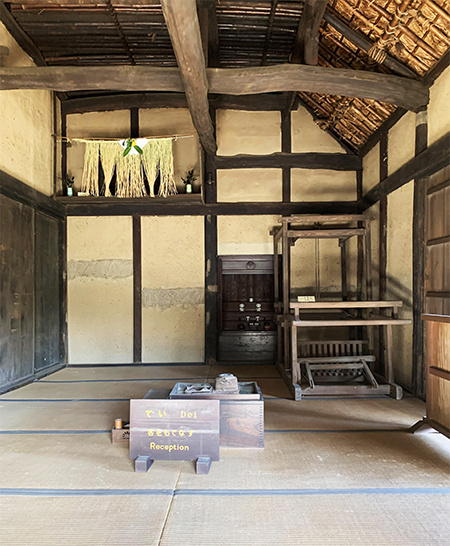
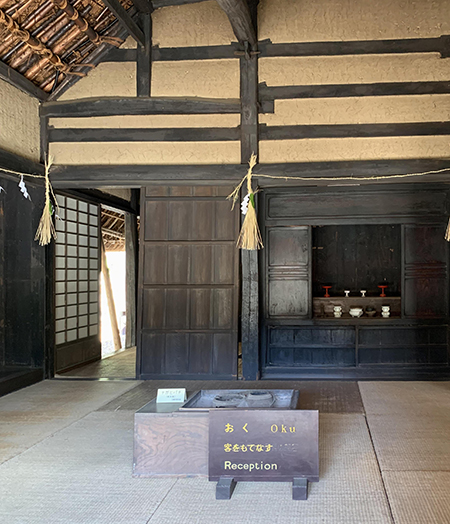
祖先への帰依を強く感じさせられる仏壇や精神性を伝える床の間。
やはりこの列島社会では、こうした価値感でわれわれは生き延びてきた。

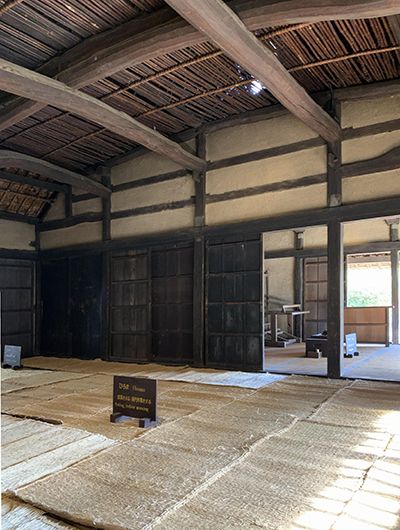
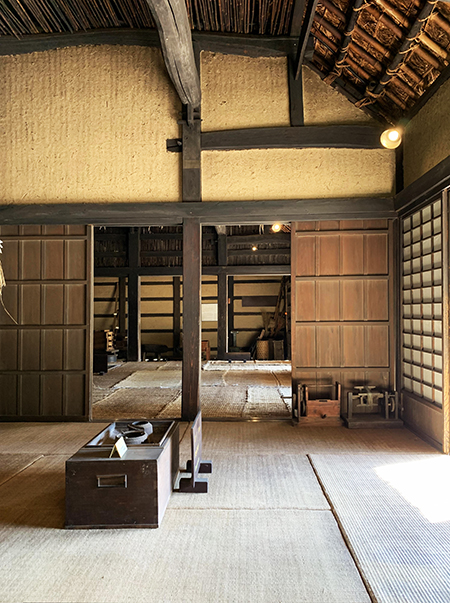
そういうなかでもやはり「畳の間」という文化は格別。
江戸時代中期、まさにこの家の建てられた頃くらいまで
一般庶民は「畳の間」が普及していなかったとされています。
全国畳産業振興会HPをみると、
「中国伝来のものが多いなかで、畳は日本固有の敷物。その歴史は
「菅畳八重」「皮畳八重」などの記述がある古事記にまでさかのぼります。
まだ畳床などはなく、コモなどの敷物を重ねたものと推測されます。
現在の畳に似た構造になったのは平安時代。板敷に座具や寝具として
置くという使い方で、使う人の身分によって畳の厚さやへりの柄・色が異なりました。
鎌倉時代から室町時代にかけ、書院造が生まれて、部屋全体に
畳を敷きつめる使い方に発展しました。それまでは高貴な人や客人の
もてなしのためのものでしたが、建物の床材として利用されるようになったのです。
しかしそうした使い方も貴族や武士の富の象徴。
桃山時代さらに江戸時代に至るなかで、数奇屋造や茶道が発展して普及し、
徐々に町人の家にも畳が敷かれるようになりました。
それでも身分による畳の制限の風習は残り、庶民が使用できるようになったのは
江戸時代中期以降。畳師・畳屋と呼ばれる人々が活躍し、
畳干しする家々の光景があちこちで見られるようにいなりました」
と記述されています。
なぜ日本独自で畳という進化した床素材があるのか、
本当にオモシロい民俗だと思われてならない。
畳の間で仏壇・床の間が装置されるという、ジャパンオリジナル空間。
これは誰が作ったという文化ではなく、日本という社会が作ってきた規範。
座るということに深くこだわった結果がこの畳文化なのか、
いやそうではなく、畳とは最上級の「寝室床」ということで
言ってみればベッドとカーペットの中間的存在で日本独自に発展したものか。
体感的に言えば畳の間では、つい寝そべりたくなって「大の字」になる。
板敷きの床ではあんまりそんな衝動には駆られないけれど、
畳の間ではついそうしたくなるのにはきっと理由があるのでしょう。
そういう空間に先祖が祀られているのには、日本人的感受性が表現されている。
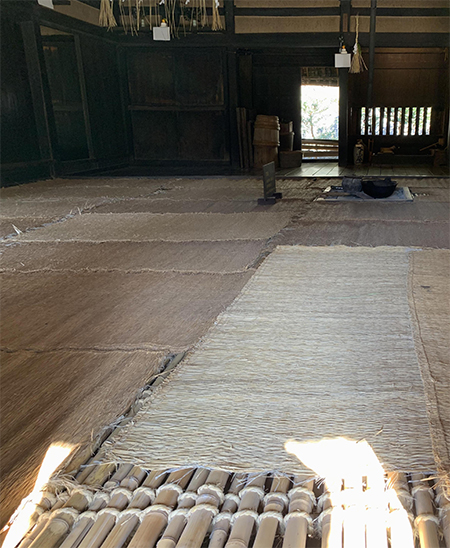
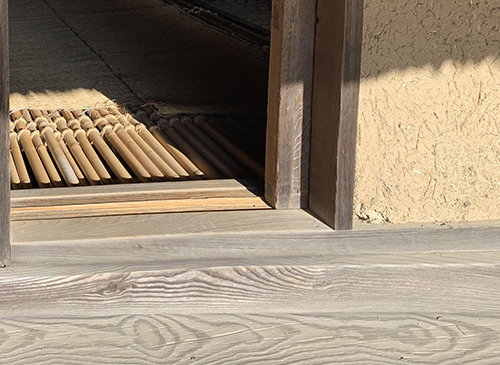
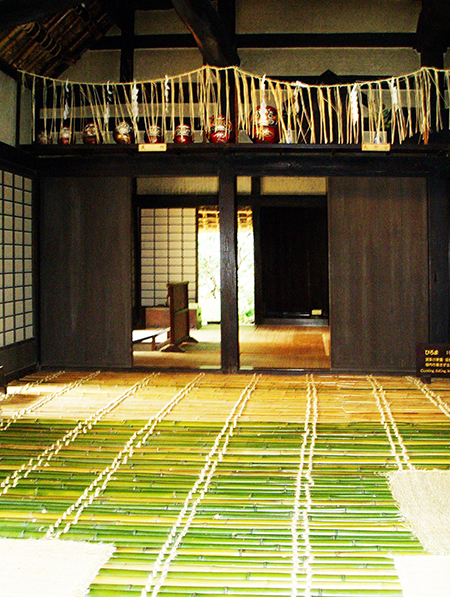
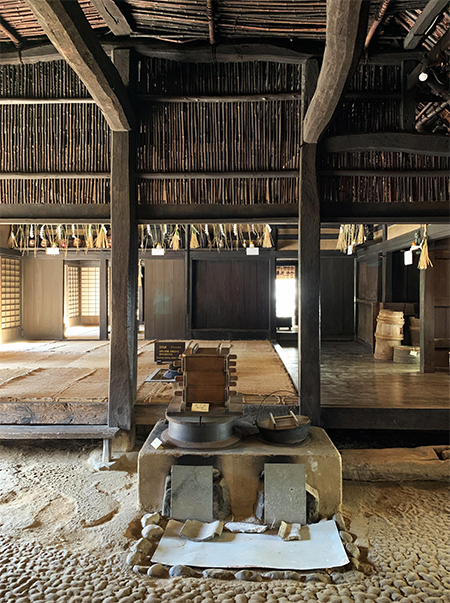
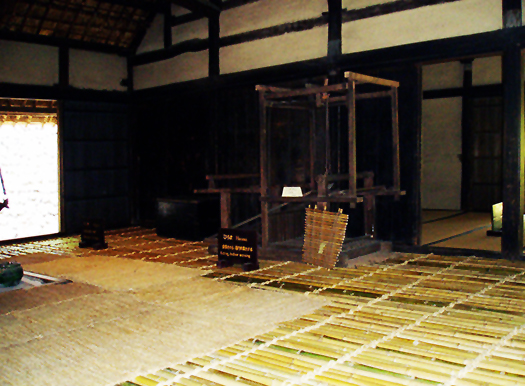
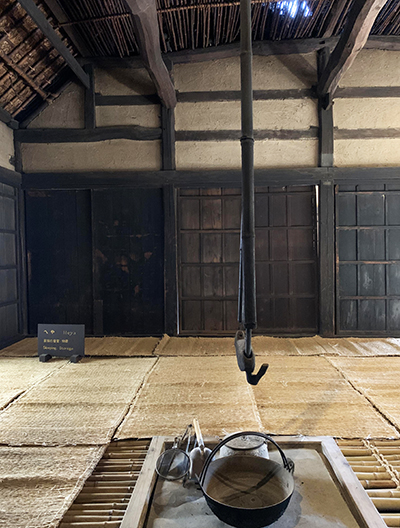
一方で、この家の竹簀の子敷き+ムシロカーペットという構成も
いかにも地域の気候風土に柔軟に対応しようとする民俗が感じられる。
第一、床が竹だと毎日が「竹踏み健康法」になるではないか(笑)。
ツボが刺激されていいとされている。
身分制での規制があったことで逆に庶民はどんどん健康になった?
前向きに考えるという意味では、有効な社会環境だったとも思える。

現代住宅では自由に素材選択可能であるけれど、
こういった民族体験はかならず投影されていくものでしょうね。

English version⬇

[Floor material for old folk houses “Hare and Ke” / Good Japanese house ㉒-4]

By the way, the last inning of an old folk house that has existed in Hadano, Kanagawa Prefecture for 334 years.
Exploring old Japanese houses is the closest to digging up old folk.
We live in the present age, but the foundation of our way of life is
It seems that the folk nature of these old folk houses has their roots.
When I think about it, there is something that I have cherished in the space of “Hare”.
It must be clearly pinned up.
A Buddhist altar that makes you feel strongly devoted to your ancestors and an alcove that conveys spirituality.
After all, in this archipelago society, we have survived with such a sense of value.

Even so, the culture of “tatami mats” is exceptional.
Until the middle of the Edo period, when this house was built
It is said that the “tatami room” was not popular among the general public.
Looking at the National Tatami Industry Promotion Association HP ,
“Among many of them from China, tatami is a rug unique to Japan. Its history is
It goes back to the Kojiki with descriptions such as “Suga tatami mat Yae” and “Skin tatami mat Yae”.
There are no tatami floors yet, and it is presumed that rugs such as como are piled up.
It was during the Heian period that the structure resembled the current tatami mats. As a seat or bedding on a board
The thickness of the tatami mat and the pattern and color of the edge differed depending on the status of the user.
From the Kamakura period to the Muromachi period, Shoin-zukuri was born, and the entire room
It has evolved into a way of using tatami mats. Until then, of noble people and guests
It was for hospitality, but it has come to be used as a flooring material for buildings.
However, such usage is also a symbol of the wealth of aristocrats and samurai.
During the Momoyama period and the Edo period, Sukiya-zukuri and tea ceremony developed and became widespread.
Gradually, tatami mats were laid in the houses of the townspeople.
Even so, the custom of restricting tatami mats by status remained, and it was only possible for ordinary people to use it.
Since the middle of the Edo period. People called tatami mat masters and tatami mats are active,
You can now see the sights of tatami-dried houses here and there. ”
It is described as.
Why is there an evolved floor material called tatami that is unique to Japan?
Don’t think it’s a really funny folklore.
A Japan-original space where the altar and alcove are installed between tatami mats.
This is not a culture of who created it, but a norm created by the Japanese society.
Is this tatami culture the result of a deep commitment to sitting?
No, not so, tatami is the highest grade “bedroom floor”
So to speak, it is an intermediate between the bed and the carpet, and it was developed uniquely in Japan.
Speaking sensibly, between tatami mats, you just want to lie down and become a “large letter”.
I can’t really drive such an urge on a wooden floor,
There must be a reason why you want to do that between tatami mats.
The fact that ancestors are enshrined in such a space expresses Japanese sensitivity.

On the other hand, the composition of this house’s bamboo duckboard + Mushiro carpet is also available.
You can feel the folklore trying to flexibly respond to the local climate.
First, if the floor is made of bamboo, every day will become a “bamboo stepping health method” (laughs).
It is said that the acupoints are stimulated.
Did the common people get healthier and healthier because of the restrictions on social division?
In terms of thinking positively, it seems that it was an effective social environment.

In modern houses, you can freely select the material,
This kind of ethnic experience will always be projected.

【大工職人・竹簀子・縁起ダルマ/日本人のいい家㉒-3】


江戸時代中期の農家住宅で床に竹簀の子が使われているのは、
板床の素材入手が困難であったという事情があるとされる。
たしかに現金収入、市場経済が十分に普及していない段階では、
製材が困難な木の板は入手することが難しかった可能性が高い。
板の製材では大がかりな木挽きの土場が不可欠で、
そのための大鋸使いの専門的な工程が必要だった。
技術があってもその装置を導入するに足る市場性があるかないかの問題。
鄙の建築現場では製材を流通させて現場に運んでくる経費も
大きな負担になったことだろう。ふつうそういうのはキャンセルされる。
必要なのは小ロットであり、流通に乗せての産業化はしにくい。
棟札の残るこの家では専門職として「木挽」の名が記されている。
基本的には建築材料は地元の自然環境から用意されたモノでしょう。
あたりをつけた地元の山から必要な材木を棟梁と木挽2人で
切り出す段取りをする工程から建築作業が始まったに相違ない。
木挽きは地元を知り尽くしていたに違いなく、
「これはあそこの柱、こっちは梁に使う」と相談して決めた。
しかし木の板はムリでも、よりよいものを選択する知恵はあっただろう。
南関東は温暖であり夏期は蒸暑気候が襲ってくる。
そういう風土条件からすれば竹簀の子床は地面と茅葺き屋根などの温度差で
微妙な空気対流効果が期待されただろうと思います。
もちろん「冬期の寒さは肌の感覚がなくなってしまうほどだった」
というこの家の住人へのヒアリング記録があるのだけれど、
さりとて床材の木板と竹簀の子での相違は家全体の断熱にさしたる効はない。

21回で見た多摩丘陵近くの川崎の家では武蔵野の雑木林から
曲がりの激しい木材を多用して、木組み技術で300年以上の耐久性を確保していた。
その武蔵野雑木林と比較すればこの秦野の家は、丹沢山系に近く、
より良質な構造材を獲得できたと思われます。
しかし、古民家では主要居室での梁組み表しが大工棟梁の腕の見せ所だったか、
この家でも棟札に名の残る職人たちの仕事の痕跡が残る。
「大工者鍛冶谷村 理兵衛 平沢村 源兵衛 当村木引 七兵衛
貞享四年丁卯二月吉日 大工当流 理兵衛」
当流とは、棟梁の当て字だろうけれど、理兵衛さんの仕事が梁組みに残る。
木引と記載があるけれど当用漢字では木挽だろう。
先般見た九十九里の網元の家でも主要居室天井の「木組み」が見事だったが、
いわゆる「腕の見せ所」という大工文化を想像させる。
この家でも野太い梁が交差する様が見事だけれど、
梁材の「曲がり」は激しくはない。根曲がりぶりでは五箇山の家の
「チョーナ梁」には及ばない。比較的温暖な気候風土が反映されたか。
あるいは職人さんたちへの手当てが九十九里の網元ほどには潤沢でなく
材料を探せる地域範囲が比較的近隣地域に限定されていたのか、
このあたり、職人仕事とその江戸期でのコスト感覚にも想像が及ぶ。さて。
こういったポイントも含めてまさに「地域性」が強く反映するのが
住宅建築業という業態の初源的な姿であるように強く思われる。
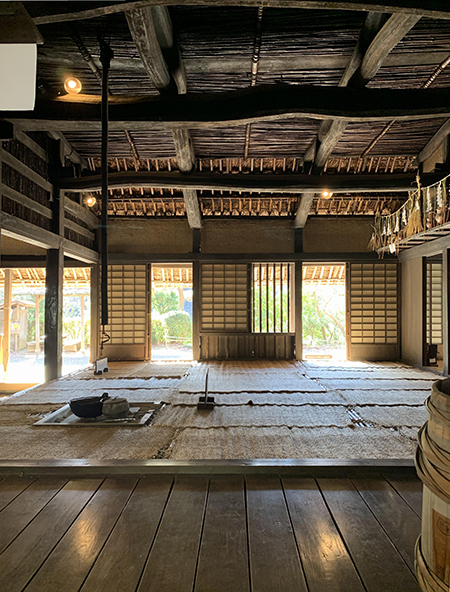
その梁の木組みの上に、竹簀の子で天井が組み上げられている。
天井という建築の組成は、初源的出自理由は冬期の室温維持だろう。
せっかく薪暖房をしても、必要な居室空間気積が大きすぎるので
それをより小さくすることが求められたのだと思う。
これも床材料と同様の理由からこの地域では竹が利用されたのだろう。
これらの竹簀の子は組み上げるのに紐で連結されている。
あるいは大工棟梁の指示を受けて家人たち総出で組み上げたのではないか。
一番上の写真では、土間と居室の区切りに柱の上部に壁が作られている。
ここでも竹簀の子組みが採用されている。
こういった職人に頼むほどではない作業については、
DIY的な工夫がされるだろうことも容易に想像される。

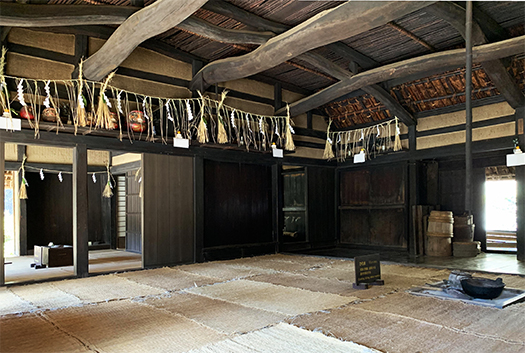
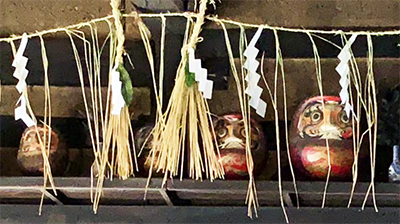
神棚のような縄飾りされた箇所に、かわいい達磨さんを発見。
毎年新年になると前の年より「少し大きめ」の達磨さんが飾られたという。
毎年1個ずつが購入されていったので、あらたに購入したときに
既存の8個の中から1個が地元神社で「ドント焼き」奉納されたとか。
「七転び八起き」という縁起担ぎなのか。日本民俗・・・。

English version⬇

[Carpenter / Bamboo drainboard / Auspicious Dharma / Good Japanese house ㉒-3]

Bamboo drainboards are used on the floor in farmhouses in the middle of the Edo period.
It is said that it was difficult to obtain the material for the board floor.
Certainly, at the stage when cash income and market economy are not sufficiently widespread,
It is highly possible that it was difficult to obtain wooden boards that were difficult to saw.
A large-scale wood-grinding yard is indispensable for sawing boards,
For that purpose, a specialized process of using a large saw was required.
The question of whether or not the technology is marketable enough to introduce the device.
At the construction site of the countryside, the cost of distributing lumber and bringing it to the site is also
It would have been a big burden. Usually such things are canceled.
What is needed is a small lot, and it is difficult to industrialize it for distribution.
In this house where the building tag remains, the name “Kobiki” is written as a profession.
Basically, building materials will be prepared from the local natural environment.
Two people, a builder and a kobiki, get the necessary timber from the local mountain
The construction work must have started from the process of cutting out and setting up.
Kobiki must have known the local area,
I consulted and decided, “This is the pillar over there, and this is the beam.”
However, even if the wooden board was unreasonable, there would have been wisdom to choose a better one.
South Kanto is warm and the hot and humid climate hits in the summer.
Considering such climate conditions, the bamboo drainboard floor is due to the temperature difference between the ground and thatched roof.
I think that a subtle air convection effect would have been expected.
Of course, “the cold in winter was so cold that I couldn’t feel my skin.”
There is a record of hearings with the residents of this house,
The difference between the wooden flooring and the bamboo drainboard is not as effective as the heat insulation of the whole house.

At Kawasaki’s house near the Tama Hills, which I saw in the 21st time, from the thickets of Musashino
By using a lot of wood that bends sharply, the woodworking technology ensured durability for over 300 years.
Compared to the Musashino thickets, this Hadano house is closer to the Tanzawa Mountains,
It seems that we were able to obtain better quality structural materials.
However, in the old folk house, was the beam assembly in the main room a showcase for the carpenter’s arm?
Even in this house, traces of the work of the famous craftsmen remain on the building tag.
“Carpenter Blacksmith Tanimura Ribei Hirasawamura Genbei Our Village Kibiki Shichibei
Jokyo 4th Year Yin Fire Rabbit February Yoshiday Carpenter’s Current Ribei ”
The current style is probably the Ateji of the ridge, but Ribei’s work remains in the beam structure.
Although it is described as Kobiki, it is probably Kobiki in this kanji.
At Amimoto’s house in Kujukuri, which I saw recently, the “wooden frame” on the ceiling of the main room was wonderful.
Imagine a carpenter’s culture of the so-called “arm show”.
Even in this house, it is wonderful that the thick beams intersect,
The “bending” of the beam material is not severe. Gokayama’s house for the first time in a bent root
It is not as good as “Chona Liang”. Did it reflect a relatively warm climate?
Or the treatment for craftsmen is not as abundant as Amimoto in Kujukuri.
Was the range of areas where materials could be searched for relatively limited to neighboring areas?
Around this time, I can imagine the craftsmanship and the sense of cost in the Edo period. Now.
Including these points, the “locality” is strongly reflected.
It seems strongly that it is the original form of the housing construction industry.
The ceiling is built on the wooden structure of the beams with bamboo drainboards.
The original reason for the architectural composition of the ceiling is to maintain room temperature in winter.
Even if you use firewood heating, the required living space is too large.
I think it was required to make it smaller.
Bamboo may have been used in this area for the same reason as the floor material.
These bamboo drainboards are tied together with a string to assemble.
Or maybe it was assembled by all the family members in response to the instructions of the carpenter builder.
In the top photo, a wall is made at the top of the pillar to separate the dirt floor from the living room.
Bamboo drainboards are used here as well.
For work that is not enough to ask these craftsmen,
It’s easy to imagine that DIY ideas will be made.

I found a cute Daruma doll in a rope-decorated place like a Kamidana.
It is said that every New Year, Mr. Daruma, who is “a little bigger” than the previous year, was displayed.
One was purchased every year, so when I bought a new one
One of the eight existing ones was dedicated to “Don’t Yaki” at a local shrine.
Is it a lucky bearer called “seven falls and eight rises”? Japanese folklore …

【かまどペチカ&座姿勢調理/日本人のいい家㉒-2】


古民家を見ていると、その空間のワンルーム感覚に気付かされる。
細々と壁を造作する手間を掛けられなかった、ということが要因だろうけれど、
いわゆる「個人主義」的な家族内仕切りが日本人的心性からは
あまり発展せず、家族一体型の間取りの仕方が普通であったからだと思う。
そういうなかで個室化があるのは、まずは祖父母の居室であり、
次いで家長自身の居室というように進んでいたのが実際だろう。
家族とは、家系の生業を一体となって支える運命共同体認識だったことが、
多くの民家の間取りからうかがい知ることができると思う。
遙かな後年、北海道の住宅はその高断熱高気密化の過程で、
細かく部屋を仕切って各室毎の温熱環境を工夫するよりも
家全体の断熱気密を考えていく「全室暖房」という考え方が自然になった。
そうすると細かく用途毎に部屋として区切るよりも
大きなワンルームという志向性が高まっていった。
そういう家の考え方と古民家の空間性にはどうも共通要素があると思う。
まったく違う経緯からの選択だけれど結果は同じような空間志向になった、みたいな。

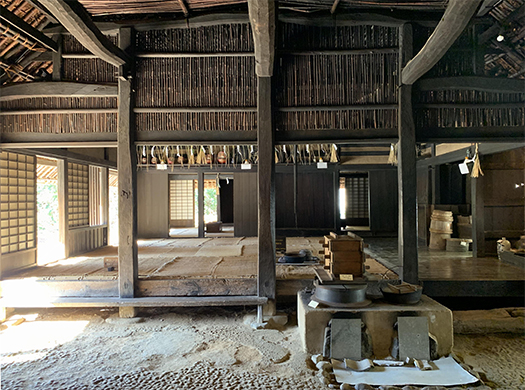
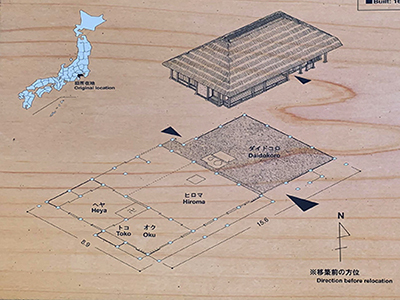
この南関東・秦野の家ではかまどがドーンと中央に鎮座する。
土間と竹スノコ床の中心居室ヒロマの境界に置かれて、
暖房と加熱調理の両方の役割を担っていたことがあきらかな配置。
かまどは土を塗り固めて造作するモノであり、内部でバイオマスを燃焼させる。
加熱調理のパワーを集中させるのがメインの役割だが、
この土塗りという組成から室中にゆったりとした「輻射熱」を放射する。
日本ではいわゆるペチカのような暖房器具は発展しなかったとされるけれど、
しかしこのかまどを見れば、ペチカとほぼ同様に機能したのではないか。
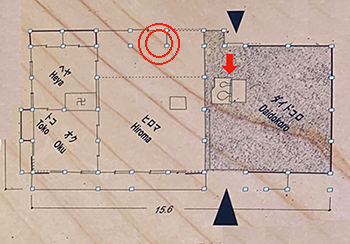
この家の場合、配置が絶妙でありヒロマの囲炉裏もこのペチカと近接配置。
かまど・囲炉裏・流しと接近しているので、非常に合理的な動線が垣間見える。
かなり複合的な温熱感を人々に与えたのではないだろうか。

さらに◎の位置には調理のための空間が配置されている。
先日のブログでも書いたけれど、この時代の台所・調理は「座って」行っている。
現代人は当然のように「立って」調理することに慣れているから奇異に感じる。


しかし、『台所道具の歴史(⑨)』という本で著者の栄久庵憲司さんは
〜「座って調理をしていた日本人が、立って仕事をするようになったのは
台所史上の大事件である。・・・高度な料理をめざし、しかも主婦の負担を軽くしようと
したのが『立働式』台所の成因であろう。」 元来、生活様式全般が床座式である
日本では、台所も例外ではなく、かまどや流しも床に作られ炊事作業は
座って行われていた。広い空間で比較的単純な食事の用意をし、女性の地位が
低い時代は座って炊事をすることが一般的であった。〜と述べている文章を発見。
不勉強でしたが、まことに膝を打つ思いがしました。
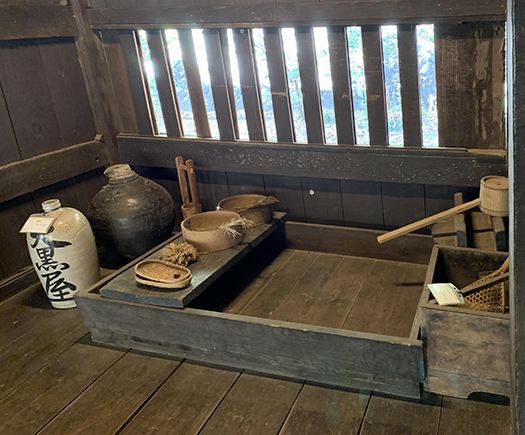
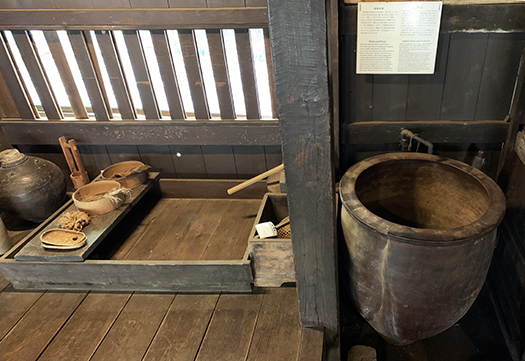
写真のような調理空間では、甕から水を柄杓で掬って「流し」で何かを洗うにも
なかなか大変だったことがわかる。
この家の解説でも座り姿勢での調理はしにくかったという記述もあった。
日本女性の常時姿勢が「立て膝」であることの意味もなんとなく見えてくる。
土間は火力調理には適しているが、より衛生的な環境が要求される
「洗う、切る」といった基本調理は、こういった板座の空間で行われたのだろう。
そして頻繁に土間の火力調理をチェックする必要性から
常時姿勢は立て膝でいるほうが臨機応変であったのだと思われる。

う〜む、今度一回、立て膝姿勢で調理してみようかなぁ。
どう考えても、複数料理の進行には適していないと思うし、
切ることだけを考えても、力の発揮に難があるように思われる・・・。
っていうか、日本の住宅に「床」が普遍化したのは、
それほどの歴史時間ではないとされる。調理空間はまだ過渡的だった?
古来からの「調理」方法の推移を研究しなければならないでしょうね。
おお、料理&歴史男子の血が騒いできた(笑)。

English version⬇

[Kamado stove & sitting posture cooking / Japanese good house ㉒-2]

Looking at an old folk house, you will notice the feeling of a studio in the space.
It may be because I couldn’t take the trouble to make the wall in detail.
The so-called “individualist” family partition is from the Japanese spirit
I think it was because it didn’t develop much and the family-integrated layout was normal.
Under such circumstances, the first thing that has become a private room is the grandparents’ room.
Next, the fact was that the patriarch’s own room had progressed.
The fact that the family was a fateful community recognition that supported the livelihood of the family as one
I think you can tell from the floor plans of many private houses.
A long time later, houses in Hokkaido were in the process of being highly insulated and airtight.
Rather than partitioning the rooms into small pieces and devising a thermal environment for each room
The idea of ​​”heating all rooms”, which considers the heat insulation and airtightness of the entire house, has become natural.
Then, rather than dividing it into rooms for each purpose
The intention of being a large studio has increased.
I think there is something in common between the way of thinking of such a house and the spatiality of an old folk house.
It seems that the selection was made from a completely different background, but the result was a similar space orientation.

In this house in Hadano, South Kanto, Kamado sits in the center with Dawn.
Placed on the border of the central living room Hiroma of the dirt floor and the bamboo drainboard floor,
Arrangement that was clearly responsible for both heating and cooking.
Kamado is a product made by painting soil and burning biomass inside.
The main role is to concentrate the power of cooking,
From this composition of earth coating, a relaxing “radiant heat” is radiated into the room.
It is said that heating appliances such as so-called stoves did not develop in Japan,
However, if you look at this kamado, it seems that it worked almost the same as a stove.
In the case of this house, the arrangement is exquisite and the hearth of Hiroma is also arranged close to this stove.
Because it is close to the kamado, hearth, and sink, you can get a glimpse of a very rational flow line.
I think it gave people a fairly complex feeling of heat.

Furthermore, a space for cooking is arranged at the position of ◎.
As I wrote in my blog the other day, the kitchen and cooking of this era is “sitting”.
It feels strange because modern people are naturally accustomed to “standing” cooking.

However, in the book “History of Kitchen Tools (9)”, the author, Kenji Ekuan, said
~ “The reason why Japanese people who were sitting and cooking started to stand up and work
This is a big event in the history of the kitchen.・ ・ ・ Aiming for advanced cooking and reducing the burden on housewives
That was probably the origin of the “standing-up” kitchen. Originally, the overall lifestyle is a floor-sitting type.
In Japan, the kitchen is no exception, and the kamadoya and sink are made on the floor and the cooking work is done.
It was done sitting down. Prepare a relatively simple meal in a large space, and the status of a woman
In the low days, it was common to sit down and cook. I found a sentence that states.
I didn’t study, but I really felt like hitting my knee.
In a cooking space like the one in the picture, you can scoop water from the jar with a cassotte and wash something with a “sink”.
It turns out that it was quite difficult.
The meaning of the constant posture of Japanese women being “standing knees” can be seen somehow.
The dirt floor is suitable for thermal cooking, but a more hygienic environment is required.
Basic cooking such as “washing and cutting” was probably done in such a space on the board.
And from the need to check the firepower cooking in the soil frequently
It seems that the constant posture was more flexible when standing on the knees.

Hmmm, let’s cook in a standing knee position once again.
By all means, I don’t think it’s suitable for the progress of multiple dishes,
Even if you just think about cutting, it seems that there is a difficulty in demonstrating power.
You will have to study the transition of “cooking” methods from ancient times.
Oh, cooking & history The blood of boys is making noise (laughs).

【築334年・南関東南面縁側の家/日本人のいい家㉒-1】


さて「日本人のいい家シリーズ」として、古民家探訪であります。
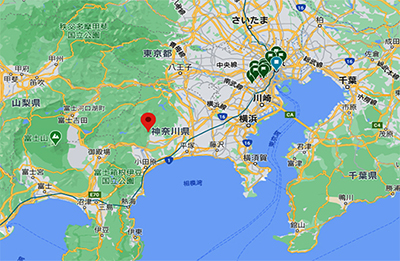
その22回目の住宅は、相模国・現神奈川県秦野市近郊の農家住宅。
前回21回の川崎市北部・多摩隣接地域「旧伊藤家」から50-60kmほど西。
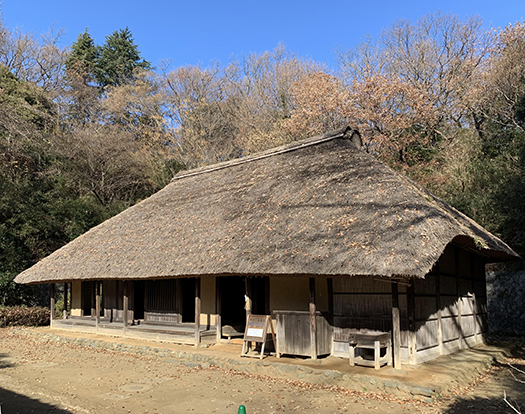
こちらは「棟札」も明確に存在する建物で、建築年代は1687年と確定している。
江戸時代前期。ちょうど「生類憐れみの令」が発令された時期。
いまから334年前ということになります。「名主の分家」という伝承があり、
経済的にはある程度安定していた農家とされています。
建物を分析すると前回見た「旧伊藤家住宅」と非常に似ていて、
太平洋岸地域の人々の古層の暮らしぶりが薫ってくる気がします。
やはり関東のなかでも有数の「日射取得率」が感じられる。


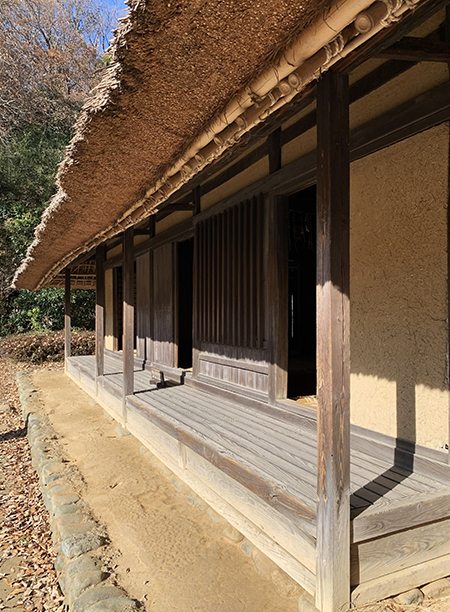
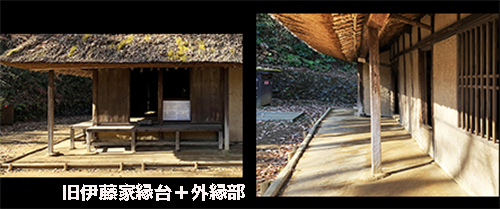
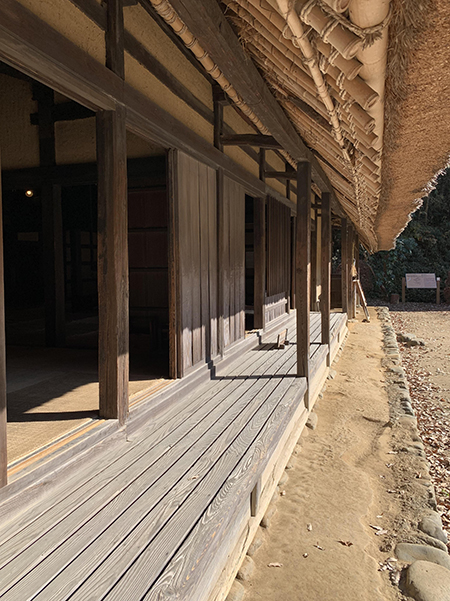
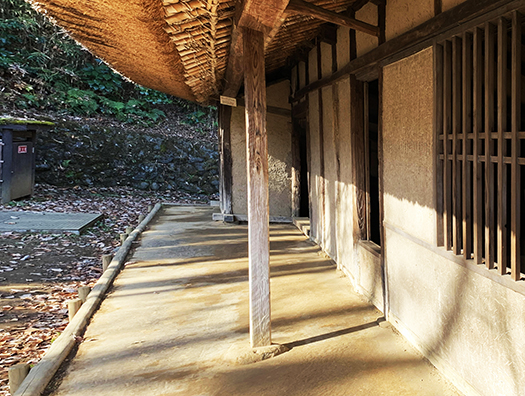
もっとも特徴的なのは、外観でも見えている居室から張り出した「広縁」。
この建物よりも少し古いと想像される旧伊藤家と比較すると
こちらの広縁は日射取得をより積極化させたと思える。
旧伊藤家では縁は「縁台」的な仮設的仕様だったけれど、こちらでは
いかにもこの家の「主役的」空間として重視されている。
関東南部としての地域気候対応を進化させると、このような方向性になるのかと。


どちらの家でも深い軒の出があって、
過剰な日射は遮る工夫がされているのですが、
軒の下への日射を考えるとたとえば冬であっても日足が長いので
かなり室内まで入ってくるだろうし、縁の上では
かなり快適な温度環境、陽だまりをたっぷりと楽しめるのではないか。
太陽光からの輻射熱は気温条件に加えてさらに好適な環境を作った。
いかにも「南関東」という地域風土からの対応の知恵。
遠く蝦夷地の気候風土からは考えられない温熱的快楽装置。
この家の場合、出入り口横にあるので、縁でのコミュニケーションが
相当に意図されていたことが見て取れる。
現代の日本家屋で失われたコミュニケーションの最たるものが
このような空間での人付き合いではないかと思う。
いま東京など過密都市部では、防犯性能の方にはるかに関心が向いている。
温熱的にも人間関係的にも「開放性」要素は消えつつある日本文化か。
そもそもの民家スタート時点から縁の空間が消え去っていった北海道だからこそ
こういう縁側空間での人間コミュニケーションに強く惹かれる。
なんか日本住宅の進化で、忘れ物したような・・・。

English version⬇

[334 years old, house on the south side of South Kanto / Japanese good house ㉒-1]

By the way, as a “Japanese good house series”, we are exploring old folk houses.
The 22nd house is a farmhouse in the suburbs of Hadano City, Kanagawa Prefecture, in Sagami Province.
It is a little west of the area adjacent to Tama in the northern part of Kawasaki City, which was 21 times last time, and is close to Odawara.
This is a building that clearly has a “building tag”, and its construction date is confirmed to be 1687.
Early Edo period. It was the time when the “Decree of Mercy for Living Things” was issued.
It is 334 years ago. There is a tradition of “branch of the master”,
It is said that the farmer was economically stable to some extent.
Analyzing the building, it looks very similar to the “former Ito family house” I saw last time.
I feel that the lifestyle of the ancient people in the Pacific coast region is fragrant.
After all, you can feel one of the leading “solar radiation acquisition rates” in the Kanto region.

The most distinctive feature is the “wide edge” that overhangs from the living room, which is visible from the outside.
Compared to the former Ito family, which is supposed to be a little older than this building
This wide rim seems to have made the acquisition of solar radiation more aggressive.
In the former Ito family, the edge was a temporary specification like a “marriage stand”, but here
It is really valued as the “leading” space of this house.
I wonder if this will be the direction if we evolve the regional climate response as the southern part of the Kanto region.

Both houses have deep eaves
Although it has been devised to block excessive sunlight,
Considering the sunlight under the eaves, for example, even in winter, the daily legs are long.
It’s going to go quite indoors, and on the edge
You can enjoy a fairly comfortable temperature environment and plenty of sunlight.
Radiant heat from sunlight created a more favorable environment in addition to temperature conditions.
The wisdom of responding from the regional climate of “South Kanto”.
A thermal pleasure device that cannot be imagined from the climate of Ezo in the distance.

In the case of this house, it is next to the doorway, so you can communicate at the edge.
It can be seen that it was quite intended.
The most lost communication in modern Japanese houses
I think it’s a social relationship in such a space.
Nowadays, in overcrowded urban areas such as Tokyo, there is much more interest in crime prevention performance.
Is it Japanese culture where the element of “openness” is disappearing both in terms of heat and relationships?
Because the space around the house has disappeared since the start of the private house in the first place
I am strongly attracted to human communication in this kind of veranda space.
It seems that I forgot something because of the evolution of Japanese housing.

【本格的ポストマスコミ時代。 新聞が消滅する?】


本日は久しぶりに時事、それも情報メディアものです。
WEBメディアが活況を呈し多くの人の情報源になってくるようになって、
比較的目にすることが増えているのが、もと財務官僚の高橋洋一氏。
氏は菅首相の相談役的な現職の内閣官房参与(経済・財政政策担当)。
経歴としては財務省官僚として理財局資金企画室長、プリンストン大学客員研究員、
内閣府参事官(経済財政諮問会議特命)、総務大臣補佐官、内閣参事官
(内閣総理大臣補佐官付参事官)などを務めた、とある。
いまは伸張しつつあるWEBメディアで活発な評論活動を行っている。
要するに高橋氏はテクノラートとして有能な人物で発言は政府系で論理的。
一方で氏は「マスゴミ」と既存大新聞に対して公言する姿勢で知られる。
東京新聞OBの長谷川幸洋氏とのジョイントWEB番組があり、
関連して新聞社の発行部数公表データを、氏の専門領域らしく
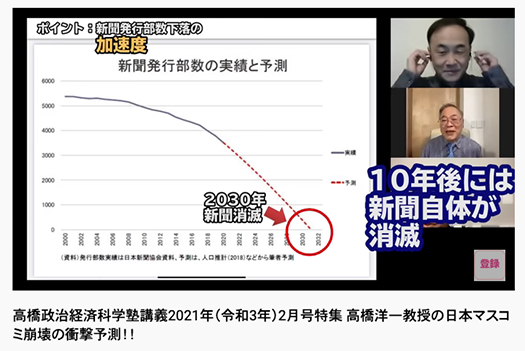
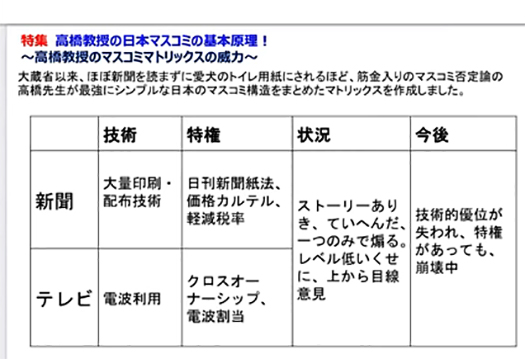
「数量物理」的に分析して別番組で発表していたのが上の図。
現状の新聞社の部数減少傾向には「加速度」が掛かっているとデータ分析して
なんと2030年頃には新聞が消滅するという大予言を出していた。
財務省官僚として、マスコミとの対応を担当として行ってきた人物であって、
いまはフリーの立場にあることから、歯切れ良く論断している。

この趨勢自体は現実に進行していることで、予測可能性が高いことは同意できる。
その代替としてWEBが大きく存在感を高めてきているということ。
実際にWEBをチェックしていれば、大新聞社の論調やメディア各社の報道内容も
自然にわかるので、主戦場がWEBになっていくのは当然だろう。
そして結果として、特定新聞の論調だけに接する大衆は少なくなってきている。
「この新聞社だから・・・」というバイアスを計算した上で多くの人が
情報を摂取しているのが現実だと思う。
しかし、現実の部数数字に即してのこうした予測を見せられるとやはり衝撃的。
ひるがえって、ポストマスコミの時代というのはどうなっていくのかと
そのことをしっかり予測し、対応を考えていかなければならないと思わされた。
多くの一般人は政府の公表データなどの「1次情報」に接するというのは、
なかなか現実にはできにくいし、しないのではないか。
やはりポータルサイトのヘッドライン的な要約整理は必要ではないだろうか。
その論調がどうであれ、いまリアルタイムでどういった現実が進行しているかは
そこで一般人は知ることが多いと思う。
それらはいまのところ、衰退しつつあるとは言えマスコミ情報が圧倒的多数。
もちろんそのマスコミ自身もどこかの1次情報が出典由来ではあるだろうが。
たぶん政治情報というのは、多くの人間にとって「熱くなる話題」。
それを基幹ビジネスにして売ってきたのが新聞社という存在だった。
ふだんは冷静な人間でも、どうしても政治論争ではアタマに血が上りやすい。
しかし大事なのは「こうあるべきだ」ではなく、民の暮らしにとってどうか、だろう。
このあたりが、マスコミ自身どうもボタンが掛け違っている。
マスコミ論調に盲目的に同意する民の激減、WEBでの多様な情報摂取が
優位になっていくほどに、マスコミの危機が深まっていくのはやむを得ない。
発行部数減少という非常ベルが鳴って、今後マスコミ側でどう対応するのか。
いまのところ、既存の有力顧客層に迎合姿勢を強化しているように思う。
要するにいまも新聞を読み続けている団塊世代に迎合するメディア論調。
この全共闘世代は左翼ノスタルジーが優勢で若年層とは相当乖離している。
海外メディアでは「とにかくWEB移行を急げ」というのが共通認識で
実際にアメリカでは相当にこの方向性が強まっているとされる。
すでに相当のメディアで基盤がWEB移行が本格化したと言われている。
日本の新聞メディアは宅配とカルテルという日本独特制度でガラパゴス化したか?
ポストマスコミの時代でも、やはりWEBに移行した「媒体」は必要だろう。
日経は日本のマスコミの中では対応が一定進んでいるとされているが、
他のメディアも、待ったなしで対応を急がなければならないことは明らかですね。

ある日、Yahooトップページからニュースソースメディアが消えたら
情報社会の基盤がおかしくなるようにも思われるのです。
ニュースメディアの改革への奮起を期待したい。

English version⬇

[Full-scale post-media era. Will the newspaper disappear? ]

Today is the current affairs for the first time in a long time, which is also information media.
WEB media is booming and has become a source of information for many people.
Mr. Yoichi Takahashi, a former finance bureaucrat, is relatively increasing.
He is an incumbent Special Advisor to the Cabinet (in charge of economic and financial policy) as a consultant to Prime Minister Suga.
As a bureaucrat of the Ministry of Finance, he is the director of the Finance Planning Office of the Finance Bureau, a visiting researcher at Princeton University,
Counselor of the Cabinet Office (Counsel on Economic and Fiscal Policy), Assistant to the Minister of Internal Affairs and Communications, Counselor of the Cabinet
(Counselor with Assistant to the Prime Minister), etc.
He is now active in critique on the growing web media.
In short, Mr. Takahashi is a talented person as a technolate, and his remarks are government-affiliated and logical.
On the other hand, he is known for his profession to the existing big newspaper as “masgomi”.
He has a joint web program with Mr. Yukihiro Hasegawa, an alumnus of Tokyo Shimbun.
In connection with this, the published data of the circulation of newspaper companies seems to be his specialty.
The figure above was analyzed in terms of “quantitative physics” and announced in another program.
Data analysis shows that “acceleration” is applied to the current downward trend of newspaper circulation
He made a big prophecy that newspapers would disappear around 2030.
As a bureaucrat of the Ministry of Finance, he was in charge of dealing with the media.
He is crisp and arguing because he is now in a free position.

We can agree that this trend itself is actually progressing and is highly predictable.
As an alternative, the WEB is greatly increasing its presence.
If you actually check the WEB, you can see the tone of the big newspapers and the contents of the media reports.
It’s natural to understand, so it’s only natural that the main battlefield will become WEB.
And as a result, the number of people who come into contact only with the tone of specific newspapers is decreasing.
Many people calculated the bias of “because this newspaper company …”
I think the reality is that we are ingesting information.
However, it is still shocking to be able to show such a prediction based on the actual number of copies.
On the contrary, what will happen to the post-media era?
It seemed that we had to anticipate that and think about how to deal with it.
The fact that many ordinary people come into contact with “primary information” such as government-published data means that
It’s hard to do in reality, and I think it’s not possible.
After all, it may be necessary to organize the headline summary of the Yahoo top page.
Whatever the tone, what kind of reality is going on in real time?
I think that the general public often knows there.
So far, the media information is overwhelmingly large, although they are declining.
Of course, the media itself may have some primary information from the source.
Perhaps political information is a “hot topic” for many people.
It was the newspaper media that sold it as a core business.
Even if you are a calm person, it is easy for you to get blood in political controversy.
But what is important is not “this should be”, but what about the lives of the people.
In this area, the media themselves have different buttons.
The number of people who blindly agree with the media tone is drastically reduced, and various information intake on the WEB
It is unavoidable that the crisis of the media deepens as it becomes superior.
The emergency bell that the circulation is decreasing will ring, and how will the media respond in the future?
So far, I think we are strengthening our stance of accepting existing leading customers.
In short, the media tone is in line with the baby boomers who are still reading newspapers.
The left-wing nostalgia predominates in this Zenkyoto generation, which is quite different from the younger generation.
In overseas media, it is a common recognition that “anyway, hurry up the transition to the WEB”
In fact, it is said that this direction is considerably strengthened in the United States.
It is said that the WEB migration of the infrastructure has already begun in earnest in a considerable amount of media.
Did the Japanese newspaper media become Galapagos with the unique Japanese system of home delivery and cartel?
Even in the post-media era, the “medium” that has moved to the WEB will still be necessary.
Nikkei is said to have made some progress in the Japanese media,
It’s clear that other media also have to hurry to respond without waiting.

One day, when the news source media disappears from the Yahoo top page
It also seems that the foundation of the information society is going wrong.
I hope that the news media will be reformed.

【北総研「防火木外壁」WEBセミナー全国330人参加】


さて、既報のように北海道の住宅建築研究機関「北総研」
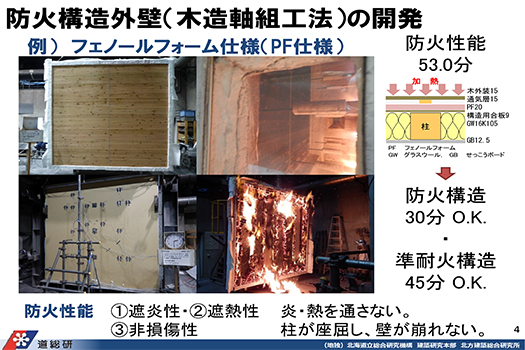
木の外壁で「防火認定」を獲得した工法についてのWEBセミナーが昨日開催。
〜プログラム  R3.2.9(TUE) 15:00 17:30
●第1部  北総研木外壁の開発経緯や特徴、
木質外装材を上手に活用するヒントについて説明します。
(1)「北総研防火木外壁」の概要について
道総研 北方建築総合研究所 糸毛 治
(2)省令準耐火構造の概要とフラット35について
住宅金融支援機構北海道支店 吉田道秀氏
(3)道内の木質外装材について
北海道木材産業協同組合連合会 内田敏博氏
(4)木質外装材のメンテナンスについて
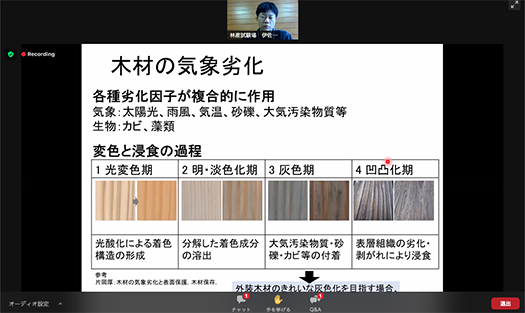
道総研林産試験場 伊佐治信一
(5)質疑応答
●第2部 建築物を設計施工する際の
防火構造認定仕様、省令準耐火構造の適合に関する留意点を説明。
(6)「北総研防火木外壁」の各構成部材の仕様範囲について
道総研北方建築総合研究所 糸毛 治
(7)省令準耐火構造の詳細と防火処置について
住宅金融支援機構北海道支店 吉田道秀氏
(8)質疑応答〜

というような流れでのWEBセミナー。
北海道内の住宅技術研究者、住宅金融支援機構、木材生産者団体、そして
木材の品質管理研究者というそれぞれの立場から、
北海道住宅技術の総力を挙げた取り組みについてのアピールがされました。
WEBセミナーという慣れない環境ではありますが、
実直に語りかけられる様子は、北海道外からの多くの参加者にも伝わったと思います。
リアルであれば実際の木材を手に取って見ていただけるでしょうが、
しかし、画面に対して近接して外装木材を詳細に見せて
木口の様子とか、立体感、嵌め込み組み手詳細の説明など、
画面一杯に展開するそれなりの迫力があって、
引き込まれるような独特の雰囲気があったのではないかと思います。
また施工後のメンテナンスの留意点についてまでも専門的アドバイスがあり、
北海道総体としての住宅への「ものづくり」パワーが見えたと思います。
主催者側の中心の方からの情報では、参加者申込み総数は330名に達し、
しかもほとんど全ての申込者が実際にアクセスしていたということ。
<こういうWEBセミナーでは「目減り」が当たり前とのこと。
実際に申し込んだことも忘れるというのは自ら顧みてもよくある(泣)>
しかも「質疑応答」では非常に多くの質問が寄せられていて
可能な限り答えられていましたが、普通のWEBセミナーには見られない熱気感。

北海道内の作り手・工務店からはツーバイフォー工法への適応要請が強い。
この点についても、試験についてはすでに完了していて
認定手続き作業に入っているというアナウンスもありました。
全国の地域工務店にとって高性能住宅であってなお、
ユーザー訴求力の高い「木の外装」での防火認定は、
デザイン面でも大きなアドバンテージを獲得できるものと思います。
北海道総体は公共的研究機関も含めて強いバックアップを提供したい。
今回の「手づくり」イベントのこころみの輪が広がっていくことを期待したいです。

English version⬇

[HokuSoken “Fire Prevention Wood Outer Wall” WEB Seminar 330 people nationwide]

By the way, as previously reported, the Hokkaido housing construction research institute “Hokusoken”
A webinar was held yesterday on the construction method that obtained “fire protection certification” on the outer wall of wood.
~ Program R3.2.9 (TUE) 15:00 17:30
● Part 1 Development history and features of the Hokusoken wood outer wall,
Here are some tips on how to make good use of wood exterior materials.
(1) About the outline of “Hokusoken fire prevention wood outer wall”
Dosoken Northern Building Research Institute Osamu Itoge
(2) Outline of Ministerial Ordinance Semi-Fireproof Structure and Flat 35
Mr. Michihide Yoshida, Hokkaido Branch, Housing Finance Support Organization
(3) About wood exterior materials in Hokkaido
Mr. Toshihiro Uchida, Federation of Hokkaido Wood Industry Cooperatives
(4) Maintenance of wood exterior materials
Dosoken Forest Products Experiment Station Shinichi Isaji
(5) Q & A
● Part 2 When designing and constructing a building
Explained points to note regarding conformity with fireproof structure certification specifications and ministerial ordinance quasi-fireproof structures.
(6) About the specification range of each component of “Hokusoken Fire Prevention Wood Outer Wall”
Dosoken Northern Building Research Institute Osamu Itoge
(7) Details of the Ministerial Ordinance Semi-Fireproof Structure and Fire Prevention Measures
Housing Finance Support Organization Hokkaido Branch Mr. Michihide Yoshida
(8) Q & A ~

WEB seminar with such a flow.
Housing technology researchers in Hokkaido, Japan Housing Finance Agency, timber producer groups, and
From each standpoint as a wood quality control researcher
An appeal was made about the efforts of Hokkaido.
Although it is an unfamiliar environment called a webinar,
I think that the fact that he was able to speak honestly was conveyed to many participants from outside Hokkaido.
If it is real, you can pick up the actual wood and see it,
However, show the exterior wood in detail in close proximity to the screen
The state of Kiguchi, the three-dimensional effect, the detailed explanation of the fitting assembly, etc.
There is a certain amount of power that expands to fill the screen,
I think there was a unique atmosphere that made me feel drawn.
In addition, there is professional advice on points to keep in mind for maintenance after construction.
I think you can see the power of “manufacturing” for housing as a whole in Hokkaido.
According to the information from the center of the organizer, the total number of application for participants reached 330,
Moreover, almost all applicants actually accessed it.

There is a strong request from manufacturers and contractors in Hokkaido to adapt to the two-by-four method.
In this regard as well, the test has already been completed.
There was also an announcement that the certification process was underway.
Even though it is a high-performance house for regional construction shops nationwide,
Fire protection certification for “wooden exterior” that is highly appealing to users
I think you can get a big advantage in terms of design.
Hokkaido as a whole wants to provide strong backup, including public research institutes.
I hope that the circle of hearts of this “handmade” event will expand.

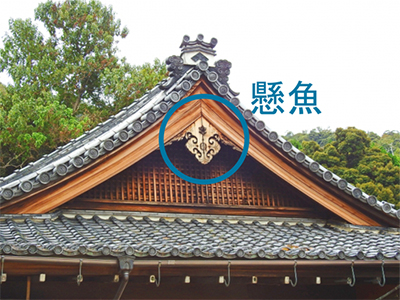
【これは「懸魚」〜げぎょ〜の原型かなぁ?】


さて、5回にわたった川崎市北方・多摩に近い古民家を見てきましたが、
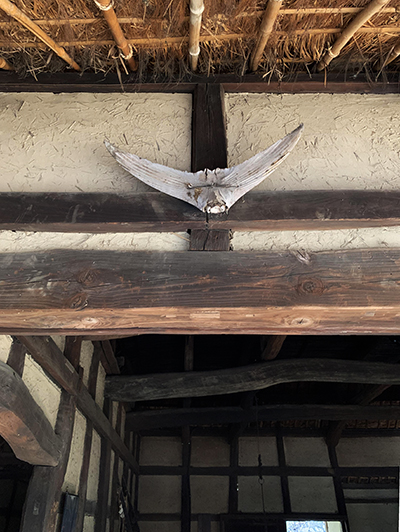
最後にふしぎな飾り物を見て、はたと当惑してしまった。
あえていえば「懸魚」〜げぎょ〜なのかなぁと思われた。
一般的に知られる懸魚は以下のような理解。
〜建築装飾の一つ。 中国や日本の建築で破風の下部内側またはその左右に
六葉といわれる金属製や木製の栓で取付け、棟木や桁の先を隠すための飾り板。
形により梅鉢懸魚,猪目懸魚,かぶら懸魚,三花懸魚などの種類がある。〜
この飾り物は平入りの玄関上に据えられていたので、
なにかのまじないの一種ではあろうと思われた。しかし、
いわゆる懸魚というのはこんなのが一般的イメージ。

あくまでの木彫品であって、建築意匠として様式化されているのが常識。
およそ350年前くらいの建築年代の農家住宅なので、
様式化以前の生々しいまじない要素が素で表されているもののように感じた。
ブリタニカ国際大百科事典には「当初魚をつるしたような形であったので
この名がある」というように記載されていた。
ということは、民俗信仰として家屋の災い除け、最大は火災だろうから、
水にまつわる魚が象徴化されて、このようにピンナップされたのか。
350年前当時でも様式化された懸魚は存在していただろうけれど、
民俗としては、このようになまなましい魚のシッポが生け贄のように捧げられたか。
大きさは柱の寸法から類推して、左右幅で50-60cmはあるのではないか。
海生の大型魚類、あるいはサメくらいの魚種のような気がする。
というより、サメのような獰猛なヤツがふさわしいのではないかと妄想した。
なかなかワイルドでいい。
上品に様式化された、いわば去勢された信仰よりも、
民の即物的息吹、息づかいが伝わってくる気がする。
上級建築や仏閣などとは違う、民のリアルな感受性として納得感。
近くには多摩川が流れているけれど、川を下ればすぐに相模湾。
活発な水上交通の交流を考えれば、大型海生漁の香りが薫ってくる。

あるいはこの家の新築祝いに相模湾海岸地域の住人が
この魚の1匹まるまんまを持参してくれて、その身をたっぷりと一同で平らげ、
なお、残った見事な尾びれをありがたく神にお供えする意味で
玄関先の魔除けとしたのかも知れない。
ありがたく食べさせていただいた上に、さらに魔除けとして奉仕する、
巨大魚としても甲斐があったのではないか。
・・・というような空想・夢想にしばし浸っておりましたが、さて。
こういう習俗について情報をお持ちの方、ぜひお教えください。

English version⬇

[Is this the prototype of “hanging fish”? ]

By the way, I have seen an old folk house near Tama in the north of Kawasaki City five times.
At the end, when I saw the mysterious decoration, I was confused.
If I dare to say it, I wondered if it was a “hanging fish”.
Generally known hanging fish have the following understanding.
~ One of the architectural decorations. Inside or to the left and right of the lower part of the gable in Chinese and Japanese architecture
A decorative board that is attached with a metal or wooden stopper called Rokuyo to hide the purlins and girders.
Depending on the shape, there are types such as plum pot hanging fish, inome hanging fish, turnip hanging fish, and three flower hanging fish. ~
This decoration was placed on the flat entrance, so
It seemed to be a kind of magic. But,
The general image of so-called hanging fish is this.

It is common sense that it is a wooden carving to the last and is stylized as an architectural design.
It’s a farmhouse that was built about 350 years ago, so
I felt that the elements that were not raw before stylization were expressed in plain text.
The Britannica International Encyclopedia says, “Because it was initially shaped like a fish.
There is this name. ”
That means that as a folk religion, the disaster of the house can be avoided, and the biggest is the fire.
Was the fish related to water symbolized and pinned up like this?
There would have been stylized hanging fish 350 years ago,
As a folklore, was such a graceful fish tail sacrificed?
By analogy with the dimensions of the pillars, the size may be 50-60 cm in width.
It feels like a large marine fish or a shark-sized fish species.
Rather, I wondered if a ferocious shark-like guy would be suitable.
It’s pretty wild.
Rather than an elegantly stylized, so to speak, castrated faith
I feel that the real breath and breath of the people are transmitted.
It is convincing as the real sensitivity of the people, which is different from high-class architecture and temples.
The Tama River runs nearby, but Sagami Bay is just down the river.
Considering the active exchange of water transportation, the scent of large marine fishing is fragrant.

Or a resident of the Sagami Bay coastal area to celebrate the new construction of this house
Bring me a whole manma of this fish and flatten it all together.
In addition, in the sense of offering the remaining splendid tail fin to the god thankfully
It may have been a talisman at the front door.
Thank you for eating, and also serve as a ward off.
I think it was worth it as a giant fish.
I was immersed in fantasies and dreams like … for a while, but now.
If you have any information about these customs, please let us know.

【江戸近郊古民家の食遊空間/日本人のいい家㉑-5】


ひとつの古民家をじっくり探索すると、その時代の暮らし、
その人々の生きる叡智がさまざまな表情を持って浮かび上がってくる。
よく人間活動を「衣食住」という側面で捉え返す視点があるけれど、
古民家、住宅には「食・住」が醸し出すリアリティが立ち上る。

この神奈川県北部・多摩丘陵地帯と接する農家住宅。
火力エネルギーが基本的に薪に頼りきりだったことが明瞭。
人間が定住をはじめてから1−2万年。日本列島では縄文がそれに相当するけれど、
それまでの狩猟採集が漁労という「安定的」な生業が獲得されたことで
定住が始まったときに、集落が形成された。
それは基本的に獲得可能なバイオマスの範囲内に収まっていたとされる。
その後、農業定住が始まるけれど、基本は里山志向だった。
そして江戸の大人口は武蔵野の雑木林資源を活用した
炭焼き産業がそのエネルギーを支えたとされるので、この家でも
そうした豊かなエネルギーによってこうした食生活が保持されていた。

食を巡る日常生活の場をクルーズアップしてみる。
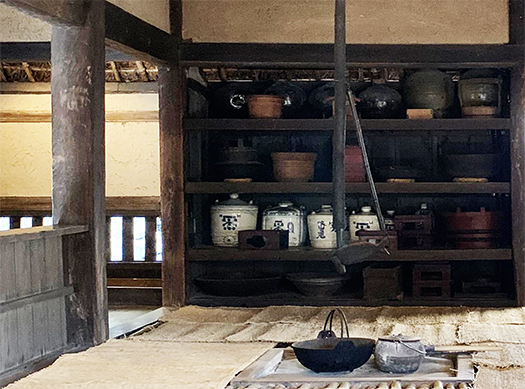
写真上は、囲炉裏端と、それの後背を形成している食器・食品棚。
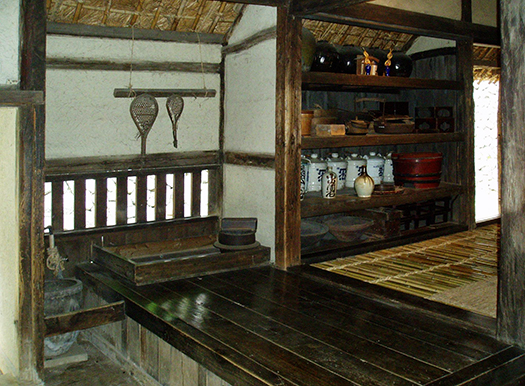
2番目の写真はいわゆる「流し」キッチン機能の中心ゾーン。
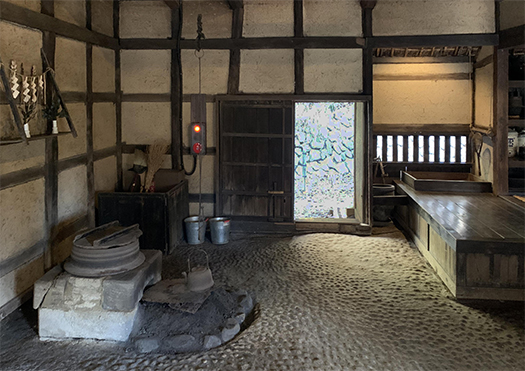
そしてそういう料理を可能にする火力の装置された土間空間が3番目。
この空間の間を行き来しながら、食生活が営まれた状況が表れている。
「おくどさま」で炊き上げられた米などが食膳にあがり、
あたたかい汁物も同様に調理されただろう。
おくどさまの火力の一部を使ってほかの調理も工夫されたに違いない。
流しに水瓶が端座していて、調理の中心空間。
そして食器や調味料が整頓された右の食品庫・棚との間を行き来して
料理プロセスが進行していた様子がよくわかる。
この配置からすると、流しでの作業は座った姿勢で行われたのかも知れない。
食材を切ったりする包丁仕事は棚前などまな板をおいての床面利用か。
囲炉裏端が食卓テーブル空間であったことは自明。
日本人の食事は膳部に載せた1人前食膳というのが伝統的とされる。
それはこういった「食卓空間」の必然のカタチであったのか。
そして縄文以来の日本の伝統食「鍋」には最適化された食卓であることもわかる。
膳部をそろえての食事は時間の許すときに行われ、
普段の暮らしでは簡便な「雑炊」などが主力メニューだったに違いない。
日本人の「食遊」空間のある典型を見るような思いがした。

English version⬇

[Eating space of an old folk house near Edo / Good Japanese house ㉑-5]

If you take a closer look at one old folk house, you will find the life of that era.
The wisdom of those people emerges with various facial expressions.
I often have a perspective to look back on human activities from the perspective of “clothing, food and housing.”
The reality of “food and housing” rises in old folk houses and houses.

A farmhouse that borders the Tama hills in northern Kanagawa prefecture.
It is clear that the thermal energy was basically dependent on firewood.
It has been 10,000 to 20,000 years since humans began to settle. Jomon is equivalent to that in the Japanese archipelago,
The acquisition of a “stable” livelihood of hunting and gathering until then was fishing.
The settlement was formed when the settlement began.
It is said that it was basically within the range of available biomass.
After that, agricultural settlement began, but the basics were satoyama-oriented.
And the large population of Edo utilized the thicket resources of Musashino
The charcoal-burning industry is said to have supported the energy, so even in this house
Such abundant energy maintained such a diet.

Let’s cruise up the place of daily life around food.
On the photo is the hearth end and the tableware and food shelves that form the back of it.
The second photo is the central zone of the so-called “sinking” kitchen function.
And the soil space equipped with thermal power that enables such cooking is the third.
The situation where eating habits were carried out while going back and forth between these spaces appears.
Rice cooked in “Okudo-sama” is served on the table,
Warm soup would have been cooked as well.
Other cooking must have been devised using part of Okudosama’s firepower.
A water bottle sits in the sink, which is the central space for cooking.
Then go back and forth between the right pantry and shelves where tableware and seasonings are organized.
You can see how the cooking process was going on.
From this arrangement, the work in the sink may have been done in a sitting position.
Is the kitchen knife work such as cutting ingredients using the floor surface with a cutting board such as in front of the shelf?
It is obvious that the hearth end was a dining table space.
It is traditional that Japanese meals are served on the table for one person.
Was it the inevitable form of such a “dining table space”?
You can also see that it is an optimized dining table for the traditional Japanese food “nabe” since the Jomon period.
Meals with a set of dishes are served when time permits,
In everyday life, simple “rice porridge” must have been the main menu.
I felt like seeing a typical Japanese “food play” space.

【床材に竹を敷き込む文化/日本人のいい家㉑-4】


沖縄の古民家でも「竹の床」というものを経験したことがある。
6月末くらいの時期に訪問したので、厚い屋根の萱葺きで直射日光が抑えられ
そして相対的に温度上昇が低減されている床土間との空隙に空気対流が起こって
徐々に発汗が抑えられていく感覚を抱いた。
現代ではエアコン機械利用になる気候対応を、建築として工夫している。
北海道は寒さへの対応での技術進化だけれど、蒸暑気候では
こういった知恵の対応もあるのかと知らされた。
そういった経験があったので、この関東神奈川県川崎の北部、多摩と接する地域の
古民家でも竹の床の文化があるのかと素直に受容していた。
ところが、川崎市教育委員会のこの建物の「ガイダンス」を読むと、
木の板材による板敷きと比べてコストが低廉で済むというポイントから
いわばコスパ優先での「庶民住宅」の床というように案内されていた。
しかし、そういった説明ではもっと厳しい生活条件下の五箇山の家などで
板敷きが敷き詰められていることと整合しないように思われる。
この家では不揃いな柱や梁が多用され、土塗り壁仕上げが目立っている。
五箇山の家では壁にも「板倉」工法で木の板が壁を構成していた。
江戸期、木材入手はどのようであったかの方に興味を抱く。
「ガイダンス」では無意識のうちに建材流通が農家住宅などにも普及していたという
そういった現代常識的な前提があるのではないだろうか。
たしかに江戸期には「木場」とかの地名が今に残るように、
あるいは紀伊国屋文左衛門の大成功などの逸話のように都市部建築は
木材流通が前提になっていただろうけれど、やや鄙の場所であれば、
地元の山から材料を切り出した方が巨大な「輸送コスト」が抑えられただろう。
五箇山は現金収入の少ない地域だけれど、豊富に木材資源はあり、
同時に飛騨の匠という地域伝統としての木工技術集積も地域に存在した。
このような条件の結果と考える方が蓋然性が高いのではないか。
この川崎市北部の農家では、近在の森から木を切り出したけれど、
それらは曲がりと太さの一定しない木材が多くを占めていた。
また、木材の供給可能絶対量は圧倒的に不足していた。
そこでやむなく、木の板敷きを諦めいわば代用として竹の床に向かったのではないか。
その設計構想時に、沖縄などの竹床文化が知識としてあったのではないか。
地域住文化・材料と建築技術の相関関係に置いて理解すべきではないかと思う。
その上でなお、住宅性能的な面からもメリットが高かったと理解した方が
より現実に近いように思え、しっくりくるのではないか。
関東も蒸暑の夏は厳しいし、梅雨時期のジメジメ感もハンパない。
たとえ冬期の寒さの厳しさを考慮しても、
それは縁側での日射輻射をゲットして「やり過ごして」夏期対策としたのではないか。
写真は以前、夏期と冬期の両時期に撮影したものがあったので
両方を併置してみた。冬には竹の床面にムシロの敷物を掛けて
いわばカーペットとして利用して寒さへの対策とされていた様子がわかる。

この旧伊藤家では最上級の座敷は畳12枚が敷き込まれている一方、
面積の1/3以上は土間が占めている。
残余の、というか、普段の生活領域はおおむねこの竹敷きの間ということになる。
畳を敷き込むというのは、農家でもあり自作したものか、
近在の畳職人から購入したものか、どちらも考えられるけれど、さて。

English version⬇

[Culture of laying bamboo on the floor / Good Japanese house ㉑-4]

I have also experienced a “bamboo floor” in an old Okinawan house.
Since I visited around the end of June, the thatched roof has a thick roof to prevent direct sunlight.
And air convection occurs in the gap between the floor soil where the temperature rise is relatively reduced.
I felt that sweating was gradually suppressed.
In modern times, we are devising a climate-friendly building that uses air-conditioning machines.
Hokkaido is a technological evolution in response to the cold, but in a hot and humid climate
I was informed that there was a response to this kind of wisdom.
Because I had such an experience, in the northern part of Kawasaki, Kanto Kanagawa Prefecture, in the area that borders Tama
I honestly accepted that even old folk houses had a culture of bamboo floors.
However, when I read the “guidance” of this building of the Kawasaki City Board of Education,
From the point that the cost is cheaper than the wooden boarding
So to speak, it was guided as the floor of a “common house” with priority given to cospa.
However, in such an explanation, at a house in Gokayama under more severe living conditions, etc.
It does not seem to be consistent with the paving of the planks.
Ragged columns and beams are often used in this house, and the plastered wall finish is conspicuous.
At Gokayama’s house, wooden boards were also used to form the walls using the “Itakura” method.
I am interested in how the timber was obtained during the Edo period.
According to the “guidance,” the distribution of building materials was unknowingly widespread in farm houses.
I think there is such a modern common sense premise.
Certainly, in the Edo period, place names such as “Kiba” still remain.
Or, like the anecdote of Kinokuniya Bunzaemon’s great success, urban architecture
It would have been supposed to be timber distribution, but if it’s a little rural place,
Cutting out the material from the local mountains would have reduced the huge “transportation costs”.
Gokayama is an area with low cash income, but it has abundant timber resources,
At the same time, there was also an accumulation of woodworking techniques as a local tradition of Hida Takumi.
It is more likely that it is the result of such conditions.
At this farmhouse in the northern part of Kawasaki City, a tree was cut out from a nearby forest,
They were dominated by wood with inconsistent bends and thickness.
In addition, the absolute amount of wood that can be supplied was overwhelmingly insufficient.
So I had no choice but to give up on the wooden board and head for the bamboo floor as a substitute.
At the time of the design concept, I think there was knowledge of bamboo floor culture such as Okinawa.
I think it should be understood in terms of the correlation between local living culture / materials and building technology.
On top of that, it is better to understand that the merit was also high in terms of housing performance.
It seems to be closer to reality, and it seems to fit nicely.
In the Kanto region, the hot and humid summers are harsh, and there is no sense of dullness during the rainy season.
Even considering the severity of the cold in winter
Perhaps it was a summer measure by getting the solar radiation on the porch and “overtaking” it.
I used to take pictures in both summer and winter, so
I tried to juxtapose both. In winter, hang a straw mat on the bamboo floor
You can see how it was used as a carpet to prevent the cold.

In this former Ito family, the finest tatami mats are laid with 12 tatami mats, while
The soil occupies more than 1/3 of the area.
The rest, or rather, the usual living area is mostly the bamboo floor.
Is it a farmer’s own work to lay tatami mats?
I can think of either the one I bought from a tatami mat craftsman nearby, but by the way.

【豊かな関東の冬期日射と住文化/日本人のいい家㉑-3】


関東という地域は一時期住んでみて、冬場の日射取得に驚かされる。
日本海側は冬期には偏西風から日本海の蒸発水分を大量の雪として受けるのと
きわめて対照的に太平洋側地域は冬場には晴天が続く。
北海道でも日本海側は豪雪地帯が続いているけれど、
道東の帯広、十勝平野はひたすら少雪。ただし超寒冷という気候。
ちなみに旭川は盆地という条件もあって、この多雪と超寒冷が同居する・・・。
ウエットな列島西部に対して太平洋側東部は冬場はとくにドライ。
川端康成は「トンネルを抜けると雪国だった」とこの激しい気候落差を描いたが、
日本社会の歴史が最終的に関東を首都地域として選択したのは
この晴天率が大きかったのではないかと個人的に思っています。
京都が首都だった日本と、東京が首都になった日本で、
どういった文化風土の違いが発現してきたのかは、
住宅の世界でも興味深いものがあるのではと思っています。
住宅性能という意味では北海道が日本に組み込まれたことが大きいでしょうが、
この首都の移転ということは住宅文化の面でどういう転機になったのか、
あるいはそうではないのか、興味を持っています。
京都には京町家という独特の都市住宅文化が涵養されたけれど、
あれは生業としては商家であり、それぞれが独立自営の風が漂っている。
一方で関東ではいわゆる「長屋」形式の賃貸住宅が主流であり、
宵越しの金は持たぬ美徳(?)が吹聴されたりしていた。
消費は美徳という価値感で、経済の右肩上がりを前提としたモノかも知れない。
京都がやや自尊タイプで文化的にとっつきにくさを持っているのに
関東・江戸文化圏は全国からの2男3男層を受け入れ続けた文化を持っている。
そういう住文化は大きなテーマだけれど、京都のような気候風土と
関東の気候風土ではいちばんの違いはなんと言っても冬場の晴天率だろう。
京町家では各戸が格子戸で街路に接し、中庭にだけ縁があると閉鎖的なのに、
江戸関東では、この家のように外部に対し比較的に開放的であるように思う。
長屋や下町での八っさん、クマさんではないが、人間関係も開放型。
主流である長屋文化では階層分化が十分進まなかったのかも知れない。
みんな借家住まいが明らかで、そういった屈託のなさがベースにあるのか。
このテーマ、関東での住文化・民家の独自性みたいな部分、今後掘り下げてみたい。
人間文化とは別に気候性から、冬場の豊かな陽射しへの対応がみえる。
写真は「でい」と呼ばれる座敷に回されている濡れ縁。
また、そとに張り出した土間のような南面の軒下空間です。
この外周部、住宅史ではここにもやがて縁が回されるようになる。
どちらも豊かな日射取得と、同時に軒の出による日射遮蔽が工夫されている。

個人的に、日本の関心が欧米に向かって開いて行ったのには
明治開国の待ったなしの状況があったのが大きいけれど、
この関東の気候風土が「脱亜」という開放性志向に向かわせたように思っている。
畿内地域は瀬戸内海航路を通じて、即アジアと「繋がっている」けれど、
箱根の関所を越えた関東の気候風土は、自然と太平洋への関心を高めていったかと。
都市住宅文化としては、江戸は度重なる大火を経験してきた。
下町情緒というような部分もあるけれど、むしろ、
多摩川周辺の地域、とくに「田園調布」のような住宅地がいかにも関東らしいのかも。
京町家というような住文化熟成ではなく、欧米キャッチアップ的な
ハイソサエティ志向がカタチになっていったものかも知れない。
とくに明治以降のなかでも戦後は大規模な人口集積、それも欧米的個人主義全盛で
「地域格差」土地ブランド化が究極的に進んだといえるのだろう。

気候風土的条件と、戦後の人口集中によって住意識がどう変遷したか、
そして住宅デザイン、住宅文化はどのように推移したのか、
そしてまた、コロナ禍での変化の胎動も言われている。
住文化がいま現在大きくゆれ動いている人口大集積地域・関東、東京は、興味深い。

English version⬇

[Abundant Kanto winter solar radiation and living culture / Japanese good house ㉑-3]

After living in the Kanto area for a while, I was surprised to get solar radiation in winter.
The Sea of ​​Japan side receives a large amount of snow from the westerlies that evaporates from the Sea of ​​Japan in winter.
In stark contrast, the Pacific region is sunny in winter.
Even in Hokkaido, heavy snowfall continues on the Sea of ​​Japan side,
Obihiro and Tokachi Plain in Eastern Hokkaido have a little snow. However, the climate is extremely cold.
By the way, Asahikawa is a basin, so this heavy snow and super cold live together.
The western part of the wet archipelago is dry in the eastern part of the Pacific Ocean, especially in winter.
Yasunari Kawabata drew this severe climate head, saying, “It was a snow country when I passed through the tunnel.”
The history of Japanese society finally chose Kanto as the capital region
I personally think that this sunny weather rate was high.
In Japan, where Kyoto was the capital, and in Japan, where Tokyo was the capital.
What kind of cultural differences have emerged?
I think there is something interesting in the world of housing.
In terms of housing performance, Hokkaido was probably incorporated into Japan,
What kind of turning point was this relocation of the capital in terms of housing culture?
Or maybe not, I’m interested.
Although Kyoto has cultivated a unique urban housing culture called Kyomachiya,
That is a merchant house as a livelihood, and each has a wind of independent self-employment.
On the other hand, in Kanto, so-called “Nagaya” style rental housing is the mainstream.
A virtue (?) That doesn’t have money for the evening was heard.
Consumption is a value of virtue, and it may be a product that is premised on the rising economy.
Even though Kyoto is a little self-respecting and culturally difficult to get along with
The Kanto / Edo cultural area has a culture that continues to accept 2nd and 3rd sons from all over the country.
That kind of living culture is a big theme, but with a climate like Kyoto
The biggest difference in the climate of the Kanto region is the rate of fine weather in winter.
In Kyomachiya, each house is in contact with the street with a lattice door, and it is closed if there is an edge only in the courtyard.
In Edo Kanto, I think it is relatively open to the outside like this house.
He is not a bear or a bear in Nagaya or downtown, but his relationships are open.
In the mainstream Nagaya culture, stratification may not have progressed sufficiently.
Everyone has a clear rented house, and is it based on such carefreeness?
I would like to delve into this theme, the uniqueness of living culture and private houses in the Kanto region, in the future.
Apart from human culture, we can see the response to the abundant sunlight in winter due to the climate.
The photo shows the wet edge that is turned into a tatami room called “Dei”.
In addition, it is a space under the eaves on the south side, which looks like a dirt floor overhanging.
This outer circumference, in the history of housing, will soon be rimmed here as well.
In both cases, the acquisition of abundant solar radiation and the shielding of solar radiation by the eaves are devised at the same time.

Personally, the interest of Japan opened to the West
It was big that there was no waiting for the opening of the Meiji era,
I think that the climate of the Kanto region has led to an openness-oriented approach called “de-a”.
The Kinai region is immediately “connected” to Asia through the Seto Inland Sea route,
I wonder if the climate of the Kanto region, which transcends the Hakone barrier, has increased interest in nature and the Pacific Ocean.
As an urban housing culture, Edo has experienced repeated fires.
There is a part like downtown atmosphere, but rather
The area around the Tama River, especially the residential area like “Denenchofu”, may be like Kanto.
It’s not a matured living culture like Kyomachiya, but a Western catch-up
It may be that the high society orientation has taken shape.
Especially after the Meiji era, a large-scale population agglomeration after the war, which was also the heyday of Western individualism.
It can be said that “regional disparity” land branding has finally progressed.

How the consciousness of living changed due to climatic conditions and postwar population concentration
And how has housing design and housing culture changed?
And it is also said that the fetal movement of change in the corona sickness.
It is interesting to see the large population areas of Kanto and Tokyo, where the living culture is currently fluctuating.